

“Ritual that is alive encourages each person to touch what is sacred in their own way, in their own time, through their own unique experience. So there evolves a dynamic dance between guiding and shaping the group’s experience and encouraging and supporting the individual’s experience, so there is a smooth and cohesive flow to the ritual.” –Suzanne Reitz and Sandy Hoyt (Celebrating, Honoring, Healing)
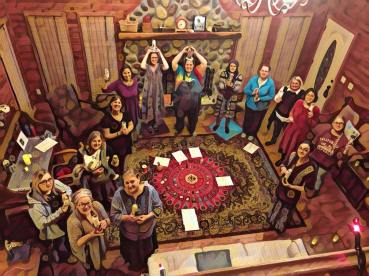 As a practicing priestess, one of the dynamic dances that I engage in is with the power of story. I both find that women’s stories are the vital lifeblood of conscious engagement and power-building with one another and that they can be one of the elements that bogs down a ritual and makes it lose power and magic. This is partially because the dominant culture may teach us to bond using stories in a way that actually drain our energy through “venting,” swapping complaints, trading to-do lists, and through describing behavior, motives, and character of other people. In women’s ritual space, I encourage people to dig deep, but also to share a here-and-now connection of shared experience rather than a there-and-then rendition of past experiences.
Chameli Ardagh in her Create Your Own Women’s Temple manual from Awakening Women explains:
To hold the group and space as sacred is one of the most important guidelines, and the guideline that may bring up the most questions or protests. It goes against our habits as women and against our identification with the small self; we are quite used to creating intimacy through sharing our wounds and problems. The Temple Group is not a place for processing wounds, analyzing ourselves, solving problems, complaining about our lovers, healing our addictions or sharing the stories of the personality. Many women’s circles (and support groups or sharing circles) are focused mostly on the personality. The Temple Group is, in a way, impersonal because it focuses on the larger vast nature of our true self. In the Temple Group we focus not so much on our identity as separate women, but on the whole group as one feminine divine body and expression. The impersonal guideline may sound uncaring at first, but as you explore new ways of being intimate and nourish each other as women, beyond the words, you discover that those are infinitely more fulfilling and caring than the personality talking and processing (p. 61).
I believe that we live in a storied reality and that we are constantly in the process of 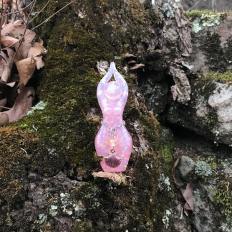 storying and re-storying our lives and that seeing our lives, and the lives of others, through a mythopoetic lens, can have a radically transformative impact on our experiences and our relationships. I have written about this for FAR in the past and noted that my personal lived experience is that stories have had more power in my own life as a woman than most other single influences. The sharing of story in an appropriate way is, indeed, intimately intertwined with good listening and warm connection. As the authors of the book Sacred Circles remind us “…in listening you become an opening for that other person…Indeed, nothing comes close to an evening spent spellbound by the stories of women’s inner lives.”
So, what is special about story as a medium and what can it offer to women that traditional forms of education cannot?
Stories are validating. They can communicate that you are not alone, not crazy, and not 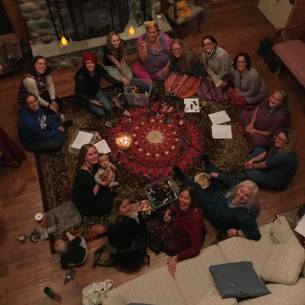 weird. Stories are instructive without being directive or prescriptive. It is very easy to take what works from stories and leave the rest because stories communicate personal experiences and lessons learned, rather than expert direction, recommendations, or advice. Stories can also provide a point of identification and clarification as a way of sharing information that is open to possibility, rather than advice-giving.
Cautions in sharing stories while also listening to another’s experience include:
- Are you so busy in your own story that you can’t see the person in front of you?
- Does the story contain bad, inaccurate, or misleading information?
- Is the story so long and involved that it is distracting from the other person’s point?
- Does the story communicate that you are the only right person and that everyone else should do things exactly like you?
- Is the story really advice or a “to do” disguised as a story?
- Does the story redirect attention to you and away from the person in need of help/listening?
- Does the story keep the focus in the past rather than the here and now present moment?
- Is there a subtext of “you should…”?
Several of these self-awareness questions are much bigger concerns during a person-to-person direct dialogue such as at a women’s retreat rather than in written form such as blog. In reading stories, the reader has the power to engage or disengage with the story, while in person there is a possibility of becoming stuck in an unwelcome story. Some things to keep in mind while sharing stories in person are:
- Sensitivity to whether your story is welcome, helpful, or contributing to the other person’s process.
- Being mindful of personal motives—are you telling a story to bolster your own self-image, as a means of pointing out others’ flaws and failings, or to secretly give advice?
- Asking yourself whether the story is one that will move us forward (returning to the here and now question above).
This work is beautiful. It is complex. It is multilayered. It is simple. It is hard. It is easy. It is rich and rewarding. It is dynamic and evolving and flowing. It is never the same.
May you be blessed with many stories together.
 Note: there is a detailed audio exploration of the themes of this post available here.
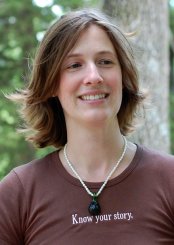
Molly has been “gathering the women” to circle, sing, celebrate, and share since 2008. She plans and facilitates women’s circles, seasonal retreats and rituals, mother-daughter circles, family ceremonies, and red tent circles in rural Missouri and teaches online courses in Red Tent facilitation and Practical Priestessing. She is a priestess who holds MSW, M.Div, and D.Min degrees and wrote her dissertation about contemporary priestessing in the U.S. Molly and her husband Mark co-create Story Goddesses, original goddess sculptures, ceremony kits, and jewelry at Brigid’s Grove. Molly is the author of Womanrunes, Earthprayer, and The Red Tent Resource Kit and she writes about thealogy, nature, practical priestessing, and the goddess at Patreon and at Brigid’s Grove.
 Recently, my colleague (I’ll call him Ben) participated in his grandson’s bris—the circumcision ritual within Jewish tradition. The circumcision was performed by a mohel–someone who is trained on removing the foreskin of an eight-day-old, male child.
  The blue organdy dress was a present my grandfather bought for me at the end of a summer I spent in San Francisco with my grandparents when I was six-going-on-seven. Was this the first time I crossed my father? Or only the first time I remember? My father had asked his father to buy me a dress for the first day of school. I was taken to the Emporium, a well-known department store in San Francisco. It was there that I spied the blue organdy dress.
 In some regards, life on Earth seems to depend on some basic inequalities. For example, differences in size, height, strength, speed and endurance advantages some and disadvantages others. Depending on another for survival is another type of inequality. Being able to adapt to change increases one’s likelihood of survival as well.
  For millennia, humans have told stories of goddesses who have decreed that, because terrible crimes have been committed against their female loved ones or those under their protection, our world would become a desolate wasteland. They withdrew their spiritual power that made life possible so that no fruits or vegetables would grow to nourish us or no sunlight would warm our bodies. Only when justice was done did these goddesses heal the wasteland so human life could continue.
 My father is dying, and I am haggard with grief and exhaustion. Over a month of frantically arranging child care, driving to the ICU in the middle of the night, fighting to protect my Dad from neglect and malpractice, chasing case managers, begging doctors, negotiating with nurses, sensitive, depleting, agonizing family debates about hospice and DNR, and hour after hour sitting and holding my Dad’s hand, singing, comforting, soothing, reassuring. Washing his face. Massaging salve into his feet and legs. Continually checking to see if he is too cold, too warm, in pain, breathing ok. Weeping as I drive home through snow and rain and dark, watching car accidents happen just one lane over, trying to soothe my frazzled and anxious little children, support my husband in his degree program, and not lose my own career entirely.
 Yesterday marked the 50th anniversary of the assassination of Martin Luther King, Jr. Thousands gathered at his memorial and many more rallied across the U.S. to honor King’s commitment to civil rights and non-violent action. His message continues to resonate in a nation that has never ceased to struggle with complex issues related to race, gender, sexuality, religion, and so on.
 Human beings tell stories. This may sound like a simple truth. To folklorists, literature professors, and people who work in media and in government, I would sound like a rather simple-minded child to be arriving so late in life at this obvious fact. We tell stories. And, just as the phrase “telling a story” might connote, our stories are not always true to life. Our stories are descriptors and meaning-making efforts, largely rooted in our grappling with self and group identity.

 If I had been asked to write the words that introduce visitors to the
