

In Zeeland, the southern, sea-kissed part of the Netherlands, a severe storm in January 1647 exposed a sanctuary to the Goddess Nehalennia. The altars and images found a new home in Domburg ’s church, until that burned down in a fire in 1848. Water, wind, fire, weren’t kind to the Goddess! Years went by, until a fisherman hauled up stone fragments from the depths in 1970 near Colijnsplaat.
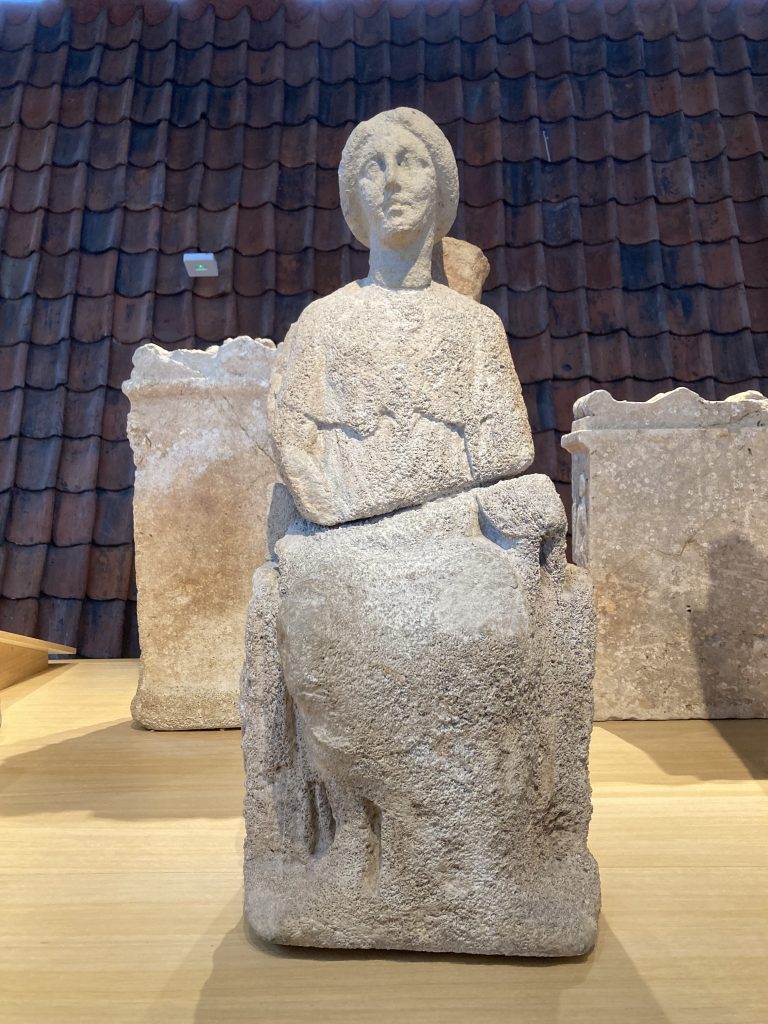
This lead to a large research project by the University of Leiden in collaboration with The Museum of Antiquities (Rijksmuseum van Oudheden, or RMO) that since recovered around 300 objects including altars, sculptures and roof tiles. Based on this, they were able to reconstruct a full Nehalennia temple at Colijnsplaat in 2005. 1)
Read on about my journey of meeting her, some of her background, and how she set me on my path of goddess archetypes…
I met Nehalennia for the first time in Leiden, as a young student in 1995… What, wait, a Goddess? Having grown up with a protestant lineage, where Mary is acknowledged as the mother of Jesus but otherwise doesn’t really play a significant part, this was a true balm for my heart. I’d already leaned into nature and goddess spirituality, but had found very few sources of inspiration at the time. Nehalennia wove herself into my being, and it was such a joy to revisit her this summer, in the permanent exposition of Netherlands in Roman Times… 2)
Local Gods in Roman Form
The area that is now known as the Netherlands was under Roman rule for nearly 500 years, roughly from 50 BCE to 400 CE, like much of Europe. According to the museum, Nehalennia was already worshipped before that time. These older cultures left no written documentation of their religious practice. Nehalennia, together with many other local Celtic and Germanic deities was added to a melting pot of the Roman pantheon and it is largely thanks to this, that we still know some of their names. Goddesses included Baduhenna, Viradecdis, Sandraudiga, Haeva, Hludana, Aufanisch, Hamaverisch and Hiannanefatisch and some of the gods were Magusanus, Grannus of Cissonius. 3)
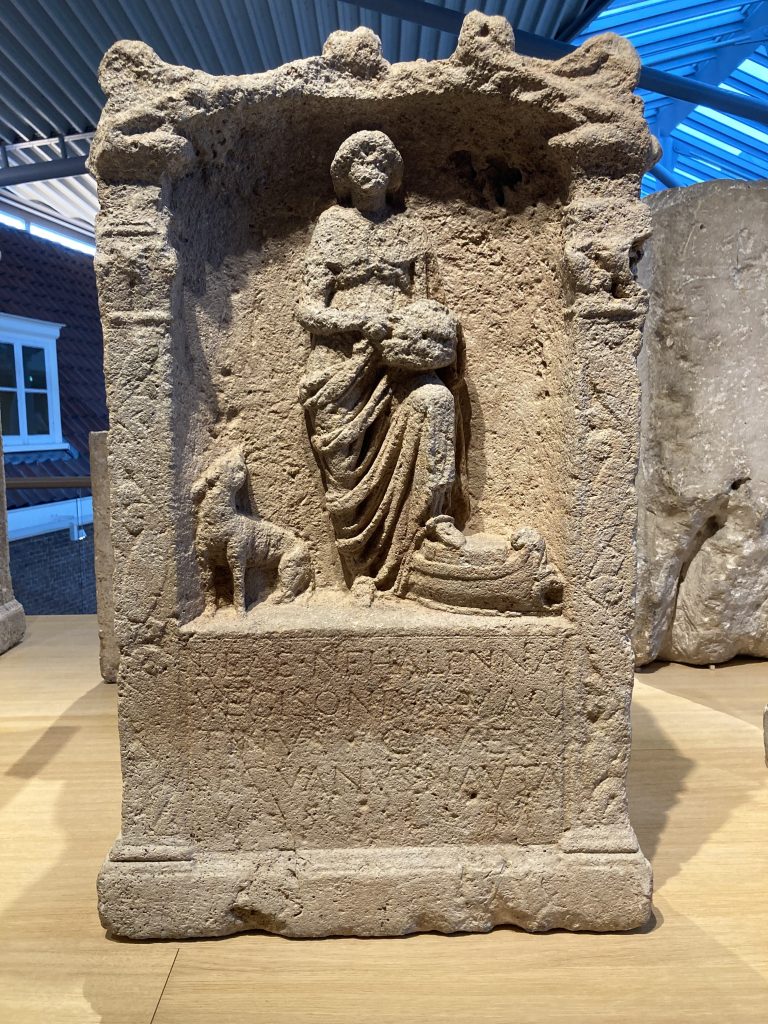
The RMO actually describes this as “local gods in Roman form.” Nehalennia is especially intriguing because she keeps her own name. She’s not turned into ‘Venus Nehalennia’ or ‘Fortuna Nehalennia’, nor does she get fused with a major Roman deity, which happened in the case of the Batavian god Magusanus, who became Hercules Magusanus. She retains her identity as Nehalennia. 3)
Most sacred objects depict her either seated or standing, often wearing a distinctive short cape. She is often accompanied by a dog, or displayed baskets of fruit. Sometimes you see a ship, prow or rudder. Latin altar inscriptions show people called on her for a safe sea journey or successful trade. They often indicate the name of the person who commissioned the altar, his profession and residence. One museum display was dedicated by Marcus Exgingius Agricola, a salt merchant from Cologne, thanking Nehalennia for the safe arrival of a ship’s cargo. 4) Professions vary from fish sauce to salt and pottery, and the dedicants lived in as far as Germany or France. It seems that her sanctuary functioned as an international place of worship around 200 CE. 5)
Personal Currents
I’d come to Leiden to study anthropology, and was introduced to the Goddess! It’s always interesting with layers of memory and how they overlap. I ‘remember’ walking through the museum at the beautiful Rapenburg canal, and seeing her altar for the first time.
Many years prior, I’d started praying to God the Mother, which took some serious de-conditioning after having learned to pray to God the Father. Through many years of discomfort, I slowly started to connect to a female deity. Still, the newness of goddess possibilities startled me. Nehalennia was my first crack in the masculine monolith, and deepening of my journey of recovering the Goddess after centuries of God-language.
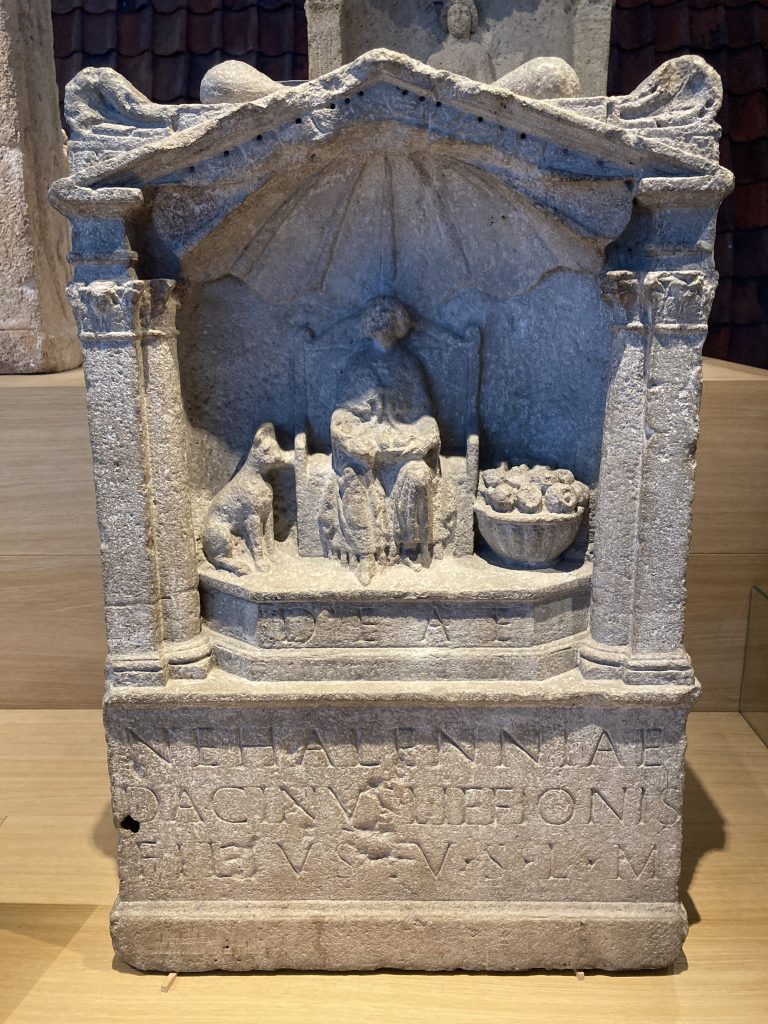
Perhaps it also resonated with my own birth in Emmeloord, a polder reclaimed from the sea. That a goddess had been sleeping in the silty soil of the Oosterschelde estuary. Lost to water and wind, to fire, and later exposed by a fishermen, a descendant of those who might have worshipped her millennia before. Until then goddesses belonged to mythology, stories, or exotic cultures. Seeing this altar, strung a cord, a harp string that resonated deep within my being, recognising an aspect of her in the land beneath my own feet.
Goddess Archetypes
I’ve written plenty on archetypes over the years. Archetypes are often classified according to characteristics or areas of life. You may know Aphrodite for her sexuality, Lakshmi for abundance, Isis for magic, Cerridwen for transformation, Athena for wisdom and so on. In that vein, Nehalennia would be known for seafaring and trade. Although these are useful signposts of the power they embody, I’m more interested in entering into relationship with them, rather than putting them in another box.
It is interesting that the first goddess I really ‘met’ was a goddess of crossings. Nehalennia was ancient, yet historically present through her artefacts and alive in my imagination. She became an inspiring role model, as original, indigenous deity of my birth soil, thriving inside (an oppressive) Roman culture, and surviving an enormous cultural translation. She shimmered as so much more complex than a goddess who kept people and goods safe at sea. Nehalennia was called on for protection in transition, but also for homecoming, and keeping promises… “I am crossing dangerous waters here, will you please protect me, and how can I honour you in return?”
In some ways, imagining a woman, like myself, not far away on mythical mount Olympus, but dangling her feet in the waters of the North Sea with a dog by her side, and a basket of fruit, made her feel more personal, approachable, intimate. Because I could imagine her there, locally and bodily, in the land of my ancestors, she became a person rather than a concept.
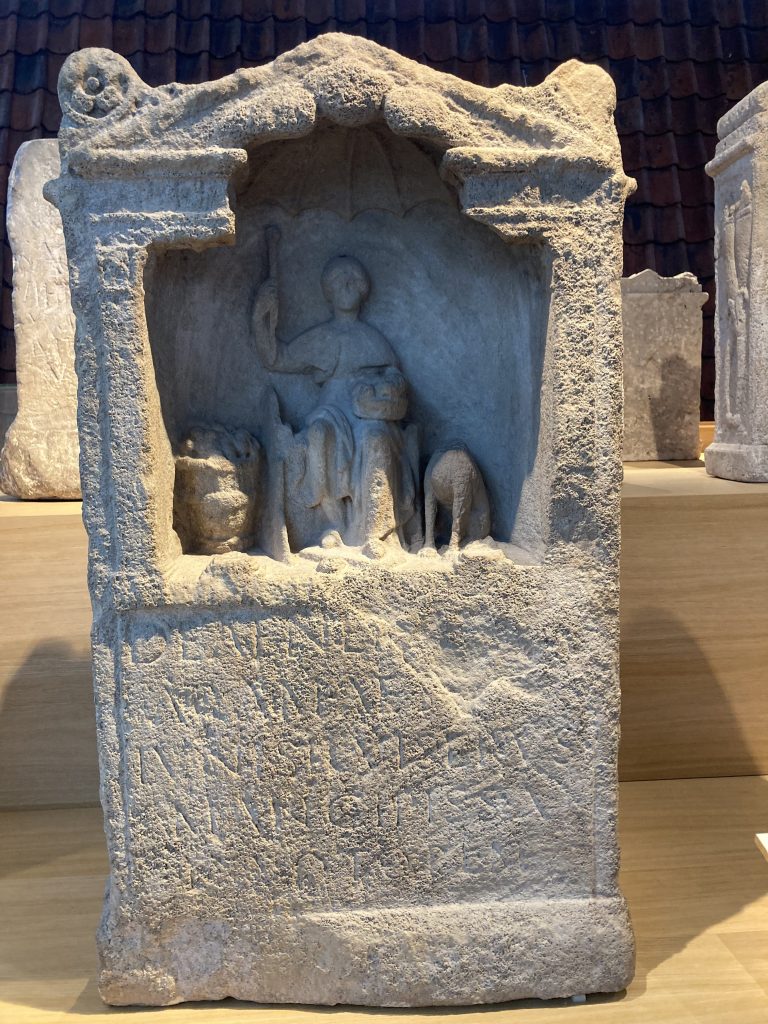
I became intrigued with what happens when goddesses stop being labels for qualities and take on depth as characters, as metaphysical friends with a complex persona that we can actually encounter. For me ‘what goddesses represent’ is one layer, but what emerges in the encounter with her interests me way more. This also means knowing that she will show up differently for you than for me.
With the power of hindsight, Nehalennia opened the way to my explorations of the archetypal realm not as an abstract pantheon, but as a community of relatable presences. Goddesses now seem to me like the complex and multi-layered women next door, who we could sit in circle with, weave, cry and dance together with. This is now manifesting in my work with Goddess Qi Gong, where we invite the Circle of Nine through visualisation, movement and ritual focus. We step into relation with different archetypal goddess aspects within and outside of ourselves, and invite them move through us. You are invited to sit and move in circle with us!
Invitations
As usual, I have a few invitations for you for different connections and communities…

The next 10-week Goddess Qi Gong journey is now open for booking. We start on October 13th, and each week, we explore one of nine aspects of the divine feminine.
✍🏽 Read more and sign up!
Weekly movement invitations to explore your relationship with body, landscape and rhythms. Includes 7 or 8 informal, live, seasonal gatherings to ritually celebrate the turning of the wheel, as well as 10 Qi Gong workshops to Move with the Seasons!
✍🏽 Explore and Join via Substack
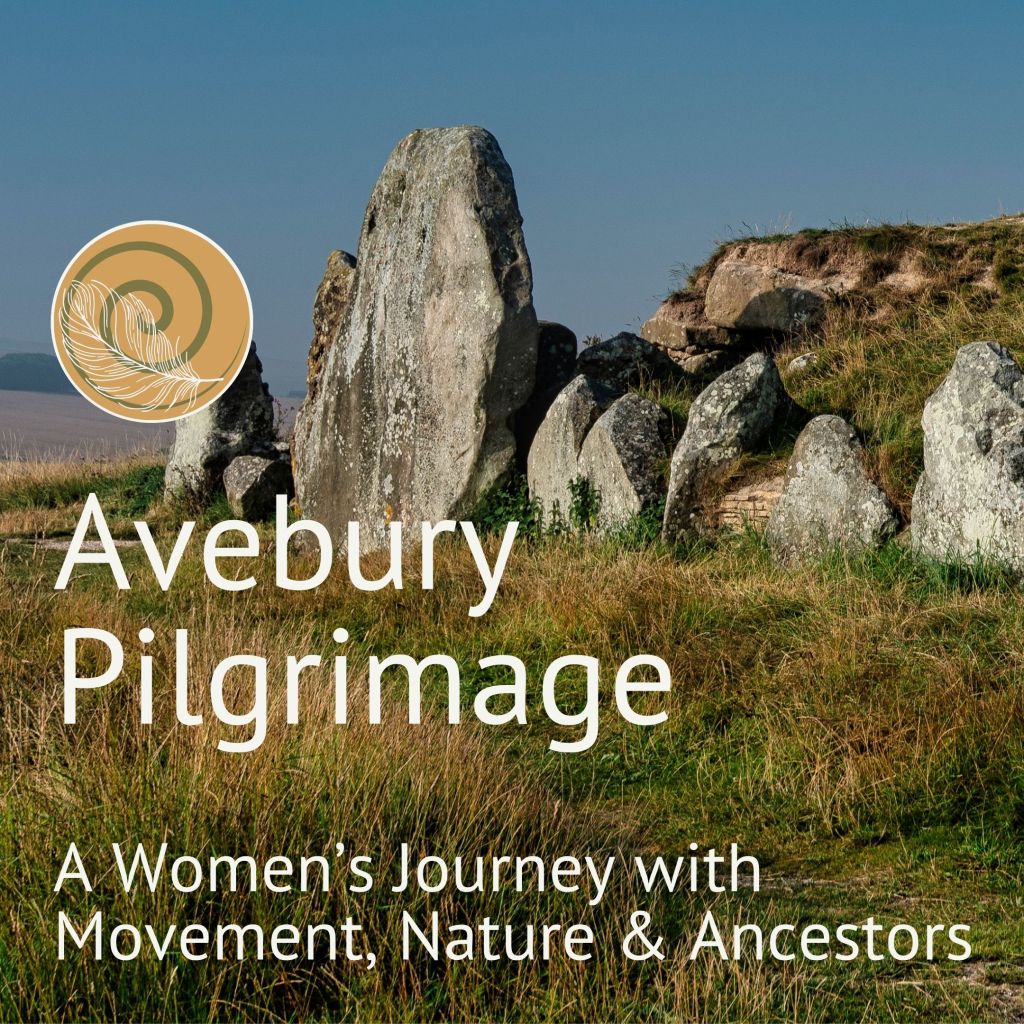
I’m in the process of booking Avebury 2027 – let me know if you’d like to join!
📅 Dates TBC, Summer Solstice June 2027, in person
✍🏽 Read more & Register
If transformation is an ongoing process of coming home to who we truly are, these magical places help us to reveal and see with different eyes! If you are Ritual Curious, let me know via this free sign up, and I’ll keep you posted of coming events! In the meantime, I’d love to hear your thoughts on this essay…
Small print & further inspiration
Recent Substack post Nine Women Within You
1) https://www.nehalenniatempel.nl/ accessed 10 September 2026
2) https://www.rmo.nl/tentoonstellingen/vaste-tentoonstellingen/nederland-in-de-romeinse-tijd/ accessed 10 September 2026
3) https://www.rmo.nl/museumkennis/archeologie-van-nederland/nederland-in-de-romeinse-tijd/thema-4-goden-en-godinnen/ accessed 10 September 2026.
See also See my earlier post on Goddess Architectures: How Cultures Shape Sacred Feminine Power.
4) https://www.rmo.nl/collectie/topstukken/nehalennia-altaar/ accessed 10 September 2026
5) https://www.rmo.nl/museumkennis/archeologie-van-nederland/nederland-in-de-romeinse-tijd/de-voorwerpen/relief-met-een-schip/ accessed 10 September 2026
Bio

Eline Kieft is a Qi Gong teacher, anthropologist and changemaker exploring embodied ways of knowing. With a PhD in dance and training in shamanic practice and Movement Medicine, she bridges academic insight with embodied spiritual practice.
Her book Dancing in the Muddy Temple blends theory and practice in service of land, body, and spirit. Now leading Wild Soul Centre for Embodied Consciousness, she offers coaching and courses to support deep transformation and inner strength through movement and the body. Try out her Qi Gong Membership for free! You can also find her on LinkedIn, YouTube, Instagram and Substack.
Discover more from Feminism and Religion
Subscribe to get the latest posts sent to your email.


I love this story of your journey to the goddess – each of us has a unique window through which (IF we are fortunate) the goddess becomes personal…. This goddess did her work! She “opened the way to my explorations of the archetypal realm not as an abstract pantheon, but as a community of relatable presences”. In my opinion if this personal aspect doesn’t become real then we are stuck with useless intellectual abstractions. Unfortunately I can think of too many feminists stuck in intellect (often they become well known because we privilege intellect over body).
LikeLike
Hey Sara, ohhh that moves me, thank you for your reflection! I agree – experience over abstractions anytime! It is nice to retrace our steps, and make connections in hindsight. She sure was a Wayshower for me (reflecting Caryn’s new approach to the divine feminine app!). It’s funny what archetypes and divine expressions open doors for us… Some resonate more immediately than others. Always a curious ‘meeting’…
LikeLiked by 1 person