The Last Time, by Molly Remer

I lie in bed with him, cementing the details in my memory. The way the morning air is heavy and green. The sound of last night’s raindrops continuing to drip from the overfull gutters on the roof. The insistent stab of a single-note bird song in the air. His head nestles in the crook of my arm the way it has done every morning for three years. Blond hair against my nose, breathing in the slightly baby smell of him. “This is the last time,” I whisper softly. “We are all done after this. This is the last time we will have nonnies.”
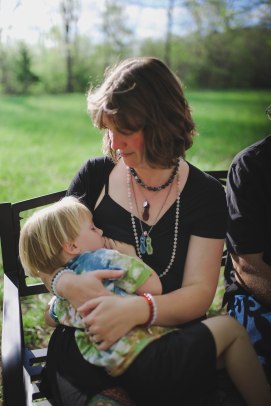
This is not the first last time for me, but it is the last, last time.  The first baby was born 14 years ago and gathered to my breast with all the tenderness and uncertainty and instinctiveness of a first, first. “Do you want nursies?” I whisper to that new little boy, and we begin the next steps in our bond, nursing for nearly three years, until one day, six weeks away from the birth of the next baby boy, I decide that we truly have to be done. I am a breastfeeding counselor for other nursing mothers and I feel like I should want to tandem nurse my two boys. I fondly envision their hands joining across my body, the easy love and camaraderie between them blossoming through this shared time with their mother. But, I feel an intense irritation with nursing while pregnant, nearly a sense of revulsion and the almost irresistible urge to shove away my sweet little boy as I prepare to greet the life of another. I talk to my midwife about my feelings and she explains that with her own two daughters, the agitated feeling at nursing the older one did not go away with the birth of the second, but instead became dramatically worse. After hearing this, I feel panicky and I decide we do, in fact, have to wean. He is a very verbal and precocious toddler and I am easily able to explain to him that it is time to be finished nursing. One night though, he lies in bed with me crying and begging to nurse. He says he really needs to. I tell him, “remember, we’re all done, but if you really, really need me, if you really, really still need to have nursies, you can.” He doesn’t nurse, but instead falls asleep, reassured that while our nursing relationship might be over, I’m still here.
Continue reading “The Last Time, by Molly Remer”

Painting Breast Cancer Goddess by Rev. Dr. Angela Yarber

October is Breast Cancer Awareness Month, though I imagine most of us are already relatively aware. One in eight women will have breast cancer. Pink is everywhere. It’s difficult to find a person who hasn’t been impacted by breast cancer on a personal level. In 2003, my mom was diagnosed. Radiation, a lumpectomy, and ten years later she was dubbed cancer free. When I finished my Ph.D. in 2009, I did a stint as a Research Assistant for a fabulous liturgical studies scholar working on a book that examined and created rituals for women with breast cancer. My task was researching everything written on breast cancer that intersected with feminism, womanism, religion, spirituality, and ritual.


Audre Lorde’s Cancer Journals struck me profoundly. The critiques weighed heavy as a movement that began with destigmatizing breast cancer and offering solidarity to patients has transformed into a pinkified commodity. Whether it’s the lack of transparency in major breast cancer foundations, pinkification, the essentializing conversations that equate breasts with womanhood, lack of access to comprehensive health coverage, the role of the meat and dairy industry in increased risks of breast cancer, the talk of “surviving” and “fighting” as though those who don’t survive aren’t fighters, or the complete lack of representation of women of color in any pink marketing (seriously, do a google image search of “breast cancer headwraps” and feast your eyes upon an endless array of young, white women), breast cancer awareness has been commodified so that helping cancer patients is second to profit. Amidst these pink teddy bears delicately embroidered with the word “fighter,” one can only wonder what we can actually do and offer and create to be supportive of those with breast cancer. What rituals might we offer? What sacred spaces might we create? What is a feminist response? A spiritual response?

Continue reading “Painting Breast Cancer Goddess by Rev. Dr. Angela Yarber”

Empowering Toys and the Problem of Class Divisions by Katie M. Deaver

I recently noticed that I’ve been spending a lot of time thinking about financial security, the way class systems work in the United States context, and how these types of realities inform my feminism.  Part of this is no doubt due to the fact that for the first time in my life I am not a student with multiple part time jobs, but rather am a “real” adult working full time at a job that offers retirement and medical benefits.

As I’ve written about before, I grew up in a poor family in rural Wisconsin and as a result I am often hyper vigilant about my finances.  While I likely go a bit overboard when organizing my budgeting, balancing, saving, and spending this type of organizing is something I can control.  The simple act of paying a bill, or determining how much I can spend on groceries this week gives me a profound sense of safety because for the first time there really is enough coming in to support my basic needs.

Continue reading “Empowering Toys and the Problem of Class Divisions by Katie M. Deaver”

Bans are Bandages not Solutions by Ivy Helman

meandmini1I’m heartbroken by yet another shooting in the United States.  I want to believe that all humans are, deep-down, intrinsically good.  I want to trust humans to act in the best interests of others.  I want peace between and inside human beings.  I want animals to be cared for, respected and deemed inherently valuable.  I want humanity to live in harmony with nature.  And, I want human societies that are just, equal and fair.

Even though I’m certain this world is achievable, it does not exist.  In fact, it often feels like we take one step forward, but something changes and we go back again.  This type of existence is no way to live.  In fact, Las Vegas was yet another example of how our way of life is worse than that.  It’s quite literally killing us.  And, I’m beyond any sort of ability to articulate just how upset I am. Continue reading “Bans are Bandages not Solutions by Ivy Helman”

The Gendered Cost of Fast-Fashion by Elisabeth Schilling

This last week, my students watched True Cost (2015), a documentary about the environmental impacts and human casualties of the fashion industry. According to the film, fashion is the number two most polluting industry in the world (oil is number one) and more lethal than some of us know. This is due to the incredible rate of people in the Global North consuming cheap clothes. I used to buy clothes weekly in graduate school, accumulating 100s of pieces, some that I never wore.

I never really thought about where my clothes came from (well, I would buy most of them second-hand, but they still had a former origin). I did not think about the pesticides flooding millions of acres of cotton and seeping into the ground and causing brain tumors and early deaths to farmers, and I did not think about the (mostly) women who made my clothes in other countries in poor working conditions, their own countries being polluted by factory run-off in their sacred rivers and the soil from where they fed their families. Continue reading “The Gendered Cost of Fast-Fashion by Elisabeth Schilling”

Listening Deeply to Yourself by Xochitl Alvizo

“You need to take a step back. You need to take a pause, relax, reassess. Two steps back, you can see more clearly, then you can move forward.” That’s what my brother first told me as I shared with him the overwhelmingness of my life. My first reaction was: Well – that is easier said than done. Plus, the thought of taking a pause and relaxing only made me think about how much more behind I’d fall on everything. I confessed to him that beside my regular teaching-related responsibilities, I commit to too many other things – only to end up feeling poorly about my performance.

“Do not be that person,” he said. I knew he was right. Some of my situation of overwhelmingness I do to myself; knowing I have limited time available, I nonetheless say “yes” more often than I say “no.” This is born of my own compulsion and socialization. But, as Dawn noted in a comment she left on Tuesday’s post, I need to remind myself that “my compulsion…is often just my compulsion.” Much of the time, I can choose otherwise. Continue reading “Listening Deeply to Yourself by Xochitl Alvizo”

Neither My Duty nor My Honor by Natalie Weaver

Just the other day, I realized that discussion of my housekeeping has been a fairly regular conversation throughout my life.  One of my earliest memories is being about four years old in my yellow bedroom on Ruth Avenue in North Canton, Ohio, sitting amidst what seemed like a mountain of stuff.  I was trying to organize and put it away at my mother’s behest.  I had a red bandana tied across the top of my hair, and I was pressed up against a large cardboard box decorated with Disney’s slapstick hero, Donald Duck.  I was young and apparently had not learned how to differentiate all my consonants, because, as the story goes, I complained that all I ever did was “cwean, cwean, cwean!”

As a teenager in my mauve bedroom on Demington Avenue in Canton, Ohio, my sister and I, who shared a bedroom, were under the constant scrutiny of our stepfather.  I don’t remember it being exceptionally messy in there; the space was probably maintained better than average for kids our age, but the house was managed like the army.  Once, the appearance of the room was sufficiently troubling as to result in the removal of our bedroom door from its hinges.  I am still not sure what the purpose of this weird punishment was (humiliation?), but I recall feeling this to be one of the lowest points in my whole housecleaning career. Continue reading “Neither My Duty nor My Honor by Natalie Weaver”

Birthing a New World by Xochitl Alvizo

Yesterday I “paused” my post and left you with words from a dear friend Edyka Chilomé, a powerful “artivist” invested in the healing of our world. And our world is in need of healing indeed.

Today was another tough day of carrying the pain of our continued inhumanity toward one another: Las Vegas, Puerto Rico, Myanmar…and so many other ongoing tragedies. I find it hard to find words – to know what to offer here on Feminism and Religion. Some days it seems necessary to go on with our work as planned; la lucha is every day and we keep at it. But other days, keeping on as planned just seems absurd.  I think these are precisely the days that Audre Lorde had in mind when she wrote that poetry is not a luxury. Continue reading “Birthing a New World by Xochitl Alvizo”

Feminist Gutter Punk Freedom by Xochitl Alvizo

My brother is, in this own words, an “old school street, squatter, gutter punk.” Indeed, he lives outside the system. He is an anarchist atheist and has lived many nights of his life on the streets – by choice. He has a quick and easy smile and makes friends effortlessly. Recently, while stuck in Seattle during an extended layover on his way back to Europe, where he’s been living the last few years, he passed the time making new friends and exploring the immediate area –

Continue reading “Feminist Gutter Punk Freedom by Xochitl Alvizo”

Catholic Bishops: Corporate Executives or Prophets? by Dawn Morais Webster

Dawn Morais Webster, the Pope off to his summer palace, Castel Gandolfo. He tells the world he will now become just a “humble pilgrim.”

This is a moment to drive the merchants of hate out of the Temple, as Jesus did.  But will the United States Conference of Catholic Bishops (USCCB) bear prophetic witness? Do they have it in them to proclaim the Gospel?

I am a Catholic from Malaysia who has lived in the United States for nearly two decades. I became an American citizen two years ago.  Every day I look for two of the Big Ideas –Catholicism and American democracy—to which I am forever tethered, to be rearticulated by new, principled leaders. And they are: not by those who command the pulpit or political power but by those who live the Gospel through their faith-inspired service to the community.  People like Sister Erica Jordan who asked House Speaker, the conspicuously Catholic Paul Ryan to explain how he translates Church teaching into health care and tax policy. He could not.

Continue reading “Catholic Bishops: Corporate Executives or Prophets? by Dawn Morais Webster”