As a maternal health advocate, I cherish the season of Advent as an opportunity to connect a beloved Christian story to the lives of women today who struggle to bring new life into the world under horrific circumstances. Every year I write something about Mary’s pregnancy and birth. In many ways she is no different from the “Marys” around the world who are young, poor, and unexpectedly pregnant, and who go on to give birth in unclean environments. I often pose the question to communities of faith, wasn’t the Christmas miracle equally that Mary survived the birth? How different would Jesus’s life have been if he’d never known his mother?
I continue asking these questions, but after my daughter was born last October, I have found my Advent reflections shifting to mirror my own parenting experiences. I began to think beyond Mary’s birth and into her early months of motherhood. One morning last December, after a particularly awful night’s sleep, I came downstairs to hear “Away in a Manger” playing on the radio. When it got to the line “But little Lord Jesus/No crying he makes,” I rolled my eyes dramatically and pictured Mary doing the same as she bounced a screaming baby Jesus in her arms. Continue reading “What If Jesus Had Gone to Daycare? by Katey Zeh”
Just before I went out on Friday night in Lesbos, my friend and sister feminist theologian Judith Plaskow emailed me from New York: “Right now we’re headed down to the Plaza Hotel to attend and try to disrupt a Trump luncheon!” That night, a friend asked me how I felt about Donald Trump. I threw my hands in front of my face and said: “I’m really glad I am not an American anymore.” Of course I am an American, but sometimes I don’t want to be one.
When I first started back on my journey to reclaim Judaism, I distinctly remember the first Hanukkah I lit candles. Not only was I bringing light into the literal darkness of night, I was also kindling the divine spark within myself. Each night I walked through a meditation I had created using the letters of the word Hanukkah, since there were eight letters and eight nights. I remember some of the words I had assigned to the nights: Holiness, Attentiveness, Night, Understand, Knowledge and Keep. I can’t remember the rest, but I do remember feeling the calm of the candlelight and the deepness of the meditation. I also remember that at some point, either I missed a night of lighting or I repeated one night twice because the days were officially over, and I still hadn’t lit all eight candles.
That has happened to me twice since I returned to Judaism. Yes, twice. Maybe three times. Oh, I don’t know. Now every time the festival approaches I worry that I’m going to do it again. I’m constantly rechecking the calendar so that I am certain I know which night we are on and so that I don’t miss one. I know it sounds like a mundane worry. Yet, in many ways Judaism works on turning the mundane into the holy. This was clearly a lesson on the ways in which the routine of life had too much control over me. Continue reading “I Missed a Day Again: Reflections on Hanukkah by Ivy Helman”
This holiday season, in the midst of our ever-repeating mass shootings and debates about the welcoming of Syrian refugees, I have seen a meme, a pithy quote, a bumper sticker time and time again amidst my fellow liberals:
“If only we had a seasonally appropriate story about Middle Eastern people seeking refuge being turned away by the heartless.”
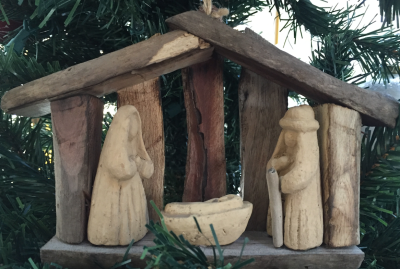
Similarly, many have posted pictures of nativity scenes with a tongue-in-cheek quip, “I’m so glad people are placing these lawn ornaments in their yards to indicate that they welcome refugees into their homes.”
Myriad articles have been published encouraging Christians to remember our calling to welcome the refugee, and as an ordained clergywoman, I affirm these thoughts. I believe it is our responsibility, as Christians and particularly as feminist Christians, to welcome the marginalized, the oppressed, the refugee. I am also a strong believer in the separation of church and state, a distinctive imperative both to my Baptist tradition and to my home country of the United States. So, in many ways, it doesn’t really matter politically that my faith tradition teaches me to welcome the refugee because my country is not a Christian nation, but it does matter that the primary symbol of my country—the Statue of Liberty—proclaims boldly and without apology: “Give me your tired, your poor, Your huddled masses yearning to breathe free, The wretched refuse of your teeming shore. Send these, the homeless, tempest-tossed to me, I lift my lamp beside the golden door!” Continue reading “Painting Marys, Welcoming Refugees by Angela Yarber”
“I was born in a strange little country town that may be like all other country towns, but I do not know. It was the world I was born to. The world is such a place that you need special things to understand it. I do not think I am a fool, but I do not understand life. It is like I am always standing in the dark somewhere. It could be on the edge of a cliff by a deep ravine… Or on a flat piece of all the land in the world… and I would not know. I would not know whether to step stand still. Either one could be a danger… When I am alone. Some lives are like that. Depending on the kindness of everybody.”
-from “Feeling for Life “ in Some Soul to Keep by J. California Cooper
In my previous post, I wrote about the truths we learn from black women’s literary tradition and from listening to the stories of those we too often ignore. Continuing that reflection over the next few months, I’d like to share some of the lessons from J. California Cooper’s short stories. The quote above is taken from the opening paragraph of one of her works.
“The tools are unimportant; we have all we need to make magic: our bodies, our breath, our voices, each other.”
–Starhawk
As November drew to a rainy close, we had a small family full moon ritual on our back deck and incorporated a simple gratitude ritual into it. The sky was overcast so we couldn’t actually see the moon, but my four-year-old daughter wanted to get out glow sticks left over from Halloween. We had so much fun dancing around with them and making patterns together in the dark night. We sang a chant I recently made up:
Hallowed evening
Hallowed night
We dance in the shadows
We offer our light.
We did a simple gratitude practice by placing corn kernels in a jar, one for each thing we are grateful for from the past month. We started out slowly and taking turns and then we sped up and the gratitude offerings came tumbling out, over one another. Even the one-year-old added corn, rapidly yet with great concentration to make it actually go in the jar. We drummed and called out, “We are ALIVE! We are GRATEFUL! We are POWERFUL! We are CREATIVE!” When we finally decided to close our ritual and go back inside, the moon peeked out from behind the clouds to briefly say hello and it felt like a blessing on the magic we’d just created together.
As we went back inside, I felt relaxed, happy, and connected. For being something very simple, not particularly pre-planned, and semi-chaotic, it felt like one of our deepest and most connected personal family rituals. The quote above from Starhawk floated back into my mind and I reflected that when I try “too hard” to get things ready for a perfect ritual, I often end up feeling a disappointed. Sometimes I feel like giving up on holding ceremonies with my children entirely. Last year, as we prepared to walk our Winter Solstice Spiral, the baby had a poopy diaper that extended up his back. I often end up snapping critically at whomever isn’t doing it “right.” My boys make fart jokes. My husband gives long-suffering sighs. Our circle looks more like a lopsided peanut. Our humming together discordant and off-key. As we lie on the ground together on the Spring Equinox to do our “Earth Listening” practice together, the kids wiggle and fight, pushing one another off the blanket and exclaiming in loud voices so no one can hear what we’re listening for. We listen to a shamanic drumming CD, but the only one to reach a trance state is the baby as I pace back and forth with him in a baby carrier. The four year old ends up crying because she doesn’t see anything and she wanted to see something cool. Martyrpriestess emerges to complain that she doesn’t know why she even bothers trying to do nice things for anyone if this is how you’re all going to act.
I recently finished reading Under Her Wings: The Making of a Magdalene, by Nicole Christine. A theme running through the book was the concept of “As Above, So Below and As Within, So Without.” I read this book as part of my research for my dissertation about contemporary priestessing and as I read, I kept thinking, I want to hear from the Mamapriestesses, from the Hearth Priestesses! Where are the other practicing priestesses with children at home? I noticed in Christine’s book that the bulk of her work took place after her children were grown and, to my mind, she also had to distance or separate from her children and her relationships in order to fully embrace her priestess self. I notice in my reading and my research group that many women seem to come to priestess work when the intensive stage of motherhood has passed, or they do not have children. Is there a very good reason why temple priestesses were “virgins” and village wise women were crones? Where does the Mamapriestess fit?
As I read Christine’s book and witnessed her intensive self-exploration, discovery, and personal ceremonies and journeys, I realized that in many ways personal exploration feels like a luxury I don’t have at this point in my parenting life. How do we balance our inner journeys with our outer processes? Christine references having to step aside and be somewhat aloof or unavailable to let inner processes and understandings develop, since our inner journeys may become significantly bogged down in groups by interpersonal relationships, dramas, venting, chatting, and so forth. For me, this distance for inner process exploration isn’t possible in the immersive stage of life as a mother. And, yet, I also know in my bones that I’m not meant to give it up. How does the As Within and the So Without actually work?
I return to our Full Moon gratitude ritual. My oldest son, 12, whose height is rapidly extending into manhood, totes his tiny brother on one hip with practiced ease, offering his own glow stick and helping my little one hold his into the air. He expresses gratitude for the fun he’s been having this month with his new video game and, “I’m grateful for you for doing things like this with us, Mom.”
My second son, 9, my bravest child, crawls willingly into the darkness under the deck to retrieve lost glow sticks, poked purposefully down porch cracks by the one year old. He returns, triumphant, holding the bundle of sticks aloft.
My daughter, nearly five, tips her face back, looking up at me with eyes alight, “I’m glad to be a Goddess Girl!” she calls out…
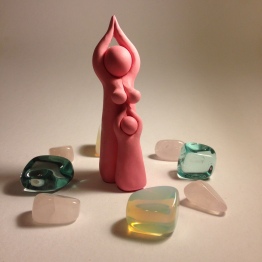
Molly has been “gathering the women” to circle, sing, celebrate, and share since 2008. She plans and facilitates women’s circles, seasonal retreats and rituals, mother-daughter circles, family ceremonies, and red tent circles in rural Missouri. She is an ordained priestess who holds MSW and M.Div degrees and she is currently writing her dissertation about contemporary priestessing in the U.S. Molly’s roots are in birth work and in domestic violence activism. She has worked with groups of women since 1996 and teaches college courses in group dynamics and human services. Molly is the author of Womanrunes: a guide to their use and interpretation, Earthprayer, Birthprayer, Lifeprayer, Womanprayer, and The Red Tent Resource Kit. She has maintained her Talk Birth blog since 2007 and writes about thealogy, nature, practical priestessing, and the goddess at her Woodspriestess blog. Molly and her husband Mark co-create original birth art jewelry, figurines, and goddess pendants at Brigid’s Grove.
Note: If you have children at home, I’d love to hear from you about the Mamapriestess topic! If you do not have children by choice, how does this play into your spiritual work? If you do not have children and that is not by choice, how does this play into your spiritual work?
A few days ago, I received a private message from an old friend who’s now living and working in Taiwan. We hadn’t corresponded in years, but he had heard about the recent shootings in San Bernardino and wanted to check-in after realizing that this was second set of mass shootings that I’d experienced so close to home (i.e., I live in a city just west of San Bernardino County and was faculty at Virginia Tech in 2007 during what became known as the deadliest shooting by a lone gunman in U.S history).
When I first moved to Greece I spoke of being attracted to a culture in which people express their emotions easily and do not hold on to anger. In the part of American culture I know, the opposite is often the case: people do not express their emotions easily and hold onto their anger. When I joined a therapy group in Greece, my therapist said that I made the right decision to move to Greece. “You needed to learn to live from here,” she said touching her belly, “and this is where Greeks live.”
During the first years I lived in Greece, I often said that I wanted to become Greek. Like others had done before me, I romanticized Greece and the Greeks. Then one winter I learned that family violence is as prevalent in Greece as it is in every other country. The cultural ability to express emotion does not stop Greek men from beating their wives or Greek women from hitting children. Indeed the more expressive nature of the Greek culture may make it easier for Greeks to resort to physical violence. On the other hand, violence stemming from withheld feelings can be cruel and unpredictable. Continue reading “When I Dance I Am I Greek by Carol P. Christ”
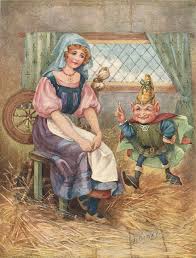
Perdita was in a panic. She looked this way and that, but all she saw was a towering pile of straw. She sat down to breathe deeply and think deeply. While she was breathing and thinking, the little man held is peaked green hat in his hands and marched anticlockwise around the room, whistling a jolly marching song she’d never heard before. He marched around the room three times.
Finally Perdita said to herself, Who knows what can happen in a year? That’s a long time. I can promise anything now.And then, well, I know I’ll be able to think of something to do. I’ll study all year! Aloud she said, “Kind Sir, you are miraculous, for no man can spin gold, and yet—here you are, spinning gold! You can have what you ask for.”
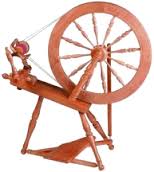
And so the little man smiled a smile that showed all his teeth and sat down at the wheel and—whirr, whirr, whirr—the whole roomful of straw was soon spun into the finest gold thread imaginable, twice as fine as the finest silk thread the merchants sold at the harvest festival.
As soon as the Queen arrived back at her palace the next day, her Nephew introduced his betrothed to her. The Queen was much older than Perdita thought she would be, and she was as wise as she was old. She took Perdita into her private chamber and asked her several questions. She learned more about Perdita than the girl realized, also about her mother and stepfather and young traveling scholars. Nevertheless, the Queen gave her royal blessing to the marriage, for she wanted her Nephew to be married to someone with a quick mind, good manners, and some ambition so the land would be well cared for after her death.
The wedding took place on the day following the summer solstice, and guests were invited from lands all around. Perdita’s mother and stepfather were invited, too, and they were both given new clothes to wear. The stepfather tried to have a private conversation with the Queen, but the major-domo led him into the map room and showed him some extremely dependable treasure maps.
After the wedding banquet of roast peacock and candied goldfish and artichoke hearts and rosewater dumplings, the Queen and Perdita’s mother walked together in the gardens and talked of many things. Pretty soon, after the stepfather had memorized several of the treasure maps and borrowed enough money to rent a ship and set off to claim his treasure, the mother was invited to move into the palace, where her healing and domestic arts would be appreciated.
A year and a day later, Perdita gave birth to a daughter who was the most beautiful baby in the whole land. The royal birth was celebrated with fireworks and parades and festivals and rituals in the temples that lasted three whole days without pause. Perdita’s mother was appointed chief nursemaid and immediately hired a wet nurse who had the creamiest milk in the whole land.
On the third night after the baby’s blessing and naming day, Perdita was alone in her chamber, brushing her long, curly hair, when she heard a noise behind her.
“Well then. I have come for the baby.”
“What?” Perdita pretended not to recognize the little man. “And just who are you? And what are you doing in my private chamber? Get out immediately or I shall call the guards.”
“You know who I am. You know why I’m here.”
“Yes, yes, I confess it. I do.” She allowed a tear to roll down her cheek. “Oh, but please don’t take my baby. I have never loved anyone before, and I love this baby more than anything I have ever possessed. Here—take my jewelry. All of it. Take my jeweled toys. Take the tapestries from the walls. Take my richly embroidered clothes. Take my royal robes. Take my golden coronet. Take these books I’ve read. Take anything you want, but please, Kind Sir, oh, please don’t take my daughter.”
“We made a bargain. I have spun the gold for you. No man can spin gold, but I can, and I spun for three nights. Because of my spinning, you are now the heiress of the throne of this land. You must keep your part of the bargain.”
“No, no!” Perdita cried, glad that the baby was in her mother’s watchful care. “I cannot give up my daughter! She is more precious to me than gold.” And Perdita began to cry, to really cry, and her crying was so heart-rending that the little man finally began to take pity on her.
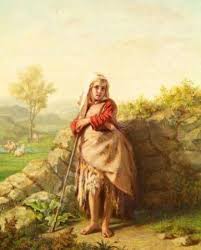
In a land not too far away there once lived a widow who was so poor and who worked so hard day and night to make a bare living that she had almost no time to teach her daughter the things a girl needs to know to be a proper wife. The girl, whose name was Perdita, had learned how to do a few useful things around the house, but when she laid the fire she always mixed green wood with the dry, when she made the soup she always forgot the salt and pepper, and when she swept she inevitably forgot to sweep under the bed. When she sewed she always pricked her fingers and left little red spots on the fabric, and when she spun she always made huge knots and horrible tangles in the new thread. Although she wasn’t very good at these important homely tasks, she had somehow learned to read and study numbers and she had even learned about Panglossian optimism. Her parents had no idea how this learning had come to her, unless it had something to do with the scholars who regularly passed through the town and with whom Perdita spent a lot of time. In her own opinion, the girl more than made up for her lack of useful skills with her brilliant mind and quick tongue…not to mention her beauty.
One day, although her mother had ordered her to finish the washing and hang the clothes in the sun to dry, Perdita left them soaking in the tub and went out and about with her mother’s second husband. On the road they happened to meet the Queen’s eldest Nephew. Now since the Queen had borne no daughters and was now too old to do so, everyone knew that one of her Nephews would inherit the throne when she died. As soon as he spotted the young man, Perdita’s stepfather saw an opportunity.
“Here’s your opportunity,” he murmured to the girl. “Do what you can to attract this fellow. If you do, things will go well for you and your mother.”
Perdita saw an opportunity, too. An opportunity to raise herself socially and find a life that was not so filled with laundry and other mind-numbing hard work. So she tossed her curls and swung her hips, she gazed up at the Royal Nephew, and soon she had his attention, for this young nobleman was interested in the things that have always interested the upper-class men. During their ensuing conversation, Perdita said coyly, “I may have a poor mother, but I’m quite clever, you know. I can read and write. I can cook and clean. I can sew and spin.”
“I’m interested in girls who can do useful things,” said the Queen’s Nephew. “Are you good at all things you do?”
“Oh, yes, I am very, very good,” the girl replied demurely. “I have a great many talents.”
“And,” said her mother’s second husband,“some of this girl’s talents no one has uncovered yet.”
“I see,” said the young man with a wink. “And may I learn what yourhidden talents are, my dear?”
“Why,” said Perdita with a pretty blush, “why I can…I can—”
“She can spin straw into gold,” said the stepfather. “Who do you know who can do that?”
“No one at all.” The Royal Nephewtook Perdita’s hand. “It’s well known that no man can spin straw into gold.”
“And she works very fast,” said the stepfather. “See how soft her hands are! Her fingers are as nimble as my own. Even though we’re not even related by blood, I have taught her all she knows!”
“Indeed,” the Royal Nephewsaid, “nimble…” And after he thought for a moment, he added, “My dear, would you like to come to my Aunt’s palace with me and show me—show us your talents?”
So with an unnecessary push from her stepfather, Perdita, who was sure she would be moving into the best of all possible worlds, went to the palace with the Queen’s Nephew. But the Queen was not there, for she was visiting one of her Sister Queens in a nearby land. When the Royal Nephew asked Perdita to show him how she spun straw into gold, she batted her eyelashes at him and, remembering what she’d seen other girls do, shrugged her linen bodice just a little bit off one shoulder. A little while later, when the Royal Nephew asked again about spinning straw into gold, she shrugged her bodice a little bit off her other shoulder. When he asked a third time about spinning straw into gold, however, she finally understood that he expected a reply.
She had to think fast. “Oh,” she said disingenuously, “oh, I only do it at night, when the moon is full, and I can never do it if anyone is watching. I can spin straw into gold only when I am left absolutely alone with my work.” She was feeling quite sure that the Royal Nephew would never leave her alone, especially with her soft linen bodice falling off both shoulders.
But Perdita hadn’t noticed that the moon was full that very night, and when the Royal Nephew offered to let her stay in the palace, she was loath to refuse the invitation. I’ll think of a way out of this predicament, she said to herself. I always do, for I’m very clever.
The young nobleman was keenly interested in gold, as nobles always are, and so he ordered a room at the far, far end of the farthest corridor to be filled one third full with straw. Then he got his aunt’s best spinning wheel and put that in the room, too.
“Here is a fine and private room,” he said to Perdita, “and I guarantee that no one will disturb you. Just spend the night here and show me how you can spin straw into gold, and I’ll give you a lovely reward in the morning.” And he winked at her.
What could the girl do? She watched the Royal Nephew close the door. She heard the key turn in the lock. She began to walk about the room. At last she sat down beside the wheel. But she didn’t have the least idea about how to spin straw into gold, for she couldn’t even spin flax into decent linen thread without getting huge knots and horrible tangles in it. She began to cry. “I’m lost!” she wailed. “No one is here to advise me. No scholar I’ve ever met has considered this situation. No man can spin straw into gold, but I can’t, either. Oh, woe is me.”
“Well now.”
Suddenly she heard a voice, and when she peeked between her fingers, she saw a little man wearing a peaked green hat and a long brown jacket and wide brown trousers. He had a long white beard and big strong hands.
“Good evening,” he said. “Why are you crying?”
“I’m supposed to spin straw into gold, but I don’t know how.”


 Just before I went out on Friday night in Lesbos, my friend and sister feminist theologian Judith Plaskow emailed me from New York: “Right now we’re headed down to the Plaza Hotel to attend and try to disrupt a Trump luncheon!” That night, a friend asked me how I felt about Donald Trump. I threw my hands in front of my face and said: “I’m really glad I am not an American anymore.” Of course I am an American, but sometimes I don’t want to be one.
 This holiday season, in the midst of our ever-repeating mass shootings and debates about the welcoming of Syrian refugees, I have seen a meme, a pithy quote, a bumper sticker time and time again amidst my fellow liberals:
 A few days ago, I received a private message from an old friend who’s now living and working in Taiwan. We hadn’t corresponded in years, but he had heard about the recent shootings in San Bernardino and wanted to check-in after realizing that this was second set of mass shootings that I’d experienced so close to home (i.e., I live in a city just west of San Bernardino County and was faculty at Virginia Tech in 2007 during what became known as
  When I first moved to Greece I spoke of being attracted to a culture in which people express their emotions easily and do not hold on to anger. In the part of American culture I know, the opposite is often the case: people do not express their emotions easily and hold onto their anger. When I joined a therapy group in Greece, my therapist said that I made the right decision to move to Greece. “You needed to learn to live from here,” she said touching her belly, “and this is where Greeks live.”
 Perdita
 In a land not too far away there once lived a widow who was so poor and who worked so hard day and night to make a bare living that she had
  “Here is a fine and private room,” he said to
  Feminism and Religion