

 Having recently become a “regular contributor” to this blog, I feel that my first post should be about how I situate myself and my beliefs in this environment. One of the first things I noticed about this blog, is that is has many Catholic, liberal Protestant, and pagan/nature religion/Goddess-followers who contribute (a journal I edit has an excellent article on Thealogy and worship of the Goddess). There are also a few Buddhist, Mormon, and New-Age contributors. In this eclectic mix, I stick out quite a bit. Not only am I a primarily white (my Abuelita was born in Chihuahua) heterosexual man, but I am also a secular humanist and an atheist. In an earlier post I wrote a piece titled “Reformer, Revolutionary, and Rationalist: Three Types of Feminism,” in which I find myself at home with the cultural critiques of the revolutionary and the logical critiques of the rationalist. As somebody who will be contributing my voice, here is where I am situated. Continue reading “Feminism and Religion: Where Do I Stand? by Kile Jones”
Second Class Rape Victims: Rape Hierarchy and Gender Conflict
Deconstructing masculinity isn’t the key to solving social, sexual, and domestic violence across the world but it is a step worth taking when attempting to engage men in affecting change to stop these violent actions since men, statistically are the perpetrators of such crimes that both cause such outcry as well as perpetual silence.
 The most disturbing part of the 2006 documentary Deliver Us from Evil isn’t the fact that Father Oliver O’Grady is rewarded by the Catholic Church with a new congregation in Ireland after his short stint in prison for the rape of dozens of children in the 1970s, but rather the hierarchy of gendered victimization which is often created throughout the various rape cases that are both reported and unreported throughout history.
I am often troubled by the ways in which rape cases are discussed and deconstructed via mediums such as blogs, online communities, social media networks, the news, and popular culture. No series of events troubled me more than the Jerry Sandusky trial, but more importantly, the ways in which the young boys and adult men who were subjected to Sandusky’s abuse quickly overshadowed the other rape cases that are reported on a daily basis, specifically those involving young girls and women. Continue reading “Second Class Rape Victims: Rape Hierarchy and Gender Conflict”
Bird Watching and Geology in the Body of Goddess by Carol P. Christ

The notion of the earth as the body of Goddess has taken on deeper meaning for me in recent years. I have felt connected to nature all of my life. Yet often, though not always, I have related to nature in general rather than in specific ways. Some years ago, after reading Hartshorne’s essay “Do Birds Love Singing?” I stopped for the first time in the wetlands of Kalloni, Lesbos, to see the flamingoes that live in the salt pans there.

One thing led to another, and I met someone with whom I spent the next six weeks visiting every pool and puddle where birds were stopping in Lesbos that spring. Continue reading “Bird Watching and Geology in the Body of Goddess by Carol P. Christ”
BREAKING NEWS: Pope Resigns
 The world is stunned this morning as news breaks that Pope Benedict XVI has announced that he will resign his position due to lack of strength to carry out his role; he stated: “to the extent that I have had to recognize my incapacity to adequately fulfill the ministry entrusted to me”.
“For this reason, and well aware of the seriousness of this act, with full freedom I declare that I renounce the ministry of Bishop of Rome, Successor of Saint Peter.” Continue reading “BREAKING NEWS: Pope Resigns”
On Pronouns and Liberation in the Classroom by Ivy Helman
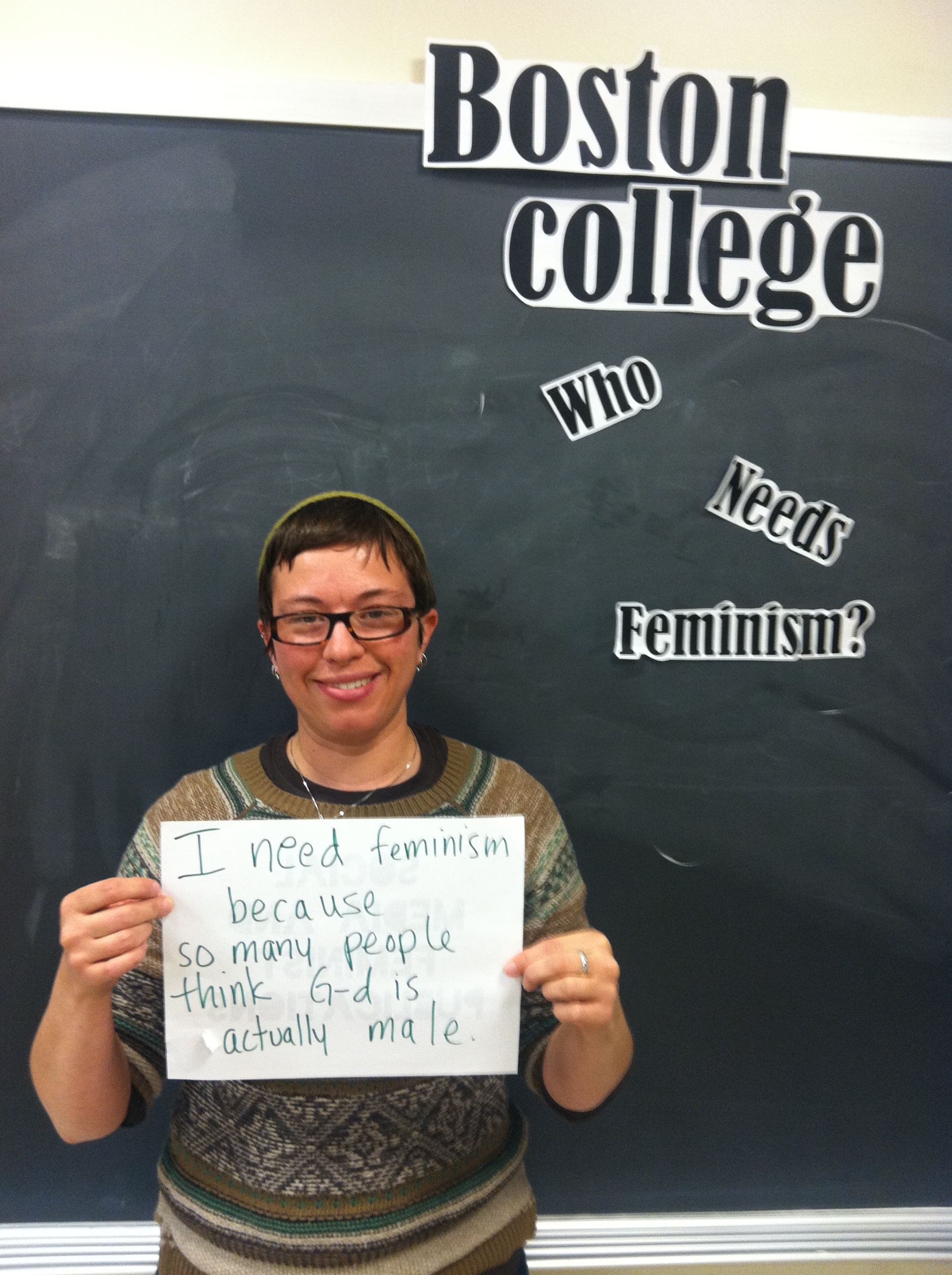 In my introduction to Christianity class, almost every one of my students (who come from diverse religious backgrounds – primarily Roman Catholic, Protestant and Muslim), continues to believe that the best image if not the only appropriate image for G-d is male. When probed they may speak generically about G-d as genderless, an entity or spiritual presence of some kind, yet conclude by affirming their belief that G-d is male often by adding something along the lines that G-d is best described as Father. Some go so far in these affirmations that they articulate G-d’s maleness as fact. It never fails that every semester I struggle with how to address this basic feminist issue within the classroom.
At least as early as 1973, Mary Daly, in Beyond G-d the Father: Towards a Philosophy of Women’s Liberation, articulated the problematic basis of the relationship between gender and divine imagery. She argues that “If G-d in ‘his’ heaven is a father ruling ‘his’ people, then it is in the ‘nature’ of things and according to divine plan and the order of the universe that society be male-dominated.” In other words, if maleness is associated with divinity, then the power, domination and running of society by men seems to be divinely ordained. Continue reading “On Pronouns and Liberation in the Classroom by Ivy Helman”
Painting Sojourner Truth By Angela Yarber

This month, I am reminded of the importance of Jacquelyn Grant’s work on womanist Christology. In White Women’s Christ and Black Women’s Jesus, Grant reviews the white feminist discussion of the so-called problem of Jesus’ maleness, while beginning to construct a womanist response to this incarnational conundrum. She states, “It is my claim that there is a direct relationship between our perception of Jesus and our perception of ourselves.”[1]
Beginning with Mary Daly, feminists have responded to Jesus’ maleness in a variety of ways. Daly argues that because the person of Jesus is male, the male is recognized and celebrated as the superior being. Because of this, the male Jesus is to be rejected or exorcised because Jesus’ gender identity contributes to patriarchy and does not hold salvific power for women. Rather than rejecting Jesus altogether, Rosemary Radford Ruether asks the seminal question, “Can a male Jesus save woman?” Continue reading “Painting Sojourner Truth By Angela Yarber”
What It’s Like To Be A Woman In The Academy: Mentoring Edition by Linn Marie Tonstad
 In my first post, I promised to return to the topic of mentoring. Mentoring is a survival strategy for feminists inside hostile or difficult-to-navigate environments; in its best possibilities, mentoring is a strategy for flourishing, not just surviving. But when a mentoring relationship goes wrong, it is so destructive an experience that it may even be characterized as traumatic. Mentoring is also a practice rife with possibilities for abuse: the recent Yale study of gender bias in the sciences shows the extent to which gender alone serves as a significant variable for scientists assessing the possible rewards of mentoring a student.
I have given a lot of thought to mentoring in recent months – as I transition into new mentoring roles in a new institution, as I negotiate changing relationships with current and former mentors, as I reflect on successful and unsuccessful mentoring relationships I’ve been involved in, and as I seek to develop policies and practices that will serve me (and more importantly, my mentees) well. Continue reading “What It’s Like To Be A Woman In The Academy: Mentoring Edition by Linn Marie Tonstad”
Imagine a Catholic Church that Loved as only a “Woman” Loves by Michele Stopera Freyhauf
 I came across an abhorrent display of ignorance Saturday when reading an article quoting the Pope’s theologian, Dominican priest Wojciech Giertych, on why women cannot be ordained. This man is in charge of reviewing speeches and texts submitted to the Pope to ensure that they are free of doctrinal error. Once you read this, I am sure that many of you will have the same thoughts that I do ranging from – that explains a lot — to — we are in serious trouble!
Giertych touted the common arguments made against ordaining women – Jesus was a man, Jesus chose only male disciples, etc. However, then he put forth statements about, (1) the theologian’s task, (2) why maleness is essential to the priesthood, and (3) what the vocation of women is and is not.
What is the Theologian’s Task?
According to Giertych, the theologian’s task in determining the definition of priesthood:
“In theology, we base ourselves not on human expectations, but we base ourselves on the revealed word of God” without the freedom “to invent the priesthood according to our own customs, according to our own expectations.”
According to CTSA (Catholic Theological Society of America), the theological task is described as follows:
“Theologians throughout history have promulgated the riches of the Catholic tradition by venturing new ways to imagine and express the mystery of God and the economy of salvation revealed in Scripture and Tradition. This is a Catholic style of theological reflection that very many Catholic theologians continue to practice today. The teaching of the Second Vatican Council in its Pastoral Constitution on the Church in the Modern World (Gaudium et Spes) is especially eloquent on this responsibility” (See Gaudium et Spes #44).
Working with Obstacles: Is Female Rebirth an Obstacle? by Rita M. Gross
 Buddhist teachings recommend appreciating obstacles because they are helpful to our practice. Without obstacles we would never develop profound understanding or compassion. Buddhists have also frequently claimed that female rebirth is an obstacle. If obstacles are of great benefit, shouldn’t women, who encounter more obstacles than men, rise to the top of the hierarchy of revered Buddhist teachers? But that has not happened. Is this obstacle actually of benefit to women, as teachings on the helpfulness of obstacles would suggest? After practicing Buddhism for almost forty years, I have come to appreciate how much the many obstacles I faced over the years have taught me. For a woman of my generation (born 1943), none has been greater than the limitations placed on me as a woman, both by Western culture and by Buddhism. Continue reading “Working with Obstacles: Is Female Rebirth an Obstacle? by Rita M. Gross”
Blessed By Gratitude and Sharing by Xochitl Alvizo
 Carol Christ’s post yesterday has gotten me thinking about the differences between Christianity and earth-based spiritualities. Of course, there are many differences, that goes without saying. However, being someone who comfortably stands at the intersection of them both I am usually more aware of the ways in which they seem to intersect in life-changing and inspiring ways for me. Nonetheless, Carol has me thinking…
Over the course of the last year here on Feminism and Religion, Carol has written a lot about the importance of ancestors – how when speaking about embodiment and interdependence it is crucial we acknowledge all the ways in which ancestors make us who we are. Mothers literally give us our bodies and our ancestors’ genes, connecting us to a long line of people both materially/biologically as well as historically. Ancestors give us a sense of connection to places and ground us to lands that were meaningful to them and thus become meaningful to us. And Carol also reminds us that our family and ancestors transmit to us memories that impact us psychically and in powerful ways. These emphases on connection, interdependence, rootedness, and embodiment flow from her earth-based Goddess practice and thealogy. Her spirituality leads her to a greater sense of appreciation and gratitude for the Source of Life and for all the sources of life, and she affirms that because of this deep awareness of interdependence and relationality people who practice earth-based spiritualities are “moved to share what has been given to [them] with others.” Continue reading “Blessed By Gratitude and Sharing by Xochitl Alvizo”
 Feminism and Religion