

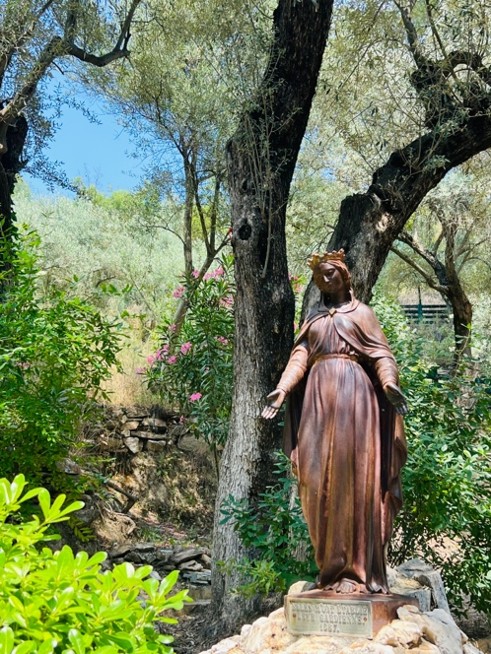
The road to the House of the Virgin winds through the hills, a thin ribbon of light. Nestled on Mount Koressos (also known as Bülbüldağı, Turkish for “Mount Nightingale”) near Ephesus, its discovery in the late nineteenth century was inspired by the visions recorded in The Life of the Blessed Virgin Mary by mystic Anne Catherine Emmerich, whose descriptions led priests to identify the small stone dwelling she saw in her revelations. Although the Bible is unclear about Mary’s later life, passages such as John 19:26–27, in which Jesus entrusts his mother to the Apostle John, lend narrative weight to the belief that she followed him; whether to Ephesus or elsewhere, this is a matter of faith and ongoing historical debate. For many, the House is a place of pilgrimage and serves as a symbol of interfaith devotion across centuries. At the wishing wall, candles and paper flutter in the breeze, small, tangled petitions to the divine. I feel my own within my heart as I light a candle among the others, its black wick catching the wind.
For me, the theological study of Mary feels like an inquiry into longing, an attempt to understand how a young girl became the gravitational center of so many human hopes. I grew up shaped by my maternal grandmother’s Catholic upbringing and my father’s Alevi heritage. Over the years, I have embraced various aspects of the Christian faith alongside the Muslim faith. When I lived in Pennsylvania, I found spiritual homes in Unitarian Universalist and PC(USA) churches that championed reproductive justice and abortion access. Since moving to Ireland, I have been deeply inspired by the diverse and poignant spiritual landscapes and history present here. In other chapters of my life, I have drawn strength from Earth-based traditions, Goddess worship, and tarot. Today, I do not belong entirely to any single religion; instead, I center myself somewhere in between. When I reflect on Mary, I think about embodiment, the ways in which mystery enters the world through flesh. And it is also a meditation on agency and consent; the way I understand it, it’s about a young girl choosing a story that will break her heart.
Feminist theologians such as Elizabeth A. Johnson insist Mary is “truly our sister,” and Ivone Gebara finds in her a symbol of “hidden resistance.” Sarah Coakley imagines Mary’s openness to God as an act of strength, where “freedom and divine desire meet without coercion.” For me, reflecting on Mary and Mariology is a way to contemplate my own yeses, and the inner places where I, too, am asked to bear the weight of something I do not fully understand.
If Mary is “my sister,” then I meet her in the cold light of a Montreal winter. I was in my early twenties when I first saw her as a girl rendered in red. I spent many afternoons wandering through the Musée des Beaux Arts, lingering in front of a painting of the Annunciation by Mary Alexandra Bell Eastlake. Even now, it remains my favorite rendition.
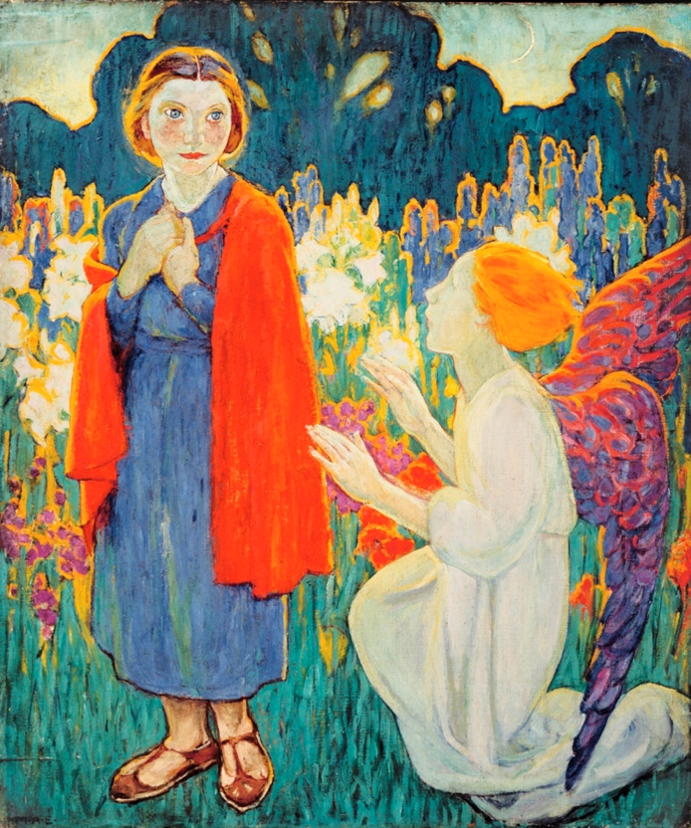
Mary appears young in the painting, her expression unreadable. She reminds me of Little Red Riding Hood, that contradictory protagonist from my favorite fairy tale, equal parts naïve and trickster. There she is, at that potent threshold. Her ‘yes’ is like a trickster’s move: a young girl claiming a role that bypasses the structures of power to speak directly to the Divine. She enters the dark woods of her own destiny with her eyes wide open. Yet her hands hold the space directly at her heart.
I, restless and longing, could only imagine the strange and profound weight of saying yes. Back then, those yeses were wishes cast to the wind. Perhaps there was even a hint of ambivalence there. I believe ambivalence and uncertainty can also belong to the realm of the yes.
These days, the ‘Yeses’ I find in parenting require me to keep saying yes to the experiences that teach me the depth of my own heart. Before becoming a parent, I remember grappling with what it would mean to become a mother, not merely the body’s work of it, but the heart’s. When I found out I was pregnant in my mid-twenties, my mother gave me a silver necklace with Mary’s likeness etched in green. My great grandmother had worn a Mary pendant, too, and holding Mary’s image close to my heart felt like an aspiration. I imagined the love that could bear my unflinching loyalty would be revealed in this slow, luminous labor, the act of giving myself fully and deliberately to someone I had not yet met, who would require me in ways both overwhelming and miraculous.
Prior to having my daughter, I had lost a pregnancy. I felt like my experiences existed outside the margins of what was considered “acceptable” or “good.” I feared that if I let my emotional life become visible, I would be judged or shamed. And so, I approached Mary tentatively. If I placed my experiences in the hands of God, as I used to imagine on solitary nights, would there be open hands to hold the fullness of my experience, the losses, the heartbreaks, the failures of kindness, the shame, the depression, the anxiety? I felt like I needed to give God (and others and everyone I encountered) my perfect image. Now I ask: what if our losses and anxieties aren’t obstacles to our faith, but are instead the very materials of it?
A year after my visit to the House, my daughter was born. As I held her in my arms, I thought of the two candles I left burning; one on that hillside, and another at the Cathedral of St John the Divine a week before my daughter’s birth, her name carved into the wax.
Author’s Note: These reflections are offered from my personal experience. I approach the rich history of Mariology with humility, acknowledging the many voices, past, present and future, who have found and will find their own unique meanings.
Elanur Williams writes from Dublin, Ireland. She is a teacher who specializes in reading and writing instruction, as well as a poet whose work has appeared in Eunoia Review, the Ekphrastic Review, Orchards Poetry Journal, and Citron Review, among others. She is inspired daily by her daughter, whose presence imbues her life with joy, magic, and a sense of limitless possibility.
Discover more from Feminism and Religion
Subscribe to get the latest posts sent to your email.


This was beautiful and moving, thank you
LikeLiked by 1 person
greetings! thank you so much for missive. We Muslims also revere Miriam mother of Jesus. Some of us believe her to be a saint. There is a zikr that one of my friends does to celebrate Miriam. Thank you so much for this beautiful piece.
LikeLiked by 1 person
I appreciate this beautiful and honest reflection on the complexity of Mary in and out of Christianity – That she is an innocent, a mother, a handmaiden of love, human/divine and a vehicle of acceptance is only part of her story.. As the Black Madonna we see her power and how she merges light and dark as one. Like you I have Christian roots but opted out of Christianity early in my twenties and never returned but Mary endured. I see her as nature, as goddess, and as a woman who suffered deeply and is therefore approachable on an emotional level… One way of looking at archetypes is that they are patterns of energy eating to be lived by an individual life. This archetype in one of its myriad forms is familiar to feminists across the globe. Her name may change but her substance does not. Invoking this energy during these times might be something to think about – she was/is everything about relationship always blurring the boundaries of what we know.
LikeLiked by 1 person
patterns of energy WAITING – not eating!
LikeLike
Thank you for your kind words and engagement with the piece. Your thoughts and reflections are much appreciated! :)
LikeLike
So beautiful!
I visited Meryemana, expecting a tourist trap and was taken utterly by surprise by what happened to me there, an uncontrollable ocean of tears. My experience there shaped the novel I was writing, Bright Dark Madonna. Thank you for sharing your experience of her. I love this: “what if our losses and anxieties aren’t obstacles to our faith, but are instead the very materials of it?” Yes, yes, yes.
LikeLiked by 1 person
Thank you so much for your thoughtful comment – I am so honored that the piece resonated with you, and now I am entirely intrigued to read Bright Dark Madonna!
LikeLike
Hi, Elanur. You might enjoy Bright Dark Madonna. It is the third novel in a series called The Maeve Chronicles, but they can all stand alone and be read in any order. Meryemana and Mary the Mother, aka Ma in the book, play a big part in the section called Ma of Ephesus.
All the best to you in all your work–and play!
LikeLiked by 2 people
If I can weight in here, I just want to add that each of the books of the Maeve Chronicles is brilliant. I tore through each one of them and then had to go back and read again. Definitely on my list for best novels!!!!!!!! For me they broke new ground and made me think about these stories in completely new and radical ways.
LikeLiked by 2 people
Janet, you are so kind! Thank you!
LikeLike
Thank you so much for your recommendations! All the best to you too :) Looking forward to reading these :)
LikeLike