

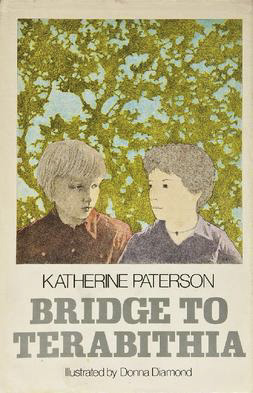
There are stories that define our childhoods, and then there are the rare narratives that teach us how to survive the contradictions of adulthood. When my family relocated from Istanbul to a Philadelphia suburb during my elementary school years, I remember feeling suspended between two universes. My efforts to map suburbia onto the vibrant textures of the home I had left behind corresponded with my encounter with Katherine Paterson’s classic novel, Bridge to Terabithia, and its sibling text, Jacob Have I Loved. I remember being completely mesmerized by Leslie Burke’s house, specifically the room she and her parents painted gold. To a child who felt uprooted and out of place, that golden room was a sanctuary of pure possibility. The book was also one of the first I’d encountered that dared to tackle the complexities of grief.
Published in 1977, Bridge to Terabithia reflects the burgeoning spirit of Second-Wave Feminism, a movement that championed the personal as political and sought to dismantle the rigid gender roles of the post-war era. Leslie’s rebellion, however, carries a bittersweet resonance for the modern reader; while her struggle fits the Second-Wave pursuit of liberation, her eventual “fridging” reflects the persistent literary habit of the era to treat female autonomy as a temporary, tragic catalyst for the male hero’s journey.
If I look beneath the surface of Bridge to Terabithia’s heartbreaking narrative, I find a sophisticated commentary on rural American life. In the economically depressed community of Lark Creek, Jesse is trapped by societal expectations of masculinity. His father pressures him to be tough and devoid of emotional vulnerability, and Jesse’s only outlet for self-expression is his drawing, a passion his father dismisses as “unmanly.” Leslie wears corduroys instead of dresses and beats all the boys in the schoolyard races. She does not have a television, choosing instead to immerse herself in literature, mythology, and ideas. She represents a liberating, feminist force for Jesse, and validates his artistic, creative soul. Leslie acts as a catalyst, dismantling the toxic gender expectations that paralyze Jesse and offering a fresh, imaginative perspective on spirituality that transcends institutional dogma. As Paterson writes, “She was not like the other girls, and he was not like the other boys,” and together, they create Terabithia, an ecofeminist sanctuary where they can escape Lark Creek’s hierarchical and patriarchal structures. Their egalitarian partnership demonstrates true strength lies in mutual respect and vulnerability, presenting a clear feminist alternative to the stifling gender roles of the outside world.
Importantly, ecofeminism emerged in the mid-1970s as a direct outgrowth of Second-Wave, counter-cultural, and anti-nuclear movements, at around the same time Paterson was writing. The forest itself functions as an equalizer, allowing the children to transcend gendered binaries. In Terabithia, they proclaim they are “the kings of the forest, and they could do anything.” Through Leslie’s life and legacy, the novel suggests both feminism and a healthy spiritual life require the same fundamental element: the courage to imagine a world defined by love, equality, and equity, rather than fear, control, and restriction.
Liturgy of Fear vs. Aesthetic Grace
The Aarons family practices a fear-based brand of Christianity that felt so different from my own experiences of faith as a non-Christian. My own experience with religion, one of pluralism, approaches death as a natural transition rather than a fear-based drama. For me, this was one of the central contradictions: the discovery that the faith I saw practiced around me, which claimed to offer salvation, could be the very force used to enforce conformity and fear. Reading about Jesse’s struggles, I witnessed the way institutional dogma can force someone to choose between their own internal integrity and the pressure to belong, and how these systems of control, whether religious or cultural, can stifle the human spirit. For the Aarons family, church attendance is a social obligation and clearly a source of anxiety. Although Jesse’s sisters are more concerned with looking fashionable at the annual Easter service than engaging with moral teachings per se, the religion of Lark Creek is one of judgment and the terrifying prospect of damnation. In contrast, Leslie approaches religion through the lens of curiosity and aesthetic appreciation. When she accompanies the Aarons family to church on Easter, her reaction juxtaposes May Belle’s rigid orthodoxy. While May Belle firmly believes that one must believe in the Bible to avoid damnation, Leslie finds the story of Jesus “beautiful” and compelling, comparing it to a grand myth or fantasy.
“It’s beautiful,” Leslie said. “It’s kind of like a story out of a book… the whole thing about God hurting his son so he could forgive people.”
When Leslie admits she does not believe the Bible literally, May Belle is horrified. Her question to Leslie — “What if you die?” — becomes tragically relevant later in the novel. Following Leslie’s sudden death, Jesse is consumed by the religious dogma he was raised on. However, Paterson (herself a devout Christian) uses Jesse’s father to deliver a profound theological correction. In a rare moment of tenderness, Mr. Aarons reassures Jesse that God does not damn good children to hell, thus favoring a theology of love and grace.
Part 2, tomorrow
Discover more from Feminism and Religion
Subscribe to get the latest posts sent to your email.


Is this one of the complexities of grief? “It’s beautiful,” Leslie said. “It’s kind of like a story out of a book… the whole thing about God hurting his son so he could forgive people.” I find this story horrific. Women with Christian, Judaic, Moslem roots all have some aspect of this kind of story written into their bones. We need to stay awake…
LikeLike
Hi Sara,
That is a profound perspective and thanks so much for sharing your thoughts. When Leslie tries to find beauty in sacrifice, she is leaning on stories to soften a brutal reality; but your reaction exposes another aspect of what it means to be raised on narratives that frame this kind of divine violence and suffering as virtues. Indeed, tragedy may force us to confront the inadequacy of the grand narratives we were taught to rely on, and staying awake to how these narratives/stories shape our responses is a vital, if painful, realization.
Best wishes,
Elanur
LikeLiked by 1 person
Oh you are so right… great response!
LikeLike