A Recipe for Dancing Your Soul Home

When you hear the word ‘soul’, what is your first association? 

Soul is a complex and much-debated word, that often brings up strong feelings. Without going into religious or philosophical discourse, it is often associated with the breath, and with that mysterious spark of life force that animates the body. I discussed soul in a previous post Untangling the Triad of Life Force, Spirit and Soul. Today I write about soul as a fluid concept, an essence that can get dispersed and also retrieved, and propose a light self-retrieval through dance as remedy that you can do by yourself. 

Continue reading “A Recipe for Dancing Your Soul Home”

Label or Be Labelled Part 3: Toward Embodied Presence

In Part 1 of this series on labelling, I highlighted the difference between naming and labelling, and the search for a personal label as ‘participation ticket’ for life.

In Part 2 on professional and spiritual identity, I looked at what we can learn from the autoethnographic practice of disclosing various selves in research situations. I also discussed the effects of Christianity on the suppression of pagan traditions in northwestern Europe, and nature-based spirituality as part of our generic spiritual DNA.

Today I share a few final reflections including what groups celebrate their differences with ‘prides and games’, and which ones remain invisible? What are the effects of woke ideology on fear of expression and loss of voices, and an invitation for embodied presence as one characteristic of our shared humanity.

Continue reading “Label or Be Labelled Part 3: Toward Embodied Presence”

Label or Be Labelled Part 2: Professional and spiritual identity

This post continues from Part 1, where I situated this essay as a reflection on Xochitl Alvizo’s article Human, Just HumanThere, I questioned the difference between the power of naming versus the pressure to label. I then described my search for a personal identifier as ‘participation ticket’ to life. This feels important nowadays to join the conversation and not be dismissed by default. However, I wondered whether looking for things that set us apart emphasises otherness rather than shared humanity.

Today, I question what can we learn from autoethnography about the many selves we bring to different professional situations and how they might hide more than they reveal. I also describe the challenges of naming nature-based practices in a geographical area where 2000 years of Christianity forced our pagan traditions underground.

Continue reading “Label or Be Labelled Part 2: Professional and spiritual identity”

From the Archives: Oakness as a Metaphor for the Wild Soul: the Dance Between Life Force, Personality and Original Nature by Eline Kieft

This was originally posted June 16, 2022

The process of fitting in and learning what is required to participate in society teaches us many useful skills such as math and language. All too often, this happens at the expense of developing expressive and intuitive abilities and trust in our unique contributions and points of view, or what I call the ‘Wild Soul’. This represents our original blueprint or essential spark that makes us into who we are.

Continue reading “From the Archives: Oakness as a Metaphor for the Wild Soul: the Dance Between Life Force, Personality and Original Nature by Eline Kieft”

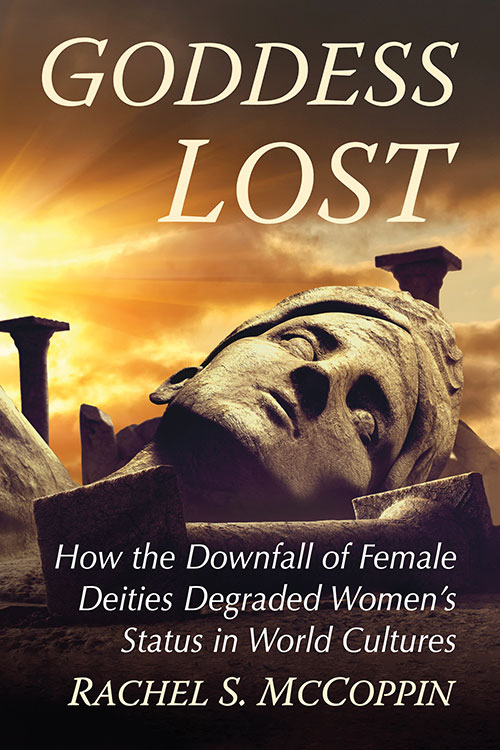
Goddess Lost: How the Downfall of Female Deities Degraded Women’s Status in World Cultures by Rachel S. McCoppin; book review by Margot Van Sluytman

She Who Knows

What then is my repentance?
If not, by rote this repetition?
“Godde is.”
“Godde is.”
“Godde is.”
“Love.”
And my face tastes
The beating heart
Of the sun’s call
For reclamation of
SHE Who Is.
SHE Who Is: knows me.
She, who also, is.
©Margot Van Sluytman

From the moment I saw the title, Goddess Lost: How the Downfall of Female Deities Degraded Women’s Status in World Cultures, by Rachel S. McCoppin, I knew I would have to read it. When it arrived in my mailbox and I saw the cover, I was imbued with inspiration. Then I read two sentences in the Preface, which articulate what for me, and for many, is one of the most vital, powerful, and, as yet, under-addressed, facts.

Continue reading “Goddess Lost: How the Downfall of Female Deities Degraded Women’s Status in World Cultures by Rachel S. McCoppin; book review by Margot Van Sluytman”

Rhiannon by Diane Finkle Perazzo

This poem is dedicated with gratitude to my “Women in the Mabinogi” writing group…


Rhiannon comes to me in my dreams.
She ebbs and flows like the waxing and waning  
of the moon.

Steady hoofbeats, 
clop, clop, clop  
and then, in a rush of beating wings
she vanishes,
leaving a swirl of tiny white petals that spiral like stars.

Continue reading “Rhiannon by Diane Finkle Perazzo”

Let’s Talk about Frozen 2 by Anjeanette LeBoeuf

AnjeanetteWhile facetiming my brother, I heard my two-year-old niece shout at the top of her lungs that she was “Queen Elsa” and was coming to save me. I had started writing about the Frozen films, when Sara posted on them. So let us continue on this Frozen journey.

Continue reading “Let’s Talk about Frozen 2 by Anjeanette LeBoeuf”

Pride by John Erickson

When we come together, we are the Divine.  I didn’t think I could experience that twice in one year; clearly, I was wrong. 

If you’re anything like me you not only hate opening up your Twitter feed each morning but also feel compelled to in order to make sure you didn’t miss whatever new atrocity to come out of 1600 Pennsylvania Ave. After the Women’s March, I felt charged. I felt that whatever this administration threw at the proverbial “us,” I knew we could and would overcome it. Although that charge kept me going for a few months, there came a time where I just couldn’t go on anymore and that I was completely drained; then walked in a man named Brian Pendleton.

After the Women’s March on January 21, I didn’t know what to expect. The event was truly so successful that many of the organizers and coordinators were on an activist high as a result of what was a truly magical and divine moment. A few months came and went and the 45th President of the United States continued (much to our surprise) to be as awful as we all knew and expected. However, while I am able to exist in a world, no matter how oppressive, as a cisgendered white male and the full on privilege and power that comes along with that territory, many of the individuals and communities being attacked did not have those same freedoms; and like with the Women’s March and how that all took shape, in walked Brian Pendleton to my life to talk to me about the #ResistMarch.
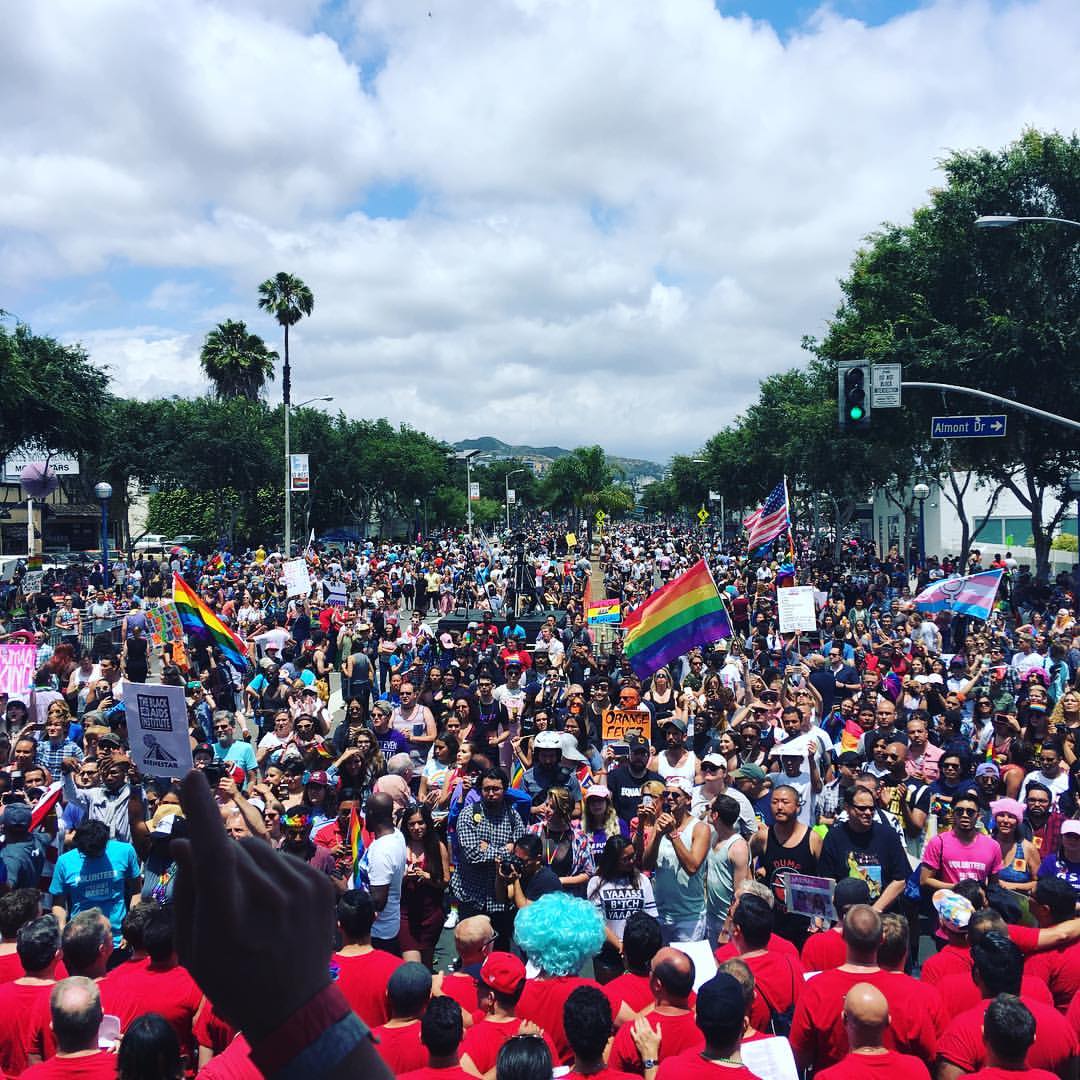
Cover PhotoAlthough my involvement during the 120 days or more that led up to the #ResistMarch happened in a flash, one thing is for certain: miracles exist not because of divine intervention but because G-d places people on this Earth to make positive impacts. The beauty of the #ResistMarch was not just the passion of the organizers but the beauty of the rainbow that came out in full force on June 11

The strength shown by our community was one that, for all intensive purposes, proves that love does conquer all. RuPaul couldn’t have expressed the common and conquering theme better than when he said: “It’s all about love; giving love and being able to receive love. That’s our secret weapon; that’s the one thing they don’t have: our love and our music. That is our activism. That is what we use and what we always use to fight the ugliness.”

That is the one experience that I took most out of the #ResistMarch: the power of love and friendship; the beauty in the unexpected conversation that leads to changing the world, again.  Thank you, Brian. Thank you, for bringing us all together to resist, recharge, and love.

19055531_10158898620590385_6920780108892374453_o

When we come together, we are the Divine.  I didn’t think I could experience that twice in one year; clearly, I was wrong.

John Erickson is the President of the Hollywood Chapter of the National Organization for Women. John is a Ph.D. Candidate in American Religious History at Claremont Graduate University where he is finishing up his dissertation tentatively titled “Step Sons and Step Daughter”: Chosen Communities, Religion, and LGBT Liberation.” John holds a MA in Women’s Studies in Religion; an MA in Applied Women’s Studies; and a BA in English and Women’s Studies. He is the Founding and Past President of the University of Wisconsin Oshkosh’s LGBTQA+ Alumni Association and currently serves as the Chair of the Legislative Committee for the Stonewall Democratic Club, a Diversity and Inclusion Fellow at Claremont Graduate University. He is a permanent contributor to the blog Feminism and Religion, a Co-Founder of the blog The Engaged Gaze, and the Co-Chair of the Queer Studies in Religion Section of the American Academy of Religion’s Western Region, the only regional section of the American Academy of Religion that is dedicated to the exploration of queer studies in religion and other relevant fields in the nation. In April 2017, he was the first openly gay athlete to be inducted into the Wisconsin Volleyball Conference Hall of Fame. Most recently, John was one of the coordinators of the Women’s March Los Angeles, which brought together 750,000 people in downtown Los Angeles on January 21, 2017, and a Committee Member for the #ResistMarch, which brought together 100,000 people from Hollywood to West Hollywood in honor of LA Pride on June 11, 2017.



Part One: Young Adult Fantasy is on Fire by Anjeanette LeBoeuf

AnjeanetteAs per my last month’s FAR post, I will be looking at book series from the Young Adult Fantasy genre. The first series of young adult fantasy that I will be looking at is Rae Carson’s trilogy The Girl of Fire and Thorns. This series heavily centers around religion, empowerment, and agency. The trilogy explores fanaticism, fate and free choice, and even xenophobia. Also, found amongst its pages are positive female friendships, daring adventures, and yes, a blooming love story. Continue reading “Part One: Young Adult Fantasy is on Fire by Anjeanette LeBoeuf”

What Czech Has Taught Me about Knowledge by Ivy Helman

20151004_161012Stalé mám žlutou knihu tak neumím slova.  (I’m still in the yellow book, so I don’t know the words).  Mluvíš o něčem ale nevím co říkáš.  (You are talking to me about something I don’t know what you are saying).  Neznám jí.  (I don’t know her).

The Czech language has three verbs that express knowledge.  The first umět expresses one’s ability.  Literally, one doesn’t know because one lacks the skill or hasn’t been taught how to do something.  The second vedět captures more the idea of stating facts or events.  It almost always requires a connecting word like “that, what, which, etc.”  One can’t use this verb with a direct object with one exception: to vím (I know (it)).  The third verb znát signals familiarity and it can only be used with a direct object.  So, if you want to ask if someone knows someone else, you use znát, if someone knows when the movie starts, vedět, and if someone knows how to play the piano, umět.

So in other words, the three sentences above are better translated as follows: I’m still in the yellow book so I haven’t learned the words; you are talking to me about something but I don’t understand what you are saying; I’m not familiar with her.

Continue reading “What Czech Has Taught Me about Knowledge by Ivy Helman”