Knowing the Live Oaks: Finding the Balance Between Historicity and Inspiration in Neopaganism and Goddess Spirituality by Chris Ash

IMG_0754Last fall, my family took a vacation to Myrtle Beach, South Carolina, where I grew up. As a child, one of my favorite places to visit was Brookgreen Gardens, a wildlife preserve that was once the winter home of Archer and Anna Hyatt Huntington. Anna was a prominent sculptor of the early twentieth century, and decided that part of the property should be sculpture gardens open to the public.

When they purchased the property, many of the trails were lined with live oak trees; Spanish moss still drips like thick honey off twisted and gnarled branches that drape over bricked pathways. As a child in the Low Country, live oaks always symbolized timelessness. They felt eternal and otherworldly, and my memories of visiting the Angel Oak near Charleston on school field trips – of throwing my legs over her lower branches, bark scratching up my scrawny legs – these are memories I still carry with me when I look to what was beautiful about my childhood. Continue reading “Knowing the Live Oaks: Finding the Balance Between Historicity and Inspiration in Neopaganism and Goddess Spirituality by Chris Ash”

Hamilton Part 3 – Conclusion: “Satisfied” By Anjeanette LeBoeuf

AnjeanetteThe conclusion of my 3-part post on how the Hamilton musical has changed the narratives and bringing diversity to Broadway. This last piece of the puzzle is how Hamilton has impacted me. I have always had a love of history, yet growing up I struggled with the narratives I was given. I couldn’t find myself within the pages; the people building, defending, and sustaining our nation were far from me. Continue reading “Hamilton Part 3 – Conclusion: “Satisfied” By Anjeanette LeBoeuf”

O Tempora o mores by Oxana Poberejnaia

oxanaI have entitled this post O Tempora o mores after a sentence by Cicero, meaning “Oh what times! Oh what customs!” I would like to discuss how some of the messages we get from religious writings are defined by the age in which they were written.

As a result, I argue that it is wiser to pay more attention to the overall message of a given spiritual tradition, rather than to subject our view on a single quote.

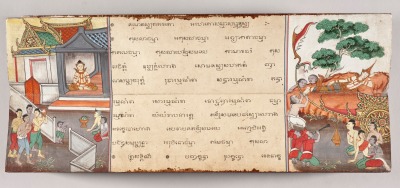
Phra_Malai_Manuscript_LACMA_M.76.93.2_(11_of_21)One of the most popular texts in Thai Buddhism (which is of Theravada tradition) is called Phra Malai Klon Suat, “Chanted Version of Phra Malai.” It was reproduced copiously in the 19th century, with the earliest version dating from the 18th century. However, its origins are believed to be more ancient, coming from the original Indian Buddhism.
Continue reading “O Tempora o mores by Oxana Poberejnaia”

Ignoring Isn’t The Same As Ignorance by Darla Graves Palmer

DarlaProfileMy book club recently read The Handmaid’s Tale by Margaret Atwood, a futuristic novel wherein women’s reproductive rights, as well as the women themselves, are controlled entirely by those in power. I’ve wanted to read it for a long time and appreciated this opportunity, though I ended up quite disturbed—not just by the tale, but by our obliviousness at times to the possibilities of what could potentially become us. During our club discussion, one of the women commented that she couldn’t understand the point or purpose of writing such a book as she felt it was too far-fetched. I was startled by her remark because I easily viewed it as a cautionary story, one that had presented what could happen if we ignore history and current events.

One pivotal passage for me in the novel was this:

“Is that how we lived, then? But we lived as usual. Everyone does, most of the time. Whatever is going on is as usual. Even this is as usual, now.

We lived, as usual, by ignoring. Ignoring isn’t the same as ignorance, you have to work at it.

Nothing changes instantaneously: in a gradually heating bathtub you’d be boiled to death before you knew it. There were stories in the newspapers, of course, corpses in ditches or the woods, bludgeoned to death or mutilated, interfered with, as they used to say, but they were about other women, and the men who did such things were other men. None of them were the men we knew. The newspaper stories were like dreams to us, bad dreams dreamt by others. How awful, we would say, and they were, but they were awful without being believable. They were too melodramatic, they had a dimension that was not the dimension of our lives.

We were the people who were not in the papers. We lived in the blank white spaces at the edges of print. It gave us more freedom.

We lived in the gaps between the stories.” (56-57)

Continue reading “Ignoring Isn’t The Same As Ignorance by Darla Graves Palmer”

Hamilton Part 2 – “You want a revolution, I want a revelation,” Changing the Narrative by Anjeanette LeBoeuf

AnjeanetteMy April FAR post introduced the phenomena that was sweeping the nation; Hamilton the Musical blending contemporary hip hop to the Broadway musical scores. The show has been breaking barriers with its success, intelligence, and fortitude. Hamilton is showing that a diverse cast can be successful. “Hamilton has created a space on Broadway for black and brown performers that otherwise wouldn’t exist. Opening up roles designed specifically to be played by performers of color means encroaching on that space.” It is showing mainstream that including dialogue surrounding immigration, race, class, and gender equality can be highly successful. The director has stated that this show is about America, past and present and one can look at the cast to see it is true.

Continue reading “Hamilton Part 2 – “You want a revolution, I want a revelation,” Changing the Narrative by Anjeanette LeBoeuf”

Let My People Go! Modern Day Oppression and Exile by Michele Stopera Freyhauf

FreyhaufLet my people go!

Where is the humanity? Why are my sisters and brothers continuously subjected to persecution? Who will help and stop this madness?

I am a member of the human race. Collectively I identify with those who need help and are oppressed. I do not identify with the oppressors, for they are like Pharaoh whose heart was hardened. In identifying with this group, I will provide a label of humanity; for the oppressors do not show care or love but evil and sin towards my people – they cannot be part of this group. As my people flee the boarders from the oppressors, the world has opened their gates to let them in. The world has not turned their back on them. However the oppressors continue to mar their homeland, destroy their culture, and attempt to erase their history, their identity, their footprint on this earth. They are not oppressors but are in fact committing cultural genocide. They are committing genocide against humanity, against anyone who does not follow their ideology, their way of life.

Why should we care? Should we care? For this I say yes. My people need protection and help, but like the Israelites in the story of the Exodus, they yearn for their homeland – a place they were forcibly exiled from. They yearn for food and clean water. They yearn for safety and protection.  While you may think that my people were not forcibly exiled – they were. They fled for their own lives – for their own people, and the community’s hearts became hardened to their pleas for help.

The Syrian crisis is one that we have allowed to repeat over and over again. According to World Vision, nearly 12 million Syrians have been forced from their homes – half of which are children.  At least 7.6 million have been displaced within Syria and more than 4 million have fled the country.  Children affected by this crisis are at risk of becoming ill, malnourished, abused, or exploited.  Save the Children produced a video that shows what happens to a girl after three years of conflict:

Continue reading “Let My People Go! Modern Day Oppression and Exile by Michele Stopera Freyhauf”

Katharine Bushnell—The Most Important Christian Feminist You’ve (Probably) Never Heard Of by Kristin Kobes Du Mez

037 DuMez 2015 photo shootKatharine (Kate) Bushnell (1855-1946) was by any measure a remarkable figure in the history of Christian feminism. A global anti-trafficking activist and author of God’s Word to Women, a fascinating feminist theology that recasts the entire biblical narrative as a story of liberation for women, Bushnell was once widely known throughout the late-nineteenth-century Protestant world.
A Midwestern Methodist, Bushnell came of age in Evanston, IL. After a brief stint as a medical missionary to China, she helped launch the American “social purity” movement by leading a dramatic exposé of the trafficking of women in Wisconsin lumber camps. Drawing attention to the injustices women faced under the Victorian sexual double standard, Bushnell helped break the “conspiracy of silence” that inhibited discussion of sexuality among “respectable” women and men. She then took her activism overseas, where she exposed the abusive practices of the British army in colonial India, particularly when it came to the confinement and abuse of local women in military brothels. Continue reading “Katharine Bushnell—The Most Important Christian Feminist You’ve (Probably) Never Heard Of by Kristin Kobes Du Mez”

Bodies of More and Less Value by Oxana Poberejnaia

oxanaThere is a story in the collection called Avadanasataka (One Hundred Legends) of the Sarvastivadin school, one of the schools of early Indian Buddhism that did not survive to present day, relating one episode from the Buddha’s previous lives. The story is about king Padmaka who sacrificed his life to cure his subjects of a disease. Here is an academic article about this episode.

The Buddha was prompted to tell this story of his previous life in order to illustrate to his monks, once again, the workings of karma. All of the monks in the Buddha’s milieu were sick with a digestive disorder, while he remained well. The Buddha presented the story of king Padmaka as a proof that no good deed is ever lost and that what he had done then has an effect now in that the Buddha has good digestion.

Continue reading “Bodies of More and Less Value by Oxana Poberejnaia”

Education, Anti-Semitism, a Counter Narrative and a Different World by Ivy Helman

meblogIt’s pretty common knowledge that education changes lives. It opens doors, improves health, promotes gender equality, decreases poverty, promotes civic involvement and has many other benefits. This is true for basic literacy campaigns as well as sex education, access to school for girls and institutions of higher education. Yet, what is taught in addition to how it is taught matters a great deal.

In a few days, I’ll begin a new semester teaching “The Jewish Experience in Central Europe” for Anglo-American University in Prague. As a scholar, a Jew and a feminist who recently moved to Prague (in the heart of Central Europe), this course hits home.   It is also timely given rising anti-Semitism in Europe. Coincidentally, this is also the first time I’m teaching a course solely on Jewish history. Continue reading “Education, Anti-Semitism, a Counter Narrative and a Different World by Ivy Helman”

Second Class Rape Victims: Rape Hierarchy and Gender Conflict

Deconstructing masculinity isn’t the key to solving social, sexual, and domestic violence across the world but it is a step worth taking when attempting to engage men in affecting change to stop these violent actions since men, statistically are the perpetrators of such crimes that both cause such outcry as well as perpetual silence.

johnThe most disturbing part of the 2006 documentary Deliver Us from Evil isn’t the fact that Father Oliver O’Grady is rewarded by the Catholic Church with a new congregation in Ireland after his short stint in prison for the rape of dozens of children in the 1970s, but rather the hierarchy of gendered victimization which is often created throughout the various rape cases that are both reported and unreported throughout history.

I am often troubled by the ways in which rape cases are discussed and deconstructed via mediums such as blogs, online communities, social media networks, the news, and popular culture.  No series of events troubled me more than the Jerry Sandusky trial, but more importantly, the ways in which the young boys and adult men who were subjected to Sandusky’s abuse quickly overshadowed the other rape cases that are reported on a daily basis, specifically those involving young girls and women. Continue reading “Second Class Rape Victims: Rape Hierarchy and Gender Conflict”