Genderqueering by John Erickson

We find our versions of home in these communities and it is within these spaces where our home not only begins to define who we are but we, as a reflection of that space, begin to outwardly redefine the spaces we exist in. If we slowly begin, through our experiences to shape our homes based on privilege and power without self-reflection and acknowledgment of others, then we are no better than those oppressive forces we say we’re against.

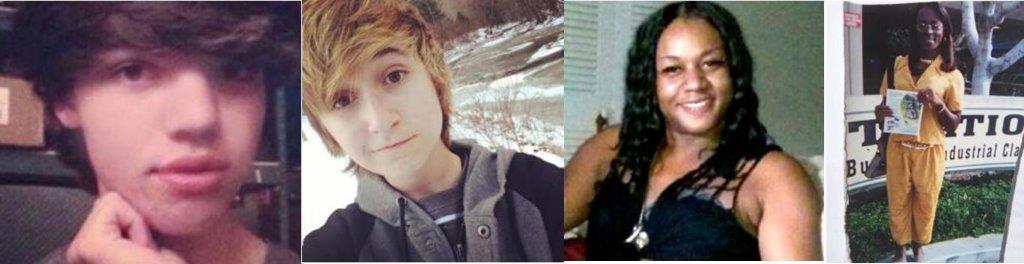
Leelah Alcorn, Ash Haffner, Aniya Knee Parker, Yaz'min Shancez
Leelah Alcorn, Ash Haffner, Aniya Knee Parker, Yaz’min Shancez

This post is a response to a recent blog entry titled “Who is Gender Queer?” on this site from Carol Christ.  The post can be read by clicking here.  I want to thank my friend, advocate, and upcoming scholar Martha Ovadia for reasons only she knows!  Stay brave, speak up, be heard!
_________________________________________

It is terrifying to know that something is wrong but not be able to speak truth to power.

It is even more terrifying to know something is wrong, be able to speak to it, and then silence those voices that do not have that same privilege, power, or position.

The struggle that many of us in positions of privilege and power face is not just that of being ostracizing and essentializing forces—it is that we, as allies, members of communities, or even those dedicated to a cause, can ourselves participate in the oppression we are fighting against and can do harm.

It’s taken me a long time to not only be comfortable with who I identify as, but also how I go about fighting and defining my life based on said identity and experience. However, the one thing that I have the ability to do is choose that identity more freely than others. Unlike Leelah Alcorn, Ash Haffner, Aniya Knee Parker, or Yaz’min Shancez pictured above, I did not have to face the types of oppressions they did, to which they sadly lost their lives, as a result of the fact that we exist in a society that can’t deal with the inability to leave things undefined or to allow people to define who they are on their own terms.

It is vital that although my lived experiences could never meet nor match the same types of oppression that these brave individuals had to face, I, as a white, cisgendered gay male, do not become part of their oppression through my own position and privilege.

As a man who exists in the world of feminism and within various women’s communities, I walk a daily tightrope of privilege and power to insure that I do not silence those that I consider allies, friends, mentors, or colleagues. As a man who exists in the world of the LGBTQ community, I walk an additional tightrope to additionally not take away from or diminish the experiences of those members of our community that do not have the same type of lived experiences as myself.   Even within minority communities, there are positions of hierarchy and within these hierarchies of knowledge, identity, or power, comes a responsibility to insure that the oppressed do not become the oppressors.

We find our versions of home in these communities and it is within these spaces where our home not only begins to define who we are but we, as a reflection of that space, begin to outwardly redefine the spaces we exist in. If we slowly begin to shape our homes based on privilege and power without self-reflection and acknowledgment of others, then we are no better than those oppressive forces we say we’re against.

I can’t speak for what identity feels like –I can only speak for what essentializing does, and what it does is reflected in the deaths of Lelah, Ash, and the many others who die nameless.   It is our responsibility, as allies, members of communities, and those fighting to end sexist, patriarchal, and, even now, homonormative oppression, to make sure that no more deaths occur on our watch or that truth is spoken to power even when power is masquerading around as truth.

John Erickson is a Ph.D. Candidate in American Religious History at Claremont Graduate University. He holds a MA in Women’s Studies in Religion; an MA in Applied Women’s Studies; and a BA in Women’s Literature and Women’s Studies.  He is a Non-Fiction Reviewer for Lambda Literary, the leader in LGBT reviews, author interviews, opinions and news since 1989 and the Co-Chair of the Queer Studies in Religion section of the American Academy of Religion’s Western Region, the only regional section of the American Academy of Religion that is dedicated to the exploration of queer studies in religion and other relevant fields in the nation and the President of the University of Wisconsin Oshkosh’s LGBTQA+ Alumni Association.  When he is not working on his dissertation, he can be found at West Hollywood City Hall where he is the Community Events Technician and works on policies and special events relating to women, gender, sexuality, and human rights issues that are sponsored or co-sponsored by the City of West Hollywood. He is the author of the blog From Wisconsin, with Love and can be followed on Twitter @JErickson85
Hail Mary: The Rosary and Why I Keep Praying by Marie Cartier

MarieCartierforKCETa-thumb-300x448-72405My mother-in-law is currently in hospice and expected to cross over any time now. My wife is with her. Those two sentences alone—since I am a woman writing this blog—signify historic/herstoric change. I am a woman and I am writing about my mother in law and I am writing that my wife is with her. We are in a sea change regarding gay marriage. I will be allowed bereavement to go with my wife, when the time comes, for the services.
What has not changed in my life is my dependence on traditional prayer. Although I am a witch/Wiccan, have done all kinds of meditation from Transcendental Meditation, and Buddhist chanting, to visualization, spell work, and New Age affirmation—when push comes to shove as they say, I get out the Rosary.

Why? Continue reading “Hail Mary: The Rosary and Why I Keep Praying by Marie Cartier”

An Advent Journey by Victoria Rue

Victoria RueI decided to take the fall semester off from teaching.  I wanted to volunteer my abilities somewhere in the world.  With guidance from a friend and Volunteers in Global Service, I exchanged emails with Visthar: an Academy for Justice and Peace in Bengaluru, South India.  “Visthar” means open space.  What I discovered right away was that the work of Visthar dovetailed with my own: gender, sexuality, religion, education and theatre.

Visthar presents workshops on the intersection of gender, sexuality and religion to lgbtq activists, social workers, students, women pastors and inter-faith leaders. Within the trainings, Visthar asked me to offer a theatre workshop that allowed participants to creatively embody and strategize these issues.   Continue reading “An Advent Journey by Victoria Rue”

The Lesbian Bar of “The Lord is With You All…” by Marie Cartier

puerto rico-marie cartierWhile attending the recent National Women’s Studies Conference this past month, I had a unique and –yes—a religious experience.

I was staying with a friend who (luckily for me) owns a home in Puerto Rico. I saw more of Puerto Rico in four days then I believe many might see on a two week vacation! I saw the ocean, swam in the ocean, walked all over Old San Juan with its blue streets, gambled and danced salsa at the famous Hotel San Juan, ate amazing food (especially at my friend’s sister’s restaurant Mom and Dad’s Café) —and of course went to the conference.

And I went to an “old school” lesbian bar. A bar where women loving women gather who were diverse in age—ranging from women in their twenties to women in their fifties and sixties.

My friend said this is the best lesbian bar in Puerto Rico. I brought three friends of mine with me from the conference—wanting to share the wealth of experience that my Puerto Rican friend was allowing me to have with others.

We danced in Spanish to “Last Dance,” danced salsa, ate empanadas—I was already having a somewhat religious experience when I met the owner of the bar—Mildred. Continue reading “The Lesbian Bar of “The Lord is With You All…” by Marie Cartier”

Old and Gay – Dying Alone and Rae’s Friends by Marie Cartier

MarieCartierforKCETa-thumb-300x448-72405A dear friend of mine is dying. Yes, the saying might be true—we all die alone. But we all are not necessarily lonely when we die. How can we die happy…with our self-respect intact?

We are all alone, born alone, die alone …I do not say lonely — at least, not all the time — but essentially, and finally, alone. This is what makes your self-respect so important, and I don’t see how you can respect yourself if you must look in the hearts and minds of others for your happiness. —Hunter S. Thompson

Many of the women that I interviewed in my book Baby, You Are my Religion: Women, Gay Bars, and Theology Before Stonewall lived a closeted gay life. Their respect for their gay self had to be hidden in order to survive. It was how they respected the gay inner self—it is how they protected that self’s very survival.

Many of them, as many of us do, had friends that affirmed their inner identity even as it was hidden to a majority of the outside world. As they grew older, their friends (as many of our friends will do) died. That meant that the friends they had in the gay bars died holding the secret of their gay lives. Many of these women grew up into adulthood without the benefit of a community. For them “gay pride,” “coming out,” and even the word “lesbian” were not words they would ever use in their common conversation. Continue reading “Old and Gay – Dying Alone and Rae’s Friends by Marie Cartier”

Taking Time to Smell Your Roses: What Are You Grateful for This Spring? by Marie Cartier

MarieCartierforKCETa-thumb-300x448-72405I am taking this space, this month to share two very wonderful pieces of news. And I will make the caveat opening here: this is a blog about the benefits of gratitude and I am reaping them here—with a bit of shameless self-promotion. I am advocating here again for my work, my “book child”, as I did in my birth announcement blog!

As we move into spring, I want to step back and take stock of what I have planted that is coming into bloom. And with this, I hope to suggest to you all, dear readers, that you do the same. I (I’ll speak for myself here) tend to rush so much and feel I have so much to do that sometimes when something amazing happens that I have worked so hard for—it just passes me by, and I am on to the next thing before I get a chance to really acknowledge even what that amazing thing was. Continue reading “Taking Time to Smell Your Roses: What Are You Grateful for This Spring? by Marie Cartier”

God Doesn’t Live Here Anymore: Gay Bars and the Growing Divide Between Sexuality and Spirituality by John Erickson

oes God exist within the LGBTQ community anymore or has the community itself abandoned God for all-night raves, dance clubs, alcohol, and hypersexualized and over commoditized fetishized forms of femininity and masculinity? Oftentimes, I find myself answering yes to the above questions. After surviving hate crime after hate crime and endless batches of newly elected conservative politicians hell bent on ignoring medical and social epidemic plaguing the very country they were elected to serve and protect, why would a community, oftentimes linked to sin itself, believe in a holy entity?

John Erickson, sports, coming out.My good friend and fellow Feminism and Religion Contributor Marie Cartier’s forthcoming book, Baby You Are My Religion: Women, Gay Bars, and Theology Before Stonewall argues that American butch-femme bar culture of the mid-20th Century should be interpreted as a sacred space.  Specifically, gay bars served as both communal and spiritual gathering spaces where butch-femme women were able to discover and explore not only their sexuality but also their spirituality.  An opus of an academic accomplishment based off of the amount of in-depth interviews she conducted, Professor Cartier explores lived religion in an area that has become all too common within the LGBTQ community: the bar

The Palms, the last local and only lesbian bar to be found in city of West Hollywood, CA is closing its doors and I can’t help but wonder where its patrons or parishioners will now go? Continue reading “God Doesn’t Live Here Anymore: Gay Bars and the Growing Divide Between Sexuality and Spirituality by John Erickson”

Thanks for Coming (Out): Sexuality, Sports, and Spirituality by John Erickson

I have to be honest, Jason Collins’ admission that he was a homosexual, albeit brave, upset me. While coming out is an completely unique experience to every individual that does it, Jason Collins’ story was just another example of the rampant sexist and heteropatriarachal world that privileges male bodies and sexualities over women’s similar experiences. While I applaud Jason’s story and it’s timing, the first thing I asked to my colleagues was: Where was the hubbub over Sheryl Swoopes or Martina Navratilova?

John Erickson, sports, coming out. Like marking off items on a proverbial checklist, closeted LGBTQ individuals who exist within and outside of the world of professional sports, can recount the numerous things they struggle with in terms of their sexuality.  From fearing of the actual coming out process, dressing in their car or at home to avoid the subtle glances and whispers of individuals in the locker room, to wondering what coming out would mean not only for their game but also for their social and, if they choose, spiritual lives, closeted and out LGBTQ individuals within the multi-billion dollar professional sports industry must grapple with that age old question: what does it mean to be gay and open about it?

The Locker Room

I have to be honest, Jason Collins’ admission that he is a homosexual, albeit brave, upset me.  While I understand that coming out is an completely unique experience to every individual who does it, for me Jason Collins’ story was also an example of the rampant sexist and heteropatriarachal world that privileges male bodies and sexualities over those of women.  While I applaud Jason’s story and the timing, the first thing I asked to my colleagues was: where was the same hubbub over Sheryl Swoopes or Martina Navratilova? Continue reading “Thanks for Coming (Out): Sexuality, Sports, and Spirituality by John Erickson”

Don’t Worry, I Won’t Marry Your Girlfriend: Sexuality, Identity, and the Easy Laugh

No longer having to deconstruct the larger cultural and sexual narratives, heterosexuals who do not support marriage equality or feel threatened by homosexuals return to their one source of power that reinforces the ideology that they are on the right path: the Bible. “Marriage is between a man a woman,” or “A man shall not lie with another man as he would a woman,” becomes the newly reinforced heterosexual rallying cry and the progressive progress that occurred in the past becomes nothing more than a joke.

johnI must say, I will be the first to admit that the recent outbreak of videos promulgating the idea that gay men will marry a straight guy’s girlfriend or lesbians will marry a straight girl’s boyfriend all for the sake of marriage equality left me stifling my laughter as I attempted to pay attention in class.

However, after the calamity died down I took a moment to reflect upon the intrinsically embedded aspects of misdirected norms of sexuality, gender, and misogyny latent within the laugh lines and the guffaws throughout each video. Continue reading “Don’t Worry, I Won’t Marry Your Girlfriend: Sexuality, Identity, and the Easy Laugh”

Visions of My Grandmother by John Erickson

“I never told my grandmother I was gay. I’ve often wanted to visit her grave, clench my hands together, and pray that she forgive me for betraying the trust she instilled upon me long ago. However, even today, I cannot bring myself to make that trek, up the hill into the countryside where her ashes lay below the ground.”

I haven’t dreamt of my grandmother since her passing one hot summer July evening.

The night, and the days that followed, continue to be a blur.  However, as my family members continue to see her in their nightly visions, I, go on unabatedly longing to see and hear the voice of a woman who made me feel the presence of the divine with each passing story.

My sister saw her in a dream when she was buying shoes, my mother has seen her multiple times when she would be undergoing a particularly stressful situation, and I, left alone and oftentimes wondering through an abyss of loneliness and disarray, wake up each morning wondering why, I am left all alone. Continue reading “Visions of My Grandmother by John Erickson”