

This was originally posted on November 17, 2014

I believe that we can restore our hope in a world that transcends race by building communities where self-esteem comes from not feeling superior to any group, but from one’s relationship to the land, to the people, to the place, wherever that may be.—bell hooks
In these words from her poignant memoir-reflection-analysis Belonging, bell hooks suggests that rather than creating identity by comparing ourselves to others, whether in the academy, in communities, or in the larger society, we would do better to root our identity in the land.
Hooks “left home” in rural Appalachia in order to pursue “higher” (why do we call it that?) education including a Ph.D. which enabled her to teach at prestigious universities in the urban north. Despite her considerable success as an academic and a black feminist, hooks suffered persistent depression in the cities where she taught. Eventually she diagnosed her dis-ease as a longing for the home she had left behind, specifically as a need to connect with the traditions of her ancestors, the mountains, and the land that had sustained them since the end of slavery.
Hooks asks if one of the reasons that so many black people have failed to thrive in the urban north has to do with the loss of connection to the land and ancestral traditions that occurred with twentieth century migrations to the north. Though black people—and hooks herself—hoped to find greater freedom and dignity in the north, hooks wonders if the price they paid was too high.
Though the questions hooks asks are rooted in the experiences of former slaves and their white neighbors in the south of the United States, they are relevant to all of us who as individuals and families have migrated in search of “a better life”—including for education and work opportunities.
The stories hooks tells evoke the memory of my grandmother tearfully pointing to pictures of the family left behind in New York when she and my grandfather and their three children emigrated to California during the depression. They remind me of the painful separation from my family, and the hills, mountains, and ocean of southern California that ensued when I left home to attend university in northern California, and then moved on to graduate school on the east coast.
In the university, I learned that just about everything I already knew was not enough, and that the skills I had, such as the ability to sew a suit with two linings and bound buttonholes from a Vogue Paris Original Christian Dior pattern, or to feed. bathe, and put five children under the age of five to bed as a teenage babysitter, were not valued. The skills that were dis-valued were not only mine, but also were the skills of my female ancestors who knew not only how to cook and birth babies, but also how to sew, how to knit, how to quilt, how to make lace, how to make things of use and beauty, clothes to be worn by family members and tablecloths and doilies to decorate homes.
I also learned that the place from which I came, the lower middle class tract home suburbs of post-war California, were nothing more than “little boxes made of ticky-tacky” that I was lucky to have escaped. To this day, sadly, I retain negative feelings for the homes and neighborhoods in which I was raised, while at the same time holding fond memories of certain people, as well as of peacocks and black-tailed deer.
For hooks the cure for her dis-ease was returning home to her beloved Appalachian mountains, to a university and community committed to overcoming the racism of the past. Not all of us had the deep sense of belonging hooks experienced as a child, and not all of us will be able, as she did, to “return home.’
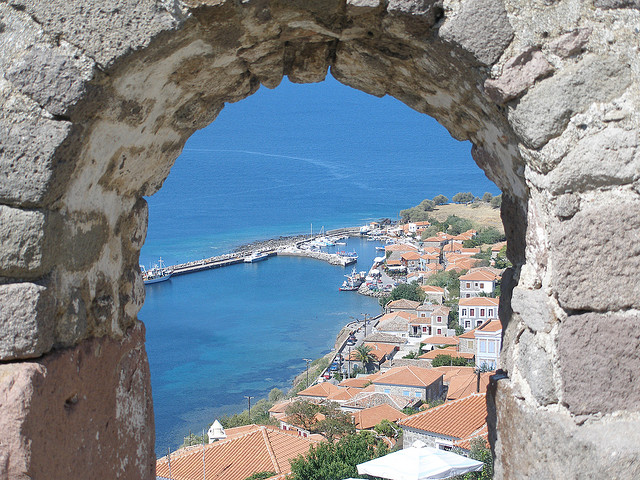
But perhaps we can cultivate a deeper sense of belonging, wherever we are.
Last night a Greek American expatriate friend of mine and I were speaking about the volcanic past of our island, Lesbos, some twenty million years ago, that we had learned about in the Museum of Natural History in Sigri. “It is so long ago, it feels hard to connect to it,” one of us remarked, “until you realize,” the other said, “that all of that history is found in the hewn stones of our buildings and in the cobbled stones of the road beneath our feet.

In recent years I have learned to identify over 300 bird species that populate our island, and to understand why wetland ecosystems are important not only to birds, but to the sustenance of native plants, including species found only in Lesbos. In addition, when functioning, wetlands absorb water that since the channeling of rivers and the draining of seasonally flooded fields, now periodically threatens homes and businesses in the town of Kalloni. Knowing things like this is another part of what belonging to the land means.
As well as connecting to the land and wildlife of the island, I have made new memories rooted in place, become part of the human community of the island, learned traditional songs and dances, worked to protect the environment, and run for office with the Green Party Greece.
Hooks is right. Part of the dis-ease those of us who have left home, and those of us who have pursued “higher” education suffer, is dis-connection from our roots in ancestral memory and in the land.
I believe that we can learn again to value the work of women’s and men’s hands as much as or even more than the “theory of forms” produced by Plato’s mind (which in any case I consider to be false).
I believe we can re-connect ourselves to “to the land, to the people, to the place, wherever that may be.”
I agree with hooks that it is through restoring these connections that hope and healing for ourselves, our communities, and our world will be found.
Discover more from Feminism and Religion
Subscribe to get the latest posts sent to your email.


“we would do better to root our identity in the land’ Carol’s lived experience taught her that rooting oneself to place opened her life to nature in ways she hadn’t intended…I can say from personal experience that I have deep roots to the land I live with though I was not born here but came as called. Though those before me were briefly colonists and before that Indigenous peoples I became rooted by caring for the land and committing myself to her on this piece of ground – being a naturalist means to pay attention and that I do. I look around me at the wealthy homes that are being built up on fragments – inhabited briefly for ‘recreation’ some leave their poison behind as one pair of neighbors sprayed their lawn with pesticides poisoning the air around us. They don’t care and with so many recreationists I feel like I want to get out until my land pulls me back in….I belong to her as one of her species so I stay. Rooted to Place helps sustain us during troubled times…
LikeLiked by 1 person