From the Archives: I Sing Asherah Exalted! by Janet Maika’i Rudolph

This was originally posted Dec. 16th, 2021

With this season of the festivals of light upon us (Hanukkah, Christmas, Solstice, Kwanzaa), I wanted to focus on the more joyful aspects of our lives. For that, I have been diving into passages about joy and singing in the bible.

Sometimes when I write these posts, they take me in directions I never thought to go. This post is one of them. The surprise direction I found is in the Psalm below:

Sing unto him, sing psalms unto him: talk ye of all his wondrous works.
Glory ye in his holy name: let the heart of them rejoice that seek the LORD.
Psalm 105:2-3 KJV

Continue reading “From the Archives: I Sing Asherah Exalted! by Janet Maika’i Rudolph”

Re-claiming Friday the 13th and Other Tidbits by Janet Maika’i Rudolph

I am struck by how language affects our thoughts, values and even our actions. One standout for me is Friday the 13th which is a day accused of being cursed and holding bad luck in modern beliefs. There is even a series of horror films created in the date’s honor. But why has this date been declared so negative?  Like so much, the answer is that it is a suppression of women and our strength. Although I have heard different explanations for its meaning, my favorite is this; there are 13 moons in a solar year. That means that a woman will menstruate 13 times in that solar year. Thirteen is a symbol of women’s power. And Friday? Friday is the only day of the week named for a Goddess. In English it is Freya’s day named in honor of the Norse Goddess of love. In Spanish it is viernes, in French vendredi, both named for Freya’s counterpart Venus. I present to you that this makes it an extremely powerful day. Perhaps a horror for misogynists but for we women a day to celebrate.

I have also been thinking about the roots of the word “history” – his story.  Many in feminist communities, including here at FAR, counter it with “herstory” – her story. But truly our past is not broken up into genders for the arc of the past affects us all, perhaps differently but all of us nevertheless. We all breathe the same air, live under a culture’s laws, etc.  … Here are some names I have been playing around with as replacements: Ancestorstory.  Ourstory. Hustory.   

Continue reading “Re-claiming Friday the 13th and Other Tidbits by Janet Maika’i Rudolph”

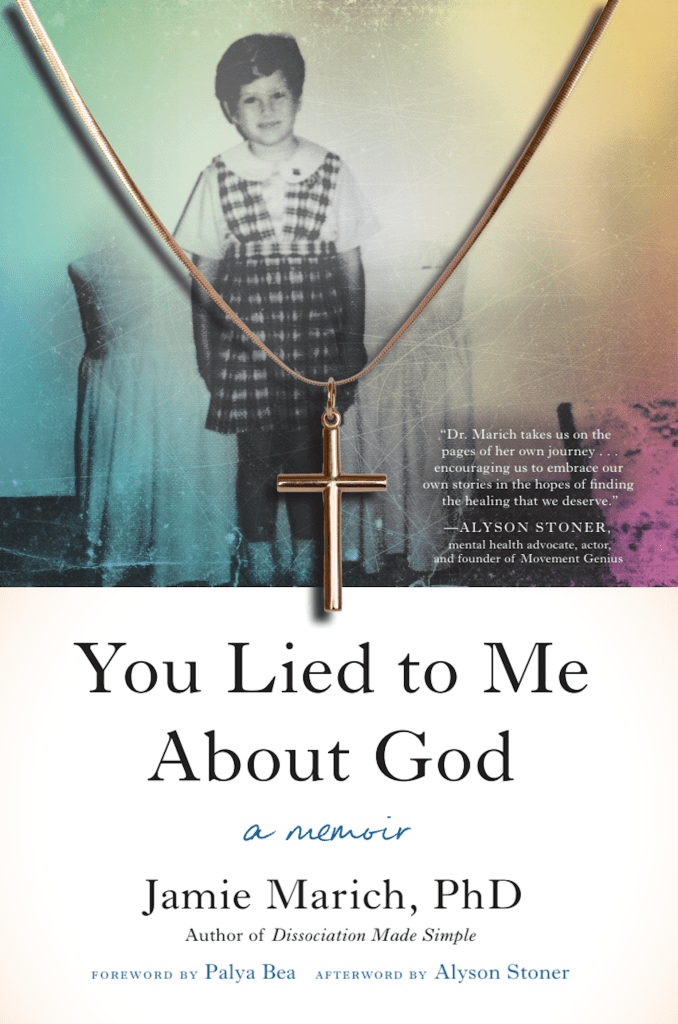
You Lied to Me About God, a memoir by Jamie Marich, PHD, book review by Janet Maika’i Rudolph

This was a hard book for me to review. Perhaps because she writes about such difficult issues and yet she does so in a compelling and at times even humous manner.  I feel a responsibility and yet find it hard to capture how she manages a breezy manner while discussing heavy material. Perhaps, even though our backgrounds are vastly different, I was also relating to so much of what she said. Jamie also covers so much ground; it is hard to pick out individual aspects to discuss.

As a child Jamie Marich was caught in the web of different religious systems, Catholicism from her mother and Evangelical from her father. They were at soul-hurting odds with each other (both parents and religions). Each one proclaimed they were the one true path so there was the ever-present threat of choosing the wrong one and facing a parent’s wrath along with that of eternal damnation. She labels this spiritual trauma. It cuts to the soul of a person being trapped into a no-win situation. It’s a conflict-driven, shame-filled, guilt-ridden way to grow up.

Continue reading “You Lied to Me About God, a memoir by Jamie Marich, PHD, book review by Janet Maika’i Rudolph”

Harris Could Not Outrun 2000 Years of Patriarchy by Janet Maika’i Rudolph

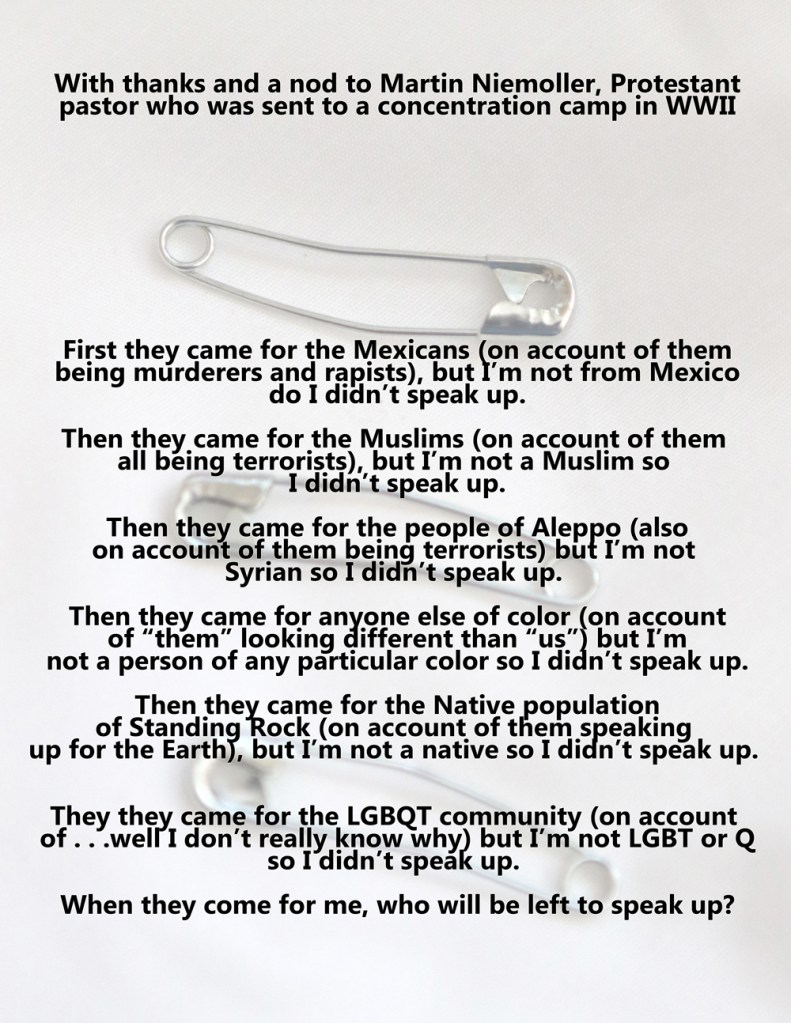
I made this poster 8 years ago and am devastated to have to dust it off again. The safety pins came from a British idea when Brexit was passed. People would wear the safety pins on their clothes to let anyone feeling vulnerable know that they would be “safe” with them.

The political finger pointing for Harris’ loss is beyond noxious. I have heard all manner of scapegoats; Biden, the Obamas, VP candidate Walz, Harris for saying too much of one thing, not enough of another, the progressives, Liz Cheney and even George Clooney. . . .blah blah blah

How can we make sense of a world where women voted for a misogynistic abuser. Black and brown people voted for a white supremist. Latinos voted for a policy of mass deportations targeting their brethren. Youth voted for a climate denier affecting their future. And so on. Think of all the women who voted for a world where they, their daughters and their granddaughters can be denied basic healthcare. It’s a true-to-life Cinderella scenario whose stepmother cut the toes off her own daughters to please a prince. Or Chinese mothers who would bind their own’s daughter’s feet, thereby crippling them in the service of marriage.

Continue reading “Harris Could Not Outrun 2000 Years of Patriarchy by Janet Maika’i Rudolph”

Women’s Bodies As Battlefield by Janet Maika’i Rudolph

Elizabeth Cady Stanton wrote in the introduction to her book The Women’s Bible:

The Bible teaches that woman brought sin and death into the world, that she precipitated the fall of the race, that she was arraigned before the judgement seat of Heaven, tried, convicted and sentenced. Marriage for her was to be a condition of bondage, maternity, a period of suffering and anguish, and in silence and subjection, she was to play the role of a dependent on man’s bounty for all her material wants . .

We are facing the long-term results of these biblical writings. This upcoming election is so unsettling because it is showing patriarchy in all its ugliness. We see how this is being played out, especially regarding abortion, but in all areas of the functioning of women’s bodies. The reason abortion is at the foundation of it all is that the drive to police women’s bodies is the crux which justifies all sorts of cruelties. It is the same with racism. These are issues that span the pantheon of rights; human, economic, healthcare, bodily autonomy. It takes a police state to quell all of these.

Continue reading “Women’s Bodies As Battlefield by Janet Maika’i Rudolph”

By Song, All Was Created by Janet Maika’i Rudolph

This blogpost is part of an on-going collaborative project between myself and my dear friend Ecuadorian elder and medicine woman, Susana Tapia Leon. The purpose of the project is to illuminate in word and images the underlying pagan meanings of biblical verses. There are many rich verses that got hidden within translations. This has had the effect of erasing their original meanings or at least making them very difficult to uncover. I have come to call these hidden gems because they were not erased completely. In this post, I am offering alternative translations of 3 verses that focus on song.  

Susana Tapia Léon, Cantadora 1
“She came alive after a month of work
She was always inside waiting to be revealed.”
Continue reading “By Song, All Was Created by Janet Maika’i Rudolph”

To Childless Cat Ladies by Janet Maika’i Rudolph

I feel you. In a patriarchy where women’s reproductive abilities determine our worth, to be childless is a curse. We can thank VP candidate JD Vance for revealing this truth in all its ugly fullness. He is a walking billboard for patriarchy. Bottom line: Patriarchy is all about women’s bodies, our reproductive abilities and men’s desire to control them. We saw this in the Dobbs decision where it was declared that women have no constitutional right to the basics of healthcare, in Texas where it’s pretty much illegal to have a poor pregnancy outcome, and in Ohio where raped children are expected to give birth to their abuser’s child. Its endless 

But it is JD who made it plainer than plain what this is all about. Besides childless cat ladies being an old trope, just think of the judgement involved. Who is JD to decide on anyone’s family constellation? Or their pets? He also made disparaging remarks about the “childless left,” who have no “physical commitment to the future of this country.” That is a statement that only a person who totally lacks empathy can make. He is making a sweeping generalization that people without children don’t care about the future. This statement is more confession than truth. He reveals that until he had children, he had no care about the future of our world. It’s beyond egocentric. If only his kids are the center of his “caring,” that shuts out most of the world’s other children.

Continue reading “To Childless Cat Ladies by Janet Maika’i Rudolph”

Queering the American Dream by Angela Yarber, Book Review by Janet Maika’i Rudolph

I love stories about journeys or pilgrimages. They are quests that take us out into the world even as we are forced to face our innermost selves. They are sure to be filled with adventure, challenges, and unexpected beauty. Such a journey has the ability to rip apart our world and reform it in new and unexpected ways. Like I said an adventure. Each journey not only affects us personally but changes corners of the world and all the people that it touches.  Angela Yarber’s book is one such journey. Reading it changed my world.

Rev Ang traveled with what she calls her “queer little family;” herself, her wife Elizabeth and their toddler son Ru. They set off into the country where they could not take for granted they would be accepted. They knew they might be seen as other and have to face down hatred. It is a vulnerable place to be, and it can be frightening, especially in the backcountry where being queer can be seen as an invitation for violence. That takes even an extra level of courage.

Rev Ang speaks with an honesty that is remarkable.

Continue reading “Queering the American Dream by Angela Yarber, Book Review by Janet Maika’i Rudolph”

The Impresa of Great Mystery by Janet Maika’i Rudolph

The Fibonacci series has been called the fingerprint of god. That is because they are a sequence of numbers found ubiquitously in nature. I’ve been thinking up new names for it. It is a progression created by adding each number to its previous number after starting with the number one. It looks like this:

1, 1, 2, 3, 5, 8, 13, 21, 34, 55 and so on to infinity.

The Fibonacci Sequence was first described in the 12th century by Leonardo Pisano Bigollo, an Italian mathematician. His nickname was Fibonacci, which translates to “son of Bonacci.” He has been called the Leonardo of Pisa, the city of his birth. The series is unique. When you take the ratio of any two successive numbers in the series (after the three), the resultant numbers have a pattern. They fall into an increasingly narrow range with the sequence revolving around a ratio called the Golden Mean, the golden ratio, or the golden number. It is 1.618. Below is an example of how the number sequence works:

5 / 3 = 1.666
8 / 5 = 1.600
13 / 8 = 1.625
21 / 13 = 1.615
34 / 21 = 1.619
55 / 34 = 1.617

Continue reading “The Impresa of Great Mystery by Janet Maika’i Rudolph”

Women’s Rights: How Far Back in Time Will our Legal System Go? by Janet Maika’i Rudolph

Wikimedia Commons

I was in the process of writing this blogpost last week when the Arizona supreme court decided to turn abortion rights back to the civil war era (1864). This was a time when women had no rights at all and abortion from conception was illegal. But civil war era laws are downright quaint and modern compared the legal underpinnings of the supreme court’s Dobbs decision.  

In his decision, Mr. Alito cited four “great” and “eminent” legal authorities, Henry de Bracton, Edward Coke, Matthew Hale, and William Blackstone. For perspective here are their dates. 

Henry de Bracton  c. 1210 – c. 1268
Edward Coke 1552 – 1634
Mathew Hale 1609-1676
William Blackstone 1723 –1780

To help me understand Alito’s logic, I read up on some conservative commentary. Here is what I learned: When the founding fathers needed to create legal documents, they didn’t create them out of thin air. They relied on the logic of the four men (and others) listed above. Yes, they did pick some enlightened aspects of these thinkers of the time, esp. in regard to the rights of the common people in relation to royalty. The thought of commoners having rights was revolutionary in its day. But as we have learned so painfully, our founding fathers limited who those rights applied to. They did not take into consideration the rights of anyone other than landowners, which at the time meant white men.

Continue reading “Women’s Rights: How Far Back in Time Will our Legal System Go? by Janet Maika’i Rudolph”