No matter how carefully developed they are, theories of female power in pre-patriarchal societies are dismissed in academic circles as “romantic fantasies” of a “golden age” based in “emotional longings” with “no basis in fact.” I was reminded of this while reviewing three books about the Goddess last week.
In one of the books, the co-authors, who define themselves as feminists, summarily dismiss theories about the origins of Goddess worship in pre-patriarchal prehistory. In another, the author traces the origin of certain Goddess stories and symbols found in recent folklore back to the beginnings of agriculture. Inexplicably, she stops there, not even mentioning the theory that women invented agriculture. Considering that possibility might have suggested that the symbols and stories the she was investigating were developed by women as part of rituals connected to the agricultural cycle. To ask these questions would have raised a further one: the question of female power in prehistory. And this it seems is a question that cannot be asked. This question was addressed in the third (very scholarly) book, which I fear will simply be ignored. Continue reading “Fear and Loathing in Discussions of Female Power in the Academy by Carol P. Christ”
Recently in a conversation with a noted archaeologist and his male graduate student assistant, I proposed that the absence of war and the trappings of war, including images of larger than life-size warrior kings, suggested to me that we should not understand the social structure of ancient Crete on the model of patriarchal kingship. “Kings are always warriors,” I said, “yet there is no clear and convincing evidence of organized warfare in ancient Crete. And,” I continued, “because warrior kingship is not a ‘natural state,’ but one achieved through warfare and domination, kings must legitimate and celebrate their power through larger than life-size images of themselves. Such images were common in ancient Sumer and in ancient Egypt, but are not found in ancient Crete.”
One of things that has dismayed me since I began graduate school and started focusing my study on the Bible, is how much sensationalism exists. We are told in the academy not to use Wikipedia or watch the History Channel. The first, as we know, is unreliable due to the fact that anyone can enter information and make changes. The other caters to the general public. What compounds this problem is the fact that scholars, many times – even reputable ones – appear on these shows. Sometimes creative licenses are exercised by the producer distorting or otherwise shifting the message of what the scholar was trying to explain. Other times, scholars will just give the producers and the public exactly what they want to hear and thus perpetuating myths rooted in literalism.
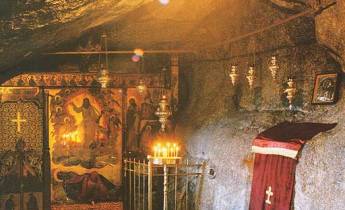
Cave in the Church of the Apocalypse in Patmos, Greece
This is not the only time this issues manifests. The other time I encountered this is when I travel to sacred or holy sites in the Middle East. The people in charge of sites may want raise money and increase tourism – so they give the people what they want. What do I mean by this? Walking into a place that has a story whether true or not provides pilgrims a sense of awe and wonder.
Certainly I am not saying that this experience should be diminished or should be taken away. What I am saying is that we should be a bit more truthful in our descriptions and remove the shroud of literalism that seems to fuel tourism and not faith. What was difficult for me when visiting Patmos is the rhetoric surrounding the island. It may or may not have been where John had his visions, but certainly the mystique surrounding the Church of the Apocalypse seems to perpetuate the literalism that surrounds the Book of Revelation as being prophetic in dealing with the end times. Moreover, the vendors around the Church certainly focus their merchandise to support this myth. However, while I study the Book of Revelation and teach that it is something other than prophetic, a person visits the island and the church, are told that it is prophetic – who is a person to believe? Me or the religious order running the Church or the vendors living on the island?
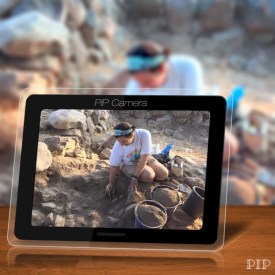
This also happens at dig sites. If a tourist is led by a guide or lead at a holy site being excavated and they tell them what they want to hear so they come back and tell their friends, who has more creditability – me or the person who guides on the site? When scholars like myself, write about a topic that seems to gel with what the commonly held view of the academy, and goes against literalism or fundamentalist beliefs, we become heretics in relation to the information being fed by the sensationalism on the History Channel and the tourist industry. So the popular view does not change and the academic view is left on the margins and Biblical literalism wins.
This short paper was part of a series of assessment pieces for university where we had to imagine ourselves as people living in a number of ancient cultures. It addresses a very direct question: “Imagine you are in Ancient Greece sometime during the 5th century BCE and a family member is preparing to be initiated into the Mystery Rites at Eleusis. You have come to support them and join in the festival. Briefly describe your experience?”
It is the month of Boedromion (Late September/Early October) and the sixth day of the Eleusinian festivities held annually in the great city of Athens. I travelled some distance to take part in the nine-day festival held in honour of the ‘Greater Mysteries’ for which my niece prepared as an initiate. The city is alive with women, men and children from near and far. Many have come to take part and fulfil the countless functionary roles associated with the festival, along with the great crowd of initiates who have spent the past three days fasting and ritually preparing. Continue reading “Demeter – Mother of Creative Potential”
History is written by the victors – this is something that we all know, or at least should know. I apologize in advance for being elementary in my discussion, but I think one thing that scholars tend to do too often is assume our readers or audience has a firm grasp on what we are talking about. With this topic, I am not assuming.
When studying artifacts from past civilizations, an interesting phenomenon of using spolia as a demonstration of conquest is commonplace. If a conquered country’s deity is placed on the bottom of a column, or even turned a different direction, the significance usually means that deity is demoted or inferior – this is found in the Hagia Sophia (especially under the structure). If spolia is found whereby a country adds their deity (even if that deity is their ruler) to another country’s monument, then there is a coexistence or combining of empires with the conquesting ruler in prominent view, even substituting past rulers. This is best demonstrated on the Arch of Constantinople whereby Christian symbols and the likeness of Constantine was incorporated into an arch that once displayed the victories of Marcus Aurelius and Domitian. If you are interested in this topic, please see my article “Hagia Sophia: Political Symbolism in Stones and Spolia” in Popular Archaeology magazine.
The data came as somewhat of a shock to me. I stumbled across it one day in The Civilization of the Goddess, a mammoth book by the late Lithuanian-American archaeologist Marija Gimbutas about what Gimbutas dubbed “Old Europe” – a culture area in southeastern Neolithic Europe that she maintains was centered around female deity.
Until she had the temerity to suggest that people at some point in the past might have worshipped goddesses rather than gods, Gimbutas had a sterling reputation among academics, even being hired to teach at two of the most prestigious of all American archaeology departments, Harvard’s and UCLA’s. After presenting her goddess theory of Old Europe, however, Gimbutas came under attack by a few powerful male archaeologists, after which her reputation among academics began to plummet (see Spretnak 2011 for a good accounting of Gimbutas’ fall from grace).
Marija Gimbutas
Before I get to the data that so startled me, I need to tell you a bit about archaeologists. Like the members of many academic disciplines, they disagree with each other – sometimes vehemently (and perhaps even somewhat more vehemently than scholars in other disciplines). One thing however they all agree on is this: the higher the quality and quantity of grave goods buried with an individual, the higher that individual’s status in her or his society. Continue reading “When Baby Girls and Old Crones Ruled by Jeri Studebaker”
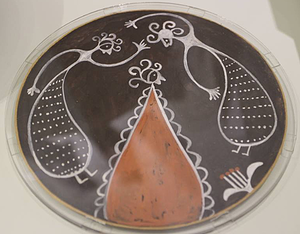
The image from an ancient Cretan bowl (c.1700 BCE) from the Sacred Center of Phaistos pictured here has often been interpreted as an early depiction of Persephone’s descent or rising. But are clues from later Greek mythology pointing in the right direction in this case?
Recent headlines in the international press announced that the enigmatic language of the ancient Cretan “Phaistos Disk” has been translated—in part—by the Welch-Cretan scholar Gareth Owens. Owens states that the Phaistos Disk records an ancient hymn to a Mother Goddess. More specifically he claims that one side is dedicated to a Pregnant Goddess and the other to a Birth-Giving Goddess.
On the recent Goddess Pilgrimage to Crete women had the option of riding up a winding road on a mountainside in the back of a farm truck singing “She’ll Be Comin’ ‘Round the Mountain” or could choose to go with the guard in his closed automobile.
That evening one of the older women who had chosen to ride in the car said, “I saw how much fun you were all having, but I have done that before. This time I was happy to let the rest of you do it.”
“That’s exactly how I feel about death,” I responded. “Some people want to live on after death, but I don’t. I am happy to let others do it. The only thing that would upset me would be if life did not go on after me.” Continue reading “The Ancestors Live in Us by Carol P. Christ”
Although writing in patriarchal Greece from a patriarchal perspective, Hesiod said in his Theogony or Birth of the Gods that Gaia or Earth alone was the mother of the Mountains, Sky, and Sea. With the male Sky she gave birth to the next generation of deities known as the “Titans,” who were overthrown by Zeus. Hesiod’s was a “tale with a point of view” in which “it was necessary” for the “forces of civilization”–for him represented by warrior God and rapist Zeus–to violently overthrow and replace earlier conceptions of the origin life on earth and presumably also to overthrow and replace the people and societies that created them.
With the triumph of Christianity in the age of Constantine in the 4th century AD, Christus Victor replaced Zeus in the cities, while the religion of Mother Earth continued to be practiced in the countryside. Over time, many of the attributes of Mother Earth were assimilated into the image of Mary, and priests began to perform rituals earlier dedicated to Mother Earth, such as blessing the fields and the seeds before planting. In the Middle Ages “the Goddess” re-emerged within Western Christianity in devotion to the Virgin Mary, the female saints, and figures such as Lady Wisdom, at the same time that the history of the Goddess was being erased.
In the middle of the 19th century, in Das Mutterrecht (The Mother Right), J. J. Bachofen stunned the scholarly world with his theory that matrilineal kinship, matrilineal inheritance, and reverence for the Great Mother were to be found at the origins of civilization. Bachofen challenged the view that patriarchy and the worship of male Gods had existed “from the beginning .” Continue reading “COMPLICATIONS AND CONFUSIONS IN DISCUSSIONS OF THE GODDESS by Carol P. Christ”


 No matter how carefully developed they are, theories of female power in pre-patriarchal societies are dismissed in academic circles as “romantic fantasies” of a “golden age” based in “emotional longings” with “no basis in fact.” I was reminded of this while reviewing three books about the Goddess last week.