

 A while back I gave a talk on feminist trinitarian theology to an audience of mostly progressive academics, including feminist and womanist scholars of religion. In the course of analyzing what I called the ‘trinitarian imaginary’ in Christianity and its often-patriarchal and masculinist forms, I suggested that transforming that imaginary might require recognizing the hypothetical character of theological statements until the eschaton, a theme that has been developed in depth by a German theologian named Wolfhart Pannenberg. Now, Pannenberg is decidedly neither a feminist nor a progressive theologian. To name just one example: in his three-volume Systematic Theology, his few explicit references to feminist or female theologians include a brief mention of Mary Daly (volume 1, p. 262) in connection with a critique of feminist theologians for projecting (!) masculinity into God in their readings of divine fatherhood, and a critique of Valerie Saiving and Susan Nelson Dunfee’s positions on the traditional Christian doctrine of sin as pride (volume 2, p. 243). So when I mentioned Pannenberg as a resource in my talk, one of the feminist scholars in the audience audibly gasped and flinched – it became clear in the Q&A that she had significant concerns about whether I could count as a feminist at all. After all, to mine someone like Pannenberg for constructive feminist theological work might imply an endorsement of his other positions, or might entail taking over aspects of his system that would taint my own project in anti-feminist directions – all legitimate concerns. Continue reading “When Feminists Disagree by Linn Marie Tonstad”
Category: Belief
A Pro-Science, Skeptical Woman Speaks by Kile Jones
 In my last post, “Feminism and Religion: Where Do I stand?” I talked about how I support an atheistic, secular, and liberal feminism that criticizes organized religion and certain religious beliefs. After reading the comments and responding to them, I figured that having a brief interview with a woman who holds these sorts of views would be a good way to introduce them to this blog. I met Anondah Saide at a course at Claremont Graduate University titled, “Evolution, Economics, and the Brain,” taught by the Executive Director of the Skeptics Society and Founding Publisher of Skeptic Magazine, Dr. Michael Shermer. Anondah was the TA for the course, and I found her comments in class to promote science, reason, and skepticism towards religious and spiritual claims of all kinds. So without further ado, here is the interview: Continue reading “A Pro-Science, Skeptical Woman Speaks by Kile Jones”
Living by an Ethic of Love by Elise M. Edwards
 If we base our love ethic in the love of God, we will be committed to the presuppositions that everyone has the right to be free and to live fully and well. We will not try to deny others access to safety, food, shelter, and companionship, nor prevent them from obtaining opportunities for growth and outlets for self-expression because of their gender, sexual orientation, race, ethnicity, class or cost to ourselves.
I enjoy Valentine’s Day, and this has been the case for many years, whether I have been in a relationship or not. I think romantic love needs to be celebrated, even if it is at the urging of greeting card companies, chocolatiers, florists and jewelers. Of course, those of us who are even the least bit critical of consumerism and media propaganda will acknowledge that these companies try to convince us that we need to buy luxury items to demonstrate our love to the important individuals in our lives. When our consumption of these goods hurts other people in our world and our planet (as in the consumption of blood diamonds or flowers that have been flown around the world, and thus contributing to environmental ills), we must recognize that they are not true reflections of love. This is not to say that the intent of the giver or recipient is untrue. I do want to challenge the predominance of these kinds of images of love, and provoke us to reflect on another way – an ethic of love rooted in the love of God. Continue reading “Living by an Ethic of Love by Elise M. Edwards”
Second Class Rape Victims: Rape Hierarchy and Gender Conflict
Deconstructing masculinity isn’t the key to solving social, sexual, and domestic violence across the world but it is a step worth taking when attempting to engage men in affecting change to stop these violent actions since men, statistically are the perpetrators of such crimes that both cause such outcry as well as perpetual silence.
 The most disturbing part of the 2006 documentary Deliver Us from Evil isn’t the fact that Father Oliver O’Grady is rewarded by the Catholic Church with a new congregation in Ireland after his short stint in prison for the rape of dozens of children in the 1970s, but rather the hierarchy of gendered victimization which is often created throughout the various rape cases that are both reported and unreported throughout history.
I am often troubled by the ways in which rape cases are discussed and deconstructed via mediums such as blogs, online communities, social media networks, the news, and popular culture. No series of events troubled me more than the Jerry Sandusky trial, but more importantly, the ways in which the young boys and adult men who were subjected to Sandusky’s abuse quickly overshadowed the other rape cases that are reported on a daily basis, specifically those involving young girls and women. Continue reading “Second Class Rape Victims: Rape Hierarchy and Gender Conflict”
On Pronouns and Liberation in the Classroom by Ivy Helman
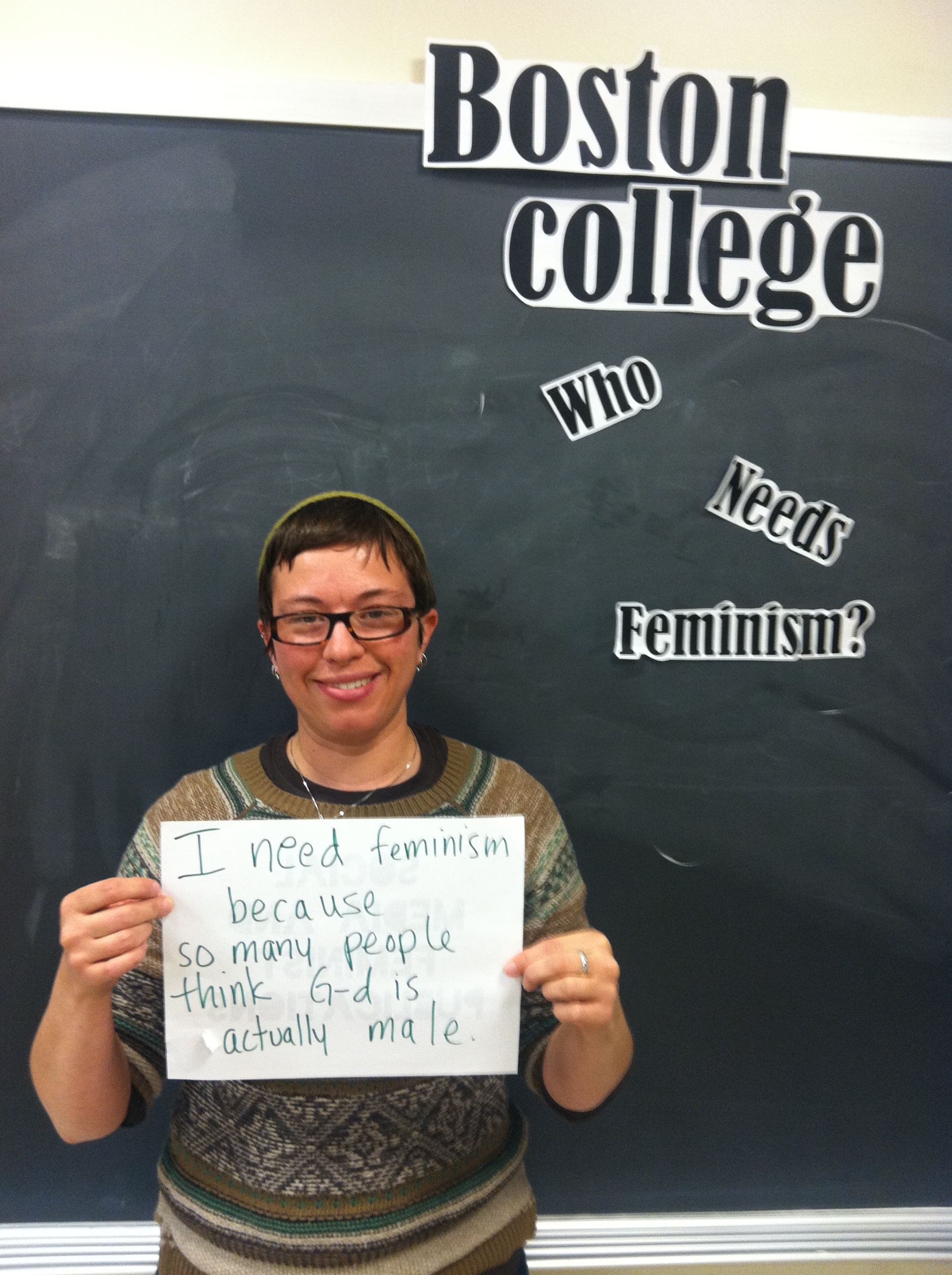 In my introduction to Christianity class, almost every one of my students (who come from diverse religious backgrounds – primarily Roman Catholic, Protestant and Muslim), continues to believe that the best image if not the only appropriate image for G-d is male. When probed they may speak generically about G-d as genderless, an entity or spiritual presence of some kind, yet conclude by affirming their belief that G-d is male often by adding something along the lines that G-d is best described as Father. Some go so far in these affirmations that they articulate G-d’s maleness as fact. It never fails that every semester I struggle with how to address this basic feminist issue within the classroom.
At least as early as 1973, Mary Daly, in Beyond G-d the Father: Towards a Philosophy of Women’s Liberation, articulated the problematic basis of the relationship between gender and divine imagery. She argues that “If G-d in ‘his’ heaven is a father ruling ‘his’ people, then it is in the ‘nature’ of things and according to divine plan and the order of the universe that society be male-dominated.” In other words, if maleness is associated with divinity, then the power, domination and running of society by men seems to be divinely ordained. Continue reading “On Pronouns and Liberation in the Classroom by Ivy Helman”
And Thus God made a Covenant with Hagar in the Wilderness by Michele Stopera Freyhauf
 We are familiar with the covenant God made with Abraham and Moses, but are you aware that God also made a covenant with Hagar?
In the wilderness Hagar encounters a deity at the well named Beer-lahai-roi (Genesis 16). Water and wells are important because they symbolize fertility and life. Wells for women are common places where they met their future spouses. Because wanderers in the desert need water to survive, water itself becomes a symbolic of life-giving or life.
In the seemingly barren dessert, the fertile Hagar finds out that she is pregnant and going to be the mother of many children. Hagar is promised progeny in a motherless state. According to Pamela Tamarkin Reis, this is called the “after-me” descendants, which guarantees Hagar that her children will live for “immeasurable generations;” a pattern that fits within the scope of this promise. This same promise of progeny is also given to Eve in Genesis 3:20, providing and interesting parallelism between Eve and Hagar.
It is worth pointing out the irony exists in this promise. Sarai uses Hagar to “build her up.” According to Nahum Sarna, to be built up in terms of the number of children that you have, implies that you are mother to a dynasty. In this pericope, however, it is Hagar, not Sarai that is built up through this divine promise.
This patterns of promise exists within the birth narrative through the annunciation of Ishmael and the promise of progeny. It is through this narrative that Hagar enters into a covenantal relationship with the deity. According to J. H. Jarrell, birth narratives have six common elements that establish this relationship: mother’s status, protest, offer, son’s future forecast, Yahweh naming, and acceptance of the contract. Hagar’s story contain these elements:
- Mother’s Status: Hagar is without child because she is a virgin (16:1).
- Protest: Hagar flees from her mistress (16:8).
- Offer: Return to your mistress and submit to her authority (16:9).
- Son’s Future Forecast: He will live at the east of all his brothers (16:12).
- Yahweh Naming: You will bear a son Ishmael because the Lord has given heed to your affliction (16:11).
- Acceptance of the Contract: She called the name of the Lord (16:13).
Winds of Change in the Roman Catholic Church by Michele Stopera Freyhauf
 In 2007, I had a conversation with a professor who felt that change was in the air for the Roman Catholic Church. The basis of this opinion was based on language. The words and the context used in writings that emerged from the Vatican were changing and somehow different – a difference that went beyond personal writing styles of Pope John Paul II and Pope Benedict XVI. This professor was hopeful that positive change for women could be coming. He was right about change in the Church, however, the changes surrounding women that emerged have not been positive.
As I continue to reflect on these words, I ponder the issue of language; specifically the impact words have and the way they are used to facilitate subtle changes in thinking, opinion, and beliefs. The method of persuasion that seems to be employed is the Aristotelian Rhetorical Theory that utilizes the five canons of rhetoric: invention, organization, style, delivery, and memory.
An example of this can be seen clearly in the changes in the liturgy that occurred last year. First, the teaching comes out with the rationale as to why the liturgy needs to change. From there a discussion, especially through the media, addressing the upcoming modifications are followed by subtle changes in the liturgy beginning with the call – response and the language in the creed. Next, the language of the celebrant began to change. Finally, the full implementation of changes is made with the addition of new gestures or movements. When I discussed the mass changes with a family member, there was an admittance that the changes no longer affect them – the changes were no longer noticeable. Their memory was impacted because the routine is now second nature.
In order to come to grips with the issue of language and the observation of my professor, I wanted to do a cursory review of the writings issued by the Vatican during this period. Admittedly, with a blog post, there is a limitation as to the depth and breadth of information that can be disseminated. It is my hope to eventually complete a thorough review of the modification of language used during Pope Benedict XVI’s papacy. For now, I want to address a few observations.
Continue reading “Winds of Change in the Roman Catholic Church by Michele Stopera Freyhauf”
Imix: Primal Mother and Dawn of a New Age by Michele Stopera Freyhauf
If you are reading this, then we survived another apocalypse. People are fixated on end-times; especially predictions, prophecies, etc. Specials on Nostradamus, the Book of Revelation, TV Evangelists looking for end signs plague television shows, movies, and writings. Countdown clocks and reminders to repent are all around us.

What is unnerving is how we obsess about the end of the world instead of living in the world we have right now.
I would like to share a Mayan poem that I came across. It is called “Imix”- a Mayan Oracle Interpretation translated by Ariel Spilsbury and Michael Bruner and I am drawn to it due to the imagery and symbolism:
I Am Imix, Primal Mother.
Still, dark womb of the patterned potential of becoming, sacred, interstellar genesis, I Am.
Nourishing, fertile abyss, I birth you.
Benevolent, my mighty cauldron of primal waters, enveloping the living seed. Eternal is my embrace. Continue reading “Imix: Primal Mother and Dawn of a New Age by Michele Stopera Freyhauf”
Cancel Christmas? By Elise M. Edwards
Despite the time and energy it takes to participate in the religious and social rituals associated with Christmas, the result is that I am spiritually grounded, emotionally provoked, mentally rested, and physically fed. Advent, Christmas, New Year’s, and the last week of the year are times when I reconnect to what is important to me, and the holiday rituals help me do this.
The “holiday season” is upon us, and I’m still busy and exhausted, as I’m sure many of you are. Although my life isn’t as stressful as it was in October, I am still juggling multiple commitments while trying to make significant progress on my dissertation. This past weekend, I spent some time with other dissertation writers in the same predicament, and quite a few of them were thinking of cancelling Christmas in their households in response.
My immediate reaction to canceling Christmas (or another alternative they mentioned, micro-Christmas) was to inwardly scream “THAT’S RIDICULOUS!!!!” To be honest, I’m not sure my facial expression didn’t make my reaction plain. But since I value my relationships with these people and I genuinely respect their insights, I decided to keep my reaction to myself and to give the matter more thought. I realized later on that all of the “cancel Christmas” advocates were women. So I began to consider what the implications of cancelling Christmas would be for women. Continue reading “Cancel Christmas? By Elise M. Edwards”
Does Belief Matter? by Carol P. Christ
 In recent days I have been pondering the fact that some people and some feminists seem to see the issues of religious faith and belonging to be rooted in birth, family, and community, while for others the question of belonging to a religious community hinges on belief and judgments about the power exerted by religious institutions. What accounts for this difference in the way we view religious belonging?
Recently I watched The Secret History of Sex, Choice and Catholics, a film featuring Roman Catholic feminists and ethicists who dissent from the Roman Catholic hierarchy’s views on contraception, abortion, and homosexuality. At the beginning of the film those interviewed state almost univocally that for them being Catholic stems from having been born Catholic. These Catholic dissidents continue as Catholics, even though they disagree with major portions of Roman Catholic teaching. It may have been because they were not asked, but most of them did not name reasons of belief for remaining Catholic.
Thus the viewer did not learn the theological reasons these progressive Catholics stay in the church. I wondered: Do they believe that salvation occurs only through Jesus as the Christ? Do they believe in original sin? How do they feel about the God of Exodus and the prophets who achieves his will through violence or the Christian doctrine of hell? I also wanted to know how they justify being part of an institution that, as June Courage stated on these blog pages, is responsible for the deaths of women and children through its contraception and abortion policies just as surely as if it were bombing their homes in an unjust war. Continue reading “Does Belief Matter? by Carol P. Christ”
 Feminism and Religion