“We Are Atheism” and Amanda Brown by Kile Jones

Kile Jones, atheistSo far, as a regular contributor to Feminism and Religion, I have interviewed a “pro-science” woman and one who started an online community for grieving unbelievers.  In this post, I will interview Amanda Brown, an atheist activist who co-founded a project called We Are Atheism.  Amanda grew up in Independence, MO, in the Assemblies of God and the Restored Church of Jesus Christ of Latter Day Saints. Since then, she has been involved in helping atheists “come out” and share their experiences.  So without further ado, here is the interview:

943021_10100185792782141_825478688_n

Why did you start “We Are Atheism”?

I started We Are Atheism because I saw a gap in the age of atheists coming out of the closet.  I also wanted a way for people to see for themselves that atheists are real people.  We Are Atheism is focused on the fact that atheists are mothers, fathers, teachers, brothers, friends, and so much more. When I was at the 2011 Secular Student Alliance Conference in Columbus, OH, I heard most of the leaders tell stories about their groups and how many of them didn’t know other atheists. I thought this was horrible, and being a person who was in the same position, I wanted to start something that would bring our community together.  Those who met on the internet could take their community from online to the neighborhood. Continue reading ““We Are Atheism” and Amanda Brown by Kile Jones”

The ‘Other’ as Target Market in Pentecostal Brand Evangelism by Andreea Nica

Andreea Nica, pentecostalismIn my last post, Leaving Behind My First Love, I mentioned I would examine the historical significance of Pentecostalism and how it relates to the marketization of the church and patriarchal standards. I realize this is a complex topic that involves many theoretical frameworks and conceptualizations, so I do welcome your thoughts. In this post, I will be highlighting trends regarding the marketization of Pentecostalism, brand evangelism as a marketing strategy, and how concepts of neo-liberalism intersect with the Pentecostal faith.

Pentecostalism stems from Evangelical Protestantism incorporating spiritual elements such as speaking in tongues (glossolalia), charismatic leadership, religious healings, and ecstatic praise and worship. Modern Pentecostalism dates back to 1906 at the Azusa Street Revival. However, the First Day of Pentecost can be found in the Book of Acts when Jesus’ disciples gathered in a room and began to speak in different languages. Continue reading “The ‘Other’ as Target Market in Pentecostal Brand Evangelism by Andreea Nica”

God Doesn’t Live Here Anymore: Gay Bars and the Growing Divide Between Sexuality and Spirituality by John Erickson

oes God exist within the LGBTQ community anymore or has the community itself abandoned God for all-night raves, dance clubs, alcohol, and hypersexualized and over commoditized fetishized forms of femininity and masculinity? Oftentimes, I find myself answering yes to the above questions. After surviving hate crime after hate crime and endless batches of newly elected conservative politicians hell bent on ignoring medical and social epidemic plaguing the very country they were elected to serve and protect, why would a community, oftentimes linked to sin itself, believe in a holy entity?

John Erickson, sports, coming out.My good friend and fellow Feminism and Religion Contributor Marie Cartier’s forthcoming book, Baby You Are My Religion: Women, Gay Bars, and Theology Before Stonewall argues that American butch-femme bar culture of the mid-20th Century should be interpreted as a sacred space.  Specifically, gay bars served as both communal and spiritual gathering spaces where butch-femme women were able to discover and explore not only their sexuality but also their spirituality.  An opus of an academic accomplishment based off of the amount of in-depth interviews she conducted, Professor Cartier explores lived religion in an area that has become all too common within the LGBTQ community: the bar

The Palms, the last local and only lesbian bar to be found in city of West Hollywood, CA is closing its doors and I can’t help but wonder where its patrons or parishioners will now go? Continue reading “God Doesn’t Live Here Anymore: Gay Bars and the Growing Divide Between Sexuality and Spirituality by John Erickson”

Tikvah v’hashamayim (Hope and the Heavens): A Jewish Perspective on Redemption by Ivy Helman.

headshotThe Torah is bursting with hopes over-fulfilled.  Abraham and Sarah hoped for a child and gave birth to a nation.  The Israelites hoped for freedom from slavery and eventually received an entire Promised Land.  We understand hope and, in so many ways, we live on it, as hope has sustained us for thousands of years.  Today, our hopes inspire our actions and motivate us to work for peace, justice and equality.   In Jewish terms, we call this goal or vision of a better world in the here-and-now: redemption.

Yet, redemption does not just appear out of thin air or because we wish it.  Redemption and the hope of it requires work and cooperation with the Source of All Life.  As Deuteronomy 30:19 says, “I have put before you life and death… [therefore] choose life…”  This cooperation could be a simple commitment to tikkun olam, repairing the world (some times translated as social justice).  For others, choosing life could mean more observant religious practice.  It could also be a combination of the two.  In the end, though, I think both hope and redemption require choosing life in some form or another.

Just as how we choose life depends on who we are, how we achieve this redeemed world depends on how we understand G-d’s redemptive power.  Some of us think redemption will come through the moshiach (a savior), Continue reading “Tikvah v’hashamayim (Hope and the Heavens): A Jewish Perspective on Redemption by Ivy Helman.”

Leaving Behind My First Love by Andreea Nica

Andreea Nica, pentecostalismDuring these realizations, the words of Sue Monk Kidd permeated my mind, “The truth may set you free, but first it will shatter the safe, sweet way you live.”

When most people inquire who my first love was, I’m reluctant to give an honest answer. At times, I just uttered the first boy’s name that would come to mind. As I matured and developed into a confident young adult, I decided to provide a more honest answer. “My first love was God. Jesus. You know, the Trinity.” I would receive puzzled looks, quizzical faces, and frazzled exits. Given the multitude of embarrassing responses, I began to rephrase my answer in a way that prompted them to further question my response. “I fell in love with God as I grew up in a charismatic, Pentecostal religious community. During my college years I left Pentecostalism, my family unit, and the community.” Responses were drastically different with this answer. Many people desired to know more about my transition and how I found the inner strength to embark on an alternative path. I quickly realized I didn’t have all the answers. Although my B.A. in Psychology aided me in understanding aspects of the psychological implications of my departure from the religious institution and a family that identified as Pentecostal, there was still much to uncover. Continue reading “Leaving Behind My First Love by Andreea Nica”

“Free-Speech or Speech-Free?” by Kile Jones

Kile Jones, atheist[This post is written in response to the chilling effect taking place in the U.K. since the Woolwich Attack.  It is also in response to the uses of the Public Order Act of 1986.]

In any “liberal democracy” that has constitutional protections for “free speech,” there will also be laws against “inciting violence,” “hate speech,” “threats,” “slander,” “libel,” “harassment,” and other “speech codes.”  This is because the government, or those who voted on the passing of such laws, worry about the potential threat un-regulated speech will have on the levels of violence and disharmony in society.  They worry about people being able to yell “fire!” in a theatre, which can cause (which is a key word here for legal reasons) physical harm, not being held liable for such speech.  As much as I understand these worries, I am of the opinion that the potential evils brought about by a lassez-faire approach to speech morally outweigh the evils of blasphemy laws and censorship. Continue reading ““Free-Speech or Speech-Free?” by Kile Jones”

Appreciating the Sacrament of the Present Moment by Michele Stopera Freyhauf

In order to be at peace, it is necessary to find a sense of history – that you are both part of what has come before and part of what is yet to come. Being thus surrounded, you are not alone; and the sense of urgency that pervades the present is put in perspective. Do not frivolously use the time that is yours to spend.  Cherish it, that each day may bring new growth, insight, and awareness.  Use this growth not selfishly, but rather in service of what may be, in the future tide of time. Never allow a day to pass that did not add to what was understood before. Let each day be a stone in the path of growth. Do not rest until what was intended has been done. But remember – go as slowly as is necessary in order to sustain a steady pace; do not expend energy in waste. Finally, do not allow the illusory urgencies of the immediate to distract you from your vision of the eternal.

                                                     (Elisabeth Kubler-Ross, The Final Stage of Growth, 167)

Freyhauf, Feminism, Religion, Durham, Old Testament, Blogger, Bible, Gender, Violence, Ursuline, John CarrollLast month we lost a good friend unexpectedly.  His death, just days after his 49th birthday caused me to confront my own mortality. His death also makes me think about that void in life that we leave as well as the legacies we leave behind. How will I be remembered?  Did I make a difference while on earth? Have I served and given back enough?   Continue reading “Appreciating the Sacrament of the Present Moment by Michele Stopera Freyhauf”

Thanks for Coming (Out): Sexuality, Sports, and Spirituality by John Erickson

I have to be honest, Jason Collins’ admission that he was a homosexual, albeit brave, upset me. While coming out is an completely unique experience to every individual that does it, Jason Collins’ story was just another example of the rampant sexist and heteropatriarachal world that privileges male bodies and sexualities over women’s similar experiences. While I applaud Jason’s story and it’s timing, the first thing I asked to my colleagues was: Where was the hubbub over Sheryl Swoopes or Martina Navratilova?

John Erickson, sports, coming out. Like marking off items on a proverbial checklist, closeted LGBTQ individuals who exist within and outside of the world of professional sports, can recount the numerous things they struggle with in terms of their sexuality.  From fearing of the actual coming out process, dressing in their car or at home to avoid the subtle glances and whispers of individuals in the locker room, to wondering what coming out would mean not only for their game but also for their social and, if they choose, spiritual lives, closeted and out LGBTQ individuals within the multi-billion dollar professional sports industry must grapple with that age old question: what does it mean to be gay and open about it?

The Locker Room

I have to be honest, Jason Collins’ admission that he is a homosexual, albeit brave, upset me.  While I understand that coming out is an completely unique experience to every individual who does it, for me Jason Collins’ story was also an example of the rampant sexist and heteropatriarachal world that privileges male bodies and sexualities over those of women.  While I applaud Jason’s story and the timing, the first thing I asked to my colleagues was: where was the same hubbub over Sheryl Swoopes or Martina Navratilova? Continue reading “Thanks for Coming (Out): Sexuality, Sports, and Spirituality by John Erickson”

Review of “The Book of Mormon” by Ivy Helman

IMG_5998My friend and I won two tickets to “The Book of Mormon” showing as part of Broadway in Boston.  Having known nothing about the musical, we were curious and excited to be going.  Nearly two weeks later, we are still discussing how we feel about the production.  We agree that overall we like it and there are some very funny parts, but we are also troubled and disgusted by it on a number of levels.  Moreover, the fact that we like it makes us quite uncomfortable.

As a Broadway production, the cast was amazing!  The songs were creative.  Characters were dynamic and showed marked growth.  “Spooky Mormon Hell Dream” was outright brilliant with its use of humor, satire and fear to explain the Mormon preoccupation with hell as punishment for immorality and/or disbelief. Continue reading “Review of “The Book of Mormon” by Ivy Helman”

(Femen)ism? by Kile Jones

Kile Jones, atheistAs most of us are aware by now, there is a “feminist-sextremist” group from Ukraine called “Femen.”  This group has been very controversial by their public demonstrations of nudity, the words they paint on their bodies, and their explicit condemnations of political structures and organized religions.  They were started by Anna Hutsol in 2008 and have now spread throughout Europe and the Middle East.  The question I pose for this post is: Does Femen harness or hinder the power of the feminist critique?

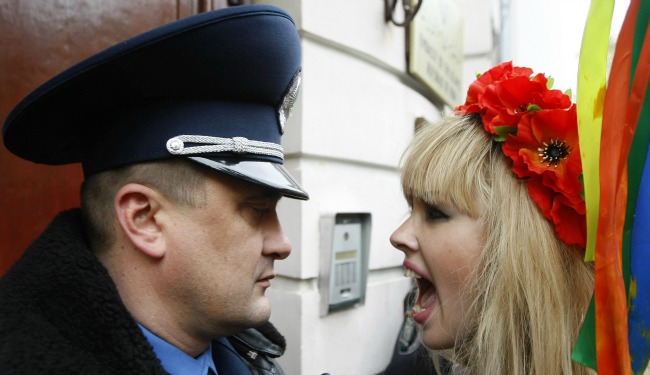
Image from Konstantin Chernichkin/Reuters

Femen is precisely the kind of movement that pushes us in our understanding of feminism, the means by which it is best expressed, and the issues surrounding moral condemnation and religious sensitivity. Continue reading “(Femen)ism? by Kile Jones”