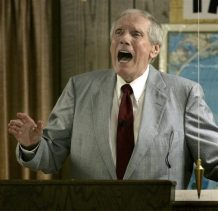
In Memoriam – God Hates Fags

Phelps didn’t just live a life filled with hate but he also embodied the very reasoning why so many communities cannot cross that proverbial bridge to work together to see past their differences and maybe never will. In the case of Phelps, sticks and stones may break our bones, but words really do hurt.

Fred Phelps, an American PasFred Phelpstor who headed the Westboro Baptist Church in Topeka, Kansas died at the age of 84 on March 19, 2014.  While some individuals leave behind legacies of their good deeds and loving memories, the only thing Phelps left behind was a family and church founded on the principle of hate.

A frequent eyesore at various events ranging from military funerals and gay pride gatherings to mainstream events that captured the attention of our pop-culture obsessed society, Fred Phelps and his clan believed it was their sacred duty to warn others of God’s anger over the growing acceptance of not only modernity in general but also issues like gay rights and abortion.  From slogans and signs such as ‘God Hates Fags’ to ‘Thank God for IEDs (Improvised Explosive Devices), Phelps has caused many controversies both during his lifetime and after his death.

Continue reading “In Memoriam – God Hates Fags”

Gendered Imagery of God (Part 1) by Elise M. Edwards

Elise Edwards

I have been doing a lot of thinking about gendered imagery and language for God over the past few months. Honestly, a lot of this reflection was provoked by hostile comments I got from my college students at the end of the fall semester because I require gender-neutral language for God and gender-inclusive language when referring to people. The policy in my syllabus is this:

For academic discourse, spoken and written, students are expected to use gender-inclusive language for human beings, and gender-neutral language for God. (e.g. “God” instead of “He;” “God’s” instead of “His;” etc.) This is to prepare students to communicate to the world beyond the Christian university setting. I want to equip you to succeed in graduate school, in the corporate world, and in public communication, all settings in which gender inclusive language for is increasingly expected.

I provide links to websites that discuss the issue, and we talk about it more when we discuss 20th century feminist issues in my course on the Christian Heritage and when we discuss prejudice and sexism in my ethics class.  Some students have thanked me for the policy. But many students are perplexed by it, and I’m perplexed by their confusion. It shocks my system when I hear people refer to “man” for all people; I first became aware of the issue when I was in 2nd or 3rd grade and the Girl Scouts changed their pledge because it referred to “mankind.” That was over 30 years ago!

While I’m confused as to why replacing “man” with “people” is such a difficult task, I am more empathetic to the reorientation required to replace “He” with “God.”  (And I also acknowledge that the term “God” is not completely genderless either.) I recognize that for many of my students, I might be the first one to challenge their gendered conceptions of God.  So I am empathetic, but insistent.

The way discussions about the “gender” of God and Savior are often dismissed as irrelevant, unimportant, silly, or the remote concern of “those feminists” bothers me. Traditional Christian theology asserts that God is a different kind of being than humans are.  Therefore, God (the first person of the Trinity) and the Holy Spirit do not have a sex or gender, as sex is a characteristic associated with physical creature-ness and gender is (to simplify) a social construction related to sex. The second person of the Trinity, Jesus, is thought to be male.  In the Incarnation, the eternal God became human while also divine, and therefore has a sex and gender in the person of Jesus.  But the Trinity as a whole is without sex and has characteristics that we would associate with femininity, masculinity, and genders in between.  According to this logic, references to the maleness of God should only be understood metaphoricall,y not literally, and therefore replacing that language with genderless/sexless language should not be inherently problematic.

I’m not saying that the use of any language in reference to God is appropriate or acceptable within the bounds of traditional theology.  We (traditionals and non-traditionals alike) should be concerned with how we refer to God, because as Sallie McFague and others remind us, these metaphors/models of God have consequences in the world beyond language.  Maleness becomes deified or closer to godliness than femaleness, maleness becomes the model for the priesthood, maleness is the true form of authority, etc.  I believe that many of the concerns about feminine imagery for God are based in this same concern: that by associating God with one sex or gender, we claim God’s preference for that sex or gender.  In a patriarchal system, this correlation between God and the feminine simply will not do.  Feminists who assert feminine qualities of God are merely making projections of themselves, critics claim.

How we conceptualize the being we worship matters. It matters to me, at least. While I acknowledge that there is a danger of simply projecting an image of myself as a deity that I worship, I also think there is great harm in loving and worshiping the divine imaged as those who are at times hostile to me, and historically have been so to my ancestors and kin. So although I know and have good relationships with older, white males, I see no reason why I should image and worship God “the Father” who looks like an old white man. How would that benefit my spiritual practice?

Thank you Carol Christ, for asking me to state my views about this in the comments to my last post. I look forward to more discussions with you and the members of this community.  When I read your work years ago, I was convinced about the validity and rightness of affirming feminine forms of divinity. Although the Christian (patriarchal) tradition does not have much room for Goddess language, I am comfortable with it, at least for the first and third persons of the Trinity. In my next post, I’ll talk more about the ways I am considering the gender of the Christ.

Elise M. Edwards, PhD is a Lecturer in Christian Ethics at Baylor University and a graduate of Claremont Graduate University. She is also a registered architect in the State of Florida. Her interdisciplinary work examines issues of civic engagement and how beliefs and commitments are expressed publicly. As a black feminist, she primarily focuses on cultural expressions by, for, and about women and marginalized communities. Follow her on twitter, google+ or academia.edu.

Religion: Trapped in Love Through Shame by Andreea Nica

Andreea Nica, pentecostalismI was first introduced to shame in the church. Shame paradoxically drew me closer to God, prevented me from committing sins, and helped me repress certain natural urges. The church I grew up in indoctrinated its congregation to believe that shame would transform us into true and wholehearted believers – that as carnal beings, we needed to feel both guilt and shame in order to be saved and transformed into spiritual entities.

One question that permeated my mind growing up, but I’d never dare to publicly ask:

Why would Jesus die for me when I never asked Him to? Continue reading “Religion: Trapped in Love Through Shame by Andreea Nica”

Why I Don’t Believe in Female Pastors by Andreea Nica

Andreea Nica, pentecostalismIt may come as a surprise to those who identify as both feminists and religious practitioners that I don’t believe women should be pastors of any dominant religious congregation. This includes most religions which, I assert, are rooted in and structured by the tenets of patriarchy. Does that mean I think women should be congregants of a patriarchal-originated religious system? You guessed it – no. While this may seem like a radical notion to some, it took me quite some time to come to terms with my own conflict in being both feminist and a believer.

My transition from the Pentecostal sect was a long, intricate process that involved life-altering decisions. The notion of leaving the church was driven by my immersion in women’s studies during my undergraduate degree. There were many difficult questions I simply didn’t have an answer for, as the church didn’t provide me with them.

One of them being: Can women instruct an entire congregation of believers?

For those who are female pastors, I’m sure you’ve heard this one a million times, but somehow it never fades from religious and secular discourse. Whether it’s the Islamic, Jewish, Christian, or Mormon faith, women have had to constantly fight for their right to preach religious doctrine. In the beginning of my transition, I was on the side of: Preach it ladies! Continue reading “Why I Don’t Believe in Female Pastors by Andreea Nica”

Evangelical Missionaries Preach Death in Uganda by Andreea Nica

Andreea Nica, pentecostalismA former evangelical Christian friend of mine sent me information on the intriguing documentary God Loves Uganda. The newly released documentary addresses how the American evangelical movement has prompted a political and social shockwave in the country of Uganda. While missionaries are typically associated with delivering aid and improving the conditions of third world countries, the spreading of Christian values and ideals has inflicted suffering upon ethnic communities through evangelical indoctrination.

The intent of the film is to raise awareness of the political and social brutality that the evangelical missionaries are instigating; specifically through their teaching that homosexuality is a sin and should be dealt with accordingly. In Uganda this means death. Given the rise of globalization, transnational religious actors have been more enabled to engender other nations with their respective religious beliefs, often with minimal regard for the cultural and political landscape of the nation they wish to transform. Continue reading “Evangelical Missionaries Preach Death in Uganda by Andreea Nica”

Yes, You’re a Homophobe by John Erickson

Jesus loved sinners and Jesus would rather be dancing with me in West Hollywood on a Friday night than lugging through a swamp luring ducks into a trap with a duck caller made by a clan who think that my sexual actions are similar to that of an individual having sex with an animal.

John Erickson, sports, coming out.

To be able to walk down the street holding the hand of the one you love is a great feeling and an action that some of us aren’t able to perform without fear.

A line has been drawn in the sand between those who support gay rights and those who do not.  While some call it being on the “right side of history,” I simply now refer to it as not sounding and looking like a bigot in the halls of history and in the various books, Facebook posts, and Tweets that our children will one day read. Continue reading “Yes, You’re a Homophobe by John Erickson”

Seeing Death and Resurrection by Linn Marie Tonstad

Linn Marie TonstadYesterday, I visited the Capuchin catacombs in Palermo, Sicily. In a grotto about a mile or so from the center of the modern city are found the preserved remains of about 2,000 people who paid the monks to preserve their bodies after death, dress them in their finest clothing, and put them on display. Each of them is placed in its own niche along the wall, held up by iron bands, and has a tag around its neck with its name and date of death. The bodies are not displayed in random order: they are sorted (to some extent) by sex, profession, and familial status. In one large recess, a number of children’s skeletons are on display, many of them in heartbreakingly tiny coffins. In another corridor, friar after friar hangs in his robes, some with cords around their necks signifying their adherence to a Franciscan order. Almost indistinguishable from the cords are the braids still hanging from the heads of some of the women’s bodies. Some families are arranged together; in another corridor doctors and lawyers are segregated and in yet another female virgins are gathered together. The oldest body I saw dated from 1599 – high on a wall hangs the body of a monk whose name was almost illegible but who hailed from the Umbrian hill town of Gubbio.

Some of the skeletons presented death’s heads; others had skin dried to a leathery tightness over remaining bony protuberances. Some of their outfits are well preserved; others have disintegrated under the relentless assault of the years. The practice became illegal around 1880, but until then, people chose – or perhaps their relatives chose for them – to be preserved in this seemingly macabre manner. Continue reading “Seeing Death and Resurrection by Linn Marie Tonstad”

On the Transmission of Life by Natalie Weaver

Natalie Weaver

Among the more controversial Roman Catholic documents is Humanae Vitae, the 1968 encyclical of Pope Paul VI on birth control.  This encyclical famously instructs against the use of artificial contraception methods in the regulation of birth.  This position is based on the theological warrant that the natural law of God’s reproductive design requires human sexuality, if it is to be moral, to be always nuptial, companionable, and open to new life.  The encyclical anticipates a number of reasons why people will object to this teaching, including: population problems, family and personal limitations, economic concerns, and so on.  It also anticipates that some will suggest procreative and unitive ends must be seen diachronically in the context of the fullness of nuptial sexuality, such that sexuality would be understood holistically rather than as a series of individual sexual acts.  Despite its acknowledgement of these concerns as legitimate, the encyclical argues that grave harm flows from the distortion of natural law and leads inevitably to the degradation of sexual dignity and nuptial integrity (for example, in making free sex more available to young people outside of marriage or cheapening male regard for women on account of women’s sexual objectification).  The encyclical thus opts for an approach that evaluates sexual morality in terms of individual sexual acts.

The perspective of the document has been critically unpacked for decades, and its instruction is in the very least unconvincing to many Catholic couples.   I find in my teaching that Catholic college students today are unfamiliar with the document’s language and rationale, even though they may know the basic instruction that Catholics aren’t supposed to use birth control.   Since this issue is both topical currently due to the healthcare legislation and since birth regulation is a requisite discussion in my course on sexual ethics, I have the students read the encyclical itself.  Now, this is a hard task because I know by and large what the student reactions will be.  Their most favorable reaction is generally that the document has no instructional or binding value for them.  Their least favorable reaction is that the document makes poor sense of the human situation today, especially because human sexual expression reaches well beyond the Church’s vision of normative, heterosexual, marital union. Continue reading “On the Transmission of Life by Natalie Weaver”

God the Father or Buffy the Vampire Slayer? by Linn Marie Tonstad

Linn Marie TonstadIn the second season of the television show Buffy, the Vampire Slayer [spoiler alert!], Buffy is faced with an agonizing dilemma. She is condemned to save the world “again.” Buffy’s former lover is the evil Angelus. Angelus – once the good Angel – has awoken a demon that will swallow up the whole world into an eternity of suffering.  In what follows, I read Buffy as God the Father. Angelus represents sinful humanity, Angel is Jesus, and the Spirit is the sword in Buffy’s hand. Buffy attempts to destroy Angelus. But at the moment that she is about to kill Angelus, his soul is returned to him. Unfortunately, only Angel’s blood will close the gaping mouth of the demon. The shift from Angelus to Angel gives a vivid representation of the shifting positions of the first and second Adam in the Christian narrative of redemption. Angelus is evil. Angel carries the weight of Angelus’s guilt without any of the responsibility belonging, strictly speaking, to him. Yet finally, the innocent Angel must bear the consequences of Angelus’s evil for the salvation of the world.

The gender dynamics of this scene complicate and illuminate traditional readings of the involvement of the Father in the crucifixion. Gender subordination and the subordination of the Son to the Father go together, and are ultimately justified by the same theological logic. Reading the Father as an 18-year old girl helps to mark the inadequacy of language to capture God. The evident implausibility, even absurdity, of the image, makes visible the theological truth that God is not a father among other fathers.   Continue reading “God the Father or Buffy the Vampire Slayer? by Linn Marie Tonstad”

Theopoesis and the Interior Divine by Natalie Weaver

Natalie Weaver

Last week I traveled to Leuven, Belgium for the 9th Leuven Encounters in Systematic Theology conference.  I have been to this conference before, and I find that my perspective is generously enlarged by hearing voices that emerge from contexts and concerns that differ from my own in the USA.   This year, the conference theme was “Mediating Mysteries: Understanding Liturgies.”  The keynote speakers offered inspiring investigations into what “full, active, and conscious” participation of people in the Catholic liturgy means today (for, such were the goals for liturgy articulated at the Second Vatican Council).  Some provided critical evaluation of the newly revived Roman missal.  One speaker offered a searing critique of the distinction between true mystery and fabricated mystique in the Mass.  The breakout sessions were exceptionally well designed.  Here I noticed a common thread of people searching beyond the formal magisterial liturgies and studying the value of those mediated mysteries that are celebrated and communicated in culture, literature, and art. Continue reading “Theopoesis and the Interior Divine by Natalie Weaver”