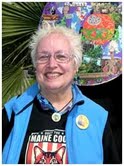
Storytelling as a Spiritual Practice by Nurete Brenner

“The master’s tools will never dismantle the master’s house.” Audre Lorde

Question: What tools do we have that are powerful enough to dismantle the Master’s house?

Answer: Storytelling.

Storytelling does not belong to the “master.” Storytelling is subversive because it belongs to the collective and not to the individual; it gives agency to the powerless; it is not dependent on time or money, and it makes visible those who are overlooked and ignored in our globalized industrialized system. Continue reading “Storytelling as a Spiritual Practice by Nurete Brenner”

Seed Bearer by Sara Wright


Yesterday old eyes
stung –
fierce white
heat –
blurred vision.
Singing love songs,
I scattered seeds
in furrows
raked smooth,
tucked tufts
under stone…

Imagining
a Wildflower riot!
Bittersweet orange,
blue and gold
winding through
rice grass –
sage scrub,
vining over
wave -like gopher mounds. Continue reading “Seed Bearer by Sara Wright”

The Finish Line by John Erickson

I see it…do you?

It’s just within reach and I’m almost there…the proverbial finish line to my Ph.D.

That’s right folks, I’m graduating.

To say that this has been an easy journey, one that many of you have read about and witnessed, would be an understatement.  For many of us, that finish line is far away or getting there seems more like a hope and dream rather than a reality.  Whether or not it is because of economic hardships, life in general, or the regular types of “isms” that so many of us face while trying to better ourselves via academic enrichment, the struggle is real. Continue reading “The Finish Line by John Erickson”

Time to Dismantle the Myth of the Nation State? by Carol P. Christ

I am a citizen of two countries currently being torn apart by popular nationalism. In Greece, the cry is “Macedonia is only Greek,” while in the United States a nation of immigrants is being told that it must fear being invaded by immigrants. The truth is that the idea of a nation state is a fiction created in the nineteenth century. It is high time to dismantle it.

Here is the Greek case. Phillip of Macedon invaded from the north and created a federation of Greek states in 338 BCE. His son Alexander the (so-called) Great conquered territories extending as far as India before his death in 323 BCE, establishing the seat of his empire in the newly founded city of Alexandria in Egypt. Phillip and Alexander are claimed as Greek, but in fact Phillip forced independent Greek-speaking city states into union under his rule.

Although the Greek language became the lingua franca of the Alexandrian Empire, the people who spoke forms of Greek did not become an ethnically pure free Greek nation under Alexander. Rather they became subjects in an empire ruled by a king that united people of different cultural traditions under a newly imposed Greek language. It is probable that Phillip and Alexander originally spoke a form of Greek, but even this is debated by experts. Continue reading “Time to Dismantle the Myth of the Nation State? by Carol P. Christ”

Leading by Mandala by Nurete Brenner and Elizabeth Meacham

Liz and Nurete (L to R)

Lake Erie Institute

The old myths and images that sustained us in earlier periods are no longer serving us during this time of breakdown of the old and the uncertainty about the future. The lone wolf, the frontiersman, the all-powerful superhero – these tropes fade into irrelevance as it becomes clear that no messianic figure is going to step forward and part the sea for us. We need to find new stories to accompany us and new images to illuminate the path as we shift from a patriarchal-hierarchical structure to a collective, relational, participatory one born in partnership rather than domination.  Women’s leadership is the emergent idea that leadership is about co-creating a new story for the world during a time of radical transformation in Earth history.

The word “leadership” stems from the Indo-European root leith which means to cross a threshold. How does a society cross the threshold from the myth of the strong leader to a new story of collective leadership? One answer is by telling new stories. Traditionally women have been the storytellers of our culture, relaying and relating the fairy tales, the bedtime stories, the family-history narratives and cultural myths. The men who share in this story-telling role are those who are at one with their feminine aspect and we recognize that this activity is not at all new for Indigenous cultures which have maintained an ongoing tradition of participatory story-telling leadership. Continue reading “Leading by Mandala by Nurete Brenner and Elizabeth Meacham”

Seeking Happiness, According to Paulo Coelho by Elisabeth Schilling

Lately I’ve been reading a few Paulo Coelho books. I won’t say they are beyond feminist criticism, but it’s not what I’m going to focus on this post; but as always, feel free to say in the comments why/if you find them problematic. I expect and welcome it because it might be another layer of this conversation that I don’t have time or am not yet emotionally ready for myself.

What I want to focus on is the solution the author seems to advance in each of his books, at least those I’ve read, to our perpetual unhappiness despite the evidence that everything is fine, better than might otherwise be.

Adultery: I never finished this one, actually. I had to take it back to the library the last time I had to leave Ireland, but I’m sure I will find it again and read the rest of it soon. So I can’t say what the ending revealed, but what sticks in my mind was the predicament of the main character. She, from her perspective, had it all: wealth, an interesting career she liked, an attractive husband who was attentive and kind, a family, health. This was why she was so confused that she was unhappy. This is the premise of many of his books: the person who doesn’t know why they are unhappy. Also, the observation that no one is really happy.

Continue reading “Seeking Happiness, According to Paulo Coelho by Elisabeth Schilling”

Emotional Policing from Within: Choosing Right Relationship Over Being Right on FAR by Elisabeth Schilling

I have something hard to say. It is about some of ourselves, some of the time.

Let me start by offering you my perspective on negativity on the internet: people are not always conscious or mindful. We let our bitter wounds affect our ability to listen to each other and respond in compassionate ways. Being compassionate does not mean we have to agree with each other. But it means that we shelf our ego and do not immediately jump to disregarding another’s experience or perspective; we can disagree without being harsh. We can be honest, while being kind.

There is some negativity in the comments from regular FAR readers and contributors that I want to speak to in hopes we can become a more supportive community and a better model of peaceful difference. Support simply means that we will create a more safe space for people to share their experiences, give their opinions, and be able to disagree. Diplomacy is the key. If diplomacy does not feel authentic to you. If it feels repressive and you equate it with being polite, then let’s look at the definition of the term:

Diplomacy: “The art of dealing with people in a sensitive and tactful way.” Continue reading “Emotional Policing from Within: Choosing Right Relationship Over Being Right on FAR by Elisabeth Schilling”

The Gifts of Life: Do We Remember? by Carol P. Christ

Strawberries shaped my view of a world full of gifts simply scattered at your feet. A gift comes to you through no action of your own, free, having moved toward you without your beckoning. It is not a reward, you cannot earn it, or call it to you, or even deserve it. And yet it appears.

Sweetgrass belongs to Mother Earth. Sweetgrass pickers collect properly and respectfully, for their own use and the needs of their community. They return a gift to the earth.

That is the fundamental nature of gifts: they move, and their value increases with their passage. The fields made a gift of berries to us and we made a gift of them to our father. The more something is shared, the greater its value becomes. This is hard to grasp for societies steeped in notions of private property, where others are, by definition, excluded from sharing.

The essence of a gift is that it creates a set of relationships. The currency of a gift economy is, at its root, reciprocity.

Robin Wall Kimmerer, Braiding Sweetgrass, 27-28

Thanksgiving has come and gone. We gave thanks for the food placed on the table and for the family or friends who shared it with us.

In our culture giving thanks can feel forced: I remember how my brothers and cousins and I hated to be asked to say grace at Grandma’s house. When we have not been taught, it can be difficult for us to understand that nothing is ours by right. Continue reading “The Gifts of Life: Do We Remember? by Carol P. Christ”

The Ninth Touchstone: Repair the Web by Carol P. Christ

As I reflected on the Nine Touchstones again recently, I was pleased to discover that the first and the eighth touchstones are articulations of the central values of egalitarian matriarchal societies. Few of us live today in egalitarian matriarchies, and it would not be possible for all of us to return to cultivating the land. I offer the Nine Touchstones in the hope that they can help us to find a way to express and embody the values of egalitarian matriarchal cultures in the modern world. The touchstones are intended to inform all our relationships, personal, communal, social, and political.

Nurture life.

Walk in love and beauty.

Trust the knowledge that comes through the body.

Speak the truth about conflict, pain, and suffering.

Take only what you need.

Think about the consequences of your actions for seven generations.

Approach the taking of life with great restraint.

Practice great generosity.

Repair the web

The ninth touchstone is based on the Jewish “commandment” to repair the world. It is derived from the mystical tradition in which prayers were directed towards reuniting the broken sherds that became the created world with their transcendent source. It was reinterpreted by liberal Jews in America as a commandment to create justice in this world through social and political action. I rephrase it as “Repair the web,” to underscore to the need to repair not only the human community, but also the web of life in which it is situated.

To nurture life is to protect the weak and the vulnerable and to create the conditions in which human beings and all beings can experience the joy of living.

To walk in love and beauty is to love yourself, other human beings, and all beings in the web of life, and to appreciate the beauty that is found in all of our diversity and difference.

To speak the truth about conflict, pain, and suffering is to recognize that everything is not love and light in the modern world: to speak the truth about that which is broken is the path to healing.

To take only what you need is to recognize the interdependence of life: when we take more than we need, we take from others without reason.

To think about the consequences of your actions for seven generations is to recognize that what we do today will affect the next generations and the planet as a whole, in good ways, and in bad.

To approach the taking of life with great restraint is to think about what we eat, never to kill unnecessarily, and not to react with violence when there are other ways to resolve conflict.

To practice great generosity is to recognize that none of us has the God-given right to own anything, and to learn to give and receive in the grace of life.

To repair the web is to always act to create a better life for ourselves, for the next generations, and for the species with which we share life this earth.

The Nine Touchstones help us to imagine the way to a better world. Can we join together to create it?


*Parts of this blog will be included in my keynote address at The Parliament of World Religions on November 5, 2018 in Toronto, Canada.

*Also see: Ethics of Goddess Religion: Healing the World , Nurture Life: Ethics of Goddess Spirituality,  Walk in Love and Beauty: A Touchstone for Healing,  Trust the Knowledge that Comes through the Body: Heal Yourself, Heal the World,  Speak the Truth About Conflict, Pain, and Suffering, Take Only What You Need, Think About the Consequences of Your Actions for Seven Generations, Approach the Taking of Life with Great Restraint,  Practice Great Generosity


Carol P. Christ is an internationally known feminist writer, activist, and educator currently living in Lasithi Prefecture, Crete. Carol’s recent book written with Judith Plaskow, Goddess and God in the World: Conversations in Embodied Theology, is on Amazon. A Serpentine Path: Mysteries of the Goddess is on sale for $9.99 on Amazon. Carol  has been leading Goddess Pilgrimage to Crete for over twenty years: join her in Crete. Carol’s photo by Michael Bakas. Carol will be speaking at the 25th Anniversary Celebration of the Re-Imagining Conference at Hamline College in St. Paul Minnesota on November 1 and 3 and at the Parliament of World Religions in Toronto, Canada on November 5.



A Ritual to Bless Our Children by Barbara Ardinger

It was maybe twenty-five years ago that I first got addicted to the Sunday morning news/talk shows. I’d turn on the TV at 7 a.m., watch an hour of local news, then Stephanopoulos at 8 a.m., then MSNBC until noon or later. Not anymore. This morning, I turned the TV off at 10:00 and immediately got into the shower to wash off what I’d been hearing. I’m worn out by the news!

Now don’t get me wrong. I am totally against any “normalizing” of the Troll-in-Chief. In fact, I’m convinced we ought to pack him into capsule with about a hundred cheeseburgers and without his phone and fire him off to one of the outer planets. Maybe Saturn, which astrologically forces us to face ourselves and to get to work and learn our life lessons.

Continue reading “A Ritual to Bless Our Children by Barbara Ardinger”