From the Archives: The Three Mothers: Feminine Elements and the Early Kabbalah by Jill Hammer

This was originally posted May 22, 2108
For over ten years, I’ve been teaching a work of early Jewish mysticism known as Sefer Yetzirah, or the Book of Creation.  There are widely differing opinions on the book’s origin and dating, but many scholars date it to the sixth century.  Its core concept can be described simply: the Divine used the Hebrew letters as metaphysical channels to create the different aspects of reality: the directions, the elements, the planets, the months of the year, and so forth.  Each letter is a channel by which God creates a unique form or entity, and meditating on the letters provides us with a connection to divine creative power. In its discussion of the letters, Sefer Yetzirah shows a strong connection to feminine imagery, and thus helps the later kabbalah develop its own link to the feminine.

Continue reading “From the Archives: The Three Mothers: Feminine Elements and the Early Kabbalah by Jill Hammer”
Archives from FAR Founders: Rosemary Radford Ruether’s Quests for Hope and Meaning by Gina Messina-Dysert

This was originally posted on December 18, 2013. This is part of a project to highlight the work of the four women who founded FAR: Xochitl Alivizo, Caroline Kline, Gina Messina, and Cynthia Garrity-Bond

Rosemary Radford Ruether is one of the most brilliant theologians of our time and her newly released autobiography, My Quest for Hope and Meaning, is a gift to those of us who have been so touched by her work.  In this intimate and beautiful piece, Ruether shares her personal journey in feminist scholarship and activism.  The autobiography opens with a profound forward by Renny Golden (that is also shared here on Feminism and Religion) and continues with an introduction and six chapters where Ruether guides us through an exploration of the influence of the matriarchs in her life, her interactions with Catholicism, her continued exploration of interfaith relations, her family’s struggle with mental illness, and her commitment to ecofeminist responses to the ecological crisis.

Ruether states that “Humans are hope and meaning creators” (xii), and her autobiography details her own quests for hope and meaning.  She reflects on the incredible impact made by the female-centered patterns in family and community in her life.  According to Ruether, these “matricentric enclaves” grounded and shaped her interest in feminist theory and women’s history.  She also describes the spiritually and intellectually serious Catholicism that she received from her mother and articulates her continued frustration with Vatican leadership that has undermined the efforts of Vatican II.  For Ruether, her ongoing affiliation with feminist theological circles is crucial as she continues to work toward shaping an ecumenical and interfaith Catholicism.

Continue reading “Archives from FAR Founders: Rosemary Radford Ruether’s Quests for Hope and Meaning by Gina Messina-Dysert”

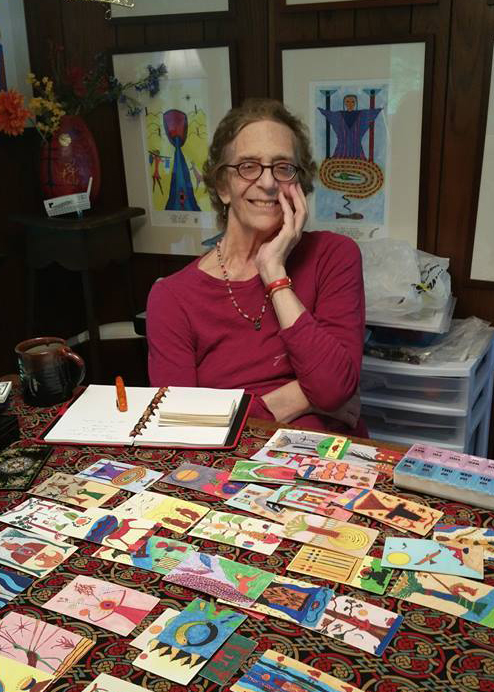
In Memoriam, Rachel Pollack  JIA (8/17/45 – 4/7/23) by Janet Maika’i Rudolph

How do you speak about someone who not only rocked your own world, but those of countless others? Whose fertile imagination and generous nature inspired and transformed so many lives? My friend, teacher, and mentor Rachel Pollack died in April. It’s hard to wrap my head around what a huge loss this is, not only for me, but for the world. She had an encyclopedic knowledge at her fingertips of mythology, tarot, historical trends, cultural trends, ancient civilizations. She was a storyteller at heart, using personal stories, universal stories to teach. She encouraged and guided each of us to discover and tell our own stories. Her stories won both the Arthur C. Clarke and the World Fantasy Awards. I call her the Grandmother of the Tarot because her work in that area has been so ground-breaking, far-reaching and depthful.

I write JIA, instead of RIP, special for Rachel. JIA means Journey In Adventure.  Rachel was adventurous to her core.  Rather than resting in peace I see her continuing her immensely adventurous journey just now on the other side of the veil. I see it as a continuing wondrous, magical ride that she has earned.

Continue reading “In Memoriam, Rachel Pollack  JIA (8/17/45 – 4/7/23) by Janet Maika’i Rudolph”

From the Archives: Archy and Mehitabel by Barbara Ardinger

This was originally posted on December 1, 2019

Archy the Cockroach and Mehitabel the Cat were introduced to the world in 1916 by Don Marquis, a columnist for the New York Evening Sun. Marquis was more than a mere columnist; he was a social commentator and satirist admired by nearly every famous writer of the first quarter of the 20th century. Franklin P. Adams, for example, said Marquis was “far closer to Mark Twain than anybody I know” (see note).

Continue reading “From the Archives: Archy and Mehitabel by Barbara Ardinger”

To Stand in the Presence of the Ancients! – Enheduanna, Part 1 by Janet Maika’i Rudolph

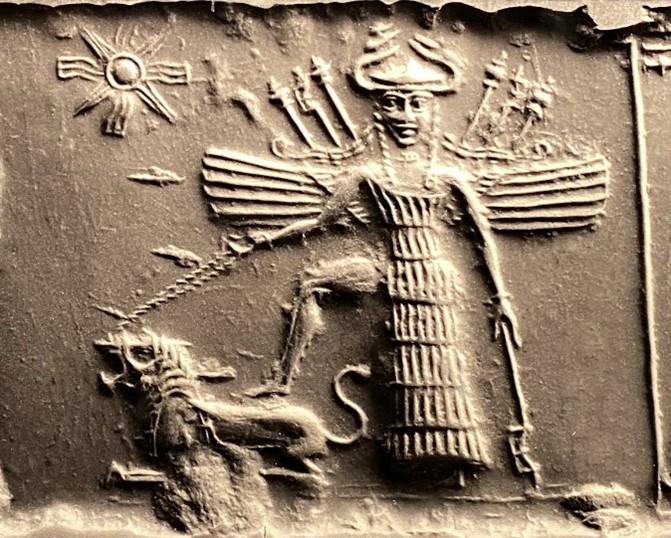
Ishtar controlling a lion ca 2334-2154 BCE

To be in the presence of antiquities is powerful. They carry an energy which is palpable.  I found this to be true at the recent exhibit at the Morgan Library in Manhattan that ran from October 14, 2022 through February 19, 2023. 

Enheduanna is a fascinating woman who lived in the lands of Mesopotamia circa the 23rd century BCE. She was a priestess who was also a writer and chronicler of her times. She named herself in her writings making her the first known author of any written works in history. She was so influential that for centuries after her death, scribes learned their craft in scribal schools by reading and copying out her work. Scholars have referred to her as the Sumerian Shakespeare[1]

Her main temple was in Ur, the very city that hundreds of years later gave rise to the biblical priestess Sarah and her husband, Abraham. We can only image how much they had been influenced by her.

Continue reading “To Stand in the Presence of the Ancients! – Enheduanna, Part 1 by Janet Maika’i Rudolph”

Legacy of Carol P. Christ: REMEMBERING MERLIN STONE, 1931-2011

This was originally posted on February 20, 2012

“In the beginning…God was a woman.  Do you remember?”  Feminst foremother and author of these words Merlin Stone died in Feburary last year.

I can still remember reading the hardback copy of When God Was a Woman while lying on the bed in my bedroom overlooking the river in New York City early in 1977.  The fact that I remember this viscerally underscores the impact that When God Was a Woman had on my mind and my body.  Stone’s words had the quality of revelation:  “In the beginning…God was a woman. Do you remember?”  As I type this phrase more than thirty-five  years after first reading it, my body again reacts with chills of recognition of a knowledge that was stolen from me, a knowledge that I remembered in my body, a knowledge that re-membered my body.  My copy of When God was a Woman is copiously underlined in red and blue ink, testimony to many readings.

Continue reading “Legacy of Carol P. Christ: REMEMBERING MERLIN STONE, 1931-2011”

Boundaries: A Poem Drawn from the Well of Jacob by Marcia Mount Shoop

kikuchi valley, waterfall and light lay in the forest, kikuchi, kumamoto, japan

Today is the day in the Christian church year that we remember Jesus’ last supper with his friends/chosen family before he was betrayed by some of those same friends/chosen family. He talked to his beloved circle that night about many things, including betrayal and their capacity to embody Divine Love in a broken world after his death. Just a few days later he was executed by the Roman government because his prophetic and compassionate life was a threat to the powers that be of his day–both governmental and religious. In honor of this day in my faith tradition, I share a poem I wrote about one of the women in Jesus’ life before he was executed by Empire. Since Jesus’ death, he was kidnapped again by multiple Empires who have used him to put an ecclesial and even divine seal of approval on systems of oppression and genocide. The woman at the well gives us a window into Jesus the liberator. May we have space to remember him today as another Easter Sunday approaches for Christians around the world.

Continue reading “Boundaries: A Poem Drawn from the Well of Jacob by Marcia Mount Shoop”

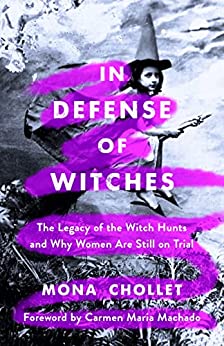
Life Still Shaped by the Witch Hunts? by Eline Kieft

In this article I reframe my understanding of feminism through the lens of Mona Chollet’s In Defence of Witches, and reflect on how my psyche as a woman today is still deeply influenced by the effects of the witch hunts in mediaeval times. 

Continue reading “Life Still Shaped by the Witch Hunts? by Eline Kieft”

That Old, Old, OLD Story – The Warts and Wisdom of the Ancient

My grandmother Clarine was an incredible human being. I absolutely could not be more proud to be her granddaughter. She started her first teaching position in 1927 at age 17. She met my grandfather in seminary; but despite her clear talent and call, the church apparently felt one minister was enough for the family and refused to ordain her. Undaunted, she famously wrote a one line reply to the bishop: Well, Moses got along fine without it, and Jesus got along fine without it, so I’ll be fine without it, too.

Continue reading “That Old, Old, OLD Story – The Warts and Wisdom of the Ancient”

Return to Mountain Mother[1] by Jeanne F. Neath

Mountain Mother, I hear you calling me.
Mountain Mother, we hear your cry.
Mountain Mother, we have come back to you.
Mountain Mother, we hear your sigh.

Lyrics by Carol P. Christ [2]. Sung to the tune of “Ancient Mother.” (origin unknown)

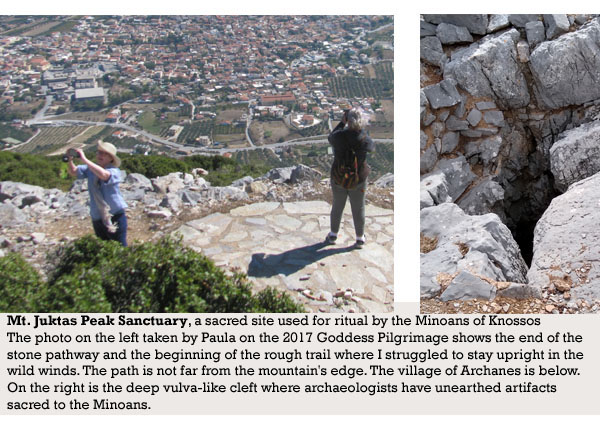
What do a bunch of feminist women do while riding a tour bus around the Mediterranean island of Crete? If they are on the Goddess Pilgrimage started by Carol Christ and continued by Laura Shannon, they sing songs honoring the Goddess. The song that drew me most from the first time I heard it on the fall 2022 Goddess Pilgrimage was “Mountain Mother.” Not surprising since the rocky, sparsely vegetated, yet hauntingly beautiful mountains of Crete surrounded us much of the time as our trusty bus wound its way up and down and around the island.

Continue reading “Return to Mountain Mother[1] by Jeanne F. Neath”