oes God exist within the LGBTQ community anymore or has the community itself abandoned God for all-night raves, dance clubs, alcohol, and hypersexualized and over commoditized fetishized forms of femininity and masculinity? Oftentimes, I find myself answering yes to the above questions. After surviving hate crime after hate crime and endless batches of newly elected conservative politicians hell bent on ignoring medical and social epidemic plaguing the very country they were elected to serve and protect, why would a community, oftentimes linked to sin itself, believe in a holy entity?
My good friend and fellow Feminism and Religion Contributor Marie Cartier’s forthcoming book, Baby You Are My Religion: Women, Gay Bars, and Theology Before Stonewall argues that American butch-femme bar culture of the mid-20th Century should be interpreted as a sacred space. Specifically, gay bars served as both communal and spiritual gathering spaces where butch-femme women were able to discover and explore not only their sexuality but also their spirituality. An opus of an academic accomplishment based off of the amount of in-depth interviews she conducted, Professor Cartier explores lived religion in an area that has become all too common within the LGBTQ community: the bar
I have to be honest, Jason Collins’ admission that he was a homosexual, albeit brave, upset me. While coming out is an completely unique experience to every individual that does it, Jason Collins’ story was just another example of the rampant sexist and heteropatriarachal world that privileges male bodies and sexualities over women’s similar experiences. While I applaud Jason’s story and it’s timing, the first thing I asked to my colleagues was: Where was the hubbub over Sheryl Swoopes or Martina Navratilova?
Like marking off items on a proverbial checklist, closeted LGBTQ individuals who exist within and outside of the world of professional sports, can recount the numerous things they struggle with in terms of their sexuality. From fearing of the actual coming out process, dressing in their car or at home to avoid the subtle glances and whispers of individuals in the locker room, to wondering what coming out would mean not only for their game but also for their social and, if they choose, spiritual lives, closeted and out LGBTQ individuals within the multi-billion dollar professional sports industry must grapple with that age old question: what does it mean to be gay and open about it?
I have to be honest, Jason Collins’ admission that he is a homosexual, albeit brave, upset me. While I understand that coming out is an completely unique experience to every individual who does it, for me Jason Collins’ story was also an example of the rampant sexist and heteropatriarachal world that privileges male bodies and sexualities over those of women. While I applaud Jason’s story and the timing, the first thing I asked to my colleagues was: where was the same hubbub over Sheryl Swoopes or Martina Navratilova? Continue reading “Thanks for Coming (Out): Sexuality, Sports, and Spirituality by John Erickson”
Love the sinner, hate the sin. We are all familiar with the bludgeon this statement represents in Christian circles. It functions as a way to maintain one’s goodness and Christlikeness (supposedly!), while simultaneously condemning and persecuting those who find themselves drawn to live lives outside the constraints of heteronormativity in all its variations. The statement hardly needs to be deconstructed – it proves its own emptiness in relation to the way sexuality is understood as identity in the contemporary context. (There are Foucaultian reasons to be unhappy with this understanding of sexuality – one of the disciplinary functions of power on his account is the desire to find a name that will express one’s true identity – but we’ll save that for another day.)
Instead, I think we should consider a much more fundamental contradiction in the way Christian churches today speak and think about sexuality. In many mainline congregations in the US-European context, the debate has been framed around celibacy versus “practice” for persons identifying as gay and lesbian. Excluding the fringe ex-gay movement and its horrors, there are three typical positions that churches take up. One, celibate gays and lesbians may participate fully in church life. Two, married and monogamous gays and lesbians may participate fully in church life. Three, neither marriage nor monogamy are required for gays and lesbians (or anyone else) – the latter is perhaps not a frequent position for churches to take, at least officially, other than in the MCC. For most mainline denominations, the fault line lies between those who assert the ‘vocation’ of celibacy for gay and lesbian persons, and those who permit marriage. Continue reading “Lust in the Heart by Linn Marie Tonstad”
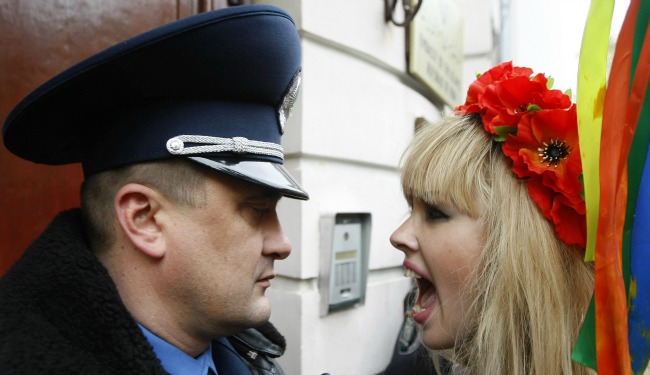
As most of us are aware by now, there is a “feminist-sextremist” group from Ukraine called “Femen.” This group has been very controversial by their public demonstrations of nudity, the words they paint on their bodies, and their explicit condemnations of political structures and organized religions. They were started by Anna Hutsol in 2008 and have now spread throughout Europe and the Middle East. The question I pose for this post is: Does Femen harness or hinder the power of the feminist critique?
Image from Konstantin Chernichkin/Reuters
Femen is precisely the kind of movement that pushes us in our understanding of feminism, the means by which it is best expressed, and the issues surrounding moral condemnation and religious sensitivity. Continue reading “(Femen)ism? by Kile Jones”
Cosplay is often a deliberate, interpretive and self-chosen performance of gender and power. Like drag performers, cosplayers put on a show of the characters they represent; and in my experience, they often do so within diverse, supportive and principally, inclusive communities.
This week my husband sent me a great blog post he found about cosplay and one woman’s determination that she would no longer tolerate being demeaned, objectified or trivialized because of what she chooses to wear. Blogger Megan Marie’s post, entitled “What would you do if you weren’t afraid,” inspires me. She points out and refuses the trappings of rape culture: victim blaming, assumed male control over female sexuality and shame; and claims her right to be who she is. I, as fellow (what is the female equivalent for fellow???) cosplayer, was also moved by her defense of this creative art. I have been cosplaying a long time, but I have been too afraid to speak much about this or to directly protest the rejection of these fantasy images within some feminist communities. So to answer Megan Marie’s question* in her own words, “What would you do if you weren’t afraid? My answer. I’d write this blog.”
Coplay = costume + play! It is the recreation of popular characters from video games, comic books, anime, scifi series, fantasy literature or the like. Cosplayers do this for the fun of it, the craft involved, to express one’s fandom and sometimes, professionally, usually within an arena where fans can enjoy one another’s recreations. The attempt to embody these characters involves a great deal of work and artistic expression. Many conventions, like Fanime Con in San Jose, CA, host panels in which fans can learn cosplay skills, such as armor construction, wig making and costume design. I have cosplayed the following characters: Sailor Star Healer, Eudial and Sailor Iron Mouse from the anime Sailor Moon, Misa
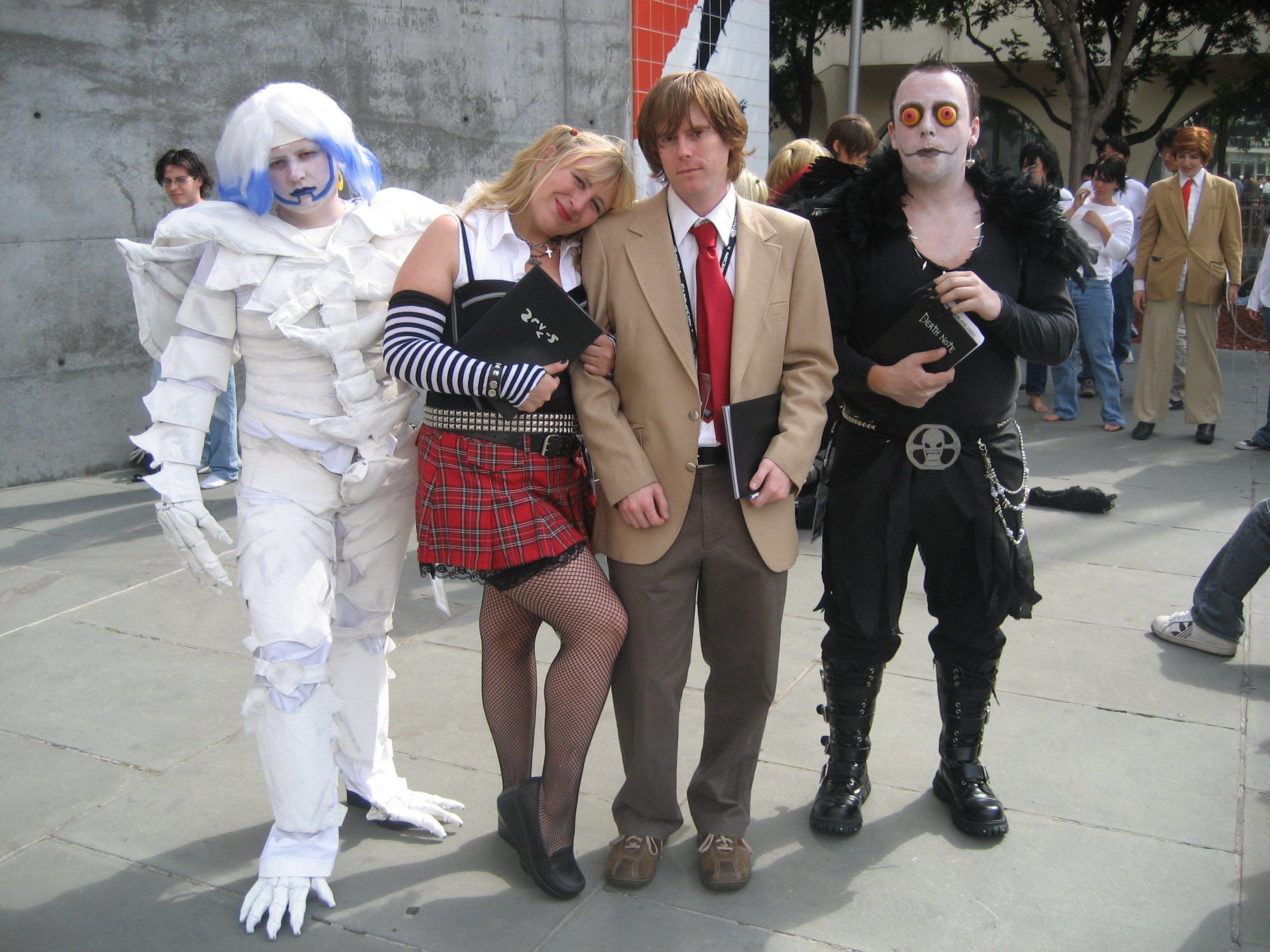
Death Note Cosplay: Misa and Light are in the center, flanked by their respective “Shinigami,” or the death gods they are working with
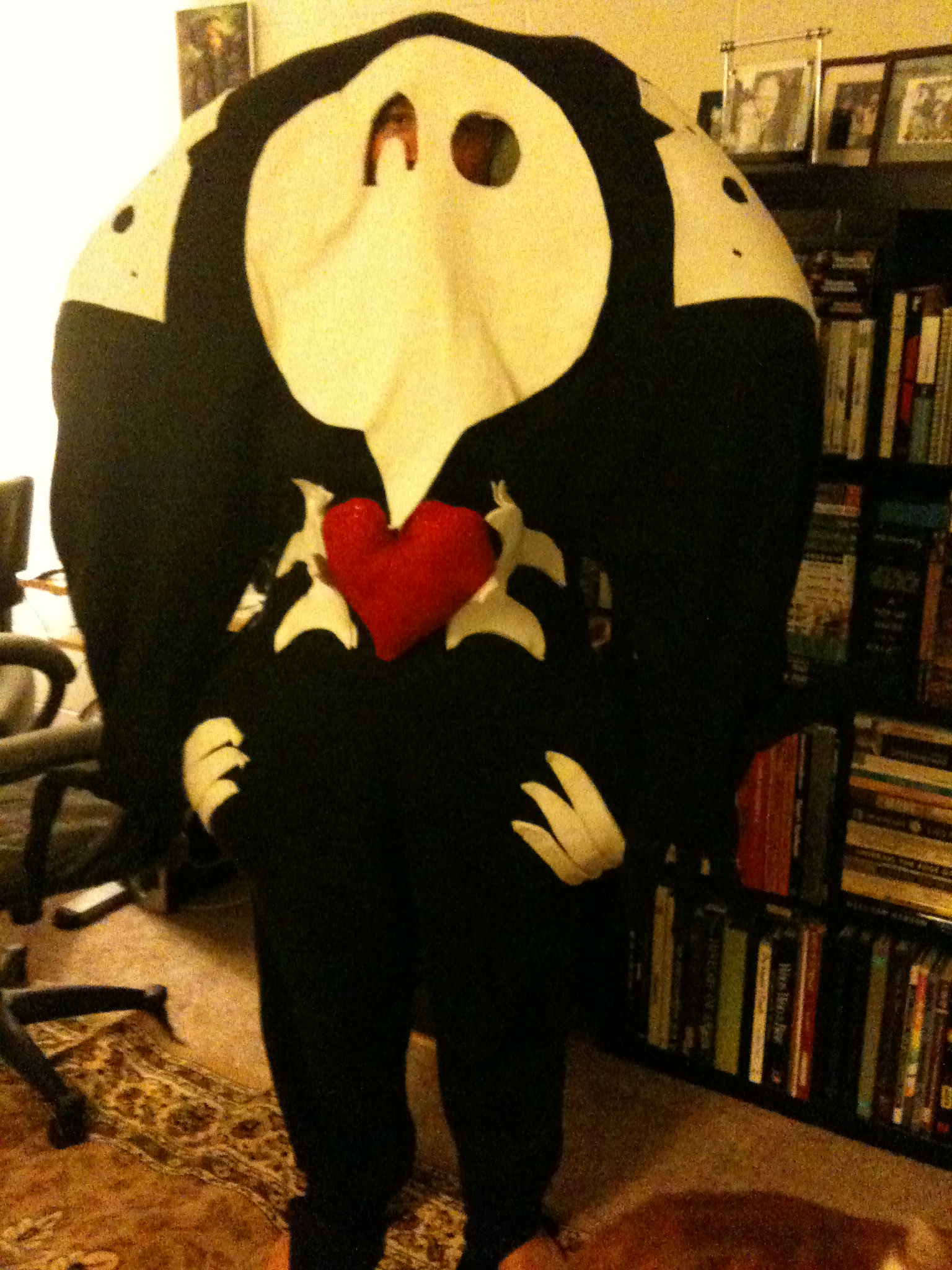
Sachiel from Neon Genesis Evangelion: I am trying on my almost finished costume here!
I am currently planning a to make a Metroid out of an umbrella and to cosplay Nyan-kitty at the May conference that my husband (who will be playing Tac-nyan), my sister and many of my friends attend.
In my last post, “Feminism and Religion: Where Do I stand?” I talked about how I support an atheistic, secular, and liberal feminism that criticizes organized religion and certain religious beliefs. After reading the comments and responding to them, I figured that having a brief interview with a woman who holds these sorts of views would be a good way to introduce them to this blog. I met Anondah Saide at a course at Claremont Graduate University titled, “Evolution, Economics, and the Brain,” taught by the Executive Director of the Skeptics Society and Founding Publisher of Skeptic Magazine, Dr. Michael Shermer. Anondah was the TA for the course, and I found her comments in class to promote science, reason, and skepticism towards religious and spiritual claims of all kinds. So without further ado, here is the interview: Continue reading “A Pro-Science, Skeptical Woman Speaks by Kile Jones”
On Sunday, February 10, the Tet parade in Little Saigon, Westminster (CA) went on as planned. Several thousand people turned up to celebrate the Vietnamese New Year, or what Khanh Ho, Assistant Professor of English at Grinnell College, has likened to “Mardi Gras, New Years, and Christmas all rolled into one.”
Deconstructing masculinity isn’t the key to solving social, sexual, and domestic violence across the world but it is a step worth taking when attempting to engage men in affecting change to stop these violent actions since men, statistically are the perpetrators of such crimes that both cause such outcry as well as perpetual silence.
The most disturbing part of the 2006 documentary Deliver Us from Evil isn’t the fact that Father Oliver O’Grady is rewarded by the Catholic Church with a new congregation in Ireland after his short stint in prison for the rape of dozens of children in the 1970s, but rather the hierarchy of gendered victimization which is often created throughout the various rape cases that are both reported and unreported throughout history.
I am often troubled by the ways in which rape cases are discussed and deconstructed via mediums such as blogs, online communities, social media networks, the news, and popular culture. No series of events troubled me more than the Jerry Sandusky trial, but more importantly, the ways in which the young boys and adult men who were subjected to Sandusky’s abuse quickly overshadowed the other rape cases that are reported on a daily basis, specifically those involving young girls and women. Continue reading “Second Class Rape Victims: Rape Hierarchy and Gender Conflict”
I remember being quite happy when my values about body, faith, and purpose lined up with those of my parents. With the support of my Protestant evangelistic community as well, I was “bold and fearless,” not caring who might judge me or disagree with me because I was not standing on my own. The anxiety of becoming embarrassed or having my world crashing down because of the ideas I expressed did not exist. My beliefs seemed special and right, and I had constant reaffirmation from family and community that they were.
But now I hold perspectives about spirituality and humanity that I can no longer discuss with ease in front of my family–not without my mother crying and feeling as if she did not know or like the person I had become. This may matter to me more than it might to other people since I have, for over a year now, returned to that home to write my dissertation. I am constantly challenged with the task of creating a space where I can honor my desires, needs, and truths. Like Judith Butler says, if I am a person who exists by doing, when I cannot express/speak/give an account of myself, I cannot fully exist. Family is important, but what gets sacrificed by pretending and silence? It is not only the self, but the chance for deeper, more authentic bonds. Continue reading “Luke 12:51-53: On the Verge of a Paradigm Shift by Elisabeth Schilling”


 My good friend and fellow Feminism and Religion Contributor Marie Cartier’s forthcoming book, Baby You Are My Religion: Women, Gay Bars, and Theology Before Stonewall argues
 that American butch-femme bar culture of the mid-20th Century should be interpreted as a sacred space. Specifically, gay bars served as both communal and spiritual gathering spaces where butch-femme women were able to discover and explore not only their sexuality but also their spirituality. An opus of an academic accomplishment based off of the amount of in-depth interviews she conducted, Professor Cartier explores lived religion in an area that has become all too common within the LGBTQ community: the bar






 Feminism and Religion