From the Archives: Uppity Women Unite by Barbara Ardinger

This was originally posted on August 2, 2014

I have a poster on my wall: UPPITY WOMEN UNITE. In big, red, capital letters. I don’t remember where I got this poster, but I know I’ve had it since the late 70s or early 80s. I’m sure it comes from the raggedy late 60s, when second-wave feminism got up a head of steam and uppity women began getting our attention. That’s when Betty Friedan said being a proper 50s housewife was like having a mental illness. It’s when Gloria Steinem founded Ms. Magazine, which (oh, horrors!) did not give us recipes or home-making tips and did not tell us how to dress to lure our men into bed. It’s when Mary Daly started giving us a whole new, original take on the English language. Ahhh, yes, those were the good ol’ days. And the bad ol’ days, too, when the Equal Rights Amendment was not ratified.

“Uppity” can be a troublesome word. In the olden days, if someone called you uppity, it means you were inferior to them and weren’t staying in what they thought was your proper place. If you were a black person, for example, and if you didn’t step off the sidewalk when white men were coming, you were uppity. If you were a woman who wanted equal pay for doing the same work a man did, you were uppity. Those women in the 1980 movie, 9 to 5, were majorly uppity. And they won the battle.

Continue reading “From the Archives: Uppity Women Unite by Barbara Ardinger”

From the Archives: I Believe Anita! by Marie Cartier

This was originally posted on April 7, 2014

During the past week I attended a Los Angeles premiere of a new documentary Anita: Speaking Truth to Power (Dir: Freida Lee Mock USA, 2013). The screening was sold out and I had great seats saved for me– sitting with a friend who works at Samuel Goldwyn, the distributor of this fine film.

In 1991, Anita Hill provided testimony she hoped would serve to dissemble the nomination of Clarence Thomas as a Supreme Court justice. Although the vote would end up being close (52-48) Hill’s testimony did not serve to dissuade the decision — Clarence Thomas’ nomination was confirmed and he was appointed to a life term on the Supreme Court four days after Hill’s testimony concluded. Here is an outline of the debate.

anita-580x857

I remember watching the hearings in 1991 at a friend’s house in Sacramento, CA where I was couch-surfing with another friend while we were in Sacramento from Los Angeles to protest for gay rights—to speak our truth to power. I remember being amazed that she was doing this—and that it was being televised. We were glued to the set before we went off to the protest we were attending.

Continue reading “From the Archives: I Believe Anita! by Marie Cartier”

Post-Roe Dirge by Liz Cooledge Jenkins

I have seen a sad thing.

Faces twisted in strange (un)righteous anger outside a clinic

Or sitting around the dinner table laughing

Like the world was not just shaken gravely beneath the feet of half of them

(No, all of them)

(No, all of us)

Or shouts of celebration when a wail of grief is due.

We played the pipe for you and you did not dance.

We sang a dirge, and you did not mourn.[1]

(What is wrong with them?

What has gone so wrong with us?)

Continue reading “Post-Roe Dirge by Liz Cooledge Jenkins”

Miami in Virgo, a Mystical Feminist Novel by Sally Abbott     

Fifty years ago, California and elsewhere in the US and around the globe were roiling, creative, hopeful, and passionately dynamic places where many of those currently active in feminism and  feminist religion and spirituality found their voices and lives’ work. To offer a taste of that historical moment through the eyes of one young woman, you are invited to enter the world of the novel Miami in Virgo.

Set in California’s Central Valley in the mid-seventies, Miami in Virgo is a coming-of-age novel narrated by seventeen year-old Miami Montague. Insecure and fatherless, Miami struggles to hammer out an identity through her photography and the practice of feminist Wiccan ritual with her friends. She is short-circuited and ambushed, however, by emotional rivalries, sexual insecurity, and family drama. Her early years spent with her fundamentalist grandmother in east Texas cast a long shadow.

Disappointments in love coupled with exposure to the nascent gay pride movement in San Francisco lead her to question her own sexuality. Her confidence in free fall, Miami enters into a reckless one night stand at a Halloween party that has disastrous consequences for her move into a household full of teenage stepbrothers when her mother unexpectedly remarries and they move across county. Her peccadilloes take on a spiritual dimension and she goes through a soul searing scrutiny which eventually leads to the resolution of her conflicts through the deepening of her character.

Continue reading “Miami in Virgo, a Mystical Feminist Novel by Sally Abbott     “

Little Red Deer by Sara Wright

At the forest edge

  twigs rustle,

papery leaves

betray

a vision of grace

  emerging

from behind

my chair.

Staring intently

liquid coals

will me

to turn…

You nibble

a few grasses

at my feet

without fear.

We meet

on pine strewn paths

or when I trim

 cherry or rose

plucking old thorns.

Continue reading “Little Red Deer by Sara Wright”

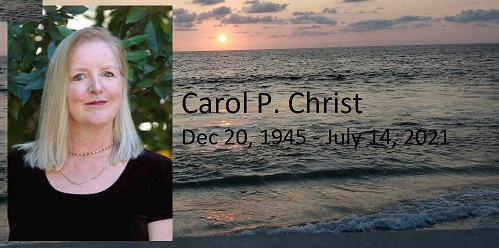
The Legacy of Carol P. Christ: Dance of the Bees: Reading the Language of the Goddess

This blog was originally posted on December 1, 2014

The image from an ancient Cretan bowl (c.1700 BCE) from the Sacred Center of Phaistos pictured here has often been interpreted as an early depiction of Persephone’s descent or rising. But are clues from later Greek mythology pointing in the right direction in this case?

Recently, my colleague Mika Scott posted the Phaistos bowl image on our Goddess Pilgrimage Facebook site in conjunction with the bee pendant from Mallia. This juxtaposition led me to think again about the importance of bees and pollination in agricultural societies and to offer an alternative reading of the symbolism on the bowl.

Continue reading “The Legacy of Carol P. Christ: Dance of the Bees: Reading the Language of the Goddess”

Be the Donkey: On Parshah Balak by Ivy Helman.

The Torah portion for July 16, 2022 is Balak (Numbers 22:2 -25:9).  Some of what happens in Balak is familiar: idolatry, divinely-sanctioned death penalties, and a plague.  But, did you know that this parshah has a talking female donkey who stands up to abusive behavior?  Perhaps not.  That talking donkey and the larger story of Balak’s attempt to curse the Israelites raises questions about gender, how we treat animals, choices, free will, violence, courage, and having one’s eyes open to what is really happening around one’s self. All of which is what we will be looking at today.

Balak begins with this story about Balaam.  The Moabite king, Balak, wishes to curse the Israelites because he is worried about their size and their impact on the land and its current inhabitants (22:3-4).  He sends representatives to bring  Balaam, a powerful man whose curses and blessings have tangible effects on their recipients (22:6), to him.  Balaam meets with those representatives and tells them to wait; he has to talk to the deity in order to know what to do.  The deity commands Balaam to stay put and to not curse the Israelites, for they are blessed (22:12). Indeed, a first in quite a while. 

Continue reading “Be the Donkey: On Parshah Balak by Ivy Helman.”

Remembering Rosemary Part 2 by Janice L. Poss and Theresa A. Yugar

Editor’s Note: A more formal memorial to Catholic Feminist Theologian Rosemary Radford Ruether was posted here at Feminism and Religion at the time of her passing. Now we are delighted to share these memories of her by two scholars, Theresa A Yugar and Janice L. Poss, who knew her well, especially in her last months. Therese’s reflection is below and Janice’s will appear tomorrow. As Janice notes in her post, “More than any deep theological concept, doctrinal exegesis, or other hyper-scholarly thought, she taught me simply by being who she was – a woman – and she gave me the ultimate gift, the gift of herself.” Through these posts, Theresa and Janice pass on some of Rosemary’s wise and caring gifts to our FAR readers. Part 1 was posted yesterday. You can read it here.

Janice, Theresa with Rosemary

Almost five years ago, Rosemary Radford Ruether suffered a devastating stroke that left her partially paralyzed and no longer able to speak or write, activities that were integral to her life as a writer, teacher, activist, and scholar. During her difficult last years Janice and I learned new ways of engaging her that were academically stimulating and fulfilling for her. We became advocates for her during her disability as she had been an advocate for us. Thus, out of pain grew blessings.

Janice and I dedicate and share with you these two short reflections that reflect our struggle to find our way without her. We know there will be many more reflections composed and shared by others whom she mentored, influenced and touched. Now—in the midst of our grief and sadness at her loss—we offer our personal memories of how she enriched our lives every day until she passed from our midst at 2pm, on Saturday, May 21, 2022.

Continue reading “Remembering Rosemary Part 2 by Janice L. Poss and Theresa A. Yugar”

Remembering Rosemary Part 1 by Janice L. Poss and Theresa A. Yugar

Editor’s Note: A more formal memorial to Catholic Feminist Theologian Rosemary Radford Ruether was posted here at Feminism and Religion at the time of her passing. Now we are delighted to share these memories of her by two scholars, Theresa A Yugar and Janice L. Poss, who knew her well, especially in her last months. Therese’s reflection was posted yesterday and Janice’s is below. As Janice notes in her post, “More than any deep theological concept, doctrinal exegesis, or other hyper-scholarly thought, she taught me simply by being who she was – a woman – and she gave me the ultimate gift, the gift of herself.” Through these posts, Theresa and Janice pass on some of Rosemary’s wise and caring gifts to our FAR readers.

Janice L. Poss, Rosemary and Theresa A. Yuger

She’s gone, but not forgotten. She is there, presence felt. The Spirit, as they say, works in mysterious ways. I knew about Rosemary for several years after attending two presentations  on feminist topics that she gave at Loyola Marymount University in 2005 and 2008. In 2006, I also recall hearing about her while organizing the first Roman Catholic Women Priests (RCWP) Mass in Los Angeles. Once I entered Claremont Graduate University as a Ph.D. student I heard quite a bit about her because my colleague and friend, Theresa Yugar, mentored me through orientation until she graduated. Occasionally I would see Theresa and Rosemary at Pilgrim Place when I attended Women Church Services. Although Rosemary was still teaching one class a semester, I could never attend because I was working full-time.

Continue reading “Remembering Rosemary Part 1 by Janice L. Poss and Theresa A. Yugar”

Advancing Our Feminist and Womanist Theologies by Xochitl Alvizo

I recently completed a chapter for a book on Latinx theologies; it’s the second edition of the Wiley-Blackwell Companion to Latino/a Theology, edited by Orlando O. Espín, but this time with the slightly changed title of Companion to Latinoax Theology—aiming to be more inclusive in its umbrella term. The project has 35 contributors and covers everything from interreligious dialogue and care for creation, to race, racism and latinoax cultures, as well as chapters on such subjects as Christology, the bible, and ecclesiology. My particular chapter was about the intersection of gender, feminisms, and Latinoax theologies—not surprising. But what I loved in the process was a particular emphasis that emerged—decoloniality, like a thread woven throughout the chapter as it evolved; and this I now see as a necessity for Christian theologies. Let me explain.

Continue reading “Advancing Our Feminist and Womanist Theologies by Xochitl Alvizo”