Living in an Ever-Changing Co-Creative Universe by Carolyn Lee Boyd

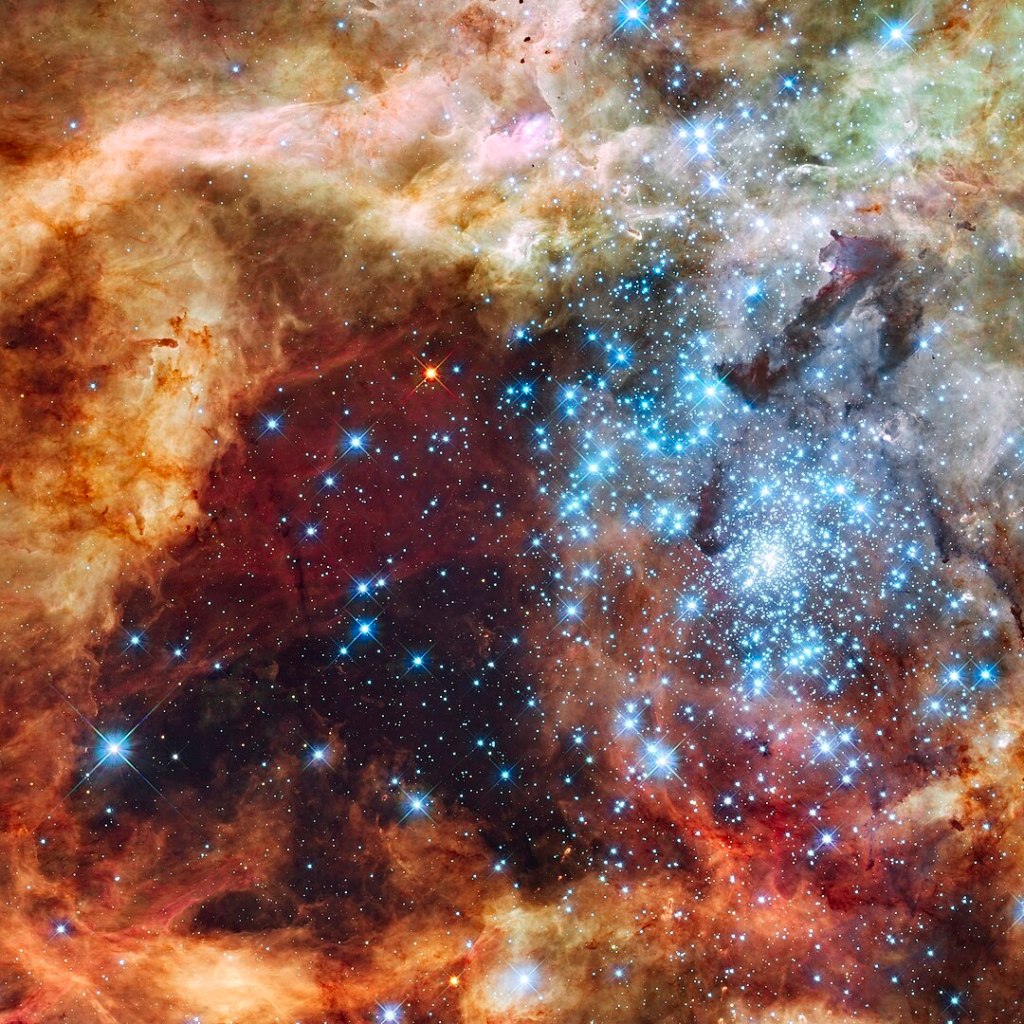
Grand Star Forming Region. These stars are only a few million years old.

Imagine living in a co-creative universe where all beings, including the Divinity and humans, are ever co-evolving reality in a way that nurtures life. What kind of a world would that be? Feminist theologian and FAR contributor Carol Christ brilliantly describes how these ideas, part of an approach called process philosophy, deeply resonate with Goddess thealogy in her 2003 book She Who Changes: Re-Imaging the Divine in the World

She writes “process philosophy states that all life in is process, changing and developing, growing and dying, and that even the divine power participates in changing life. Humans and other beings are not things (substances or essences) situated in empty space, as has often been thought by philosophers and scientists, but are active processes ever in relation and transition…” (3). In fact, “the whole universe is alive and changing, continually co-creating new possibilities of life” (45). Further, “Process philosophy asserts that feeling, sympathy, relationship, creativity, freedom, and enjoyment are the fundamental threads that unite all beings in the universe, including particles of atoms and the divinity” (3). 

Continue reading “Living in an Ever-Changing Co-Creative Universe by Carolyn Lee Boyd”

Samhain and the Goddess by Judith Shaw

The wheel of the year is turning us once again toward the dark half of the year. Here in the United States, the bright, shining days of youth and achievement receive the most attention. Death and darkness are rarely honored and often feared.

But the ancient Celts had a completely different view of their place in the world. With a strong belief in reincarnation, the Celts saw death as simply a point of transition in a very long series of lives. People honored the darkness of both night and winter as starting points. In the Celtic worldview a day began at sunset, not sunrise, and the New Year began on Samhain, October 31—the midpoint between Fall Equinox and Winter Solstice.

Samhain, one of the four great fire festivals of Celtic tradition, might have begun long before the Celts arrived in Ireland under the influence of an ancient goddess, Tlachtga (tclak ta). She was most likely from the time of the Fir Bolgs, (fair bolak) the Bronze Age inhabitants of Ireland from the East, and later incorporated into the Celtic pantheon.

Tlachtga--celtic-goddess-painting-by-judith-shaw
Tlachtga, Celtic Goddess of Sun & Lightning, gouache on paper
Continue reading “Samhain and the Goddess by Judith Shaw”

Merrows: The Enchanting Mermaids of Celtic Mythology by Judith Shaw

Mermaids have captivated our imaginations worldwide for thousands of years. Across cultures, mermaids are depicted in differing ways—as a dangerous seductresses like the Greek sirens, or as one who could grant immortality like the Japanese ningyo.  

Celtic Ireland, with its abundance of fairies and magical beings has its own kind of mermaid, the Merrow. This term derives from the Gaelic word, “murúch,” which translates as “sea maiden.”

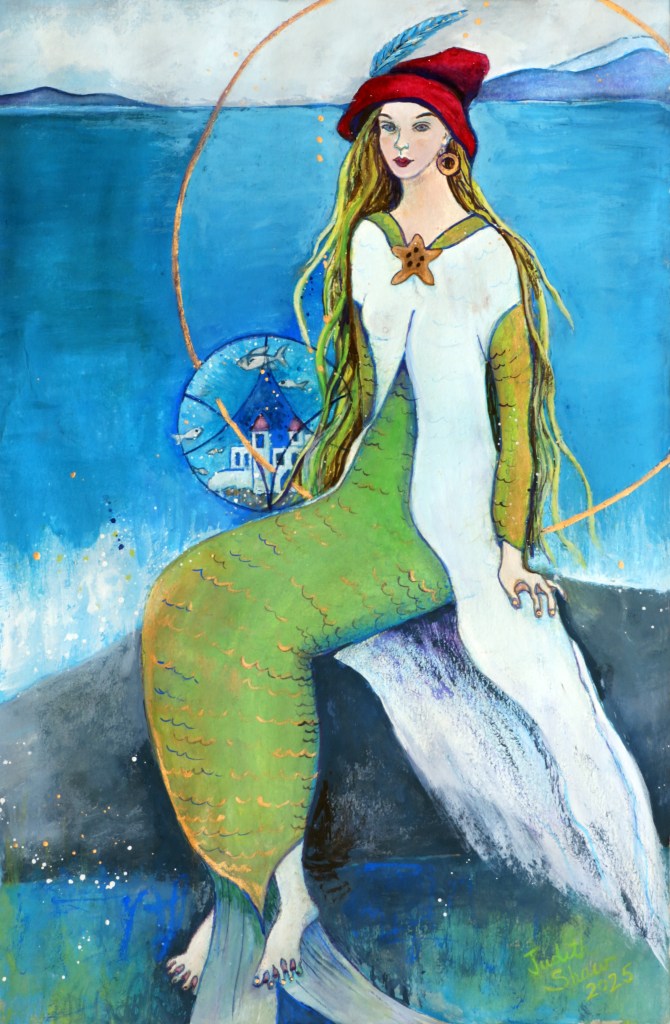
A Merrow‘s Longing by Judith Shaw, gouache on paper, 12″x18″
Continue reading “Merrows: The Enchanting Mermaids of Celtic Mythology by Judith Shaw”

The Cauldron of Life: Destruction and Creation in Celtic Myth, Part 1 by Judith Shaw

With each passing day, the world spirals deeper into chaos under the weight of the most unsuitable and morally bankrupt president the United States has ever elected. In nearly every aspect of life—from politics to economics to technology to the environment—the world as we knew it is gone. We find ourselves caught between chaos and creation. We are in liminal times.

Badb, Dark Goddess by Judith Shaw
Badb: Fate Weaver by Judith Shaw
Continue reading “The Cauldron of Life: Destruction and Creation in Celtic Myth, Part 1 by Judith Shaw”

Summer Lessons, by Molly M. Remer

Let us be gentle with ourselves 
as we cross the threshold 
into summer, 
as we both open our hearts to change 
and open our hands to choice. 
It is now that we both let things go 
and celebrate what is flourishing, 
what is thriving and growing 
and calling us onward. 
Let us be soft and supple, 
luminous and languorous. 
Let us practice the discipline of pleasure 
and the liturgy of delight. 
Let us protect wide margins for magic,
commit to our own life’s unfolding 
and swim freely 
in the current of the sacred 
that is always available 
to receive us 
and welcome us home.

Today, I sit missing the orioles and thinking about cycles of change, how things grow and decline, and how we can choose to be present or not with what we see and feel. I tip my head back in the green filtered light of morning and discover berries beginning on the mulberry trees. The wild raspberries and blackberries too are tipped with small, firm caps of green. I am feeling the sort of overdue clarity that descends when I finally realize I can let something go, that not everything is mine to carry or mine to fix. I know that this clarity too will come and go, but for now, I welcome it, feeling the cool wind stirring my hair and brushing my shoulders as I enjoy the sunshine and the sound of hawks on the wing. There is a powerful hope in these blue sky days and for now, I bask in the sensation of both remembering and reclamation.

This year, as we tip into summer in the Northern hemisphere, the temperatures in my own Midwestern biome have been surprisingly cool, peaceful and rainy. In an era of climate change, this slow entry into the heat of the year has felt welcome and encouraging. Something that continues to inspire and teach me this year has been to start where my feet are, to return again and again to where I am on this earth and in my body. In a culture that encourages fragmentation and distraction, distance, discord, and dis-embodiment, this practice of return is an act of both rebellion and reclamation.

I have been writing for Feminism and Religion for 13 years. This year, sitting down to write and reflecting on the life lesson of starting where my feet are, I decided to go back through my past summer posts here to discover the other lessons I have learned from summers gone by. I chose thirteen lessons to share from past summer posts:

Continue reading “Summer Lessons, by Molly M. Remer”

The Wisdom of Cerridwen: Transforming Her Cosmic Brew by H. Bryon Ballard

Moderator’s Note: This is the Preface to the recently published anthology, The Wisdom of Cerridwen: Transforming Her Cosmic Brew.

Cerridwen, ancient Queen,
Dark Mother, take us in.
Cerridwen, ancient Queen,
Let us be reborn.
—a Reclaiming chant

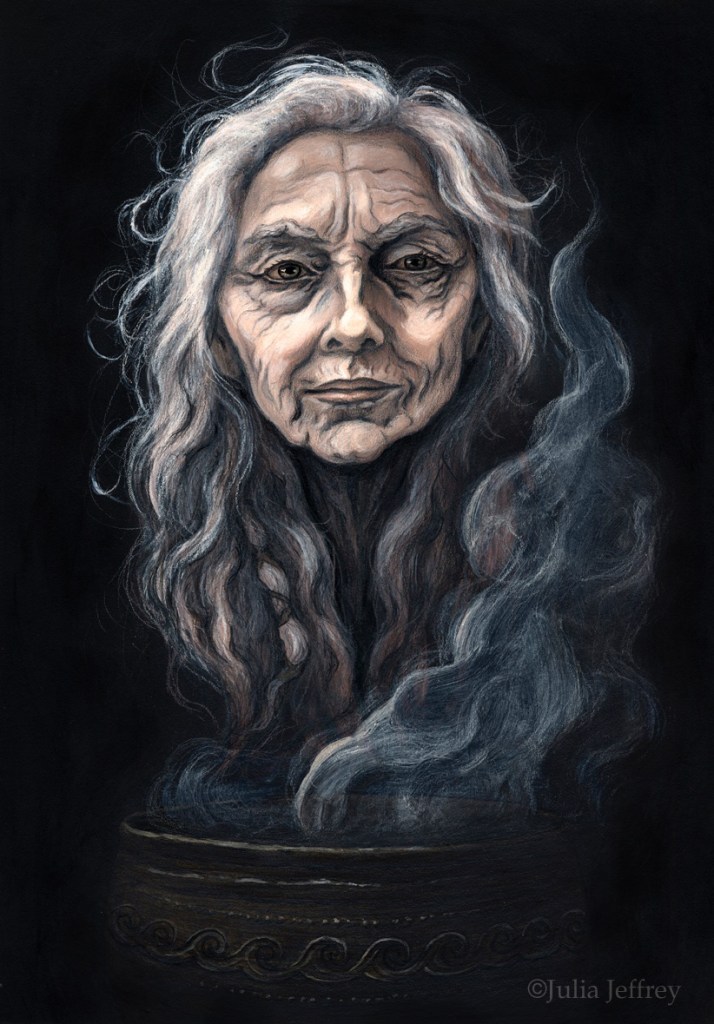
The Cauldron, Julia Jeffries

Open these pages and relish the words of this divine Mother, this wild Sister, this trickster and keeper of the Cauldron of Eternity! Spend time with Her. Learn Her sacred ways, Her stories, Her lore.

I learned the chant above at the Glastonbury Goddess Conference where I taught several years ago. I often use it in both my private meditations and in public rituals. It is simple but direct, quite unlike the Goddess it honors. I learned how to pronounce Her name from a Welsh-speaking colleague who gave it a rolling “r” and an emphasis on the second syllable. Keh-RRRHID-wen. Try it. So delicious to say.

Continue reading “The Wisdom of Cerridwen: Transforming Her Cosmic Brew by H. Bryon Ballard”

Pandora/Gaia—Bringer of Gifts by Judith Shaw

As we move deeper and deeper into full autocratic rule, the timeless themes found in mythology help me find my way. 

My first thought for these days was of Pandora, whose story in the myth of Pandora’s Box serves as a powerful metaphor for the complexities of human choice—relevant today by the choice of many to elect Trump, resulting in multiple destructive consequences. 

Hope Endures, by Judith Shaw, gouache on paper, 7.5″x10″
Continue reading “Pandora/Gaia—Bringer of Gifts by Judith Shaw”

Opening All the Windows and Returning the Goddess to Her Rightful Place by Caryn MacGrandle

The quote that describes Jesus as the “front door of God” is found in the Bible, John 10:7, where Jesus says, “I am the door of the sheep”; essentially meaning that the only way to access God is through Jesus, as he is the entrance point to God’s presence.

I have been calling on Hathor, and last night, She came.

Ah, let me back up a few steps.

I have up to now not given much thought to Egyptian Goddesses instead preferring my Celtic and Greek ones. But a few days ago, I attended this lovely workshop by Tahya who has developed a modern day systrum, the percussion instrument used by Priestesses in honor of Hathor.  And as so often happens on my path, when you crack the window, She comes. 

The last two days I have been listening to Hathor meditations, the Mother of all creation, the Goddess of Love, an Egyptian Goddess whose worship may have begun in the Predynastic Era over 5,000 years ago.

Continue reading “Opening All the Windows and Returning the Goddess to Her Rightful Place by Caryn MacGrandle”

Amphitrite: Greek Sea Goddess — Balance, Abundance and Protection, by Judith Shaw

In the origin stories of the Greek deities the overarching importance of water, which surrounds their domain, is undeniable. Water held the power of life, death and renewal.

In each successive pantheon of Greek goddesses and gods — the Primordials, the Titans, and the Olympians — a goddess and a god ruled the seas together. During the time of the Primordial deities, it was Thalassa and Pontus, followed by the Titans, Thetys and Oceanus, and Doris and Nereu, and finally by the Olympians, Amphitrite and Poseidon.

“Amphitrite, Greek Sea Goddess,” gouache on paper, 11″ x 17″ by Judith Shaw
Continue reading “Amphitrite: Greek Sea Goddess — Balance, Abundance and Protection, by Judith Shaw”

Guanyin: My Very Own Goddess of Compassion

It was a class that changed the course of a personal history. Mine. The year was 2001. I had arrived in the United States a couple of years earlier to study journalism. In my last term – after four semesters of trying hard to navigate the American education system, what with its confusing terminology of credit hours, electives, majors, minors, I decided to venture out of my comfort zone (this was my Breaking Bad moment) – and took a 3-credit grad course, Religion in China, as an elective (that word again; and oh, when I first arrived, I thought 3 credit hours meant dedication to a grand total of three hours of coursework over the entire semester; you get to choose when).

Goddess Tara. Personal collection.

It was in this class I was first introduced to Guanyin, the Chinese goddess of Infinite Compassion and Mercy. Guanyin, a bodhisattva[i] who rushes to the aid of her devotees upon hearing their cries, herself has quite an interesting history. She arrived in China from India as Avalokiteshvara or “the lord who gazed down at the world” as a male. Little wonder then that this gender fluidity makes her a popular deity among members of the LGBTQ community. Somewhere along the journey, Avalokiteshvara transforms into Tara. Apparently, so moved was Avalokiteshwara by the suffering of those trapped in samsara[ii] that he wept copiously, his tears creating a lotus from which sprang the goddess Tara.

Continue reading “Guanyin: My Very Own Goddess of Compassion”