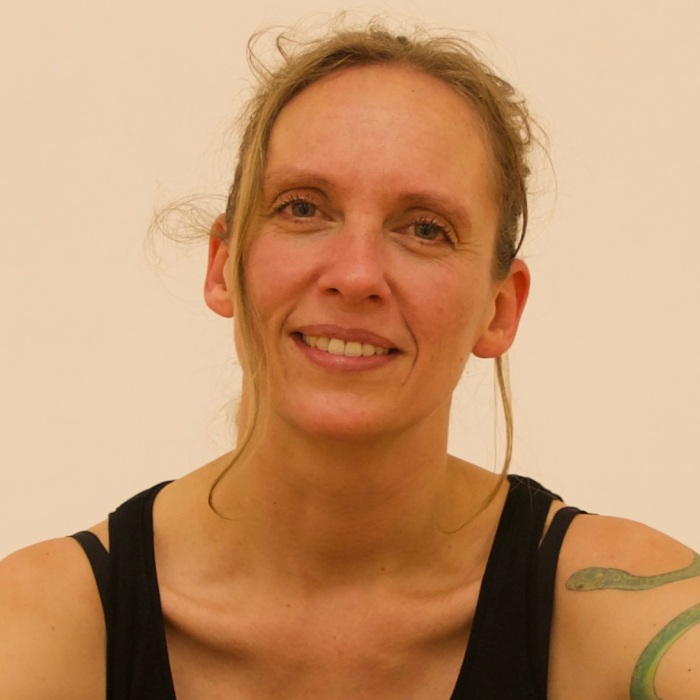
Re-Anointing the Body by Eline Kieft

How ‘at one’ are you with your body, and what reasons might there be if your body-sense got separate(d) from your soul-sense?

This piece starts with the difference between feminine and masculine spirituality, and introduces a few reasons why living in a physical body isn’t always easy.

It then invites a shift to the beloved body and how we can start to re-instate our body as a sacred place and love it from within.

Continue reading “Re-Anointing the Body by Eline Kieft”

“For I know the plans I have for you:” The coming out story of a queer Catholic raised in the Purity Culture Movement part 1 by Emma Cieslik

It was my last interview for the Muncie LGBTQ+ History Project. I was a senior in college, and I was about to complete my tenth interview focused on the intersections of Christian religion and queer identity. I was slated to conduct an oral history interview with Rachel Replogle, a nonbinary lesbian who runs Indiana’s only queer-affirming wedding videography business. I had expected to explore elements of her work in churches and religious spaces—and I had encountered experiences of trauma, both familial and religious, through the project—but Replogle’s story touched a nerve about my own experiences and made my question the project’s impact on the people conducting it.

Since 2018, the Muncie LGBTQ+ History Project has been collecting the stories of queer people who grew up in and around Muncie. I worked with the project for over a year as a research associate, conducting ten long-form oral history interviews with members of the Muncie LGBTQ+ community about their experiences growing up in Muncie, a small town in East-Central Indiana in the heart of the Rust Belt. Spearheaded by Dr. Emily Johnson [1] the project seeks to uplift and celebrate queer experience in the Midwest. I entered the project with an interest in how queer individuals engage with religious identity, especially in spaces that deny their personhood and/or invalidate their relationships.

Continue reading ““For I know the plans I have for you:” The coming out story of a queer Catholic raised in the Purity Culture Movement part 1 by Emma Cieslik”

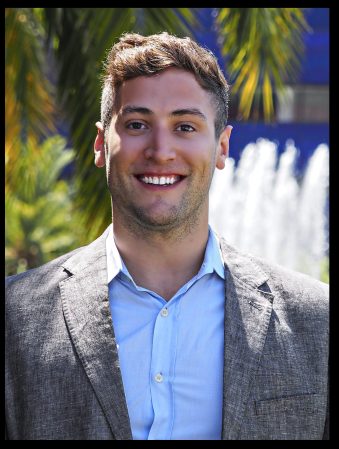
The Door by John Erickson

Faith is something we get from each other, and sometimes in the most magical of circumstances, faith becomes embodied by the person you love the most.

I have a Ph.D. in American Religious History but I’ve never been much of a religious person.  It’s been one of the conundrums of my life but nevertheless, I found religion and its role in influencing, for good and bad, the lived experiences of the LGBTQ community something worth exploring.

I’ve been struggling with writing this post ever since I graduated and officially became “Dr. John.” In preparing for my defense, the Chair of my Dissertation Committee requested that at the start of the defense, he wanted me to introduce my project, its overall scope, and most importantly why I wrote it.

Why did I write it?  How does one answer why they chose to devote 8 years of their life to a single subject in search of an original idea?  While some would sit and grapple with this question, I knew what the answer was all along because it always was (and always will be) about my maternal grandmother, Gladys Hritsko.

I wanted to know what made me different.  Throughout my dissertation, I interviewed people who, much like myself, grew up in similar small towns, attended the same conservative church services, and heard the same damning things that I did about my sexuality being preached from the pulpit. Many of my subjects were deeply hurt by religion and it set some of them up for years of searching and painful memories and experiences that both forced them to leave their religious and faith-based communities they grew up in or, in the worst case, being kicked out by their family as a result of their religion.

Continue reading “The Door by John Erickson”

Let’s Talk About Shame by Janet Maika’i Rudolph

Disclaimer/Trigger Warning: This post includes content about rape, sexual assault, domestic abuse, violence.

The recent, meaningful discussions on this forum about how so many of us feel broken due to our own personal histories have fortified and inspired me. I’ve marveled as women have spoken up so honestly and even brutally about the effects of trauma, rape, cold and dismissive mothers, abusing fathers and so on.

Some of you know my own story. I am a survivor of my father’s childhood abuse and then a rape at knifepoint in my early twenties. I carry a deep and abiding sense of shame. This feeling has always flummoxed me. Why should I feel shame when I didn’t do anything to create my own abuse? Shouldn’t my father have felt the shame? The rapist? Why did I get saddled with it? I was the victim (and survivor), not the perpetrator. But shame is indeed the feeling I carry and I’m not alone. Why is this feeling so pervasive? I don’t have all the answers, but I do have some clues about where to look.

Continue reading “Let’s Talk About Shame by Janet Maika’i Rudolph”

The Bodies of Christ, Broken for You by Tallessyn Zawn Grenfell-Lee

Years ago, I learned of a small Christian sect that has an unusual sexual practice due to an interpretation of each Christian as the literal ‘bride of Christ.’ Every member of this religion is instructed from the age of 12 to imagine their sexuality always in relation to the (male) person of Jesus; men are encouraged to imagine they are women during intercourse and masturbation, to avoid a homoerotic relationship with Jesus; and they basically imagine their wives are Jesus.

I admit that I find this idea both bizarre and alarming. Yet, ironically, this sexual practice does accomplish one interesting goal: men imagine women as the literal Body of Christ.

Huh. Continue reading “The Bodies of Christ, Broken for You by Tallessyn Zawn Grenfell-Lee”

Pleasure, Touch, and Spirituality by Chris Ash

Sitting in front of the computer, I slowly and intentionally insert earbuds, click to start my favorite writing playlist, and open up Microsoft Word. I feel the tips of my fingers resting lightly on the keys, and notice the slight give of each printed square, glossy in the middle from months of 80 words per minute. I lightly tap my fingers on the keys, not pressing enough to type a letter, body motionless except my fingers, watching the absolute stillness of the screen, exploring the edge between pressure and performance with slow, shallow breaths, finally noticing the moment when the edge is breached, the key catches, and a letter appears on my screen, taking it in with satisfaction.

This is how all my writing starts, with a ritual of simple pleasure and partial attempt at channeling. My partner recognizes this move when he sees it. It’s one I repeat throughout the writing process, as I’m waiting (hoping) for the next words to come to me. I’ll stop, lift my head and close my eyes, and allow my fingers to wiggle lightly over the keyboard as if inviting the unseen to move through me and write my piece. If that still doesn’t produce words, I might run my hands from thigh to knee, fingers pressing with increasing depth into denim-covered flesh. Or I might bring my hands up to my face, fingers resting on my hairline, palms lightly covering my eyes, as I experience the instant soothing of darkness and warming effect over closed eyelids, connecting to the me-within so she can help me bring forth missing concepts. Continue reading “Pleasure, Touch, and Spirituality by Chris Ash”

Playing Safe: BDSM & The Ethics of Justice and Care By Angelina Duell

From the archives – 9/23/11 – our first FAR year! 

This post is written in conjunction with the Feminist Ethics Course Dialogue project sponsored by Claremont School of Theology in the Claremont Lincoln University Consortium,  Claremont Graduate University, and directed by Grace Yia-Hei Kao.

It is Wednesday night and I am alone in the house. It’s dark; the only light is from my computer screen. A bead of sweat rolls from my brow as I delicately tap the keys of my keyboard until two words stare back at me, “BDSM feminism.” With bated breath, I press enter.

Just kidding.  Continue reading “Playing Safe: BDSM & The Ethics of Justice and Care By Angelina Duell”

Sex is a Feminist Issue: An Interview with Rev. Dr. Beverly Dale by Jera Brown

Sex is a feminist issue. Harmful perspectives on sex and our physical bodies have been used to disempower and invalidate the sexuality of women, LGBTQIA folks, and people of color. It runs through our theology and cultural traditions within the church.

I run a personal blog which speaks positively about sex and queerness. And when folks find it, frequently, their first questions to me is what other resources are out there that teach a better Christian perspective? I often tell them to start with The Incarnation Institute for Sex and Faith.

IISF offers “inclusive, science-friendly, sex-positive” educational programming for church leaders and lay people. Founder Rev. Dr. Beverly Dale, affectionately known as “Rev Bev,” is ordained through the Christian Church (Disciples of Christ) and currently teaches courses on sexuality and religion at Lancaster Theological Seminary.

The institute recently released a four-part web series, Reading the Bible with Sex-Positive Eyes, which includes the topics: “Introduction to Christian Sex Negativity: The Beginnings,” “Discerning Truth, Discerning Culture,” “Sex in the Bible: The Good, The Bad & the Ugly,” and “Sex: Whether, When, and How.”

I interviewed Rev Bev about the new series.

Continue reading “Sex is a Feminist Issue: An Interview with Rev. Dr. Beverly Dale by Jera Brown”

“The Burning Lava of a Song” by Joyce Zonana

Aurora’s autobiographical narrative is a passionate paean to poets as the “only truth-tellers, now left to God”; she celebrates them as agents for personal and social transformation. As we come to the end of this National Poetry Month in the U.S., where truth is under siege, it’s worth recalling Aurora Leigh and its daring exploration of poetry, gender, divinity, and social justice.

jz-headshotI was in graduate school when I first read Aurora Leigh, Elizabeth Barrett Browning’s fiery 1856 epic about a young woman claiming her vocation as a poet despite Victorian society’s patriarchal strictures. The poem was not on any assigned reading-list; I’d simply stumbled across it while doing research for my dissertation. The opening lines brazenly assert the speaker’s authority and ambition:

OF writing many books there is no end;
And I who have written much in prose and verse
For others’ uses, will write now for mine,–
Will write my story for my better self . . .

Encountering those words, I was immediately possessed by Aurora’s voice and vision, a welcome change from all the male poets and critics I’d been reading. I devoured the verse novel’s nine books in one night. The poem became the centerpiece of my dissertation, and I studied and enthusiastically taught it for years.

Continue reading ““The Burning Lava of a Song” by Joyce Zonana”

Pride by John Erickson

When we come together, we are the Divine.  I didn’t think I could experience that twice in one year; clearly, I was wrong. 

If you’re anything like me you not only hate opening up your Twitter feed each morning but also feel compelled to in order to make sure you didn’t miss whatever new atrocity to come out of 1600 Pennsylvania Ave. After the Women’s March, I felt charged. I felt that whatever this administration threw at the proverbial “us,” I knew we could and would overcome it. Although that charge kept me going for a few months, there came a time where I just couldn’t go on anymore and that I was completely drained; then walked in a man named Brian Pendleton.

After the Women’s March on January 21, I didn’t know what to expect. The event was truly so successful that many of the organizers and coordinators were on an activist high as a result of what was a truly magical and divine moment. A few months came and went and the 45th President of the United States continued (much to our surprise) to be as awful as we all knew and expected. However, while I am able to exist in a world, no matter how oppressive, as a cisgendered white male and the full on privilege and power that comes along with that territory, many of the individuals and communities being attacked did not have those same freedoms; and like with the Women’s March and how that all took shape, in walked Brian Pendleton to my life to talk to me about the #ResistMarch.
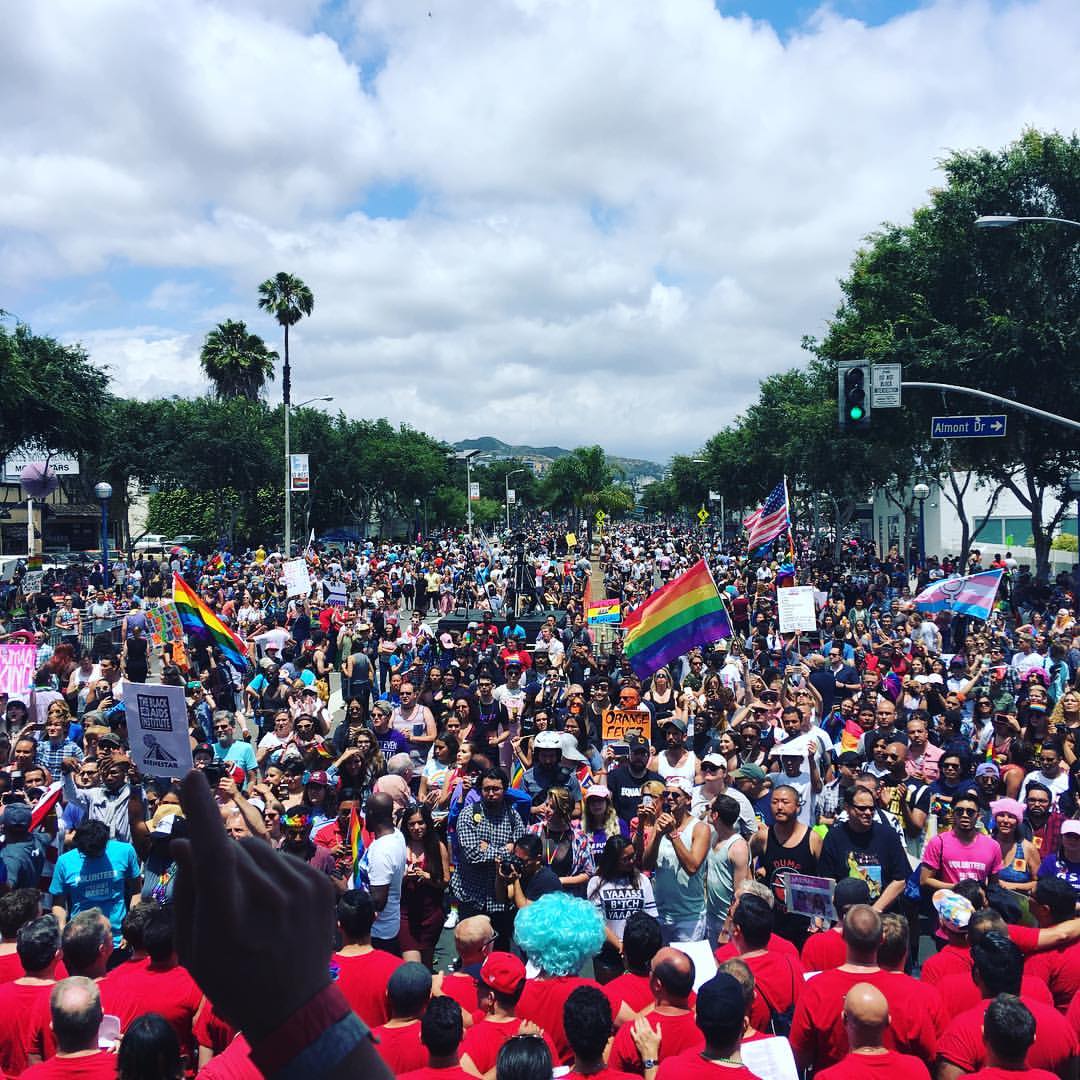
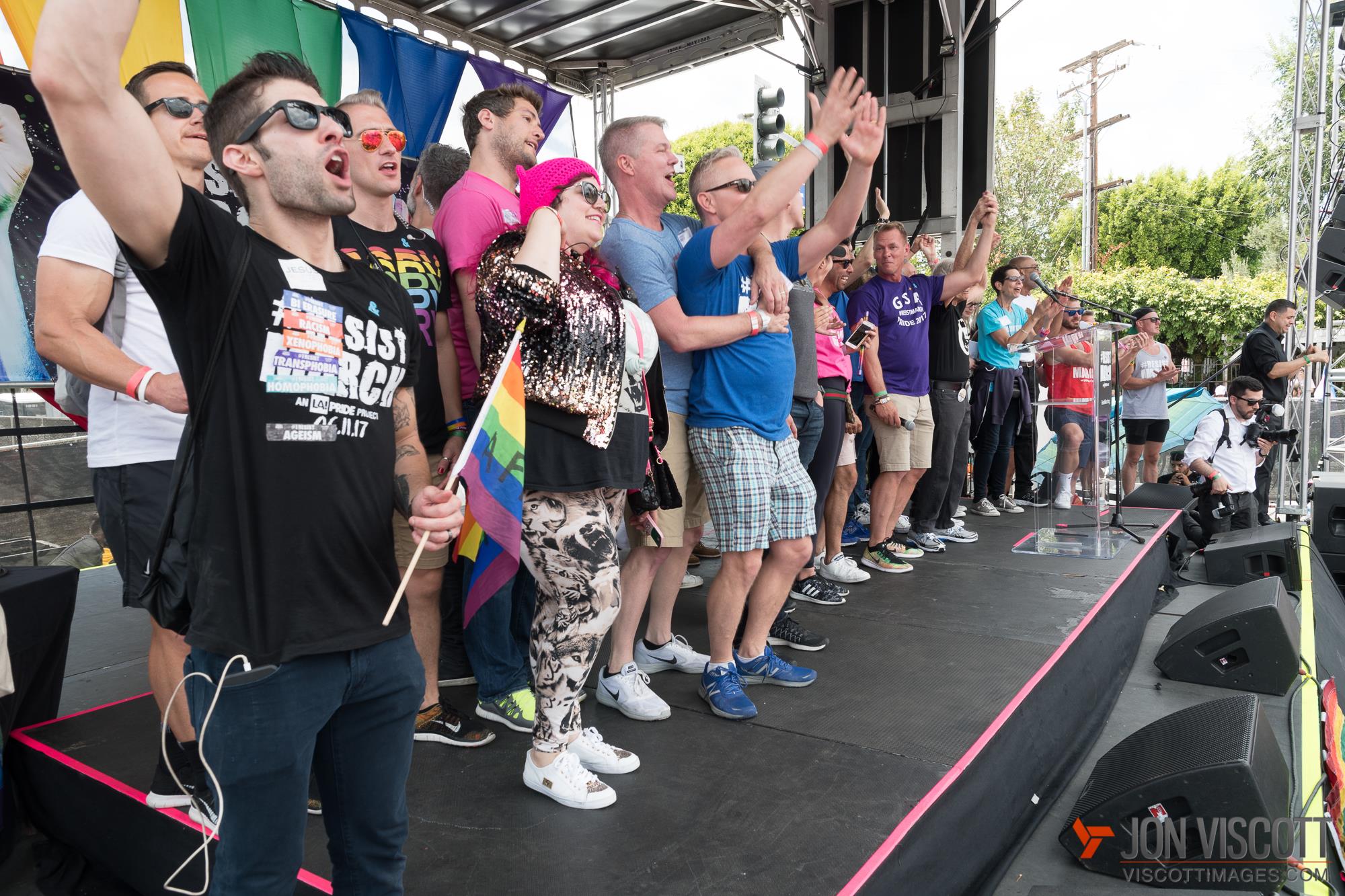
Cover PhotoAlthough my involvement during the 120 days or more that led up to the #ResistMarch happened in a flash, one thing is for certain: miracles exist not because of divine intervention but because G-d places people on this Earth to make positive impacts. The beauty of the #ResistMarch was not just the passion of the organizers but the beauty of the rainbow that came out in full force on June 11

The strength shown by our community was one that, for all intensive purposes, proves that love does conquer all. RuPaul couldn’t have expressed the common and conquering theme better than when he said: “It’s all about love; giving love and being able to receive love. That’s our secret weapon; that’s the one thing they don’t have: our love and our music. That is our activism. That is what we use and what we always use to fight the ugliness.”

That is the one experience that I took most out of the #ResistMarch: the power of love and friendship; the beauty in the unexpected conversation that leads to changing the world, again.  Thank you, Brian. Thank you, for bringing us all together to resist, recharge, and love.
19055531_10158898620590385_6920780108892374453_o

When we come together, we are the Divine.  I didn’t think I could experience that twice in one year; clearly, I was wrong.

John Erickson is the President of the Hollywood Chapter of the National Organization for Women. John is a Ph.D. Candidate in American Religious History at Claremont Graduate University where he is finishing up his dissertation tentatively titled “Step Sons and Step Daughter”: Chosen Communities, Religion, and LGBT Liberation.” John holds a MA in Women’s Studies in Religion; an MA in Applied Women’s Studies; and a BA in English and Women’s Studies. He is the Founding and Past President of the University of Wisconsin Oshkosh’s LGBTQA+ Alumni Association and currently serves as the Chair of the Legislative Committee for the Stonewall Democratic Club, a Diversity and Inclusion Fellow at Claremont Graduate University. He is a permanent contributor to the blog Feminism and Religion, a Co-Founder of the blog The Engaged Gaze, and the Co-Chair of the Queer Studies in Religion Section of the American Academy of Religion’s Western Region, the only regional section of the American Academy of Religion that is dedicated to the exploration of queer studies in religion and other relevant fields in the nation. In April 2017, he was the first openly gay athlete to be inducted into the Wisconsin Volleyball Conference Hall of Fame. Most recently, John was one of the coordinators of the Women’s March Los Angeles, which brought together 750,000 people in downtown Los Angeles on January 21, 2017, and a Committee Member for the #ResistMarch, which brought together 100,000 people from Hollywood to West Hollywood in honor of LA Pride on June 11, 2017.