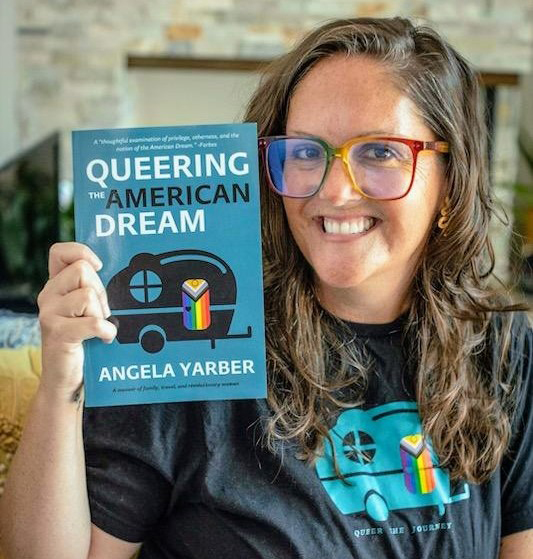
Why I Wrote Queering the American Dream by Rev. Dr. Angela Yarber

Like most authors, I had grand plans for Queering the American Dream. Heeding the wisdom of the venerable black, queer writer, Pauli Murray—“One person plus one typewriter constitutes a movement”—I committed, not simply to writing and publishing a book, but creating a movement. With my modern-day typewriter (laptop) in hand, I dreamed of readers throwing off the shackles of an ill-suited dream, galvanizing retreats, coaching to help other marginalized creatives queer their own iterations of the so-called American dream.

I tried learning about book marketing and pitching companion essays and creating a launch team and all those things small-time authors without expensive publicists on retainer do. I tried so hard.

Continue reading “Why I Wrote Queering the American Dream by Rev. Dr. Angela Yarber”

Human Being or Human Doing? by Mary Gelfand

As a cis white woman in her mid-70s, with a family history of arthritis, I am sometimes confronted by various challenging questions that I prefer not to explore. Who am I if I can’t take care of my basic physical needs? Do I have value if I can’t do my fair share of the household tasks? Who am I if I can’t contribute to my communities? Who am I if I can’t ‘do’? Can I learn to just ‘be’?

These questions swirling around in my head are indicative of the fact that, despite my best efforts, I am still shedding the ubiquitous patriarchal conditioning that tells me I have no value or worth unless I can do—something. Traditionally that something was bearing and raising children, cooking and cleaning house, making and mending clothing, growing food. I have long felt that I must ‘do’ in order to earn my right to inhabit this planet.  Patriarchy tells me I am only valued to the extent I am productive. As my body ages, being productive becomes harder. Many women struggle with these questions daily, especially older women like myself. And no doubt some men as well.

Continue reading “Human Being or Human Doing? by Mary Gelfand”

RACHEL KADISH:  TRANSCENDENCE AND TEXT, part 1 by Theresa C. Dintino

Moderator’s Note: This post is presented as part of FAR’s co-operation with The Nasty Women Writers Project, a site dedicated to highlighting and amplifying the voices and visions of powerful women. The site was founded by sisters Theresa and Maria Dintino. This was posted on their site on November 7, 2023

I love recognizing Toni Morrison’s influence on a writer as I am reading a book. Reading Rachel Kadish’s novel, The Weight of Ink, immediately sunk into Jewish reality, life, and experience without any explanation or apology, I sniffed a familiar point of view, a ghost of novels prior, detected the faint fingerprints of a giant. I liked it and when I recognized it for what it was, I thought to myself, Good for her.

Kadish had taken Toni Morrison’s advice to black writers that says you don’t have to explain yourself to white readers and applied it to not explaining herself to non-Jewish readers.

Why not?

Continue reading “RACHEL KADISH:  TRANSCENDENCE AND TEXT, part 1 by Theresa C. Dintino”

Women’s Rights: How Far Back in Time Will our Legal System Go? by Janet Maika’i Rudolph

Wikimedia Commons

I was in the process of writing this blogpost last week when the Arizona supreme court decided to turn abortion rights back to the civil war era (1864). This was a time when women had no rights at all and abortion from conception was illegal. But civil war era laws are downright quaint and modern compared the legal underpinnings of the supreme court’s Dobbs decision.  

In his decision, Mr. Alito cited four “great” and “eminent” legal authorities, Henry de Bracton, Edward Coke, Matthew Hale, and William Blackstone. For perspective here are their dates. 

Henry de Bracton  c. 1210 – c. 1268
Edward Coke 1552 – 1634
Mathew Hale 1609-1676
William Blackstone 1723 –1780

To help me understand Alito’s logic, I read up on some conservative commentary. Here is what I learned: When the founding fathers needed to create legal documents, they didn’t create them out of thin air. They relied on the logic of the four men (and others) listed above. Yes, they did pick some enlightened aspects of these thinkers of the time, esp. in regard to the rights of the common people in relation to royalty. The thought of commoners having rights was revolutionary in its day. But as we have learned so painfully, our founding fathers limited who those rights applied to. They did not take into consideration the rights of anyone other than landowners, which at the time meant white men.

Continue reading “Women’s Rights: How Far Back in Time Will our Legal System Go? by Janet Maika’i Rudolph”

Genuine Inclusivity Means Rejecting “Comparative Suffering” by Dr. Hadia Mubarak

Moderator’s Note: Part 1 was posted yesterday. You can read it here.

Rejecting the notion of “comparative suffering” is critical for those who are committed to the work of social justice, human rights, and antiracism. There is no Guinness world record for “human suffering” for which groups or individuals need to vie to outrank one another. The human capacity to empathize with one people’s suffering does not diminish our capacity to empathize with another group’s suffering, even when those respective groups are at war with one another.

On March 26, I began my talk on a women’s panel titled, “Global Women Speak,” for Mount Saint Mary University with this reminder. Before I could speak about the humanitarian challenges facing Palestinian women in Gaza today, I felt compelled to make this argument due to my experience six days earlier at another women’s interfaith panel. In this previous panel, a co-panelist rudely cut me off four times within a span of one minute when I began to address Palestinian suffering, although she had already addressed Israel’s current challenges in response to a question that we were all asked. For several days following this jarring experience, I kept wondering, what felt so threatening to this co-panelist about the stories of Palestinian suffering that she felt compelled to shut it down?

Continue reading “Genuine Inclusivity Means Rejecting “Comparative Suffering” by Dr. Hadia Mubarak”

New Beginnings: Sedum tells a Story by Sara Wright

Love made manifest

Almost two weeks ago my beloved Vet retired from the Bethel Animal Hospital. He will continue his healing acupuncture practice elsewhere part-time, but he will no longer be at the clinic. For regular acupuncture and all serious issues with my two dogs (one has been seriously ill for the last few years) he will work in conjunction with a new vet who I have yet to meet.

He has assured me that I will like Shelby, the woman he has chosen for us. I do trust his judgement.

I desperately wanted Gary to retire for health reasons last fall and spoke to him about it.  We have been very close friends for many years, and it had become obvious to me that it was time. His wife felt the same way. He made the final decision to retire in November. My personal sense of loss was hidden under the shadow of my deep concern for him.

Continue reading “New Beginnings: Sedum tells a Story by Sara Wright”

Miriam Speaks by Janet Maika’i Rudolph

Wikimedia Commons: Anselm Feuerbach

Intro:  I have been working on a project inspired by Charlene Spretnak and her book Lost Goddesses of Early Greece. I am writing biblical stories through the eyes and words of the women. The scribes who wrote down the tales of the bible, wrote mostly from men’s point of view. And they had their own which was to destroy evidence of the Goddesses. I tell Noah’s story through Naamah, his wife. Abram and Sarai’s journey to Egypt through the eyes of Sarah. Exodus in Miriam’s voice. In my telling, Miriam went to Midian with Moses and, while there, experienced the Burning Bush and worked with Moses’ wife Zipporah to protect knowledge of the Goddesses. Below is an abridged version of this section of Miriam’s tale.  

I look around at your world today. You, yes you, are my descendants. My beloveds. I mourn for what you’ve lost. No, I am angry, how could things have gotten this bad? I dare you, I dare any of you to challenge my work. We did everything we could. It should not have taken this long to find our clues. But then I see the job the scribes did. It was better and more thorough than even we, who saw so much, could have imagined. I look around at this precious earth we bequeathed to you and see how damaged it is.

Continue reading “Miriam Speaks by Janet Maika’i Rudolph”

Activate your Body to Navigate Overwhelm

We live in a time of radical change, in a steam cooker of accelerated alchemy. No wonder most of us struggle with chronic overwhelm.

Beliefs, habits, thought patterns and organisational structures don’t change overnight, and we need ways to boost our resilience in the long arc of paradigm shifts. How can we look after ourselves during this personal and collective dance of change?

In this post I reflect on the connection between movement and health, breathing, and the role of our nervous system. I propose 5 simple steps to minimise and transform overwhelm when it happens.

Continue reading “Activate your Body to Navigate Overwhelm”

The Mothers, the Goddess, Lost and Found, part 2 by Elizabeth Cunningham

Excerpts in two parts adapted from My Life as a Prayer: A Multifaith Memoir. Part 1 appeared yesterday. You can read it here.

The Goddess finds me

Between the birth of my son and the birth of my daughter, I had a second miscarriage. The signs that something was wrong were subtle at first. I drove myself to a doctor’s appointment, hoping to be reassured that everything was all right (though I already sensed it wasn’t). En route to the office, perhaps to distract myself, I pondered why it was that I had never written about the church, or Christianity. Then…

I turn onto the main street. I glance at an old clock tower, and there she is superimposed against it, huge, big as the sky, vast as the earth.

I hear her voice.

You have been searching for me all your life.

She speaks inside me, all around me.

The wild mother, the witch in the wood.” [She shows me the stories I’ve written.] “You have been searching for me all your life.

Continue reading “The Mothers, the Goddess, Lost and Found, part 2 by Elizabeth Cunningham”

Legacy of Carol P. Christ: Body, Nature, Ancestors

This was originally posted on January 23, 2012

Some years ago, womanist theologian Karen Baker–Fletcher asked about ancestors following a lecture I gave on the body and nature.  I have since come to realize that ancestors are a missing link between the two:  we cannot speak adequately of embodiment and interdependence in the web of life without recognizing the ancestors whose lives made ours possible.  Our mothers quite literally gave us our bodies.  All of our ancestors gave us their genes.  Care and callousness with origins going back longer than conscious memory was imprinted on the psyches of our parents and grandparents and transmitted to us.  All of our ancestors give us connections to place.  While many black people in America can recite oral histories that begin with slavery in the United States, I come from a family where stories of origin for the most part were not valued or told.  Both of my father’s parents lost their fathers when they were very young, and my father, who was raised Catholic at a time when Catholics were discriminated against, preferred to think of our family as “American now.”  Like the hero of the film Lost in America, most members of my family dreamed of “melting right into that pot.” In the process we lost stories we need to help us to understand ourselves and the complex realities that “becoming American” involved.

Continue reading “Legacy of Carol P. Christ: Body, Nature, Ancestors”