May you witness a growing trust in the guidance around you. May you allow magic to find you where you are.
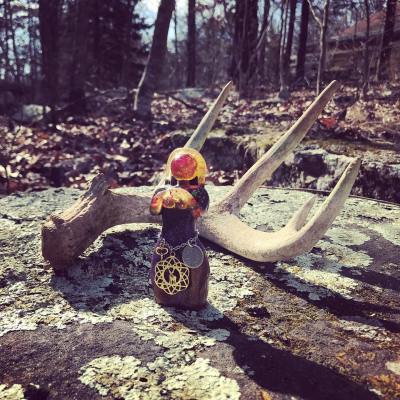
Seven years ago, I did a drum-guided meditation in which I journeyed deep into the forest. On my head as I walked, antlers grew, curving above me. As I followed the sound of drums and the glimmer of firelight, I kept raising my hand to check to see if they were still there, firm beneath my hand. I reached the fire and met the Goddess there, she reached up and took the antlers off my head and cast them into the flames, where they twisted and glowed until they became a golden ring, which she removed and placed on my finger, antlers now wrapped around my index finger. In waking life, I scoured etsy and two years later located a bronze antler ring extremely similar to my vision, which I bought and placed on my own finger in the woods as a symbol of my earth based path, my priestess vows, and some kind of unspoken dedication, felt within but not able to be fully verbalized at the time.
It is often said that every year when you read the same Torah passages, you are in a different place, spiritually and otherwise. Therefore, one will always be learning new meanings and discovering new insights from them. No more is that true than in this week’s Torah parshah Tazria-Metzora.
Tazria-Metzora (Leviticus 12:1- 15:33) is a double parshah containing a list of rules concerning ritual purity and impurity, mostly having to do with leprosy. The parshah begins with the requirement for women a certain number of days after childbirth to immerse in a mikvah as well as offer animals for sacrifice at the temple. Then, it commands the circumcision of a boy child at 8 days of age. The next three chapters discuss an extensive list of what has to be all possible encounters with leprosy, including the infection of a home itself. The parshah prescribes various interactions between lepers, homes with leprosy, and the kohenim. Mostly, the kohenim decide if the skin lesions people or houses have are leprosy, another skin disease or harmless. If diseased or if the lesions are inconclusive, the people and houses enter quarantine. The kohenim also consult on whether a leper or house is healed and how to go about atonement. For atonement, former lepers immerse in the mikvah and pay for the kohenim to offer specific sacrifices at the temple. Homes also undergo a type of ritual purification by the kohenim when they have been healed of leprosy. This double parshah ends with immersion requirements for emissions of semen and menstrual blood.
Historically, there are two considerations, which I have discussed in other posts, to address first. To begin with, there is the ancient world’s understanding of disease as punishment for sin. This sin can either be the sin of the diseased person or punishment from generations past. For more about how this cycle of sin, punishment, repentance and atonement work as well as my thoughts on it, see here.
I was intrigued by the discussions of Jung and Jungian motifs, such as the sacred marriage, that sprang up in response to Mary Sharratt’s wonderful post “The Via Feminina: Revisioning the Heroine’s Journey,” partly based on Maureen Murdock’s book. Carol Christ pointed out the problematical nature of the whole notion of the sacred marriage, relying as it does on our stereotypes of the masculine and feminine.
Sara Wright reported that her sense of the dangers of Jungian thought led her to change her profession; she had once been a Jungian analyst. Barbara McHugh put forward a well-thought out and articulate version of the Heroine’s Journey, corrected for sexist thought.
Those of us in the Northern Hemisphere are coming out of a long pandemic winter and entering a new season of waxing light, hope, and growth. Yet these continue to be turbulent times. Even with the progress of the Covid vaccine, none of us truly knows when life will ever return to “normal.”
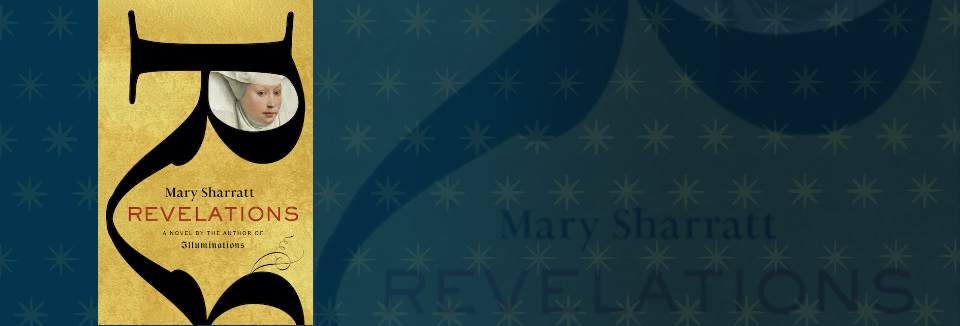
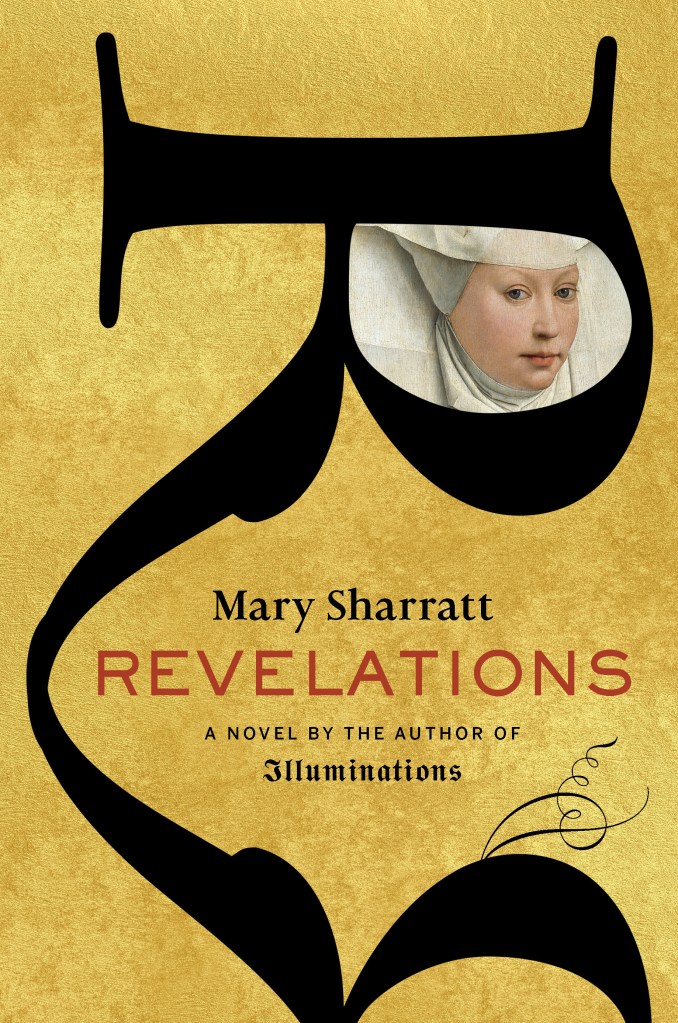
Like us today, the medieval mystics Julian of Norwich and Margery Kempe, the heroines of my new novel REVELATIONS, which will be published on April 27, lived in a time of pandemic and social upheaval, yet both women bore witness to the divine promise that ultimately all shall be well.
During a near-death experience, Julian received a series of divine visions and spent the next forty years unpacking them in her luminous theology of an unconditionally loving God who is both Mother and Father. Julian offered radical counsel to Margery Kempe, a failed businesswoman and mother of fourteen, who was haunted by her own visceral mystic experience. With Julian’s blessing, Margery walked away from a soul-destroying marriage and became a globe-trotting pilgrim-preacher and rabble rouser. Though these two women might seem like polar opposites—Julian, the enclosed anchoress, and free-roving Margery experiencing her visions in the full stream of worldly life—they complement each other. Together their lives and work form a Via Feminina, a distinctly female path to the divine.
The women mystics have always fascinated me. I identify very powerfully with Hildegard of Bingen, the heroine of my previous novel ILLUMINATIONS, as well as with Margery and Julian as spiritual women facing the roadblock of an institutional, male-dominated religion that side-lined them precisely because they were women. But instead of letting this beat them down, they found within their own hearts a vision of the divine that mirrored their female experience. I believe it’s no mere coincidence that both Hildegard and Julian dared to create a theology of the Feminine Divine, of God the Mother. All three women seized their power and their voice to write about their encounters with the sacred, preserving their revelations to inspire us today.
In our modern world, when many traditional religious institutions are crumbling, we can follow in these women’s footsteps and seek the divine—however we perceive the divine—within the sanctuary of our own hearts. This is the birthright no one can take from us, our eternal refuge. This is the Way of the Mystic.
Learn more about Margery and Julian as I discuss these mystics in a series of free virtual events.
My virtual tour kicks off with a very special Literature Lover’s event, sponsored by Valley Bookseller and Excelsior Bay Books in Minnesota. You can watch the video above. I am in conversation with acclaimed author, Elissa Elliot .
For a deep dive into Julian of Norwich’s spirituality, I am teaming up with Christine Valters Paintner of Abbey of the Arts to offer a Virtual Mini-Retreat on May 13, Julian’s Feast Day. You can learn more and register here.
Mary Sharratt is on a mission to write women back into history. Her acclaimed novel Illuminations, drawn from the dramatic life of Hildegard von Bingen, is published by Mariner.Her new novelRevelations, about the globe-trotting mystic and rabble-rouser, Margery Kempe, will be published on April 27. Visit her website.
Preface: I am submitting this story for publication because it occurred during the Christian Holy Week and because it involves me, a woman who follows her dreams… That I did so in this instance was important in ways that I cannot comprehend rationally. But I know that it involved creating space for some kind of passing over from one way of being to another. Every word is true.
Roy comes Home
In the dream I’m creating a ceremony to welcome Roy home – it’s very elaborate – yet fluid – it’s fine when I make mistakes – I am creating the space for his death but also welcoming him home. I am also asking for gifts that are expensive. Someone, I think it’s Roy, says humorously and with kindness, “You don’t want much do you?” I laugh. He is teasing me. I finish the ceremony, and I see Roy in an old dented truck pulling on his ears – he can’t hear me but we have made contact. There is such Joy in his heart that I know All Will Be Well….
In Greece the liturgies of lent and especially of the week before Easter are known as the “divine drama,” in Greek theodrama. This may refer to the “drama” of the capture, crucifixion, and resurrection of Jesus and to the suffering of God the Father and Mary.
However, it is important to recall that the drama in ancient Greece referred to both the tragedies and comedies, most specifically, those that were performed in the theater of Dionysios in Athens. While we have been taught that the Greek tragedies celebrated “downfall of the hero” due to his “tragic flaw,” it is important to remember that Dionysios was the original protagonist of the Greek tragedy: it was his death and rebirth that was first celebrated.
Some have argued that the Greek tragedies should never be “read” alone, for they were always “performed” in tandem with the comedies, which were followed by the bawdy phallic humor of the satyr plays. The tragedies end in death and irreparable loss. But if the comedies and satyr plays are considered an integral part of the cycle, death is followed by the resurgence of life.
Note: If you’ve been reading Athena’s story for the past two days (link to Part 2 here), you know what’s happened to her before her third birth. You’ve read her version as I heard it in my mind and wrote it down. Part 3, here, is mostly speculative, based on hints in books I’ve read during the past twenty-plus years. If you’ve read The Greek Myths by Robert Graves (who is said to be The Authority), you’ve met Medea in the context of the yarn about the Golden Fleece, but I’m leaving Jason out of this story. I’m also leaving Theseus (also associated with Medea) out. These boys have no role in Athena’s story of her meeting and her shamanic rebirth at the hands of the great Medea, who is sometimes called a sorceress. Read on.
Athena
And so with the help of the great Hera, who remembered how I had once loved her (and she still loved me), I left Zeus’ stony kingdom. Hera helped me depart, though I soon forgot her help. I suppose she is still there. After all, her own lands had been taken long before, her own throne stolen long ago, her temples and altars supplanted. I suppose she has nowhere to go now. For all I know, great Hera remains at the declining god-king’s side, where poets still deprecate her and laugh at her and call her a nagging wife. A god-king as impotent as he is now needs such a strong wife, does he not? I regret that I no longer know her.
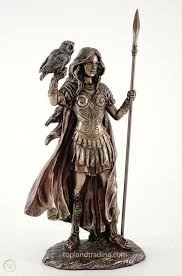
But I could find no other kingdom that would give me charity or honor, found no other king or god who would wed me or let me speak for him, and so I become disillusioned with kings and gods and epic tales. I put down my spear and shield and abandoned my armor and helmet, though I always kept my owl (who often flew above me) and my ragged plume.
And so, twice homeless, twice born and twice dead, friendless and scorned by the men I had so harshly judged, I wandered through the world, and all anyone saw was a woman, a gray, anonymous woman carrying a stick and a drooping feather. I walked up and down in the world and had no home. I had neither friends nor sisters nor protégées to honor me, neither priestesses nor queens to love me. I had no one at all. I had nothing at all. I wandered alone through all the lands around the wine-dark sea, alone in the lands around the central sea, alone in the lands along the ocean sea and the northern sea. For uncounted years I wandered alone, stopping here and there, but never staying anywhere, searching for what I never found and no longer remembered. I went in a plain gray cloak with my stick in my hand, my sad plume in a pouch at my belt. Sometimes I ate, but more often I went hungry. Up and down upon the earth I walked, and so my pride and anger began to be worn away.
Note: This part of the story concerns what nearly everybody who has read the mythology knows about the Goddess of Wisdom. But what you’ve read in, say, Edith Hamilton or Robert Graves is the patriarchal version. What would the story be like if Athena told it herself? That’s what I imagined as I wrote her story. Read on to learn more about her Greek incarnation.
Athena
After our tribe was conquered by the warriors who lived across the seas, I wished to die, and I was indeed close to death when I was carried off by the bloody hero who fancied me. I longed to die every time he violated my body, every time he crushed my mind. But I was carried away alive, a living trophy for that warrior-king. I was secured in his warship as it sailed across the sea to his hard and stony land. Weak though I was, men still fought over me. Eventually I was claimed by their god-king Dyaus, whom you may know by his commoner name, Zeus. I was claimed as his prize of war, dragged up the stony mountain that came to be called Olympus, and flung into his harem until I should become strong enough to bear his weight upon me in mating. And still I longed to die.
Note: Inspired by Mary Sharratt’s excellent post on February 13 about the heroine’s journey and by Elizabeth Cunningham’s beautiful novel The Wild Mother (who is Lilith), I took a dive into my archives and found this story about Athena, which I first wrote back in the late 1980s. That was about the time the Goddess rapped me on the head, so to speak, and said, “Pay attention.” The story is based on research I did at the time. I’ve now done some rewriting for FAR. Read on and hear the voice of Athena not as a player in the usual Greek myths but as a goddess of wisdom who is one-unto-herself.
Athena
My first birth was in the dark continent to the south of the Black Sea, always described by Homer (who invented much of what you take as true in his two long stories) as the wine-dark sea. That is, I was born in what is now Libya in northern Africa. I was born in a many-chambered palace beside a clear lake and received into the world by a tribe of strong women. I was the first-born child of Metis the Wise. You may have read that Metis was the daughter of Oceanus and a Titaness of great cunning; that’s what the “traditional wisdom” says about her. Not true. Metis was one-unto-herself, the queen of a great tribe, holder of the sacred serpents, and painter of wild scenes on tall red cliffs that exist into your day. I was the daughter of daughters from the beginning of the earth, whom some have called Amazons. I knew nothing of that name, however, for I was simply a much beloved child of a thousand thousand foremothers and a hundred living mothers.
The Roman authorities executed Jesus for sedition because he posed a threat to their hegemony: their wealth and their oppressive, imperial domination system of exploiting others for profit. Jesus spoke out against their injustice, and his message resonated with the 99%. People were beginning to listen; momentum was growing. So the Empire snuffed out that “Rebel Scum” in their most excruciating, punishing, degrading form of execution. According to the logic of imperial domination, Jesus’ death should have been a humiliating, final defeat.
Instead, his movement lived on and on, grew and grew. The symbol of Imperial execution — the cross — should have symbolized the wrongness, the lack of Divine sanction, the complete Divine rejection of Jesus’ ideas, according to Empire. Instead, the Jesus Movement reclaimed the cross from an Imperial symbol of shame and turned it into a symbol of victory. Paul, the feminist liberationist prophet most responsible for the survival and spread of the Jesus Movement, repeatedly wrote that the Jesus Movement follows Christ Crucified. Paul’s message seemed scandalous and confusing— lifting up a symbol of horror, death, and defeat as proof of victory? Why? How?







 Feminism and Religion