Lifting the Veil – #WontBeErased by Joyce Zonana

Samhain is upon us. Halloween. The Day of the Dead. All Saints’ Day. All Souls’ Day. That liminal time of year when the doorways to what the Celts called the Otherworld, Annwn in Welsh, are open. In New York City, we have the 45th annual Village Halloween Parade, a queer extravaganza of puppetry, masquerade, and cross-dressing that draws some 60,000 participants and over 2 million onlookers. Elsewhere, we have children in costume and lawns covered with plastic skeletons and illuminated ghouls. Everywhere, if we’re lucky, we might catch a glimpse of  “the piper at the gates of dawn,” the vision granted Rat and Mole in Kenneth Grahame’s The Wind in the Willows: “something very surprising and splendid and beautiful”—Pan the goat-god, boundary-crosser, Friend and Helper, trans-being.

jz-headshotJust last week—a few days after the New York Times reported on the Trump administration’s efforts to define transgender out of existence—I read for the first time Welsh writer Arthur Machen’s 1894 novella, The Great God Pan, today considered a classic of horror fiction. Condemned as “morbid” and “abominable” by most critics when it was first published, the tale was hailed as “un succès fou” by Oscar Wilde, recuperated in the 1920s by H. P. Lovecraft, and particularly praised more recently by Stephen King, who called it “maybe the best” horror story “in the English language.”
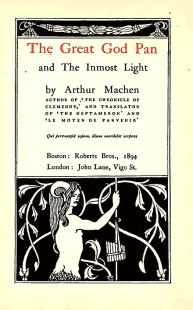
440px-Title_page--The_great_god_Pan
Original edition with cover illustration by Aubrey Beardsley

The “queer” tale (the word “queer” recurs frequently throughout) is told by a series of straight-laced Victorian men, each of whom is horrified by the unspecified behavior and bearing of a mysterious woman, Helen Vaughan. Readers are led to suspect that Helen is guilty of some sort of sexual excess or transgression, but nothing is specified until after her suicide, when the medical examiner reports that he was “privileged or accursed” to see the “skin, and the flesh, and the muscles, and the bones, and the firm structure of the human body that I had thought to be unchangeable, and permanent as adamant, beg[i]n to melt and dissolve”: Continue reading “Lifting the Veil – #WontBeErased by Joyce Zonana”
Not Yet the Death Rattle by Marcia Mount Shoop

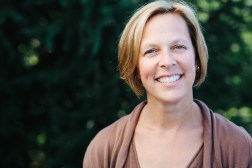
Marcia Mount ShoopI have had the honor of sitting vigil with dying people. And I have prayed through the coming of the death rattle. It can be painful to witness, especially for those witnessing death for the first time. Sometimes the person can hang on, seemingly fighting the inevitable final step of their transition into death.

In those times, I have encouraged families to share affirming words with their loved one, to tell them that it’s ok for them to go, that they are going to miss them, but that they will be ok.

I have listened as wives tell husbands thank you for all the years, for all the love, for the life they have lived together. I have been there with parents forcing themselves to say the excruciating goodbye to a child passing too soon, so the child won’t have to suffer anymore—telling them it is ok to rest, it’s ok to stop fighting. And I have listened as adult children find the courage to release the parent who has so deeply formed them.  “I love you, dad. You have taken good care of me. Thank you for loving me. It’s ok for you to go now.”

It is a sacred passage. These are Holy moments.

Continue reading “Not Yet the Death Rattle by Marcia Mount Shoop”

Goddess Pilgrimage: A Sacred Journey for Women by Carol P. Christ

A pilgrim leaves home and sets off on a journey, seeking healing, revelation, and direction in her life. She finds companions along the way whose stories reflect her own, validating her quest and shedding light on her journey. According to anthropologists Victor Turner and Edith Turner, pilgrimages have common structural elements. A pilgrim separates from family and friends, work and obligations. She steps across a threshold into “liminal space” in which daily routines are suspended, opening herself to discovering new ways of being and living.
For spiritual pilgrims, the goal is a place or places said by others to be a “sacred” because healing or revelation have occurred there through the intervention of a deity, a saint, or spirits. The place is often on a mountain, in a cave, or near a spring. Along the way, pilgrims meet and share stories as in the Canterbury Tales. Some pilgrims say that the experience of sharing community with other seekers is as important as the revelation gained at the destination. When the pilgrim returns home, she must re-integrate into the community she left behind or find a new one. Continue reading “Goddess Pilgrimage: A Sacred Journey for Women by Carol P. Christ”

The Hershee Bar: Saving A Lesbian Sacred Place (While there is still one left) by Marie Cartier (Part II)

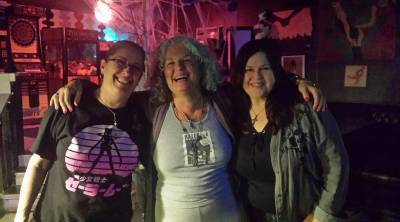
(l to r) Bartender Burt, Marie Cartier, and owner Annette Stone

Why is this bar still important? (Read Part I)

For the gender queer, marginalized community who are testing the waters of gender difference by frequenting this bar, many for the first time, for the pool leagues, and yes, the college folks, but also the working class people, and the tentative younger folks, this may be “the only place.” For the democracy of a gay bar creates a conversational cauldron for marginalized people to “hear themselves into speech” to quote the theological Nelle  Morton.

I am quoted in an article done by Virginia Pilot report Amy Poulter saying that “LGBTQ bars are also tasked with filling in the gaps as religious spaces, support groups and the go-to location to celebrate milestones and mourn losses. Bars like Hershee are often the only place LGBTQ people feel at ease and comfortable in their own skin.”

And I added, “And the council, they need to realize what they have before they destroy it.” Continue reading “The Hershee Bar: Saving A Lesbian Sacred Place (While there is still one left) by Marie Cartier (Part II)”

The Hershee Bar: Saving A Lesbian Sacred Place (while there is still one left) by Marie Cartier (Part I)

(l to r) Bartender Burt, Marie Cartier, and owner Annette Stone

I spent last weekend in Norfolk, Virginia.  I was brought there by the folks at Old Dominion University; my visit was brainstormed and facilitated by y Professor Cathleen Rhodes who teaches in the Women’s Studies Department and also manages a magnificent archive of historic LGBTQ+ spaces The Tidewater Queer History Project. This project has a walking tour of significant LGBTQ+ spaces in the area, an online archive, and graduate students intensely interested in archiving the remains of past and current LGBTQ+ sites for study, and community.

I was brought to the area because I wrote the book Baby, You Are My Religion:  Women, Gay Bas and Theology Before Stonewall. The thesis of my book is that gay bars before 1975 (pre-Stonewall) served as alternate church spaces and community centers for people exiled from all other spaces. There was literally no other public space for gay women to go in the 40s through the early 70s, as so attested to by 100+ informants that I interviewed for the book. Continue reading “The Hershee Bar: Saving A Lesbian Sacred Place (while there is still one left) by Marie Cartier (Part I)”

…and The Pub Church, Boston was Born by Xochitl Alvizo

Incarnation, Goddess spirituality, Xochitl Alvizo, god became fleshSee Part I of Pub Church series here

The question arising among a group of friends gathering for fish and chips on Fridays – why can’t church be more like this? – was the clarion call that sparked the birth of The Pub Church, Boston. This was the fumbling out of which pub church began: the reality that church had been the opposite of embodied Good News in many people’s lives, and the glimpse, the experience, that it could be otherwise.

Birth: Some of how pub church was formed was in direct response to people’s past negative experiences with church and Christianity, but much was also shaped by the “good news” people experienced at the weekly Friday gathering for fish and chips at the local pub. There, people experienced a weekly gathering in which all were invited to gather around the table, express themselves without fear of judgement, and, perhaps more importantly, experience the merry sharing of food and drink!

This, the sharing of food and drink, became the foundation for what pub church would become. Food made it possible to feel more at home, to create a relaxed environment, inspire conversation, and satisfy a need. Being at the pub with access to food and drink created an organic way to share and make new connections with one another. It facilitated the act of inviting and treating someone to a beer or to share fish and chips or a slice of pizza, often with a newly met friend. People got to know one another. Over a beer, new friends would end up sharing about the rough week they had, their past or current sorrows, or sharing a good laugh about something mundane and fun. Continue reading “…and The Pub Church, Boston was Born by Xochitl Alvizo”

Updating our Fairy Tales by Anjeanette LeBoeuf

Anjeanette

The rising voices of female empowerment, consciousness, and position has been an undertaking in the last two centuries. Yet societies are still using fairy tales; tales that were written at least 500 years ago. Many of the fairy tales can be read in a 21st Feminism lens as being harmful and products of a patriarchal society. The movement can only gain more strength and momentum if we start from the ground up – reworking the stories, fables, and myths we teach our children, we make into movies, and that children want to dress up as.

Continue reading “Updating our Fairy Tales by Anjeanette LeBoeuf”

A Tribute to Viktoria Maroniva by Judith Shaw

judith shaw photoIt’s been a very tough month for women. The “Me Too” movement started in 2006, when Tarana Burke coined the phrase “Me Too” as a way to help women who had survived sexual violence. Then on October 15, 2017 it was turned into a huge movement with a tweet by Alyssa Milano, “If you’ve been sexually harassed or assaulted write ‘me too’ as a reply to this tweet.” The tweets and the speaking out have not stopped – they continue to grow –  but the Patriarchy’s defense of a man’s right to sexually assault and abuse women continues. 

Continue reading “A Tribute to Viktoria Maroniva by Judith Shaw”

In the Shadow of Santa Rosa by Sara Wright

Last night I had a nightmare.

I am dressed in a white cloak that obscures all but my face. The robe is splattered with paint and blood. I am awash in every color of the rainbow and dripping paint. I have been raped by strangers and no one is accountable.

This morning I could not get this frightful image out of mind but I had the strong sense that it had an impersonal aspect that had nothing to do with me.

This weekend at the Pueblo of Abiquiu the community celebrates the feast day of the first official saint of the Americas, Santa Rosa, and I planned to attend…

The people of Abiquiu call themselves Genizaros. Representing Apache, Navajo, Comanche, Kiowa, Pawnee, Ute and Wichita, detribalized Native peoples from the Plains that were captured and traded during the Indian wars of 18-19th centuries, and sold to New Mexicans as slaves and servants where they were stripped of their identity, instructed in Hispanic ways, and baptized as Christians. The People survived by incorporating Hispanic and Christian cultural practices into a distinct Genizaro consciousness, one that is distinct from the Indigenous Tewa speaking peoples (descendants of the Anasazi) who also live here in six pueblos along the Rio Grande. Continue reading “In the Shadow of Santa Rosa by Sara Wright”

Troubling Our Souls: Selling Arms to Saudi Arabia, the War in Yemen, and the US Military Industrial Complex by Carol P. Christ

There is a very big elephant in the room. Apparently it is invisible because even the left is not discussing it. This elephant is the civil war in Yemen to which Saudi Arabia has contributed 19,000 (19,000!) deadly (deadly!) air strikes that have been alleged to have caused 60,000 (60,000!) civilian (civilian!) deaths (deaths!). These air strikes have been carried out with arms purchased from the US and its allies. The UN estimates that 22.2 million Yemeni civilians are in need of immediate humanitarian aid and that 13 million are at the risk of starvation. Yet a Saudi-led blockade is preventing food and other supplies from entering the country.

In the wake of the disappearance of legal American resident and Saudi journalist Jamal Khashoggi, the left castigates Saudi Arabia for a vicious murder. The US President warns congress not to cut off arms deals with Saudia Arabia because to do so would threaten more than half a million US jobs in the military industrial complex. Continue reading “Troubling Our Souls: Selling Arms to Saudi Arabia, the War in Yemen, and the US Military Industrial Complex by Carol P. Christ”