My walk to the river is a joyful entrance into the eternal Now. The water flowing, crushed fresh mint, trilling bird song desert air so sweet my body vibrates drumming with all that is…
This semester I am teaching the course EcoJustice and chose Sallie McFague’s A New Climate for Theologyas our foundational text. Something I greatly appreciate about McFague is that she continually calls us to radically redefine our understanding of the Divine and of our roles as human beings — fundamental questions that could easily lead to an existential crisis as one student reminded me.
My class and I ponder these questions, discussing our own interpretations of God, why we exist, what it means to pray, and understandings of salvation. Not surprisingly, many of us have an anthropocentric theology — one that puts ourselves at the center. We are so focused on what we need from God, we forget to ask what God needs from us.Continue reading “EcoJustice and Our Relationship with God by Gina Messina”
As I type this post, I have another browser window open to track the path of Hurricane Florence due to make landfall in my area sometime later this week. Though I now live a few hours inland, I grew up in a coastal town, so I know how unpredictable storms like these can be. It’s entirely possible that we will get a bit of rain and wind and nothing else–and it’s just as possible that we’ll be spending quite some time without power. I pray that the latter is the absolute worst of what we all endure here.
In preparing for the storm and potential power outage, I was reminded of a time about a year ago when I was returning home after dropping off my daughter at school. As I approached the first stoplight on my route, I noticed that it wasn’t working. That’s odd, I thought. I drove on, navigating through another half dozen malfunctioning traffic lights before arriving safely back home only to discover that the power was out there too. Continue reading “Longing for (Dis)Connection by Katey Zeh”
Though represented by its detractors as an incursion of paganism into Christianity, and presented as an integrally and intrinsically Christian phenomenon by its supporters, the truth about the Re-Imagining Conference and movement is that it was a product of a wider feminist awakening. The critique of patriarchal religions that emerged in the academy and in churches and synagogues in the late 1960s and early 1970s was part of the emerging feminist uprising. The feminist movement placed a question mark over all patriarchal texts and traditions, secular and religious, and as such was beholden to none.
In the spring of 1971, Roman Catholic Christian Mary Daly published “After the Death of God the Father” in the liberal Catholic magazine Commonweal. She asserted that the God whose death was touted in the “Death of God” movement was an idol fashioned in the image of male power and authority. She called for “the becoming of new symbols” to express the new becoming of women. In the summer of 1971, a group of nuns from Alverno College convened the first Conference of Women Theologians. Besides sparking dialogue about the role of women in religions, the conference endorsed my call to form a women’s group at the fall meetings of the American Academy of Religion, up until then a gathering of several thousand male scholars of religion, with only a handful of women scholars in attendance. At winter solstice, Z Budapest launched the Susan B. Anthony Coven #1 in Los Angeles publishing a Manifesto calling on women to return to the ancient religion of the Goddess. Continue reading “Sophia, Goddess, and Feminist Spirituality: Imagining the Future by Carol P. Christ”
The Goddess is the “All of Creation.” She is the Creatress and the Created. She is the life force of all there is. She is one, whole, and complete. Before Her, nothing was. She arose from the Great Void, the source of all potential, giving birth to Herself before anything else had ever been born. She separated the sky and the water, and She danced. In the ecstasy of Her Dance She conceived of all there is.
In every culture, in every part of the world, the Goddess has been revered as the Birth Giver of all Life. From the very beginning of time, in our earliest primitive state, we sought to explain the unexplainable by drawing from what we knew. The female of every species brought forth life; therefore, the Creatrix also had to be Birth Giving Mother and the Great Mother was given Her identity. Continue reading “My Life with Goddess (Part One) by Deanne Quarrie”
For about a year and a half, I have been working on a collection of poetry that I feel is worth something. I have been writing poetry since I scribed pages hidden between my math textbook when I was 9, gone through poetry workshops in graduate school where I produced a creative thesis, and continued to write off-and-on after that. I have an extensive cornucopia of poetry, but it was around last October of 2016, perhaps, that I decided to write my experience.
As a pre-teen, I wrote about what I thought my life could be, fantasizing about being an older woman with mottled relationships, missing opportunities to discuss my fragile relationship with my parents as the only-child-golden-child, my passion and doubts as a religious, my shame at not being more experienced. Even when I was in graduate school for poetry in Ohio, I didn’t think my life was worth excavating. I wrote dreamy, dense poetry that was surreal and symbolic but largely incoherent. I could again have written about my evolving religious beliefs, my curiosities and risks I took living outside of my home state of Oklahoma as a young woman for the first time, my declining relationship with my mother, or my insecurities again, but this time as a lesser-prepared graduate student in comparison with my literary and theory-laden colleagues.
On one hand, some might say the culture I come from is narcissistic and navel-gazing. I would agree, but just like I feel women can sometimes be selfish in a quite necessary and liberating way (as opposed to those around her accusingly saying she is “so selfish” for abandoning them/following her own path/needing a room of her own), I feel the confessional and self-reflective can be the healing and helpful side of the coin. For me, at least in my experience, my “finished” collection feels exactly this way.
Sex is a feminist issue. Harmful perspectives on sex and our physical bodies have been used to disempower and invalidate the sexuality of women, LGBTQIA folks, and people of color. It runs through our theology and cultural traditions within the church.
I run a personal blog which speaks positively about sex and queerness. And when folks find it, frequently, their first questions to me is what other resources are out there that teach a better Christian perspective? I often tell them to start with The Incarnation Institute for Sex and Faith.
IISF offers “inclusive, science-friendly, sex-positive” educational programming for church leaders and lay people. Founder Rev. Dr. Beverly Dale, affectionately known as “Rev Bev,” is ordained through the Christian Church (Disciples of Christ) and currently teaches courses on sexuality and religion at Lancaster Theological Seminary.
The institute recently released a four-part web series, Reading the Bible with Sex-Positive Eyes, which includes the topics: “Introduction to Christian Sex Negativity: The Beginnings,” “Discerning Truth, Discerning Culture,” “Sex in the Bible: The Good, The Bad & the Ugly,” and “Sex: Whether, When, and How.”
Women-only circles have long existed within the Goddess movement, the Red Tent movement for example exists as an inter-faith, grass-roots movement for women only to come together to claim safe and sacred space. But too often ‘women-only’ in fact means ‘cis women only’. Trans women are not allowed. This has been the topic of much heated debate in recent years, culminating last year in the publication of ‘Female Erasure’ an anthology of essays on gender politics and feminist spirituality that has led to calls for the editor Ruth Barrett to be expelled from her thealogical seminary on grounds of transphobia. Barrett and many of her contemporaries openly call for the exclusion of transwomen from women-only Goddess circles and respond to criticism by saying that asking for ‘women born women only’ space is not meant to be antitrans but simply carving out a space for people with similar life experience – in the same way that people of specific ethnic minorities may gather, or LGBTQ people. Surely, they may say, the answer is for trans women to create their own spaces?
There are two problems with this. Firstly, trans women are in a significant minority, making access to groups of other trans women practicing Goddess spirituality difficult. If a local woman’s circle is their only means to practicing their religion with others, and they are excluded by this on the basis of their genitalia, this exclusion is incredibly hurtful and undermines not just one’s ability to practice a faith but one’s very identity and esteem. Secondly, it is not just local, personal groups that are practicing this exclusion, but large and public gatherings, making very public pronouncements that trans women are not welcome. They have been excluded from womens rituals at PantheaCon in 2011 and Michigan Womyns Music Festival has a policy of excluding trans women from the entire event.
We have forgotten the names of each other underneath the shedding skin those names written in our blood that have danced to tonantzin tonatiuh before they knew they were lovers. (IFHL)
Last week I was fortunate to have attended a poetic reading and performance by a remarkably gifted young Mexican man named Israel Francisco Haros Lopez who was born to immigrant parents in Los Angelos. He is both a visual and performance artist, and his work transcends borderlands of all kinds. Israel believes that it is critical to honor and remember the ancestors so that we may once again become one with the winged ones, all those who crawl or walk on this earth, the Four Directions, Earth Air Fire and Water, Tonanztin and Tonatiuh – the Aztec Earth Goddess and the Sun God – Israel’s expression of unity in divinity, and the universe as a whole. His visual motifs are drawn from Pre – Columbian America and his work is an attempt to search for personal truths within the context of today’s world incorporating Mexican/Indigenous stories into the whole.
In her novel, Kingdom of Women, Rosalie Morales Kearns imagines a reality that is post-patriarchy, and post male violence while showing us what near-future women had to go through in order to get to that reality. Morales Kearns weaves this story through the voices of multiple characters. One of these characters is Averil Parnell, a female Catholic priest. Part I of the book opens with a woman visiting Averil to seek her counsel in regards to taking revenge on her male college professor who has been harassing her ever since she refused to sleep with him.
While Averil seems to be of little help with this particular conversation, we learn that Averil was one of the twenty three original female priests that were to be ordained by the Catholic Church. On the day of their joint ordination however, the Cathedral Massacre took place and twenty two of the female seminarians were killed in cold blood. Averil then, is most definitely a woman who understands the yearning for revenge, the feeling of survivors guilt, and the expectation to be a wonderful priest for her dear friends who had that chance ripped away from them.
At the same time this conversation is taking place it has become clear that small groups of vigilante women are popping up around the world and punishing men for acts of violence against women. The male dominated government of course sees all these punishing acts as coincidental, explaining them away in one way or another, or ignoring them completely, never imagining that it is in fact the beginning of women rising up to truly end male dominance and violence.


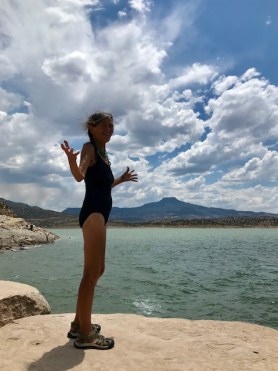
 This semester I am teaching the course EcoJustice and chose Sallie McFague’s
 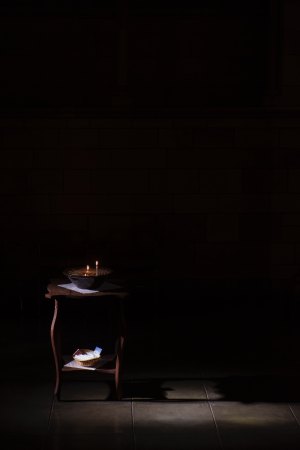 As I type this post, I have another browser window open to track the path of Hurricane Florence due to make landfall in my area sometime later this week. Though I now live a few hours inland, I grew up in a coastal town, so I know how unpredictable storms like these can be. It’s entirely possible that we will get a bit of rain and wind and nothing else–and it’s just as possible that we’ll be spending quite some time without power. I pray that the latter is the absolute worst of what we all endure here.
 Though represented by its detractors as an incursion of paganism into Christianity, and presented as an integrally and intrinsically Christian phenomenon by its supporters, the truth about the Re-Imagining Conference and movement is that it was a product of a wider feminist awakening. The critique of patriarchal religions that emerged in the academy and in churches and synagogues in the late 1960s and early 1970s was part of the emerging feminist uprising. The feminist movement placed a question mark over all patriarchal texts and traditions, secular and religious, and as such was beholden to none.
 The Goddess is the “All of Creation.” She is the Creatress and the Created. She is the life force of all there is. She is one, whole, and complete. Before Her, nothing was. She arose from the Great Void, the source of all potential, giving birth to Herself before anything else had ever been born. She separated the sky and the water, and She danced. In the ecstasy of Her Dance She conceived of all there is.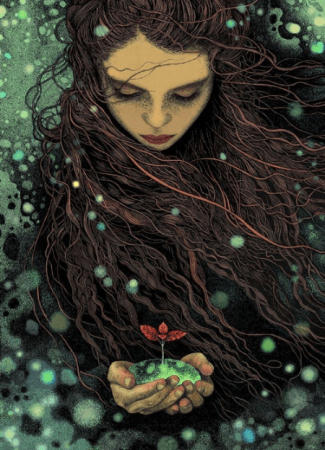



 Feminism and Religion