Apaḥ and the Nāga: Water and the Snake by Lenore Lowe

Image © 2024 Compilation of Lenore Lowe and Freepik.com

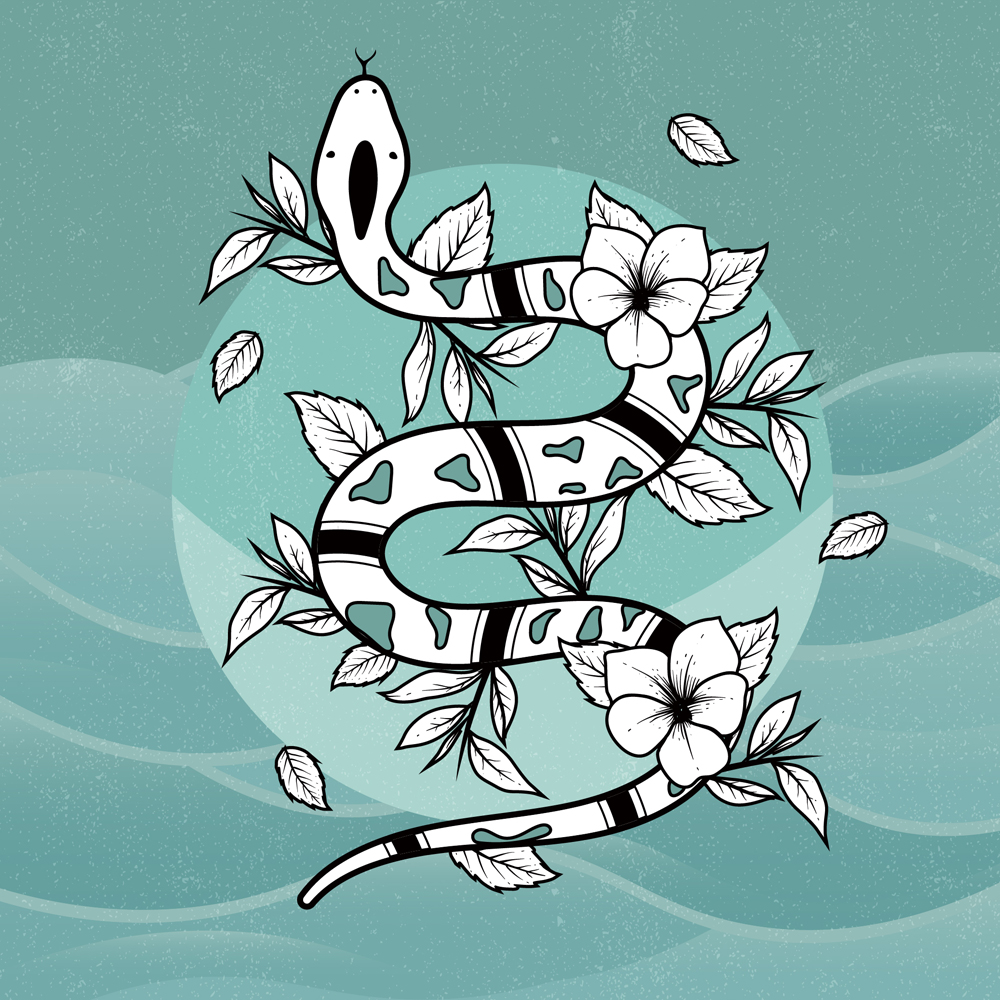
As I write this, water has slowly leaked in my front yard for a day. It has already turned what was dry and brown to moist and green. It seems fitting on the day of Nāga Pañcamī (worship on this particular 5th day of the half moon). It’s fitting that water—apaḥ—has gently made its way to the surface. It has wound around pipes, rocks and roots like a cobra—nāga—to come up to show itself. Though, there are financial challenges in fixing the leak, I can’t help celebrate it as a blessed omen of goodness to come.

            After all, it’s arrived for this extra auspicious day in the most favourable month of the vedic calendar. I admit some of my frivolity may be from feeling better on my 5th day of covid. (The significance of the number 5 is not going unnoticed: linked to Patañjali and the great Yoga Sutras.) My mind too feels like it’s been making its way back to the surface. The seepage also keeps bringing me back to thoughts about the watery world of emotions, and new depths of emotions seem to be rising up in me. They feel deeply personal and universal at the same time. The celebration is devotional, the auspiciousness of having this extra time off of work to bring roses to the Mother.

Continue reading “Apaḥ and the Nāga: Water and the Snake by Lenore Lowe”
Witch Power? part 1 by Sara Wright

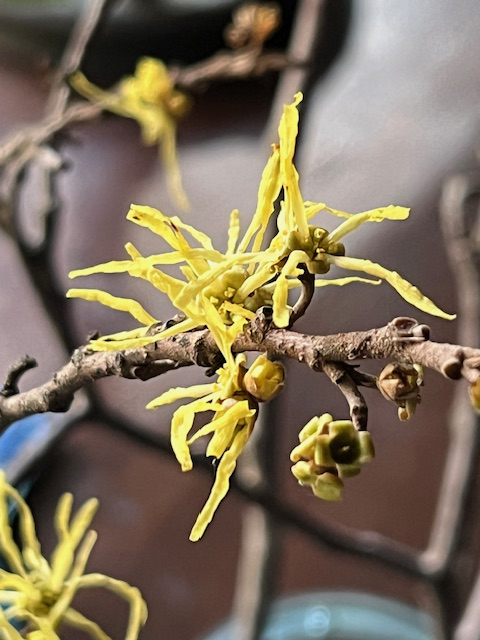
Witch hazel flower

On my grandparent’s farm witch hazel trees were common, sprouting up around old fieldstone walls at the edges of the forest. I loved these trees that bloomed in the fall after all the leaves had fallen. Masses of buttery yellow spindles covered bare twigs. Clusters of blossoms stood out starkly against the trunks of most of the hardwoods – hickory, beech, maple and oak.

As a child I carefully inspected each clump of blossoms. On some branches I found empty seed capsules which I learned much later expelled their seeds all at once the year before. Even these bird beaked pods looked to me like a kind of flower. I also saw little round balls that I later learned were next year’s buds already formed and that the identical looking flowers were either male or female. If I stood beneath a tree, the tangled shapes of the branches wove a loose string -like tapestry above me, one that was often mirrored by a cobalt blue sky.

Continue reading “Witch Power? part 1 by Sara Wright”

Legacy of Carol P. Christ: Do White Feminists Have Ancestors?

This post was originally published on Aug. 12th, 2011

Carol P. Christ is a founding mother in the study of women and religion, feminist theology, women’s spirituality, and the Goddess movement.  She teaches in the Women’s Spirituality program at CIIS and through Ariadne Institute offers Goddess Pilgrimages to Crete. Her books include She Who Changes and Rebirth of the Goddess and the widely used anthologies Womanspirit Rising and Weaving the Visions.

Some years ago when I was speaking on ecofeminism, womanist theologian Karen Baker-Fletcher posed a question that went something like this:  What I am missing in your presentation is reference to ancestors.  For black women, this issue is critical.

Baker-Fletcher’s question provoked a process of thinking that continues to this day.  For example, I began to notice that when black women spoke at the American Academy of Religion, they often began by thanking their foremothers Delores Williams and Katie Cannon for beginning the womanist dialogue.  It is far rarer to hear a white woman thank Valerie Saiving, Mary Daly, Rosemary Radford Ruether, or Marija Gimbutas before her talk.

To the contrary, many white women take great pains to distance themselves from feminist foresisters.  I once heard a white woman Biblical scholar tell women students to do work on women in the Bible or other areas of religion without using the word feminist or placing their work in a female or feminist train of thought– if they wanted to get it published.  She was very proud that she had used this method and succeeded.  In other words, she was following in the footsteps of Mary Daly, Phyllis Trible, and Elisabeth Schüssler Fiorenza but acting as if she had invented the study of women and the Bible herself.  The reason for this, she freely admitted, was that male scholars who held power in her field would not respect her work if she used the “f” word. Continue reading “Legacy of Carol P. Christ: Do White Feminists Have Ancestors?”

Herstory Profiles: The Season of the Witch by Anjeanette LeBoeuf

Throughout the modern ages there have been stories, legends, myths, and historical accounts of threatening people, mainly women, who have been linked with the supernatural, with containing powers, engaging with elements that go beyond the natural world, and who decentralize, shake up, and counter mainstream patriarchal systems and groups. And the predominate word which can be translated and transcend languages is that of WITCH. And since we are in the month of October, when it becomes somewhat acceptable for people to deck their houses with items long been associated with witchcraft, this month’s herstory profiles is diving into all things witchy.

So, lets deconstruct what witches do and how they function in history and in modern times. When we look at the origins of magic – at the very core- is the manipulation of the natural world for supernatural outcomings. Those outcomes can be a range – from conversing with supernatural beings, healings, prophecy, alchemy, transformation, and to even holding secret knowledge. The word magic has origins in Ancient Persian and Proto-Indo-European languages with concepts of “being able to” and to “have power.” If we look at ancient cultures, civilizations, and religions we found multiple variations of people and roles being able to contain, control, and weld magic.

Continue reading “Herstory Profiles: The Season of the Witch by Anjeanette LeBoeuf”

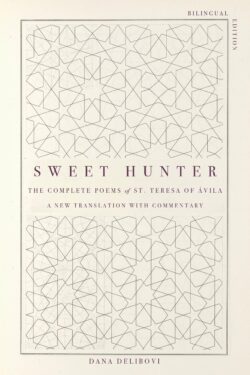
Book Review by Kristen Holt-Browning: Sweet Hunter: The Complete Poems of St. Theresa of Ávila (Bilingual Edition), translated and with commentary by Dana Delibovi

The Catholic mystic women of the medieval and early modern era—such as Hildegard of Bingen, Julian of Norwich, and Theresa of Ávila—can seem unknowable to us now. How did they nurture their fiery love of Christ within the rigid patriarchal (indeed, misogynistic) structure of medieval and early modern European Christianity? How did they find the strength and bravery to write about Jesus as husband, mother, lover? The writing of these mystic women can strike us even now as shocking, given that they often described Christ as their husband, their lover, or even their mother.

In Sweet Hunter: The Complete Poems of St. Theresa of Ávila (Bilingual Edition), poet and professor Dana Delibovi gives us the words of the sixteenth-century proto-feminist in a timbre close enough to our own to help close this gap. As Delibovi notes in her perceptive and illuminating Introduction, she centers Theresa’s balance of the mystical and the practical in her translations. Indeed, Delibovi admits that, “I had to fight the temptation to pretty-up her words and make them seem, well, more saintly.” And yet, it is this precisely this direct language that, paradoxically, heightens the divine fervor behind the writing, as when a shepherd speaks of Mary in “It’s Dawn Already”:

Continue reading “Book Review by Kristen Holt-Browning: Sweet Hunter: The Complete Poems of St. Theresa of Ávila (Bilingual Edition), translated and with commentary by Dana Delibovi”

An Incantation for 2024, USA by Marie Cartier

-please repeat and/or use in ritual, if needed

There was a time (there was a time)

We were waiting for something (we were waiting for something)

We were wanting something (we were wanting something)

We needed it to be different (we needed it to be different)

We were. We are. We are here: this is it.

We want something. We want something. We need something. We need something.

There was a time when we could make something happen.

Continue reading “An Incantation for 2024, USA by Marie Cartier”

REMEMBERING THE MAGIC OF MAMA DONNA HENES: 1945-2024 by Diane Saarinen

For those who don’t know who Donna Henes was, her official bio:

Donna Henes is an internationally renowned urban shaman, spiritual teacher, award-winning author, popular speaker and workshop leader whose joyful celebrations of celestial events have introduced ancient traditional rituals and contemporary ceremonies to millions since 1972. More at her Wikipedia page here.

Donna, known affectionately to many as Mama Donna, was so in tune with the seasons (even putting out a quarterly publication for a time called Always in Season), that when her time came to leave this sparkling, stunning incarnation of hers, she left on Autumn Equinox Eve 2024, just two days after her 79th birthday.

Sad news to those she left behind and sad news to the planet. But as we approach Samhain, Halloween and Day of the Dead, what wonderful memories my friend Donna Henes left me with! And “what is remembered, lives.”  So live on, Mama Donna!

                                                                                      *******

Continue reading “REMEMBERING THE MAGIC OF MAMA DONNA HENES: 1945-2024 by Diane Saarinen”

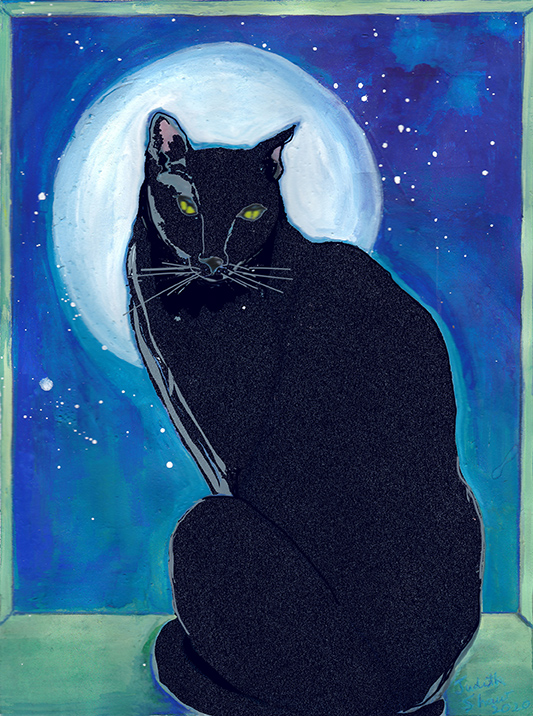
Samhain: The Cailleach, Wolf, and Black Cat  by Judith Shaw


Halloween, with its Celtic pagan roots in the sacred day of Samhain, which later morphed into a Christian holiday, is now mainly a nonreligious celebration in Europe and North America. It’s enjoyed by both young and old with scary outdoor decorations, parties, spooky costumes, haunted houses, carved pumpkins, and candy-giving.

Continue reading “Samhain: The Cailleach, Wolf, and Black Cat  by Judith Shaw”

From the Archives: In Memory of Margot Adler (1946-2014) Priestess, Journalist, Skeptic, Mystic by Elizabeth Cunningham

This was originally posted on October 22, 2014

“Ritual has the power to end our alienation from the earth and from each other. It allows us to enter a world where we are at home with the trees and the stars and other beings, and even with the carefully hidden and protected parts of ourselves that we sometime contact in dreams or in art.” –Margot Adler

Margot Adler died of cancer on July 28, 2014. A Pagan priestess, she asked for memorial events to be held in the season of Samhain, also known as Halloween.  At this time of year, the rituals of many religious traditions remind us that we are all connected, the living, the dead, and those to come, one continuous communion.  In this spirit, I offer a tribute to the late Margot Adler.

Continue reading “From the Archives: In Memory of Margot Adler (1946-2014) Priestess, Journalist, Skeptic, Mystic by Elizabeth Cunningham”

Legacy of Carol P. Christ: Exciting New Research on Matriarchal Societies

This post was originally published on Aug. 5th, 2011

The following is a guest post written by Carol Christ, Ph.D., a pioneer and founding mother of the Goddess, women’s spirituality, and feminist theology movements, and director of the Ariadne Institute.  She is also the author of multiple books including Rebirth of the Goddess.

Although there are some of us who disagree, the “party line” in the fields of Religious Studies and Archaeology—even among feminists– is that there never were any matriarchies and that claims about peaceful, matrifocal, sedentary, agricultural, Goddess-worshipping societies in Old Europe or elsewhere have been manufactured out of utopian longing.

I myself and most other English-speaking scholars defending Marija Gimbutas’s theories about Old Europe have studiously avoided the word “matriarchy” (speaking rather of “matrifocal, matrilineal, and matrilocal” societies) because the very word “matriarchy” conjures up the image of female-dominated societies where women ruled, waged wars, held men as slaves, and raped and abused men and boys. In fact, this fantasy tells us far more about patriarchy than about it does about matriarchy. Continue reading “Legacy of Carol P. Christ: Exciting New Research on Matriarchal Societies”