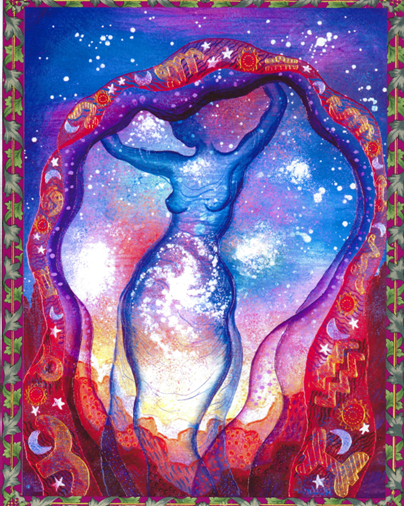
My Goddess is unconfined
–unbound
–unlimited
–unrestricted.
My Goddess exists beyond
–the images of Her created by men
–the words describing Her written by men
–the laws coercing Her, enacted by men.

Exploring the F-word in religion at the intersection of scholarship, activism, and community.

My Goddess is unconfined
–unbound
–unlimited
–unrestricted.
My Goddess exists beyond
–the images of Her created by men
–the words describing Her written by men
–the laws coercing Her, enacted by men.
Recently I had a serious accident and ended up in a nursing home after the surgery. My experience in this house of horrors was terrifying. Without any family support I was left to a health system that is hopelessly broken.
Drugged on my arrival it was a few days before I realized that the 17 drugs were making me sicker than I already was. I take only one regular medication and it wasn’t until I refused all but my one medication for PTSD/anxiety that my head began to clear. I was left alone under bright lights for my entire stay, and it remains to be seen whether I have suffered permanent eye damage as a result because I am so photophobic. The noise was unbearable making it impossible to sleep. No one bathed me or cleaned the filthy room. Ringing for help brought no one to my aid most of the time. It is important to state that there were exceptions, a couple of dedicated aides and three nurses, but no one was reliable on a daily basis. Because I was unable to eat the fatty unpalatable food, I lost pounds every few days. I was slowly starving. I remember thinking that I was going to die in this place, and it was this dawning realization that brought be back to the edge of life.
Continue reading “The Advocate by Sara Wright”This was originally posted January 9, 2017
In the middle of the night in waking sleep, I asked my great-great grandmother Annie Corliss to tell me the story of how she met and married James Inglis. This story came through me in a place I have come to call the Dreamtime. The Aboriginal term feels right. As I understand it, this is not a place where the dead speak to the living but rather a space where boundaries blur as the ancestors speak in us.
Annie Corliss’s Story: As It Might Have Been
Continue reading “Legacy of Carol P. Christ: As It Might Have Been: Ancestor Stories in the Dreamtime”
One of the basic tenants of feminist methodology in religion is the recovery of women’s history. There are many ways to approach such a task. In religions with sacred writings, one avenue for recovery may be reinterpreting them. This could come in the form of a critique. For example, traditional interpretations may overlook or undervalue women, who appear in the text, reaffirm sexist, patronizing, and/or misogynist viewpoints already found in the text, or develop new ones. In order to recover women’s history, feminists working with their sacred texts would then call out these interpretations for their sexism. They would correct phrasing, understanding, and even translations, when necessary.
In addition to critiquing, feminist interpretations of scripture could also be constructive. Religious feminists may highlight values, teachings, and images that affirm women’s lives. They may incorporate documented history into their interpretations as proof of expanded roles for women. That would then contextualize or negate later traditions that deny women such roles.
Continue reading “From the Archives: “Breathing Life into the Women of Chayei Sarah.””
In meditation this morning, it occurred to me how a vital ingredient to the paradigm shift is making the intangible tangible.
I am speaking of the work that you and I do.
I have put nine years of tireless work into my computer app, working daily and spending my personal funds to the tune of about $100,000. With new features that I added this year, the business plan is sound. I just need about ten times the registrants. In other words, I’m 100 feet shy of an 8000 foot mountain. And about to run out of money.
Continue reading “A Maternal Economy: Making the Intangible Tangible by Caryn MacGrandle”Part 1 was posted yesterday. You can read it here.
Patriarchy is a system of male dominance, rooted in the ethos of war which legitimates violence, sanctified by religious symbols, in which men dominate women through the control of female sexuality, with the intent of passing property to male heirs, and in which men who are heroes of war are told to kill men, and are permitted to rape women, to seize land and treasures, to exploit resources, and to own or otherwise dominate conquered people.[i] – Carol Christ
In Part I, I urged against the distancing that intellectual analysis can bring to situations that require us to respond from the depths of our being, and yet, how can one be a reader of this blog and not examine the intertwining strands of patriarchy, religion, women, and war in this current conflict.
Continue reading “To See Ourselves in Others: Part Two by Beth Bartlett”I have felt both a responsibility and a reluctance to write about the escalating conflict in the Middle East. The situation is so complex and such an unspeakable tragedy – acts of such terror and violence on the part of Hamas toward civilian populations met with even greater violence and repressive measures on the part of Israel toward the people of Gaza. It is a perplexity of the human condition that a people with such a deep history of being displaced and oppressed rather than refusing to oppress in turn, instead engage in the displacement and oppression of others that then erupts into more violence. Both are traumatized peoples acting out of deep pain and woundedness. Thousands have died, more are wounded and displaced, all will carry more trauma into generations to come. The very earth bears the scars of war. In the face of such unspeakable suffering, any kind of analysis feels distancing at a time when what we most need is to let the suffering move us to our depths.
Continue reading “To See Ourselves In Others: Part One by Beth Bartlett”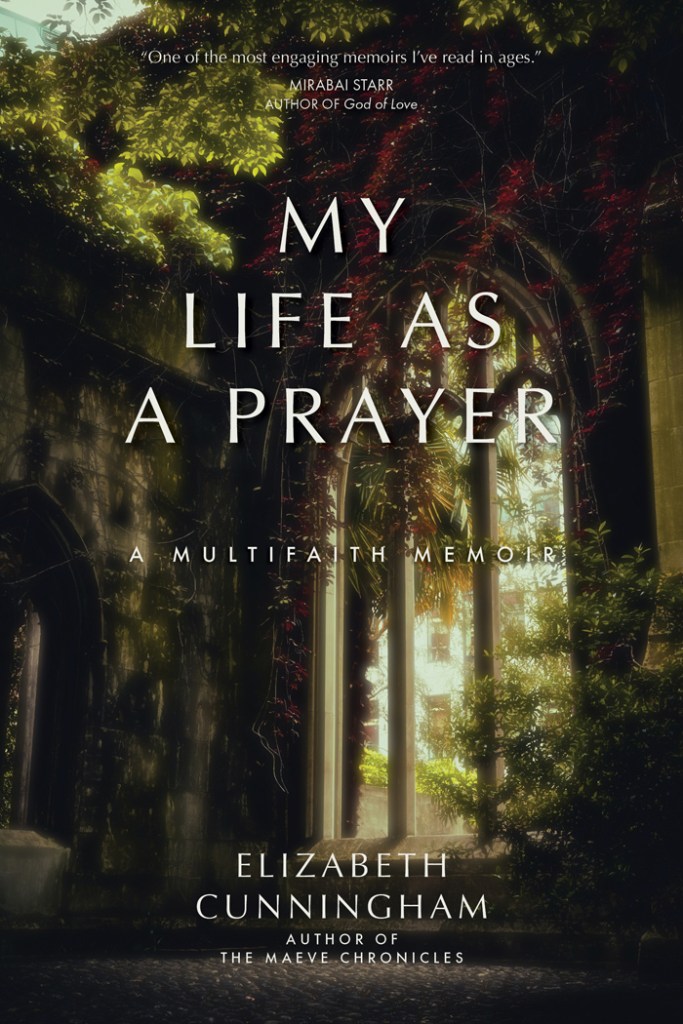
Our own FAR sister, Elizabeth Cunningham has written her marvelous memoir which came out yesterday. It is titled My Life as a Prayer with the subtitle, A Multifaith Memoir. For those of you who may not know Elizabeth, she wrote regularly for FAR for many years. She is the author the The Wild Mother and the award-winning Maeve Chronicles. Her Chronicles envision the Celtic Mary Magdalen named Maeve. Throughout the four books of the Chronicles, Maeve is filled with vivacious energy and her own life of spirit. The books are Magdalen Rising, The Passion of Mary Magdalen, Bright Dark Madonna and Red-Robed Priestess (which in full disclosure is one of my favorite series of all time.)
In My Life as a Prayer, Elizabeth’s writing is lush and poetic, clever and clarifying, multilayered and depthful. I hope I can convey all those elements in this short blogpost?
Continue reading “My Life as a Prayer by Elizabeth Cunningham, book review by Janet Maika’i Rudolph”(Written on Oct. 27)
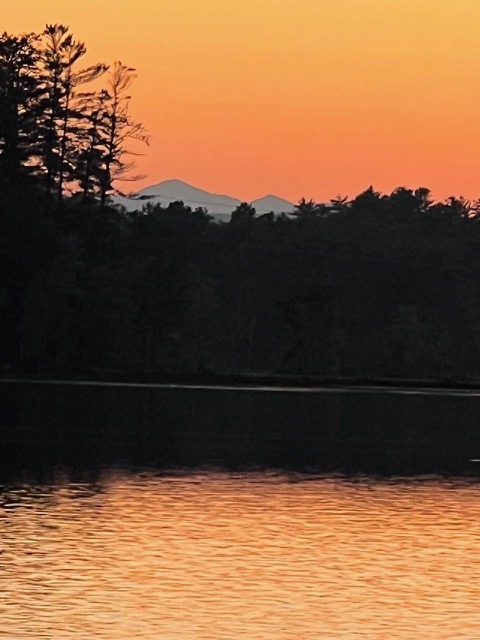
Adjusting to earth changes is as much of a personal challenge as is my aging process… The earth and I are both struggling to survive the age of the Anthropocene. Hard times.
It’s late October and the next turning of the wheel will soon be upon us. The Days of the Dead. Honoring the Ancestors, those who came before… I think of the Sandhill cranes flying south in loose family aggregations and believe some of my ancestors must be these birds… I missed seeing them this year due to an accident, but say earth prayers for their safety on the wing… I remember my Grandmother.
Continue reading “Shifting Landscapes by Sara Wright”This was originally posted on January 2, 2017
During my ancestor research, I have seen the word “tenement”—with the implication of poverty, filth, and disease–handwritten onto more than one death certificate. Last month, I visited the Lower East Side where my Irish 2x great-grandmother Annie Corliss lived in the tenements near the docks with her husband the Scottish seaman James Inglis and their nine children.
Though the tenements where they lived in the vicinity of Cherry Street a block from the East River have been torn down to build public housing, my newly discovered third cousin Hattie Murphy still lives in the area. She arranged for me to visit the “Irish Outsiders” house in the Tenement Museum on nearby Orchard Street in order to gain an understanding the conditions of life in the tenements in the middle of the nineteenth century.
Continue reading “Legacy of Carol P. Christ: Life in the Tenements” Feminism and Religion