It seems that the hearts of the whole world, and especially the hearts of women, are grieving now, as war and warmongering take over more and more of the Earth. Patriarchy rages on, like a monster in its death throes, and we wonder, “will they take us all down with them?” It is my hope that these poems will help us to keep on keeping on, keep on loving Her.
My grief, my love for the world
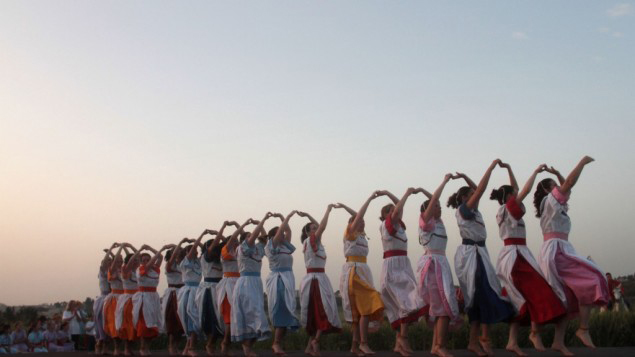
I watch the dancer, one arm framing her face, one hip drawing upward in the belly’s rhythm. The dance of mature women, Raqs Sharqi born of the sensuous music of the Middle East. Her hips pull us into infinity, an inward-outward shout of beauty and desire.
Joseph Campbell spoke of ‘mentors’ appearing to help the sojourner, and what Maureen Murdock called the gathering of allies. In my hybrid of these two archetypal journeys, there may be several mentors – human, power animals, divine guides or a combination. She could be a wise elder who helps the heroine prepare for the journey or gives her a gift for later use. In my case the wise elder was my 93 year old mom who became one of my mentors. When I expressed my excitement and fears, she said what she always says when I – one of her seven children – am facing a challenge: “Go get’em Tiger!” She also offered financial support so I could take time away from my psychotherapy practice.
Two other mentors showed up in what Carl Jung called my ‘active imagination’: Carol Christ and Marija Gimbutas. Both have transitioned so my active imagination conjured their support as divine intervention. I reread Carol’s reflections and teachings on the pilgrimage, and watched the videos she made as inspiration. I felt her invitation. I was ready to change.
Carol Christ’s Legacy honored by Laura Shannon, and the Ariadne Institute
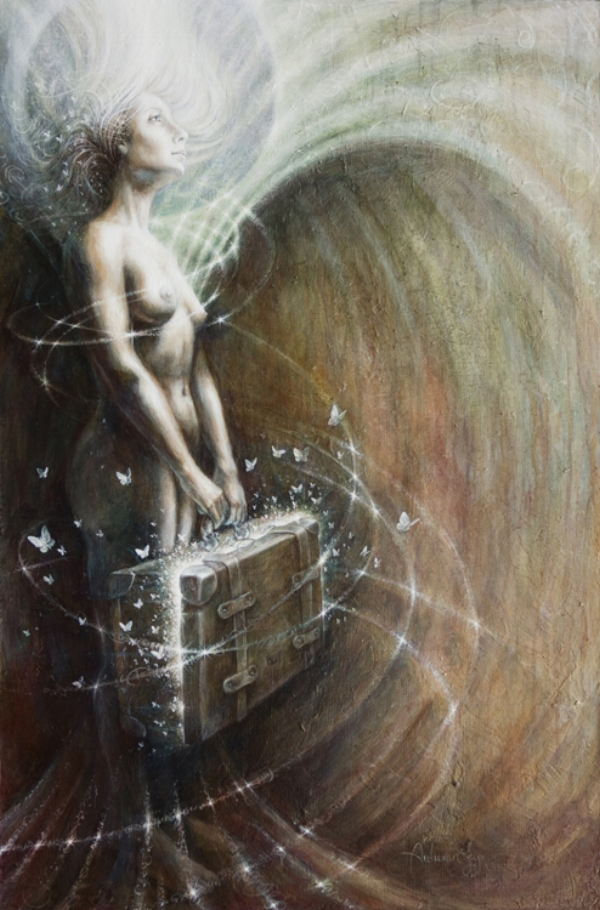
Adventure by Autumn Skye with permission of artist
When I teach the Heroine’s Journey in my Sophia Women’s Wisdom Group, I draw on Joseph Campbell’s idea of the mono-myth, an archetypal story that resonates with every human across time: The Hero’s Journey. I combine Campbell’s ideas with pieces of feminist Maureen Murdock’s heroine’s journey to recognize the unique pathway of the feminine. I call this my hybrid heroic journey. If you are not familiar with Maureen Murdock’s work, I invite you to see how she brought her feminist eye to Campbell’s iconic Hero’s Journey in her book The Heroine’s Journey: Woman’s Quest for Wholeness. After her conversation with Joseph Campbell six years prior to his transition, Murdock felt he missed “that the focus of female spiritual development was to heal the internal split between woman and her feminine nature” (p. 2). In my hybrid heroic journey, that split in the early stages is internalized negative masculinity. The rejection of our feminine nature may appear differently in each woman’s life but it is often characterized by treating ourselves how we imagine men perceive us.
My recent Pilgrimage to Crete was astonishing; my epiphany, gradual. As I share my adventure, imagine stages of your own heroine’s journey wherever you are in that cycle. I hope that by sharing this series, you will experience a real life example of Dion Fortune’s definition of magic: ‘The art of changing consciousness at will’. Starhawk, Truth or Dare, 1988.
Recently I had a serious accident and ended up in a nursing home after the surgery. My experience in this house of horrors was terrifying. Without any family support I was left to a health system that is hopelessly broken.
Drugged on my arrival it was a few days before I realized that the 17 drugs were making me sicker than I already was. I take only one regular medication and it wasn’t until I refused all but my one medication for PTSD/anxiety that my head began to clear. I was left alone under bright lights for my entire stay, and it remains to be seen whether I have suffered permanent eye damage as a result because I am so photophobic. The noise was unbearable making it impossible to sleep. No one bathed me or cleaned the filthy room. Ringing for help brought no one to my aid most of the time. It is important to state that there were exceptions, a couple of dedicated aides and three nurses, but no one was reliable on a daily basis. Because I was unable to eat the fatty unpalatable food, I lost pounds every few days. I was slowly starving. I remember thinking that I was going to die in this place, and it was this dawning realization that brought be back to the edge of life.
In the middle of the night in waking sleep, I asked my great-great grandmother Annie Corliss to tell me the story of how she met and married James Inglis. This story came through me in a place I have come to call the Dreamtime. The Aboriginal term feels right. As I understand it, this is not a place where the dead speak to the living but rather a space where boundaries blur as the ancestors speak in us.
One of the basic tenants of feminist methodology in religion is the recovery of women’s history. There are many ways to approach such a task. In religions with sacred writings, one avenue for recovery may be reinterpreting them. This could come in the form of a critique. For example, traditional interpretations may overlook or undervalue women, who appear in the text, reaffirm sexist, patronizing, and/or misogynist viewpoints already found in the text, or develop new ones. In order to recover women’s history, feminists working with their sacred texts would then call out these interpretations for their sexism. They would correct phrasing, understanding, and even translations, when necessary.
In addition to critiquing, feminist interpretations of scripture could also be constructive. Religious feminists may highlight values, teachings, and images that affirm women’s lives. They may incorporate documented history into their interpretations as proof of expanded roles for women. That would then contextualize or negate later traditions that deny women such roles.
In meditation this morning, it occurred to me how a vital ingredient to the paradigm shift is making the intangible tangible.
I am speaking of the work that you and I do.
I have put nine years of tireless work into my computer app, working daily and spending my personal funds to the tune of about $100,000. With new features that I added this year, the business plan is sound. I just need about ten times the registrants. In other words, I’m 100 feet shy of an 8000 foot mountain. And about to run out of money.
Part 1 was posted yesterday. You can read it here.
Patriarchy is a system of male dominance, rooted in the ethos of war which legitimates violence, sanctified by religious symbols, in which men dominate women through the control of female sexuality, with the intent of passing property to male heirs, and in which men who are heroes of war are told to kill men, and are permitted to rape women, to seize land and treasures, to exploit resources, and to own or otherwise dominate conquered people.[i] – Carol Christ
In Part I, I urged against the distancing that intellectual analysis can bring to situations that require us to respond from the depths of our being, and yet, how can one be a reader of this blog and not examine the intertwining strands of patriarchy, religion, women, and war in this current conflict.
I have felt both a responsibility and a reluctance to write about the escalating conflict in the Middle East. The situation is so complex and such an unspeakable tragedy – acts of such terror and violence on the part of Hamas toward civilian populations met with even greater violence and repressive measures on the part of Israel toward the people of Gaza. It is a perplexity of the human condition that a people with such a deep history of being displaced and oppressed rather than refusing to oppress in turn, instead engage in the displacement and oppression of others that then erupts into more violence. Both are traumatized peoples acting out of deep pain and woundedness. Thousands have died, more are wounded and displaced, all will carry more trauma into generations to come. The very earth bears the scars of war. In the face of such unspeakable suffering, any kind of analysis feels distancing at a time when what we most need is to let the suffering move us to our depths.