 In a recent blog, Carolyn Boyd invited us to reflect on how our women’s spiritual power is activated through symbols that help us to remember and manifest the “deep well” of our inner knowing. According to historian of religion Mircea Eliade, the sacred and the profane were not separated in premodern cultures because all of life was considered to be sacred. Many in the Women’s Spirituality and Goddess communities have advocated this earlier more wholistic understanding. Although it is not always easy to overcome the dualism between sacred and profane, we attempt to do so.
One of the symptoms of my chemotherapy is neurasthenia or partial numbness in my right foot. When it first occurred, I fell three times in my apartment because I was not lifting my foot automatically. I became afraid to move without holding onto the walls or furniture. I resisted my friends’ advice to get a walker, but finally agreed that I needed some form of physical support. I arranged for my friend Eirini Kouraki to have a rubber tip added to the shepherd’s cane I sometimes use walking in the mountains. When she brought it too me, I decorated it with three ribbons I saved from rituals at the Holy Myrtle Tree at the Paliani monastery in Crete. The most recent were brown, the color of the earth, and red, the strong energy I will need to heal. I added a light green-blue ribbon, representing the calm and clear optimism I feel as I face a crisis of life and death. The ribbons remind me of the healing power of the Holy Tree that I have called upon many times, turning a symbol of my infirmity into a symbol of healing and hope.

In the past weeks as my cancer treatment continues, I have been feeling strong enough to finish unpacking (with the help of Vera, my cleaning lady) and organizing my new home in Crete. As I rediscover sacred objects, I create altars. Altars are physical reminders of our spiritual beliefs. Creating and tending them helps to create the embodied knowing that brings the spirit into our daily lives.
The living area of my new apartment has 3 glass shelving units. In one of them, I created a triple altar with images of the Goddess and female power from ancient Crete. Because the apartment is sleek and modern yet welcoming to my antique furniture, I kept the altar minimal.
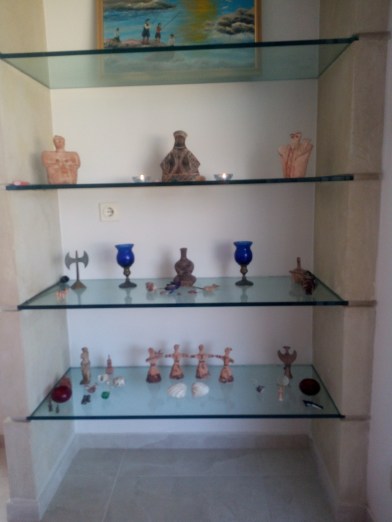
On the top shelf I placed three pre-palatial “pitcher” Goddesses, two with breasts from which liquid pours and one that is holding a water jug from which liquid can also be poured. These images, dated before 2000 BCE, express the Old European insight that the Goddess represents the powers of birth, death, and regeneration in all of life. Though they have human qualities, they are more than human. The Goddess from Malia who sits in the center of this altar has a beaked face and wings and her triangular shape evokes the mountains from which water flows to villages and fields. These images remind me that the Goddess is the Source of Life, provider of gift of life that is our embodied being and the gifts of life—including food and water–that nourish us daily.
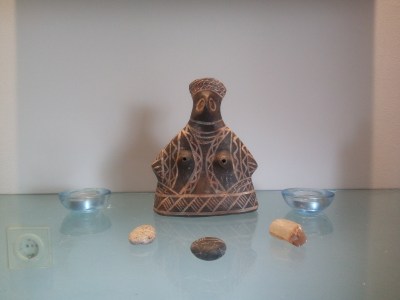
The second shelf holds one of the oldest images from ancient Crete, the Neolithic Goddess from Ierapetra. She is seated on massive buttocks, securely rooted in the earth. Her face is beaked, symbolizing her connection to the birds that fly in the air. Her body is decorated with lines identified by archaeologist Marija Gimbutas as the flowing water that nourishes all of life. Her body too is shaped like the mountain. She represents the never-ending powers of birth, death, and regeneration in all of nature.
In front of the Neolithic Goddess I placed a twig from Paliani with a dark blue ribbon reminding me that my friend Tina Nevans is sending the healing energy of the Blue Buddha to me in her daily meditations, as well as several handsewn triangles holding leaves from the Holy Myrtle tree, and a crystal extracted from the Trapeza Cave, found on the path outside of it. To Her right is a small image of the long-necked turtle Goddess from Myrtos who holds a pitcher recalling women’s daily visits to water sources, and a small copy of a Kamares ware pitcher used to pour libations in the Sacred Centers. To the left are a bronze copy of a labrys, originally the double sacred female triangle transformed into wings and also a happy little bull who reminds us that animals experience the joy of life.
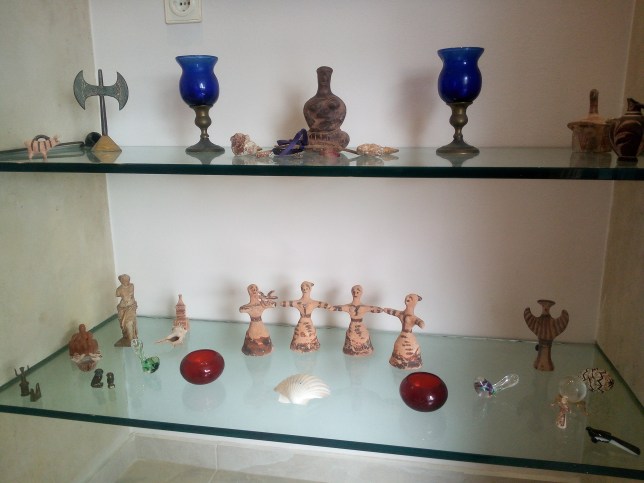
On the lower shelf, copies of dancing women from post-Minoan Paliakastro symbolize the transmission of Old European values of community, lack of hierarchy, and most of all, celebration of the joy of life as Laura Shannon has written. The dancing women are surrounded by images of later Mycenaean Goddesses and of Aphrodite who was worshiped at the Minoan site of Kato Symi in classical times, and a small reproduction of the Neolithic Goddess from Catal Huyuk, who reminds us that Crete was settled c.7000 BCE by farmers from Anatolia.
In the hallway I placed a copy of a drawing of the Holy Myrtle Tree of the monastery of Paliani created by one of the nuns. According to the story told, the area where the monastery was later built was burned in a fire but a small myrtle bush survived. It was watered by girls who saw the image of the Panagia (Mary the Mother of Jesus) in its charred branches. So, the monastery which was known as ancient in 668 CE was built. The monastery is a sacred place for the surrounding villages. The sacred tree and the icon of the Panagia in the church are said to have performed many miracles. Below the drawing of the Sacred Myrle Tree is a small image of a face in a twig from tree given to me by German artist Carla Randel.

On a small table under the drawing, I placed an image of Aphrodite who was earlier associated with myrtle trees, along with a candle, a star, a blue glass paperweight, and a triton shell, symbolizing Aphrodite as the morning and evening star, and her relation to the sea.

When I light candles in translucent glass holders on the altar with the pitcher Goddesses as the day dawns and in the evening as day turns to night, and when I gaze at my other altars, I remember that I am always surrounded by the nurturing love of the Goddess. This love takes root in my body, and I am inspired to share it with others.
To be continued.


 I went to sleep in Greece on Wednesday night January 6 feeling elated that Jon Ossoff, following Raphael Warnock whose victory had been declared earlier, was officially named the winner of his runoff election in Georgia, returning the Senate to the Democrats by the slimmest of margins. I expected to wake up to the celebration of Stacey Abrams’ contribution to the victory and to listening to commentators discussing how it came about and what we could expect from the next Congress.
 I am not big on New Year’s resolutions, but this year I have vowed to change one of my habits. I have always been house-proud and love using my artistic flair to decorate my home in beauty. I have had a cleaning lady most of the time for many years, so my homes have been relatively clean. The living room and dining room have always been ready to receive guests. But I didn’t always do the dishes or clean the surfaces in the kitchen right away, clothes I had worn often sat on chairs before I hung them up, and I didn’t make the bed every day.
 Though I have not been Christian for many years, I love to decorate my house for the holidays. I have many decorations that I have collected over the years, including a Hummel angel gazing at the Christ child that was my father’s mother’s and a small crocheted Christmas tree given to me by my mother. My Christmas tree is a living one in a pot, and I usually manage to keep it alive on the balcony or outside for several years. One of my hobbies is collecting ornaments for the tree. Among my favorites are glass icicles and snowflakes crocheted by my friend Alexis many decades ago. There are white doves and brown birds that land on the tree branches and glass balls that have come into the stores again in recent years.
 Last Friday my oncologist gave me the best birthday present I could have imagined. (My birthday was 7:30 pm last night December 20, California time.) Without going into details, my latest CT scan was so much more positive than the last one that it feels like a miracle. I have reason to hope.
 The days are slowly winding down toward Winter Solstice in the northern hemisphere, the longest night of the year. Today the sun rose at 7:20 and will set at 5:08 in Crete. In Sweden, the sun will rise at 9:25 and set at 2:12. Though I light candles in the darkness of morning and have lights on my tree, I am not celebrating the “return of the light,” but rather welcoming the restful dark.
 In the 1960s and 1970s, American-born Genevieve Vaughan was living in Rome with her husband, philosopher Ferruccio Rossi-Landi, and their three daughters. When Rossi-Landi, using Marxist models, began to write about language as a form of “exchange,” Vaughan was inspired to articulate her alternative theory based on the idea that language was developed and is learned through the gifts of the mother to the child. From that beginning, Vaughn developed an alternative theory of culture based on what she calls the “gift economy.”
 Greece is on nationwide lockdown due to a surge in Covid cases in the fall. What does this mean? For three weeks until December 1, we can leave home only for essential reasons which include: going to a nearby supermarket; visiting the doctor or pharmacy; going to banks or public utility offices; helping someone in need; traveling to work if working from home is not possible; attending a funeral; traveling to see children when parents are separated; leaving home for physical exercise or to care for pets or strays. Masks must be worn at all times outside the house; SMS must be sent to a national number listing the reason for leaving home or a paper must be carried with the same information; a special document is required for work listing hours; the fine for violation is 300 euros and police are enforcing this, particularly in the cities. Restaurants and bars are closed; only a few categories of shops are open. A curfew from 12 am to 5 am was extended to begin at 9 pm; this is because young people have been congregating outside in groups. Travel in Greece is restricted; visits to second homes are not allowed. Primary schools are open, but secondary schools are using internet. Similar restrictions were in place in March and April in Greece and the country had one of the lowest virus rates in the world until recently. The hope is that the lockdown will stem the spread of the virus and that the restrictions will be lifted before the holidays.
 During the past few days I have begun to breathe again. As I exhale, tensed muscles relax and feeling comes back into my body. I realize that I have been holding my breath not only for the days it took for the election results to come in, but for the past four years. After a long wait, Joe Biden and Kamala Harris were finally declared the next President and Vice President of the United States. Their ability to pass legislation now hangs in the balance in the two Senate run-off elections that will be held in Georgia on January 5.

