To Stand in the Presence of the Ancients! – Enheduanna, Part 2 by Janet Maika’i Rudolph

Yesterday I wrote about the priestess/scribe Enheduanna and her warrior/king father Sargon. I posited their connection to the codification of patriarchy. They did not invent it, as war and the diminution of women had been happening in some circles. I do wonder, however, if they furthered it along to a point of no return.

Another king of the time, Urukagina from circa 2350 bce[1] codified laws under the guise of reformation.  Some of his reforms were progressive in that they sought to protect the poorer classes against aristocracy and the priesthood.  But they also were clear to let women “know their place.” Here are the translated words from his laws:

“If a woman to a male has spoken . . .[bad] words(?) which exceed (her rank?), onto the teeth of that woman a baked brick shall be smashed, and that brick will be hung at the main gate.”

Continue reading “To Stand in the Presence of the Ancients! – Enheduanna, Part 2 by Janet Maika’i Rudolph”

To Stand in the Presence of the Ancients! – Enheduanna, Part 1 by Janet Maika’i Rudolph

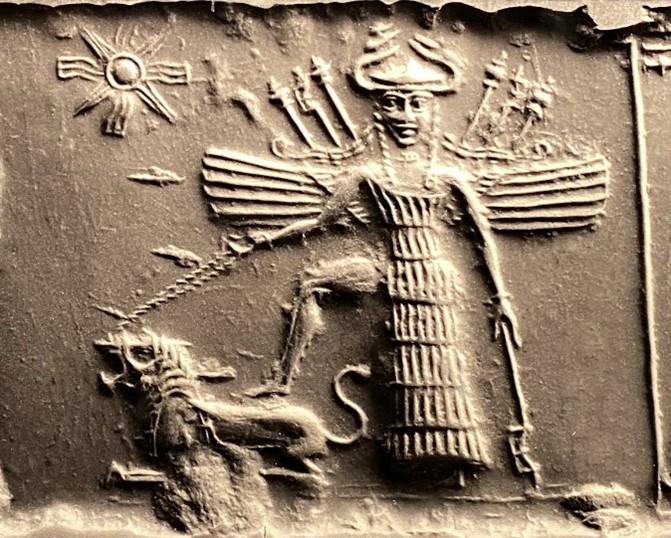
Ishtar controlling a lion ca 2334-2154 BCE

To be in the presence of antiquities is powerful. They carry an energy which is palpable.  I found this to be true at the recent exhibit at the Morgan Library in Manhattan that ran from October 14, 2022 through February 19, 2023. 

Enheduanna is a fascinating woman who lived in the lands of Mesopotamia circa the 23rd century BCE. She was a priestess who was also a writer and chronicler of her times. She named herself in her writings making her the first known author of any written works in history. She was so influential that for centuries after her death, scribes learned their craft in scribal schools by reading and copying out her work. Scholars have referred to her as the Sumerian Shakespeare[1]

Her main temple was in Ur, the very city that hundreds of years later gave rise to the biblical priestess Sarah and her husband, Abraham. We can only image how much they had been influenced by her.

Continue reading “To Stand in the Presence of the Ancients! – Enheduanna, Part 1 by Janet Maika’i Rudolph”

The Crow’s Nest by Sara Wright

 Bare tree

shadowy veil

old snow

won’t let go.

Beaded Judges

shift

spring tides

 hide

  predators

with eyes.

Crows

 reveal

 old bones…

March is the month when crows scream, screeching and mobbing as they soar through indigo skies – their harsh declarations hurt my ears though I know they are mating and nesting.

Continue reading “The Crow’s Nest by Sara Wright”

The Patriarchy Strikes Back by Janet Maika’i Rudolph

I suppose no one is all that surprised but it is still stunning how quickly certain politicians are rushing to pull back women’s rights. It’s become a race to regulate women’s bodies of with draconian and cruel laws.

Each law is more extreme than the next. In South Carolina it has even been proposed to make abortion a crime subject to the death penalty.

Commentators say the bill isn’t going anywhere.  But it was still proposed. It is now in the eco-system of abortion politics. It is being imagined and that opens up all possibilities of where it can go from here. We never thought, after all, that Roe would be overturned.

Continue reading “The Patriarchy Strikes Back by Janet Maika’i Rudolph”

Vayak’hel-Pekudei: On the Contributions and Gifts of Women by Ivy Helman.

This week’s Torah portion is a double one, Vayak’hel-Pekudei (Exodus 35:1 – 40:38 and Exodus 12:1-20).   Vayak’hel covers the construction of the Mishkan, or the temple that traveled with the Israelites while in the desert, and Pekudel outlines the requirements for Pesach, particularly the sacrificial lamb, the blood on the doorposts, and the requirement to eat unleavened bread. For this post I will focus on Vayak’hel as it is the only portion that makes direct mention of women.  It reminds us of the ways in which religion and religious institutions would not be possible without the contributions of women.

 Vayak’hel centers on the construction of the Mishkan beginning with the general assumption that everyone (here men and women) will donate the items needed to construct the Mishkan.  The text also contains verses in which women are specifically mentioned.  They donate their gold jewelry (35:22) and mirrors (38:8) as well as  spin wool and linen into yarn to be used for the Mishkan’s copious amounts of curtains  (35:25-26).  

Continue reading “Vayak’hel-Pekudei: On the Contributions and Gifts of Women by Ivy Helman.”

Women, Blame, and Patriarchy by Mary Gelfand

Pandora by Rebecca Guay

Last May I had a vision in the shower. It wasn’t the kind of vision I like to have—where the Goddess and I dance across a meadow with flowers springing up as we pass and cool breezes bringing sweet fragrances. This was the kind of vision I’d rather not have, but probably needed to. This is from my journal.

Something happened during my shower recently that feels relevant. As I stepped into the shower, a phrase thrust itself into my mind: “I was forced to watch them die and it was all my fault.” As I ‘stood’ there with water pouring over my body and that statement vibrating in my brain, it attached itself to a scene where I was the spiritual leader of a community that came under attack. I was forced to watch the women and men who believed in what I taught as they were executed. Many of them were friends and relatives. I was restrained and couldn’t intervene to save them, or join them in execution. Having to witness this was part of my punishment. Instead I was carried to a bigger town, publicly humiliated and beaten, and then executed in some painfully unpleasant way I can’t recall–probably because I don’t want to.

Continue reading “Women, Blame, and Patriarchy by Mary Gelfand”

Legacy of Carol P. Christ: “What Would Happen If One Woman Told the Truth about Her Life?”

This was originally posted on September 24, 2018

According to poet Muriel Rukeyser, “the world would split open.”

This poem accurately describes what many women experienced in consciousness raising in the 1970s and what many women experience today in the #MeToo movement.

For many of us the world did split open. We began to take ourselves and our experiences seriously. To do so we had to question received wisdom encoded in such questions as: “What was she doing there in the first place?” “Was she drinking too?” “Why didn’t she change out of her bathing suit?” Underlying these questions is the assumption that: “whatever happened, she must have asked for it.”

A lot of people are wondering why congressmen and voters who claim to uphold Christian principles are not more outraged about credible allegations of sexual assault against a child whose name was Christine Blasey. What this question fails to address is the fact that the Christian principles (if any) held by conservatives are steeped in patriarchy. Liberals may argue that Jesus would have cared about the girl, and I believe they are right. But the Christianity that developed after his death was centered on the Father, Son, and Holy Spirit, all of whom are male. This Christianity is patriarchal to the core: its deep message is that power belongs the hands of males and that male power is not to be questioned.

Continue reading “Legacy of Carol P. Christ: “What Would Happen If One Woman Told the Truth about Her Life?””

Two Steps Forward, Three Steps Back By: Anjeanette LeBoeuf

It is a new year, 2023 and with it, some truly concerning elements. One of the most all consuming is that of the persistent and continual attack on women, communities of color, non-Christian communities, and the queer community.

One of my last FAR posts talked about the situations, uprising, and horrible killings done by the Iranian Fundamentalist regime. The protests are still happening, more people are being arrested, and the death toll has continued to rise. We have also seen the death of the longest reigning monarch, Queen Elizabeth II, and the surprised resignation of New Zealand Prime Minister Jacinda Ardern.

Continue reading “Two Steps Forward, Three Steps Back By: Anjeanette LeBoeuf”

The Patriarchal Dilemma by Janet Maika’i Rudolph

I was listening to a newscast when it was reported that the Ukraine sent missiles into Russia. My initial thought was “it’s about time they took it to the Russians.” The next moment I was horrified at myself.  I am a pacifist.  I think the proliferation of weapons is one of humankind’s great evils and here I was cheering on an attack.  One that could escalate an already nasty war, lead to nuclear weapons use and possibly even a world war. And yet when I look at what is happening in Ukraine, my mind simply can’t comprehend what the people are going through. The trauma of the children cuts particularly deeply. And I can see no sane reason behind the strikes other than rank cruelty.

There it is in a nutshell, what I have come to call the patriarchal dilemma. It’s a no-win situation with no right answer. While life might place us in such positions all on its own, the patriarchal form of this is created by design. It is nasty, it is cruel, and loss of human life and ecological destruction are not glitches but features.

Continue reading “The Patriarchal Dilemma by Janet Maika’i Rudolph”

From the Archives: “The Importance of Religion for Ecofeminism,” by Ivy Helman.

Author’s note: Originally published on January 8, 2017, this post still speaks to me 6 years-to-the-day later. Now, when I teach ecofeminism, I dedicate a week to religion as we cannot deny the way in which Western patriarchy and religion have coexisted and often fed off each other. The only distinction I would add to this original post is that not all religions are equal when it comes to patriarchy and its misdeeds. Christianity has had more power and influence than others. However, Christianity is not the only religion to hold patriarchal views. That needs to change. May the New Year bring more of that needed change.

“Why is religion important to ecofeminism?” A student, in the Master’s course I teach at Charles University, asked this as we began the class session dedicated to the topic. Given the overwhelming presence of atheism in the Czech Republic, I wasn’t too surprised by the inquiry.  Nonetheless, the idea has been at the back of my mind ever since: what does religion have to do with ending patriarchy and bolstering the health of the planet? While I may take the connection as obvious, it is clearly not for many feminists out there. Here is how I understand it.

Continue reading “From the Archives: “The Importance of Religion for Ecofeminism,” by Ivy Helman.”