DeeDee & Helen—A Trans Love Story, Part II by Mary Gelfand

Part 1 was posted yesterday

Being a lifelong spiritual seeker, DeeDee began searching for a church community where she could be herself.  Fortunately, she found a Unitarian Universalist Church which had long welcomed the LGBTQ community.  DeeDee felt very welcome in this community and it was there that I first met her, in the fall of 2002. 

At that time I was doing a lot of teaching around paganism and goddess religions.  DeeDee started signing up for my classes and we became friends.  She was the first trans person I came to know deeply.  Much of my understanding of the struggles trans people face comes from my relationship with DeeDee.  For example, in one class I taught, students were asked to engage in an activity that involved braiding 3 pieces of yarn together.  Most of the students were women, and they immediately began braiding.  I took time to teach the one man in the class how to braid, and turned to find DeeDee at my elbow.  She took me aside and shyly whispered—”I never learned how to braid.  It’s not something that boys are taught.  Can you help me?”  This came in the category of “It never occurred to me,” and over the years DeeDee corrected both my assumptions and my language around what it meant to be trans.  I was always grateful for her wisdom and insight.     

Continue reading “DeeDee & Helen—A Trans Love Story, Part II by Mary Gelfand”
DeeDee & Helen—A Trans Love Story, Part I by Mary Gelfand

Author’s Note:  I am a cis woman writing about a trans woman who was my friend.  What I know about her experience comes from stories she told me, and things I learned from her wife Helen, who has given me permission to share this story.  So I am not writing from a position of personal knowledge of what it means to be trans.  I am writing out of compassion for and sensitivity to the lived experience of my friend DeeDee and of trans individuals across the globe.

***

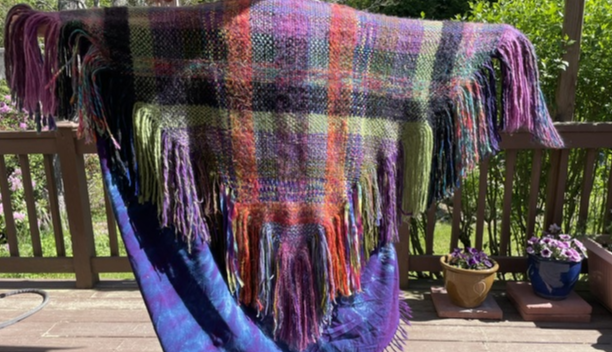
I first met DeeDee when I stopped by my Unitarian Universalist church to drop off a colorful triangular hand-woven shawl I had made for the upcoming auction.  DeeDee was sitting behind the desk, recording the items that were being donated and we chatted a for a few minutes.  In those days, I was teaching a variety of classes on Paganism and the Divine Feminine at the church. She asked if I was the Mary who taught these classes and expressed interest in joining one  That is how our friendship began.  I later learned that she made the winning bid on the shawl I donated that day.  

DeeDee was assigned male at birth–the oldest child in a large Catholic family residing in New Orleans, Louisiana.  Naturally she attended Catholic schools.  DeeDee briefly considered a life of religious service and enrolled in St. Joseph’s Seminary.  However, being extremely intelligent and given to questioning everything, DeeDee was soon pegged as a troublemaker and she and the Brothers parted ways.

Continue reading “DeeDee & Helen—A Trans Love Story, Part I by Mary Gelfand”

Nature and the Body Were Never the Enemy

Reflecting on the contradictions of modern life, this essay explores how both wilderness and female embodiment became culturally suspect within Western thought. Drawing on themes of estrangement, relational ontology and kinship, it considers how practices of attention, presence and nature connection may help us return to a deeper sense of belonging.

Continue reading “Nature and the Body Were Never the Enemy”

Embodiment as Positive Resistance

I nearly cancelled my recent trip to the United States. The political climate felt tense, the global atmosphere uncertain, and travelling across the Atlantic seemed questionable for several reasons.

Friends encouraged me to go anyway, suggesting that meeting people in person would offer a different perspective from the one shaped by media narratives. And of course, it wasn’t headlines I was meeting, but people, in a human reality that persists beneath larger systems. Thankfully, my trust in relational experience outweighed my hesitation, and I returned from my travels with renewed inspiration.

I’m writing this essay because many people I met spoke with an apologetic tone about being American. They expressed disbelief, embarrassment or anger about their conspicuous yellow haired chief. I just want to acknowledge the warmth, generosity, care and humanity I encountered wherever I went.

The entire experience confirmed what I have long sensed in my work with movement, ritual and community: that embodied presence, especially in uncertain times, is such a remedy for heart and soul. What I encountered was meaningful human contact, even in a politically divided country.

Continue reading “Embodiment as Positive Resistance”

Expanding the Possibilities of Being: Transness and the Practice of Freedom by Mark Gardett

Imagine a tree.

This tree lives in a park, surrounded by other trees. There’s a lake in the distance, and the tree has plenty of space to spread its leaves to the sun. In the summer, its leaves are lush and green, and in the winter, its bare branches shake in the wind.

Now imagine this tree saying to itself, when its leaves turn brown in the fall, “I am so ugly—the other trees won’t like me.” Imagine the tree next to it thinking, “I am the smart tree,” or “I am mom’s favorite tree,” or “I’m a failure–I will never be a good enough tree” or “I’m going to be the richest and most successful tree.”

It doesn’t seem likely. Yet as humans, we have these kinds of thoughts all the time. They’re called identifications, and every practice of yoga, despite all the incredible diversity of lineages and traditions, is designed to teach us how to let them go. No matter what school of yoga you study, this is the goal: liberation from our identification with the impermanent, changing, and ultimately unsatisfying temporary self, so that we can reunite with the true Self beneath.

Continue reading “Expanding the Possibilities of Being: Transness and the Practice of Freedom by Mark Gardett”

A Little Story about Intimacy by Sara Wright

Usually when humans hear the word intimacy they think of human loved ones. When I use the word intimacy it is because I belong to the land and by extension to all of nature beginning with my dogs who have accompanied me throughout my life and remain my most intimate companions.

Recently, after eight months of hospicing my two dying girls – we spend the last thirteen years as one unit – I wondered how long it would be before my grief would allow me to bring in another companion. My two beloved dead dogs orchestrated Coalie’s coming although I didn’t know it at the time, and now that we are together, I can walk with my grief and loss and experience joy even as I am once again initiated into interspecies intimacy that defies explanation.

 I still find myself in a state of awe. How is it possible that a 2 lb. dog could become so much a part of me so seamlessly? From the moment I saw her on a machine I knew she was mine. When she arrived, we were already connected on a level beneath words…

Continue reading “A Little Story about Intimacy by Sara Wright”

Identifying the Drama Triangle in Fiction and Reality by Stephanie Arel

Are you planning to gather with family or friends to celebrate during the holiday season?  For many, this idea elicits joy, but for others, it evokes tension, dread. Some may even think, “Ugh, I don’t want to deal with the drama.” The reaction is real. Elucidating a psychological concept related to such dread sheds light on this “drama” and may help you manage tense and potentially provocative situations over the holidays.

Stephen Karpman developed the concept of the drama triangle in his 1968 essay, Fairy Tales and Script Drama Analysis. He looked at the stories that cultures tell, considering how these stories instill images, roles, and demeanors in the social imagination, which then manifest in individual and group behavior. The narrated plot lines work on the unconscious to provide attractive stereotypes: the helpless (as a human) mermaid Ariel makes a deal with a Sea Witch for legs; she becomes human but loses her voice in exchange – a voice restored due to the true love of a prince. Cinderella, the stepdaughter working amidst the ashes for the evil stepmother, wishes for more, and viewers watch as a prince eventually arrives. Stereotypical Barbie faces an existential crisis; she, like Ariel, finds power in human form, and corrects the wrongs of patriarchal society against both doll and owner. Every drama presents a triangle.

Continue reading “Identifying the Drama Triangle in Fiction and Reality by Stephanie Arel”

From the Archives: Archy and Mehitabel by Barbara Ardinger

This was originally posted on December 1, 2019

Archy the Cockroach and Mehitabel the Cat were introduced to the world in 1916 by Don Marquis, a columnist for the New York Evening Sun. Marquis was more than a mere columnist; he was a social commentator and satirist admired by nearly every famous writer of the first quarter of the 20th century. Franklin P. Adams, for example, said Marquis was “far closer to Mark Twain than anybody I know” (see note).

Continue reading “From the Archives: Archy and Mehitabel by Barbara Ardinger”

Into the HEaRt of De-Criminalizing Indigenous Worldviews by Margot Van Sluytman

In prisons in Canada and around the world, a large percentage of criminalized people, who are more often than not, victimized people, Indigenous people make up significant percentages. In a recent *talk I gave, accompanying Indigenous Elder and Artist Philip Cote, we addressed what happens when colonial narratives and patriarchal narratives collide. The result is that our worldviews are shattered. When our worldviews, which are our foundational way of meaning-making, are dismissed, denied, and in the case of
cultural genocide: decimated, our heart health fails. Our bodies, our minds, our souls become disconnected become dissociated. Become imprisoned. Imprisoned in the figurative sense and eventually over time, in the literal sense.

Continue reading “Into the HEaRt of De-Criminalizing Indigenous Worldviews by Margot Van Sluytman”

That Old, Old, OLD Story – The Warts and Wisdom of the Ancient

My grandmother Clarine was an incredible human being. I absolutely could not be more proud to be her granddaughter. She started her first teaching position in 1927 at age 17. She met my grandfather in seminary; but despite her clear talent and call, the church apparently felt one minister was enough for the family and refused to ordain her. Undaunted, she famously wrote a one line reply to the bishop: Well, Moses got along fine without it, and Jesus got along fine without it, so I’ll be fine without it, too.

Continue reading “That Old, Old, OLD Story – The Warts and Wisdom of the Ancient”