

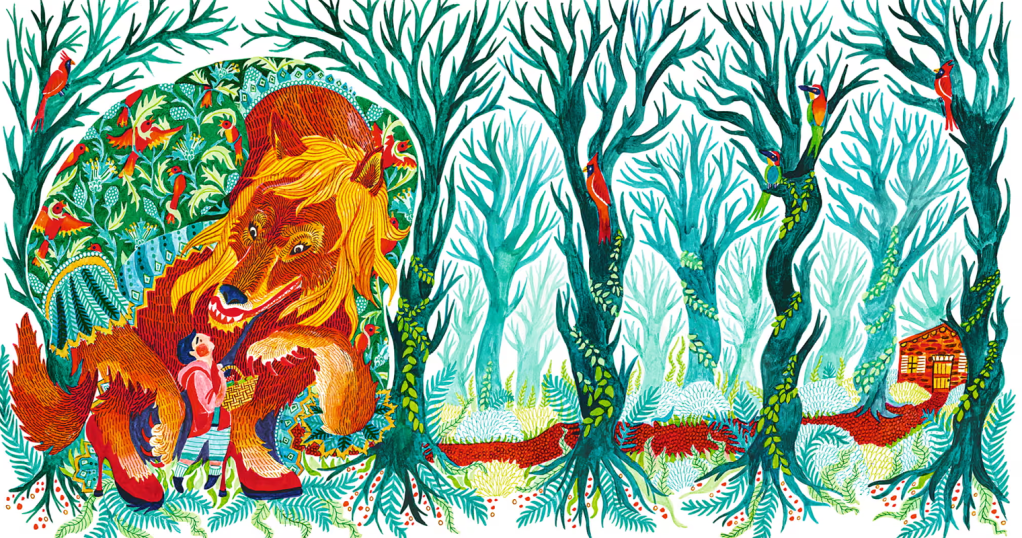
For generations, books have served as children’s first primers on the soul, and long before children encounter formal theology, they are offered spiritual blueprints through folklore, myths, and fairy tales. Although folklore is a metamorphic and often subversive space, too often these stories have been constrained by essentialist moralism, a framework where goodness must be beautiful, evil must be deformed, and gender is an immutable divine decree. Imagine the princess waiting in passive, delicate virtue; the prince acting with muscular, conquering strength. Any disruption of these orders (think of the cursed beast or the transformative sea witch) is framed as a tragedy, a cautionary tale against altering one’s inherent form.
But these interpretations do a profound disservice to the expansiveness of the divine. Spiritual language does not need to be rigid; spiritual experience is often the opposite. In fact, the lexicon of faith, mysticism, and mythology is uniquely, beautifully equipped to honor gender fluidity and the trans experience. To diversify children’s literature is not merely a political act; it is an act of holy reclamation.
The Necessity of Intersectionality
I draw on postcolonial and transnational feminist frameworks to examine how the gender binary can be approached as a historically exported colonial tool. By looking beyond “Western-centric” definitions of gender, I seek to reclaim the spiritual fluidity inherent in ancestral folklore(s). This essay is an exercise in postcolonial reclamation; by applying transnational feminist theory to the canon of children’s literature, I aim to highlight how the fight for trans liberation is not a modern departure from tradition, but rather a return to an ancient, expansive, and deeply sacred understanding of the soul.
As a Turkish-American woman whose faith is informed by both my Alevi heritage and my later baptism into the PC USA Church, my own journey has been shaped by the interplay of multiple spiritual and religious landscapes. Although I experience the world through the lens of my biological womanhood (the gender assigned to me at birth), in traversing my own reproductive experiences (including pregnancy loss and birth), I have found my greatest healing in approaching my body with love, while simultaneously learning not to derive my inherent worth from its biological markers. To honor my body is to hold space for its chapters of creation and loss, but I feel that to anchor my experience of gender in my anatomy alone is to create a fragile foundation. By separating my intrinsic value and experience of womanhood from the specific biological functions of my body (especially as it pertains to fertility), I have found a deeper capacity to witness the sanctity of others’ journeys. My reverence for my body’s seasons fuels my conviction that we are all more than the sum of our physical parts, and that the spirit is ultimately free to define its own true shape. This piece is offered from that intersection, a recognition that while my own body is not the site of gender transition, my theological and cultural roots teach me that the soul and gender are fundamentally fluid and unbound.
To do this work, I rely on intersectionality, a term coined by Kimberlé Crenshaw. Intersectionality is an analytical framework that recognizes how various social identities (such as race, gender, sexuality, class, and religion) do not exist in isolation but instead overlap to create unique experiences of discrimination and privilege. Applying an intersectional lens to children’s literature, folklore, and stories reveals that the fight for LGBTQIA+ rights is inseparable from the struggle against colonial, white-supremacist, and patriarchal structures. It is impossible to discuss this reclamation without acknowledging the rising tide of exclusionary tactics which rely on the same biological essentialism that has historically been used to oppress cis, trans, and non-binary people alike. Recognizing the sacred validity of the trans experience acknowledges that the Divine is too expansive to be contained within any single bodily experience. My critique of this essentialism is not an erasure of female or male experience, but an expansion of the sacred feminine and divine masculine to include those who have been historically marginalized by rigid, patriarchal definitions of what womanhood or manhood must look like. Please note that the intersections of LGBTQIA+ experiences with feminism and religion bring together many deeply personal perspectives. I use the acronym LGBTQIA+ to recognize the specific and diverse identities within our community; I believe that naming these experiences with precision is an act of hospitality, ensuring that all who read this piece feel fully seen and welcomed. I hold deep respect for the unique, foundational role of lesbian and feminist history, and my use of the acronym is not intended to replace or minimize these distinct identities, but to create a space that recognizes the multi-layered reality of our community, ensuring that no one’s struggle for justice is left out. I appreciate how important it is to keep our specific histories in focus, and I offer these words as an invitation to extend my profound love, care, and respect to all my readers.
From Wave to Wave
We are currently navigating an exciting, vibrant, shifting landscape of feminist thought. If Third Wave feminism gave us the vital lens of intersectionality, the Fourth Wave has utilized digital connectivity to turn those critiques into a global movement of radical visibility and collective storytelling.
If we are to gift the next generation an enriched spiritual language, we must evolve our own framework for liberation. This is where I look toward the horizon—to a Fifth Wave of feminism, a movement that moves beyond defensive postures to focus on active spiritual reconstruction. While the Fourth Wave masterfully used digital connectivity for radical visibility, the Fifth Wave I am envisioning shifts from the necessary work of defense to the generative work of spiritual reconstruction. I believe this nascent Fifth Wave is interested in the soul-work of liberation, and it asks: Now that we have identified these colonial and exclusionary cages, how do we write the stories of our own becoming?
Part 2, tomorrow
Discover more from Feminism and Religion
Subscribe to get the latest posts sent to your email.
 Feminism and Religion
Excellent, forward – looking piece that shows us possibilities for the future!
LikeLiked by 1 person
Thank you, Esther!
LikeLike