Keepin’ On Keepin’ On by Carol P. Christ

carol-p-christ-photo-michael-bakasIt is now Monday morning, five days after the new President was elected, despite losing the popular vote.

For many of us, and for me too, losing this election feels like losing everything we have worked to achieve during our whole lives. One of my friends wrote, “I am totally distraught and unable to focus.” My cousin said, “I feel like I am in Nazi Germany in the 1930’s.”

I have been scouring the internet to try to figure out what we can still do to try to create a world that guarantees liberty and justice to all people and all beings in the web of life.

There is much to fear. Continue reading “Keepin’ On Keepin’ On by Carol P. Christ”

Mother Demdike, Ancestor of My Heart, Part 2 by Mary Sharratt

mary sharrattContinued from Part 1. As I sought to uncover the bones of the cunning woman Mother Demdike’s story, I was drawn into a new world of mystery and magic. It was as though Pendle Hill had opened up like an enchanted mountain to reveal the treasures hidden within. Every stereotype I’d held of historical witches and cunning folk was dashed to pieces. Continue reading “Mother Demdike, Ancestor of My Heart, Part 2 by Mary Sharratt”

The Real World Series by Natalie Weaver

Natalie Weaver editedI live in Cleveland, and I am writing at the end of the World Series.  I don’t know how it will conclude, but like most of the people in my city, I’m holding my breath.  As I write, I literally just left the cardiac ward of one of the Cleveland Clinic hospitals, where patients’ lives actually seemed to hang in the balance of the game, according to one of the nurses who was monitoring heart rates from a central station in the hallway.  

I, who never cared about baseball and avoided Cleveland sports, am more than a little surprised at myself.  For, I have grown to care about the outcome of these games.  Why so, I ask myself.  Why am I sitting with my mom in the hospital, watching a game, when she’s ill, and neither of us has ever cared about sports?  I’ve been thinking about this recently, and believe I have landed on the right answer.

You see, when you are from Cleveland, it is not uncommon to have this precise conversation or some permutation thereof:

Self: Hi.
Stranger: Hello there.  Nice to meet you.
Self: Where are you from?
Stranger: Denver
Self:  Denver is a lovely city.  I visited for my friend’s wedding once.
Stranger:  Yes.  We love it out there.  Great weather; friendly people.  What about you… where are you from?
Self: Cleveland
Stranger: (chuckling) I’m sorry.  Mistake on the Lake.  River’s on Fire.  Etc.

Clevelanders are made to feel shame about our city, whereas, by contrast, Chicago is heralded for its architecture, food, and skyline, and so one.  Now, I have lived in Chicago.  It is beautiful and all that, and, more importantly, Chicago is not what I am writing about.  What I have come to observe about myself is that I actually love Cleveland for what it has to offer, which primarily includes people.  Hard workers, brilliantly talented musicians, artists, actors, educators, physicians, architects, and more.

I have grown to appreciate the people and stories that built the city’s heritage, culture, ethnic churches, diverse neighborhoods, beautified lakefront, museums, international airports, colleges and universities, rivers, parks, gardens, and on and on.  There is persistent and nearly inevitable derision that is glibly tossed our way here in the Two-One-Six.  I realize, it has worn me down over the years.

And, especially when I travel for academic conferences and chat over drinks at the receptions, I am tired of playing Justin Martyr to the city, in large measure to defend my own merit as a scholar and educator.   Continue reading “The Real World Series by Natalie Weaver”

Latin Identities and Muslim Malinches by Vanessa Rivera de la Fuente and Sumayah Soler

scdqgosrseo_vjrs3uaz-biiyjq

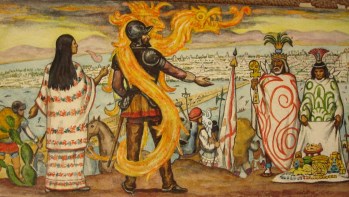
The myth says that Malinche, an Aztec princess, betrayed her people, her culture and faith, for the love and the desire to be loved and accepted by the foreign Spanish conquer, colonialist and exploiter. Her name, said with contempt, is used in Latin America to point those who sacrifice their identity and tradition in order to please foreigners over their own people and family.

Latin America has experienced in recent years an increase in the presence of Islam on the continent. As Muslims, we support and promote freedom of conscience that leads to our brothers and sisters to embrace Islam as their spiritual journey, as we did ourselves. However, we also know, because we have lived and learned from other latin muslims, that converting to Islam for Latinamericans means assuming the position of Malinche; this means to undertake a violent process of detachment and alienation of everything that identifies them as Latin, to prove their love and desire to be recognized as part of Islam. Continue reading “Latin Identities and Muslim Malinches by Vanessa Rivera de la Fuente and Sumayah Soler”

Killing Us Slowly by Judith Shaw

Judith Shaw photoKilling us slowly with your rules.
Killing us slowly with your technology.
Killing us slowly with your bureaucracy.
Killing us slowly…….

Continue reading “Killing Us Slowly by Judith Shaw”

I’ll Go With You: On Bathrooms and Theocracy by Chris Ash

IMG_0754Last month, I took a dear friend on a trip to the North Carolina mountains. Throughout the trip we were sharply aware that we were no longer in the progressive enclave where we both lived – the tiny area whose deep blue always stands out in votes-by-county maps after elections and whose responses to discriminatory legislation like HB2 – the controversial “bathroom bill” that prevented trans people from using the restrooms that correspond to their identities – has always been resistance.

Even in our progressive bubble, though, transphobic people found themselves empowered by legislative support to speak louder and more harshly to gender nonconforming people. Leaving that bubble for two days of rural travel with a trans friend meant a thread of tension that followed us throughout much of our trip, as every glance, every bathroom break and every interaction with strangers had the potential to become upsetting or frightening. Continue reading “I’ll Go With You: On Bathrooms and Theocracy by Chris Ash”

Religion, Politics, and the RNC: Separation of Church and State Anyone? by Marie Cartier

MarieCartierforKCETa-thumb-300x448-72405When you read this Feminism and Religion community, we will have just finished the televised portion of the Republican National Convention (RNC), which as I write this Wednesday, July 20 has announced that Donald Trump is the presumptive nominee for president of the United States.

Last night the first night of the RNC we witnessed the emerging platform of the party going far to the right.

From the New York Times:

Republicans moved on Tuesday toward adopting a staunchly conservative platform that takes a strict, traditionalist view of the family and child rearing, bars military women from combat, describes coal as a “clean” energy source and declares pornography a “public health crisis.”

The platform demands that lawmakers use religion as a guide when legislating, stipulating “that man-made law must be consistent with God-given, natural rights.”

It also encourages the teaching of the Bible in public schools because, the amendment said, a good understanding of its contents is “indispensable for the development of an educated citizenry.”

One thing we might ask—those of us who discourse in religion and the profane, or ways of the world—is the somewhat obvious question- whose God? Whose religion? Continue reading “Religion, Politics, and the RNC: Separation of Church and State Anyone? by Marie Cartier”

“All Children Are Our Children” by Carol P. Christ

Carol P. Christ by Michael Bakas high resoultion“All children are our children.” As I was posting my recent blog about the shooting of black men by the police, these words came into my mind with the force of revelation. At the time I was looking at a photograph of Philando Castile, taken at his place of work. Yes, I thought, my heart opening: “he is my child too.” This widening of the heart is at the center of the maternal values of ancient and contemporary matriarchal cultures around the world. It is a feeling some of us who were mothered well enough or who mothered children—including children not our own—carry within us. Is this the healing balm our world needs today?

Maternal  values?  So many of us turn up our noses at such a “gendered” term. Perhaps we were not mothered enough in our families of origin. Perhaps we still feel un-mothered. Perhaps we don’t want to be told that we have to become mothers. Perhaps we fear that if we become mothers, we will be only mothers—all of our other ambitions and desires will have to take second place.

The last is the reason I did not have children during the years when I put my career first. Continue reading ““All Children Are Our Children” by Carol P. Christ”

Dealing with Despair by Carol P. Christ

Philando Castile, school cafeteria worker, killed driving while black

In a state of shock after the police shootings of Alton Sterling and Philando Castile, I turned to my Facebook feed, looking for community in my grief and hoping to make sense of what had happened. The statement, “He would not have been shot if he had been white,” referring to Philando Castile, appeared several times. The first time I saw it, I responded, “He would not even have been stopped if he had been white.” Think about it if you are white: how many times have you been pulled over by the police?

I can answer that question: in the United States, only once, and that was because I made a second illegal U-turn at the same stop-lighted intersection as a teenager.  The policeman issued me two tickets, stating that he had been willing to let the first offence go. This is what white privilege means. Continue reading “Dealing with Despair by Carol P. Christ”

A Servant of God or a Lover of Life? by Carol P. Christ

Carol Molivos by Andrea Sarris 2Thus through an enormous network of mythological narrative, every aspect of culture is cloaked in the relationship of ruler and ruled, creator and created. . . . [Sumerian] legend endows the Sumerian ruler-gods with creative power; their subjects are recreated as servants. . . . [This new narrative was] deployed with the purpose of conditioning the mind anew.(20, italics added)

This provocative statement is found in a chapter titled “The First Major Sexual Rupture” in a collation of the writings titled Liberating Life: The Women’s Revolution by imprisoned Kurdish leader Abdullah Ocalan (pronounced Oh-cha-lan). According to Ocalan, who clearly had been reading authors like James Mellaart, Marija Gimbutas, and Heidi Goettner-Abendroth, the values of the societies that preceded Sumer in the Near East were entirely different. Continue reading “A Servant of God or a Lover of Life? by Carol P. Christ”