

Mulford would have been proud. Mulford Q. Sibley was Professor of Political Science at the University of Minnesota. He was also my PhD advisor and dear friend. A nationally known scholar of political thought, his particular interest and focus was on nonviolent resistance. Some of those in my PhD cohort had come from places of violence with the specific intent to study methods of nonviolent resistance with Mulford. As the creative and impressive acts of nonviolent resistance unfolded in the Twin Cities this past winter, I often wondered how much those in the resistance had been influenced by Mulford, either directly or indirectly in ways they may not even have known.
Mulford introduced me to several classics of nonviolence, including the work of Gene Sharp, author of the 3-volume series, The Politics of Nonviolent Action. Looking through his second volume on the methods of nonviolent action, I saw among the nearly two hundred practices so many that those in the resistance in the Twin Cities used. The resistance was varied, creative, persistent, and grounded. It easily could have been following Gene Sharp’s playbook . . .
Formal Statements – public speeches, letters of opposition, declarations by organizations and institutions, group or mass petitions, etc. At rallies, at the State Capitol, from the governor’s and mayor’s offices, in mass emails the people spoke their opposition to the ICE invasion of Minnesota. We were not cowed into silence and submission. The opposition was vocal, dignified, and determined.
Communications with a Wider Audience – slogans, caricatures, symbols, banners, posters, etc. The slogan “ICE OUT!” was chanted at every rally and protest and posted in the windows of homes and businesses.[i] After the murders of Renée Good and Alex Pretti by ICE agents, the slogans appearing everywhere were “Be Pretti Good” and “We are all Pretti Good.”
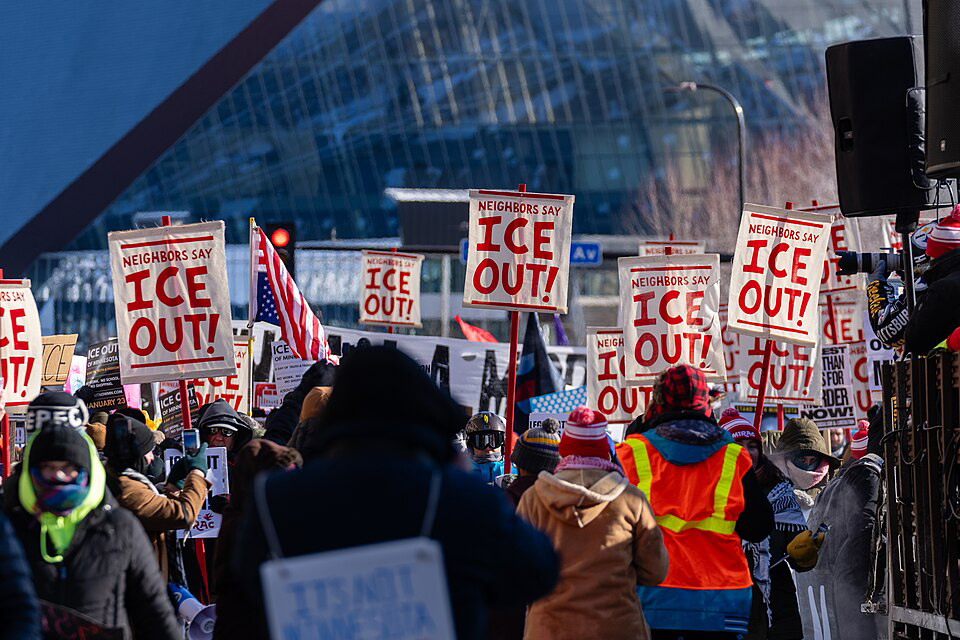
Protest art and posters exploded – from textual to visual.[ii] They carried messages opposed to ICE – “ICE Out” and “Minnesota NoICE”; of support for immigrants – “Fight Ignorance, Not Immigrants, “All Are Welcome Here”; and of love for Minnesota – a loon hugging an image of the state of Minnesota. One of my personal favorites is the one depicting the Morton’s salt symbol of the girl holding an umbrella in the rain – though in this poster she’s wearing a traditional ribbon skirt and is pouring out the salt she is carrying onto ice cubes. The text on the poster was: “Mni Sóta Makóce (Dakota for “the land where the water reflects the skies”) Knows How To Handle Ice.”
Symbolic Public Acts – displays of flags, wearing of symbols, prayer and worship. All over the state, people began flying the Minnesota state flag from their homes. It also was proudly waved at protests and rallies. Across the state Minnesotans were Minnesota proud. The resistance in Minnesota was admired around the country and the world for its creativity, perseverance, and its commitment to nonviolence, even in the face of horrific violence and provocation by ICE agents.
We began to see Melt the Ice hats — inspired by Needle & Skein’s re-imagining of the hats worn in resistance to Nazi oppression — being worn at protests and just walking the neighborhood. The MTI hats inspired a worldwide movement of knitters, with anti-fascist knitting groups continuing to gather and knit in protest across the country. They were quickly joined by those knitting bunny hats in honor of 5-year-old Liam Conejo Ramos of Minneapolis who was illegally taken into detention by ICE agents.
On January 22nd hundreds of faith leaders from all religious backgrounds descended on the Twin Cities to join in collective protest against Operation Metro Surge. Wearing their clergy stoles, they marched and prayed. They held city-wide worship services. Many gathered at the MSP airport to engage in civil disobedience, risking arrest, to protest airlines’ complicity with deportations of those arrested by ICE.
At a sacred Dakota site near Fort Snelling, Dakota activists kept a ceremonial fire burning at an encampment they had erected there. They offered prayer, song, and dance at memorials and protests. One of the dancers, Samuel Xochikoyotl Torres, said, “These traditions, these prayers, the songs and the dances that we have, there is deep wisdom in that, and this moment requires a combination of resistance, fighting, of sustaining, protecting, but also grieving.”[iii] They were joined by Native drummers and Ojibwe jingle dress dancers. One of the dancers, Tracy Strong Dagen, who had responded to a call for ceremony to honor the lives of Renée Good and Alex Pretti, spoke of the healing power of the jingle dress dance, “We were always taught that the jingle dress helps you heal. Use it in a good way, and you’re going to be good.”[iv]
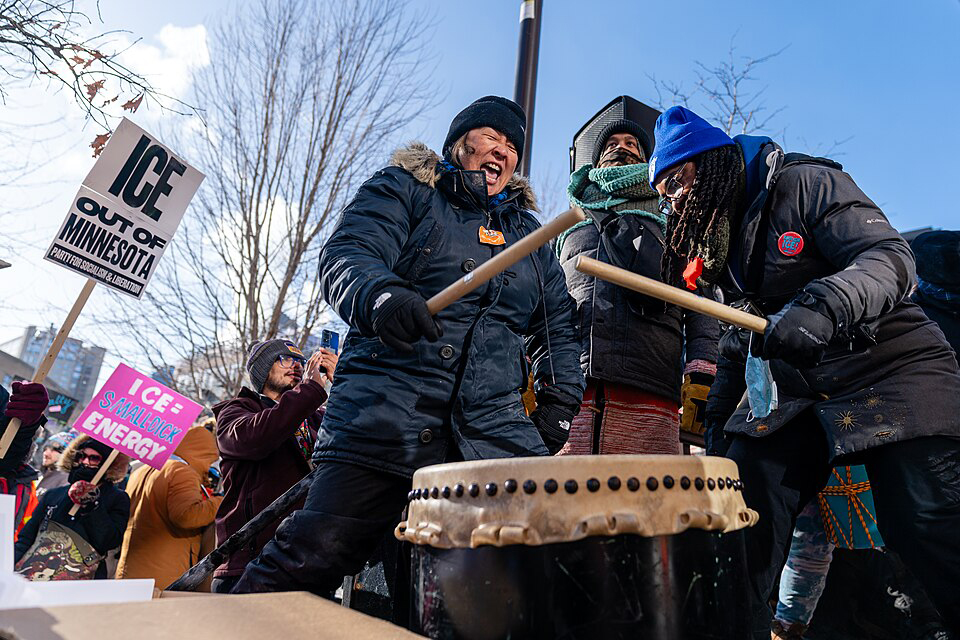
Drama and Music – performances of plays and music, singing. “Singing Resistance” began as a group of a few singers gathered after the murder of Renée Good – offering songs of healing, hope, resistance, and solidarity. The few quickly grew to hundreds and then thousands, marching through the streets, singing to ICE agents, singing in church sanctuaries and outside jails and detention centers in the hopes that those arrested by ICE could hear the love and encouragement in the voices gathered in song outside the walls. The singing has boosted the morale of everyone engaged in the prolonged struggle against ICE and gone nationwide. They’ve even put out a songbook.[v]
And then, there was the brass band. The community band, “Brass Solidarity,” formed after the murder of George Floyd and plays at George Floyd Square once a week. After Renée Good was murdered, the band started playing at her memorial and eventually began playing at protests around the city. The band brought joy to a grief-stricken city and also saw their role as calming tense situations in the daily round of ICE tear gassing and harassing peaceful protestors.
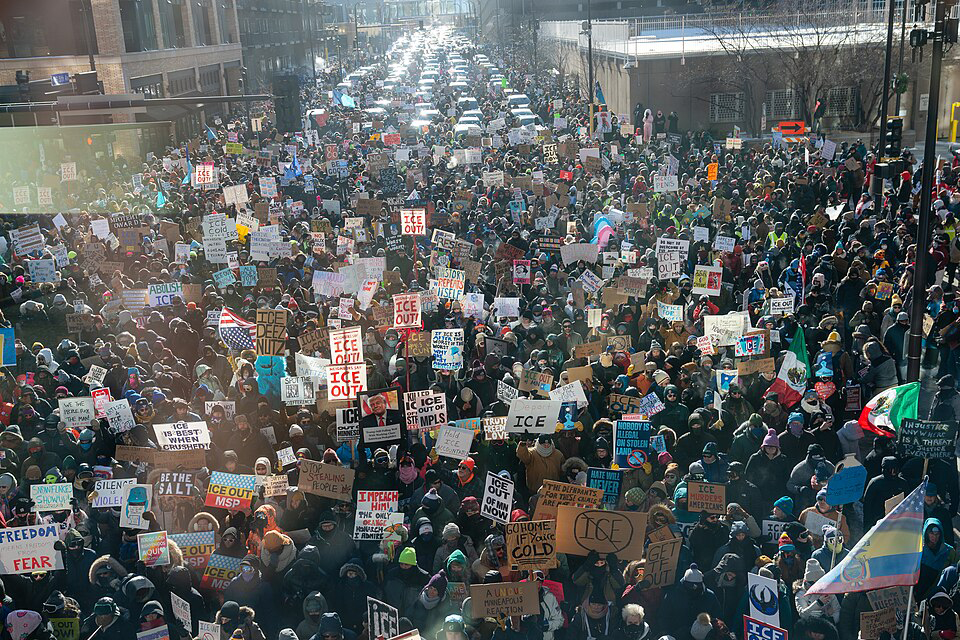
Processions: marches, parades. The most striking of the many marches around the state in opposition to ICE was the 100,000 who marched in Minneapolis on one of the coldest days Minnesota has seen in years. The marchers were undaunted by the -25 below windchills. So many showed up to voice their opposition that the march spilled into side streets so that the entire downtown was engulfed in a sea of protestors.
Honoring the Dead: Vigils spontaneously sprang up across Minnesota following the murders of Renée Good and Alex Pretti. Memorials with flowers, teddy bears, messages of remembrance, ribbons and candles, signs and written notes adorn the sites where Good and Pretti were killed. Thousands gathered for a public memorial ceremony for Good and Pretti.
Withdrawal and Renunciation – suspension of social and sports activities, walkouts, silence, student strike: Hundreds of high school students from several schools in the Twin Cities metro walked out of their classes to protest the presence of ICE agents outside their schools, the arrest and detention of their teachers and classmates, and the way Operation Metro Surge was making their friends afraid to go to school for fear of being arrested. They acted out of conscience, outrage, and solidarity.
Economic Non-cooperation – boycotts, nonconsumption, general strikes – On January 23rd, the entire state participated in a Day of Truth and Freedom in which thousands, perhaps millions, refused to go to work, school, or shop. Hundreds of businesses around the state participated, closing their doors for business, though some stayed open as warming shelters and gathering spaces for the thousands who had come out to protest that day. In addition, several businesses refused service and accommodation to ICE agents.
Continued in Part II tomorrow. All photos from Wikimedia Commons.
References
Sharp, Gene. The Methods of Nonviolent Action: Part Two of: The Politics of Nonviolent Action. Boston: Extending Horizon Books, 1973.
Gallery of anti-ICE posters opens at Can Can Wonderland on Valentine’s Day – Bring Me The News
How anti-ICE protest signs shaped the movement in Minnesota | MPR News
ICE OUT SING-IN Resistance Songbook
In Minneapolis, a community band has become part of the soundtrack of resistance : NPR
Minneapolis ICE Memorials: Renee Good & Alex Pretti
Minnesota faith, union, community leaders call for economic blackout on Jan. 23 – CBS Minnesota
Minnesota Native activists on front lines of ICE resistance
Singing Resistance Twin Cities wants to heal through song. They welcome ICE agents to join them.
The Coalition Behind Minnesota’s ICE Resistance: Labor, Faith, Immigrants – Museum of Protest
Wild, Elyse. “Q & A: Jingle Dress Dancer Answered Call to Ceremony in Face of ICE Violence.” Native News Online. February 20, 2026. Q&A: Jingle Dress Dancer Answered Call to Ceremony in Face of ICE Violence – Native News Online
[i] The term “Ice Out” had an earlier meaning in Minnesota as the day that ice on lakes melted and disappeared. The day is often noted in local weather reports. It has taken on a new meaning.
[ii] See Gallery of anti-ICE posters opens at Can Can Wonderland on Valentine’s Day – Bring Me The News to see a few of the many posters.
[iii] Minnesota Native activists on front lines of ICE resistance.
[iv] Dagen, quoted in Wild.
[v] ICE OUT SING-IN Resistance Songbook
Discover more from Feminism and Religion
Subscribe to get the latest posts sent to your email.


