Songs for the Soul by Elise M. Edwards

Elise EdwardsDuring the Christian season of Lent, many Christians focus on spiritual practices or disciplines that bring them closer to God. This year, I did not really engage in this type of reflection until the end of Lent. I have been wrapping up my first year teaching college students full-time, I’ve been focused on several writing projects, and I’ve been traveling. I did not intentionally think about spiritual practices until I participated in a silent retreat before Holy Week and traveled first to spend the holiday with my family and then again to mourn and remember the life of my aunt.  I reflected on them when I most needed them.

Continue reading “Songs for the Soul by Elise M. Edwards”

BOOK REVIEW: Amy Wright Glenn’s Birth, Breath, & Death by Natalie Weaver

Natalie WeaverAmy Wright Glenn’s Birth, Breath, & Death: Meditations on Motherhood, Chaplaincy, and Life as a Doula is a mid-life memoir of the author’s personal encounters and professional insights drawn from her work in the spaces of birth and death.  Glenn gleans from her formative experiences as a daughter and sister, her trained experiences as a teacher and doula, and her wisdom experiences as a mother, chaplain, and friend.  In an accessible voice, Glenn reflects compassionately on her early life in a Mormon family.  She considers critically the nature of religious worldviews that are doctrinally dualistic and apocalyptic.  Glenn further describes the therapeutic and illuminating value she found in the scholarly study of religions as an anthropological phenomenon.  Glenn explores how religious discourse both expresses human joy and grief and also aids us in our encounters with life and death.  Glenn intertwines her academic study with personal narrative and achieves a professionally-informed and experientially-based “thinking out loud” about the bookends of human life.   Her writing is tender, and her vision is thought-provoking.
Continue reading “BOOK REVIEW: Amy Wright Glenn’s Birth, Breath, & Death by Natalie Weaver”

THE DIVINE DRAMA AND THE UNIVERSALITY OF DEATH by Carol P. Christ

carol christIn Greece the liturgies of lent and especially of the week before Easter are known as the “divine drama,” in Greek theodrama.  This may refer to the “drama” of the capture, crucifixion, and resurrection of Jesus and to the suffering of God the Father and Mary.

However, it is important to recall that the drama in ancient Greece referred to both the tragedies and comedies, most specifically, those that were performed in the theater of Dionysios in Athens.  While we have been taught that the Greek tragedies celebrated “downfall of the hero” due to his “tragic flaw,” it is important to remember that Dionysios was the original protagonist of the Greek tragedy: it was his death and rebirth that was first celebrated.

Some have argued that the Greek tragedies should never be “read” alone, for they were always “performed” in tandem with the comedies, which were followed by the bawdy phallic humor of the satyr plays.  The tragedies end in death and irreparable loss.  But if the comedies and satyr plays are considered an integral part of the cycle, death is followed by the resurgence of life. Continue reading “THE DIVINE DRAMA AND THE UNIVERSALITY OF DEATH by Carol P. Christ”

Resurrection Garden, Resurrection Feast by Elizabeth Cunningham

Elizabeth Cunningham headshot jpegIn John’s account of the Resurrection, Mary Magdalen mistakes Jesus for the gardener.  Or perhaps it is not a mistake or not just a mistake but also a poetic truth. In any event, John’s Gospel makes clear:  the Resurrection takes place in a garden!

(For the feminist significance of horticulture, I refer you to Carol Christ’s recent post on this site: Women and Weeding, the first 10,000 years .)

Many  prominent (male) theologians, historians, anthropologists, and psychoanalysts among them James Frazer, Jung, and C.S. Lewis made the case for and/or against (in Lewis’ case) Jesus being another dying rising god of vegetation with Christianity borrowing imagery and ritual from earlier or even contemporary cults. The argument against insists that Jesus’s life, death and resurrection is historical, redemptive, and unique.  From a tour of Bloglandia, the debate pro and con appears to continue unabated.  I say better to pull weeds (if you are lucky enough to have a garden) than pontificate. Continue reading “Resurrection Garden, Resurrection Feast by Elizabeth Cunningham”

What’s Good About Good Friday? by Barbara Ardinger

Barbara ArdingerI grew up Calvinist and Republican in a suburb of St. Louis, Missouri. My parents belonged to—but rarely attended—Immanuel Evangelical & Reformed Church in Ferguson, Missouri. When children reached the age of twelve, they were “confirmed” in the church, which meant taking a Bible class taught by the minister, Rev. Press, and then going through a ceremony that made them eligible to take communion, which in that church was grape juice and tasteless crackers. Transubstantiation? I learned what the word meant, but I had (and still have) no idea if it really happens.

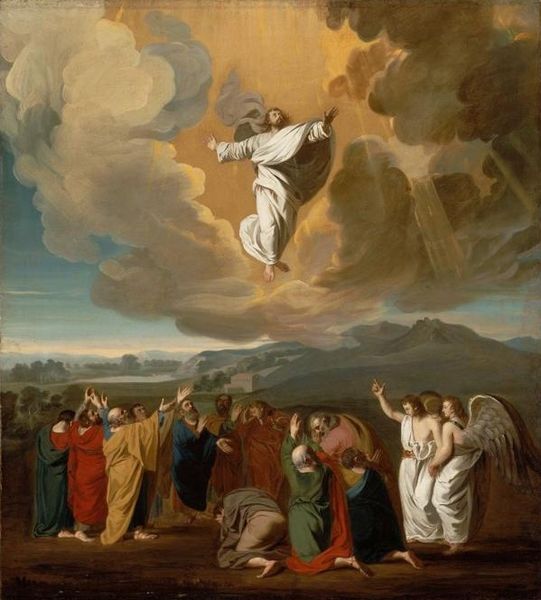
Ascension by John Singleton Copley (1775)

I’ve always been one to ask untidy questions, so of course I asked a lot of questions in confirmation class. God tells us half a dozen times in the Old Testament, for example, that he is a “jealous god.” How, I asked Rev. Press, can a jealous god be a loving god? What’s good about a jealous god? (A couple decades later, when I was studying the Aramaic Bible as translated by George M. Lamsa from the Pshitta manuscripts, I learned that the correct word is “zealous.” That was no help. I still don’t see much good in either jealousy or zealotry.) A week or two later, I asked Rev. Press, “What’s good about Good Friday?” Shortly thereafter, my mother advised me to stop asking questions in confirmation class. (Can we assume she’d received a pastoral phone call?) Continue reading “What’s Good About Good Friday? by Barbara Ardinger”

Crucifixion, Resurrection, and the Reversal of Power by Kelly Brown Douglas

Rev.-Dr.-Kelly-Brown-Douglas - Version 2

Within the Christian tradition, this week – l known as Holy Week – is perhaps the most significant week on the Christian calendar.  During this week Christians are called to contemplate and to remember the core events of Christian identity—the crucifixion and resurrection of Jesus.  Given the focus of this week for many Christians I am sharing my theological reflections on the crucifixion-resurrection event.

As I begin this reflection, it is important to recall that which I and others have pointed out in other places. In Jesus’ first century Roman world crucifixion was reserved for slaves, enemy soldiers and those held in the highest contempt and with lowest regard in society. To be crucified was, for the most part, an indication of how worthless and devalued by established power an individual was.  It also indicated how much of a threat that person was believed to be to the order of things. There was a decided crucified class of people. These were essentially the castigated and demonized as well as the ones who defied the status quo of power. It is in this respect that I believe Jesus’ crucifixion affirms his identification with the marginalized and outcasts. Indeed, on the cross Jesus fully divests himself of all pretensions to power and anything that would compromise his bond with those most othered in the world. The reality of the cross further affirms the profundity of god’s bond with put-upon bodies..

Continue reading “Crucifixion, Resurrection, and the Reversal of Power by Kelly Brown Douglas”

Gendered Imagery of God (Part 2) by Elise M. Edwards

Elise Edwards

In my previous post, I shared some of the ways in which I’ve been wrestling with gendered imagery for God, the first person of the Christian Trinity often referred to as God the Father. In this entry, I’d like to reflect on ways I am reconsidering the gender of the Christ.

It is only recently, after reading Melinda Bielas’ post “Waiting for Jesus… I mean, Superman” (December 17, 2013), that I began to question male language for the Christ. I got into an interesting conversation with Grace Kao in January about it. My thoughts on this topic are still unformed and more theologically “speculative” than I usually share on this site, but I’d love to hear what you think. I think it is important for Christian feminists to consider the doctrines of the faith and assess where they support the co-humanity of women and when they degrade it. Continue reading “Gendered Imagery of God (Part 2) by Elise M. Edwards”

Watching “Noah” Brought Me Closer to Humanity by Andreea Nica

Andreea Nica, pentecostalismAs a child, I enjoyed the story of Noah’s Ark. I would often imagine pairs of animals running for safety in Noah’s architecturally majestic haven. Practical questions didn’t enter my mind during this blissful period of naivety. I ignored the part where God expressed regret in creating humanity, or when Noah gets drunk and lies bare naked for his children to cover his shame. My bible study teacher would explain to us that the point of the story was that Noah, a holy man, trusted God and carried out his will.

Disclaimer: I understand that the film is not meant to be an exact representation of the story in the bible, but loosely based around it. Also, if you plan on watching the film, read at your discretion.

In the film, Noah’s character is played by leading actor Russell Crowe, who appears strong, confident, and zealous in his trust in God – all necessary qualities to fulfill God’s demand of killing off the rest of humanity because of their wickedness. Later in the film, Noah realizes that he and his family are also wicked leading to his revelation, ahem, God’s revelation, that humanity must cease with Noah’s family. This doesn’t pan out too well with his children and wife. It was also bad news for Emma Watson, the orphan girl Noah’s family saves and raises as their own, who after accepting that she is barren is miraculously healed and gives birth to two girls. Noah decides that the female infants must die according to God’s will to end humanity. Continue reading “Watching “Noah” Brought Me Closer to Humanity by Andreea Nica”

Musings on Reification by Sara Frykenberg

Sara FrykenbergThe following is a bit of a messy and meandering blog: a kind of a ‘brain train,’ that starts with a question of reification and eating disorders, and moves into a sense of the literal ‘consuming’ nature of oppression.   So I will start with a ‘thank you’ to readers who will meander with me and with gratitude to the teachers whose thoughts I am wandering with along the way.

Reification is the process by which those created ideas that we externalize into institutions, concrete objects, or social principles then become so real to us that we tend to think of them as a separate reality or a thing/ life in and of itself.[1] I teach this concept in my ethics classes when we discuss the way in which actions and choices are connected to what we often consider to be external forces like “the government,” or “the economy,” when in fact, we are in relationship to and often, actively play a role in maintaining these realities (even when only playing a small role). Reification can subversively undermine our understanding of response-ability because it is a way of making the structures that form our society “other” than ourselves.

My students definitely struggle with this concept and often express the fear that they are too small as individuals to see any real change happen. (I too, often struggle with this fear when thinking about the reified ‘monsters’ of oppression and hate.) Dealing with this discouragement in class, I (and we) switch gears by emphasizing praxis and recognizing its successes. I ask my students to consider what can be done and what choices/changes I, they, or we are capable of making while re-membering changes already being made. As Gustavo Guiterrez says: “Pessimism comes from reality because reality is tragic, while optimism comes from action because action can change reality.”[2] Continue reading “Musings on Reification by Sara Frykenberg”

Meditating on Oneness by Amy Wright Glenn

Utah native Amy Wright Glenn will talk about her book: "Birth, Breath, & Death: Meditations on Motherhood, Chaplaincy, and Life as a Doula." Courtesy Amy Wright GlennAt the age of fourteen, I began to question the Mormon faith of my family. I embarked on a life long personal and scholarly quest for truth. While teaching comparative religion and philosophy, I was drawn to the work of supporting women through labor and holding compassionate space for the dying.

In my book, “Birth, Breath, and Death,” I share moving tales of birth and death while drawing on my work as a doula, hospital chaplain, and mother. I weave together these stories with philosophical reflections on truth, meaning, and Spirit.

This is an excerpt taken from the first chapter entitled “Search.”

I spent much of my early twenties traveling throughout The Middle East and India. I lost track of time gazing at an ancient copy of Homer’s Iliad at a museum in Cairo. I remember sleeping through a freezing cold night on Mt. Sinai and awakening to a brilliant sunrise over the Arabian Peninsula. I climbed the pyramids in Egypt and protested the Israeli occupation of the West Bank with Arab and Jewish women peace activists. For a year, I studied in Jerusalem. Later, I dedicated myself to the practice of meditation at an ashram in the Himalayas.

A lively mix of debate and discussion characterized my Hebrew University days. In the evenings, I worked illegally as a waitress in the Jewish Quarter of the Old City. Adorned in Roman attire, I served fantastic platters of Middle Eastern cuisine and performed folk songs and dance routines for photo-snapping tourists. I was nineteen and living in Jerusalem, a place saturated in religious symbolism. Known as Al-Quds in Arabic and Yerushalim in Hebrew, Jerusalem is a city renewed and ravaged due to contested paradigms of poetry and politics. Continue reading “Meditating on Oneness by Amy Wright Glenn”