

Imagine my surprise when, a few days ago, I looked out my window to see a dappled horse munching on flowers in the field across the street from my house. In the next days I got used to her being there. I would look for her in the mornings and at odd times during the day. Sometimes she was visible and sometimes she was not. When I could see her, I would open the window and call out, “Hello, white horse, you are very beautiful.” Once or twice she turned her head to look at me and seemed to respond, “Thank you for noticing.”
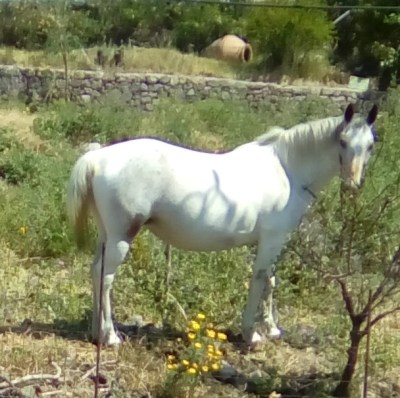
Many hundreds of years ago, Sappho must have had a similar vision in a field near a grove of trees where she and her students waited for the Goddess to appear, for she wrote: “In meadows where horses have grown sleek among spring flowers, dill scents the air.“ These lines are part of a longer poem addressed to Aphrodite that begins: “Leave Crete and come to us.” In this place, “incense smokes on the altar,” there is a stream, there are apple trees and rose bushes and horses in a field of flowers. Continue reading “Visions of the Goddess: A White Horse by Carol P. Christ”
 Very early in Henri Bosco’s 1948 novel Malicroix, a young man, Martial de Mégremut, living placidly amid fruitful orchards in a tame Provençal village, receives a letter informing him he has inherited “some marshland, a few livestock, a ramshackle house” from a reclusive great-uncle, Cornélius de Malicroix. Against his family’s strenuous objections–with alarm they speak of “marshes, mosquitoes, miasmas”–Mégremut resolves to travel alone to the remote Camargue to claim his “wild” Malicroix inheritance. The house is on an island, and to reach it Mégremut must cross a rough river, at night, in a frail wooden boat piloted by a taciturn old man who meets him at dusk in the middle of a vast plain.
 I awakened this morning to frozen raindrops hanging from trees – jeweled beads, snow capped hills, and a cacophony of spring songs – I was serenaded by robins, chickadees, phoebes, goldfinches, and nuthatch tweets as I walked out the door into the early morning sun. I listened for the cardinals, who for the moment were absent. It was cold! 28 degrees at the end of April speaks to anomalies, or more realistically, Climate Change.
 Over the past few weeks of lockdown in Greece, I have asked myself numerous times: if we can shut down the world economy because of a virus, why don’t we shut everything down until we end war or find real solutions to global climate change? In my mind the horrors of war are much worse than the horrors of disease and dying and the threat and reality of global extinctions pose a much greater threat to humanity (not to mention nature) than the Coronavirus.
 I have been writing and celebrating ritual for half of my life. The equinoxes and solstices and the cross quarter days (May 1, August 1, All Hallows, and February 2) comprise the eight spokes of the year. What I have learned from my research is that virtually every Indigenous culture follows this calendar in a general way – What I have gleaned from personal experience is that during these ritual periods my body is opened to the Powers of Nature in very specific ways that can be positive or/and negative.
 With everyone talking about it – I won’t. Let’s just say that I am in the “at risk” population and have decided that staying home is my best protection against “it.”
 This post follows last week’s post:
  Scientist Diana Beresford Kroeger proved that the biochemistry of humans and that of plants and trees are the same – i.e. the hormones (including serotonin) that regulate human and plant life are identical. What this means practically is that trees possess all the elements they need to develop a mind and consciousness. If mind and awareness are possibilities/probabilities then my next question isn’t absurd: Do trees have a heartbeat?
