

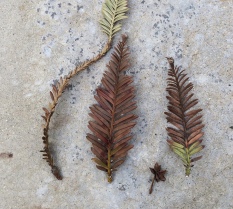
 Much of our lives lack the rich culture of ritual that I think would help us repair the relationships we have with our own bodies and with the earth. The Rg Veda is one of the oldest collection of hymns from India. In them, I find a playful and introspective expression of desires and fears that, at first, did not seem to me to hold much wisdom for a modern contemplative. But lately, I have been noticing how the speakers communicate to or about the earth, and how their lives seem centered around trying to take a part in creation. Mostly, these hymns are stories and supplications for rain, cows, victory in battle, and a long life. But there is a deep understanding of the power and divinity in the universe that is the very earth-based wisdom that our humanity-in- crisis needs. If the Qur’an is God calling for humanity to be grateful, the Rg Veda is a model of a humanity that could be nothing else.
I love one incantation, for instance, found in the tenth mandala, that seems to be from a compounding physician, praying to the healing herbs that might make her client well again. I imagine her alone, in a greenhouse pharmacy, on a damp late afternoon, fingering stems and leaves before crushing them with her mortar and pestle to make a bespoke tincture that holds a cure. She knows the plants intimately, and works as if she is on holy ground: Continue reading “Honoring the Earth in our Rituals of Well-Being by Elisabeth Schilling”
 It is, I think, quite common knowledge that most Jewish holidays relate to the seasonal cycles of the Earth. Sukkot celebrates the fall harvest. Chanukah sheds light on the winter darkness. Tu B’Shevat marks the end of the dry season and so begin the prayers for rain in Israel. For Purim, we throw off our winter doldrums and let off a little steam to settle our cabin fever. Pesach is no exception: welcome spring: birth, renewal and even creation. The leaves return to the trees, baby animals are born, flowers bloom, warmer weather arrives and somehow the possibilities of the coming summer are endless.
 In my garden blooming with native wildflowers, in nearby rivers and woods, across the New England landscape, the Earth is healing Herself. Two centuries ago, New England’s forests had been cleared for farms; myriad species of animals, birds, fish, and plants had disappeared; the network of waterways had been dammed to make power for mills.
 There is some very helpful guidance in the Qur’an for how we should and should not treat the earth. In my exploration of Qur’anic verse
 One of the concerns of ecofeminism is the modern materialistic mindset of capitalism. Materialism in capitalism instills not just owning many possessions, but it also inculcates the “need” to own the newest innovation. In addition, materialism advocates a throw-it-away mentality. In other words, it is often cheaper to buy a new shirt or computer than to have them repaired. Similarly, it is not enough to have a cell phone. Rather, one must have the newest and best one! The environment pays the price.
 In these these days when many of us are gripped by paralyzing despair as we come to terms with the election as President of a racist, sexist bigot who has created a climate of fear and promises to undo much of the progressive legislation of the past fifty years, I find it appropriate to reiterate an insight that has sustained me through many years of sadness and disappointment about the state of our world.
 I once heard an educated non-feminist say that it would not matter if women came into positions of power. He gave examples of Margaret Thatcher, Indira Gandhi and other women and pointed out that once in power they started wars and engaged in other aggressive tactics, just like men politicians.
 It would not matter if a head of a patriarchal organisation is a feminist or not. She or he will play a role of a head of a patriarchal system. That is, unless she changes the system altogether and it ceases to be patriarchal.
 It is now Monday morning, five days after the new President was elected, despite losing the popular vote.
 There are days I find myself so overwhelmed with sadness concerning the state of our world that I break down crying. Last week, I saw an episode of Mars, a scripted documentary shown on the National Geographic channel about human colonization of the red planet in 2033. One of the astronauts “interviewed” prior to leaving was asked why she was taking such a risk to inhabit Mars. She said something like, “We will give everything for this.” Why not give everything for Earth?
 In the first blog in this series
