

 Killing us slowly with your rules.
Killing us slowly with your technology.
Killing us slowly with your bureaucracy.
Killing us slowly…….
Category: environment
The Dog and the Divine by Ivy Helman
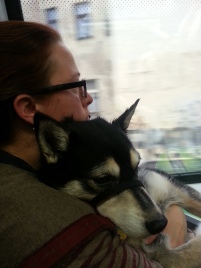 When I was in high school, I once gave a speech summarizing what I had learned about G-d through my dog. I still chuckle at the idea. I cringe sometimes and wonder what others thought of the piece. Oh, the seeming immaturity of such an idea and perhaps naiveté. I’m still embarrassed by my high school self.
The connection, on which I drew, included some of the ways I had come to love my four-legged friend as well as the way I interpreted his actions as love for me. I remember I had a list of ten things my dog had taught me about the divine. There was definitely a mention of unconditional love, being happy to see me, probably something about not being angry or ever holding a grudge, sharing secrets, perhaps a lesson on patience, and, of course, many more which I can’t remember. This is beginning to sound like my blog post about Hanukkah, isn’t it? What were the other two nights? What were the other six comparisons? Oh, never mind. Continue reading “The Dog and the Divine by Ivy Helman”
What Dorothee Soelle Taught Me about Creativity by Elise M. Edwards
 I’m currently developing a book that considers how theological and ethical considerations in architectural design can define good architecture. My book discusses five virtues related to the architectural design process that promote human participation in bringing out God’s intention of flourishing for humanity and creation. Those five virtues (or values) are: empathy, creativity, discernment, beauty, and sustainability. In the book, I’ll explain how these virtues orient design tasks to the social and ethical aims of architecture.
In this virtual space, I want to have a discussion about what these virtues mean from a feminist standpoint. In my writing, I draw from theological ethics, architectural theory, and feminist theory to emphasize community discernment and participation. It’s fitting, then, to claim opportunities in my work to acknowledge the feminists who have influenced me while also opening up the dialogue to the feminists in this community who continue to inspire and guide me to do my best work. Continue reading “What Dorothee Soelle Taught Me about Creativity by Elise M. Edwards”
Our Enchanted Bosque by Judith Shaw
 I live in New Mexico’s largest city, Albuquerque. As a Goddess Worshiper, one of the things I love about New Mexico is the easy access I, a city dweller, have to so much natural beauty. I feel Her beauty and power in the widely varied landscapes of New Mexico.
“Respect: Dualism Subversion and So Much More in Survival Reality Television,” by Ivy Helman.
 In “Ecofeminism and Wilderness,” Linda Vance believes that Western society defines wilderness by “… the absence of humans, we are saying, in effect, that nature is at its best when utterly separated from the human world. The idea of wilderness is thus an extreme manifestation of the general Western conceptual rift between culture and nature,” (62). Reality television shows, focusing on survival or living off the land, often reproduce this dualistic way of thinking.
At the same time they reproduce another of Vance’s concerns, “I would argue that wilderness recreation “re-creates” more than the self: it also recreates the history of the conquest of nature, the subjugation of indigenous peoples, the glorification of individualism, the triumph of human will over material reality, and the Protestant ideal of one-on-one contact with G-d. And as for the elements of physical challenge and risk, I think it goes without saying that they appeal most to those for whom day-to-day mobility is a given, and for whom danger isn’t always close at hand,” (71). However, by presenting this dichotomy, many of the shows also subvert the ideal of untouched wilderness, challenge the notions of human abilities and highlight our lack of embeddedness and embodiment when it comes to survival situations. Continue reading ““Respect: Dualism Subversion and So Much More in Survival Reality Television,” by Ivy Helman.”
More Than Just an Image by Jassy Watson
 I spent 2015 teaching an Intentional Creativity program ‘Wisdom of the Goddess” to an intimate tribe of women creatives from our local community. In December we held an end of Year Art Gala displaying a portion of the work which saw over 100 paintings of Goddesses created over a 10-moon period.
The program was divided into the cycles of Creation, Transformation and Celebration, as inspired by Hallie Inglehard’s book “The Heart of the Goddess”. Each month, through ritual, visioning and painting, we explored a Goddess that represented these cycles; Eve, Anjea, Demeter, Cerridwen, Kali, Persephone, Aphrodite, Ochun and finally, our Inner Goddess.
It took great courage for the artists to display their paintings in public. It is often hard to explain this work because it requires such deep and thoughtful exploration of one’s inner world along with a commitment to a creative practice that favours personal growth and discovery over outcome. It can be difficult finding the language to elucidate on this process that is not just about the act of painting.
It is painting to grow and heal.
It is sacred.
It honours and empowers women.
It inspires authentic creative expression.
It unites one with self.
It connects one back to the earth.
It transforms.
It reveals.
The show was a great success. A gallery full of Goddesses was surely a sight to behold! It was a humbling experience to be out and proud about our creative work in our regional, agricultural, largely conservative community. I feel it is imperative for the restoration of female empowerment to be remembering and re-imagining the Goddess by way of image and it was through Her that these astounding women artists found the courage to put their heart and soul on the wall for all to see.
The influence that image has is far-reaching and cannot be under-estimated. Image is a universal language that evokes emotion and can go as far as mobilising the masses and even change the course of history. The famous photo of ‘Phan Thi Kim Phuc’ running naked down a road after a napalm attack during the Vietnam War is but one outstanding example.
As I reflected on the years work however, I was reminded that while these paintings carry with them incredible insights and powerful messages of change, growth, discovery and transformation, the Goddess is so much more than just an image; and certainly more than just an image to mass-produce and sell. While “the strength and independence of female power can be intuited by contemplating ancient and modern images of the Goddess” (Carol P. Christ in ‘Why Women Need the Goddess’), it cannot be forgotten that She is the sacred made immanent in the natural world, expressed in the diversity of all forms of life and death. We seek Her, sometimes even travelling to the ends of the earth to find Her, forgetting that She is everywhere. She is you and me and Her sacred sites are found in our own backyards.
With this in mind I recently returned to some creative investigations I had begun a few years ago exploring woman in nature and the Goddess as the body of the earth through paint. The earth speaks and I am listening to Her stories and bringing them to the canvas to re-affirm my sense of wonder and respect for nature. My aim is to awaken an ancient memory of the sacred relationship between human and nature, for now, more than ever, it is critical that this relationship be restored. In doing so, the earth may once again be seen and valued as a living, breathing body that sustains and nourishes all life rather than being merely a commodity to be devastated and destroyed in the name of capitalism and greed. Further, these images are reminders of the interconnectedness of all life; we are not separate from the earth, but part of its’ intricate web.
The following image was inspired in part by Terry Tempest Williams ‘When Women Were Birds’ but is also an image born from a revelation I had many, many years ago when I first starting seeing woman in nature, especially in the body of trees.
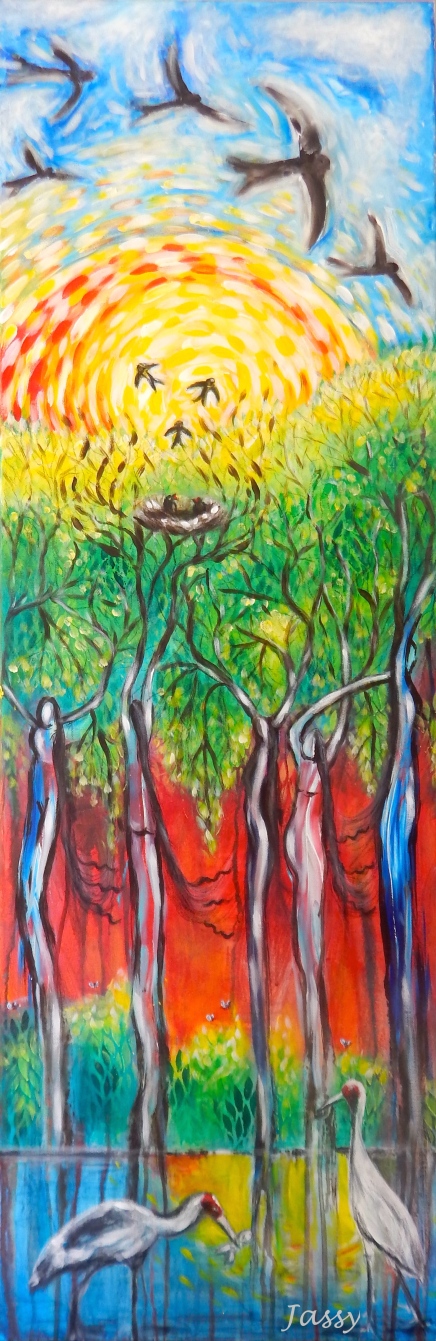
“We are the birds eggs. Birds eggs, flowers, butterflies, rabbits, cows, sheep; we are caterpillars; we are leaves of ivy and sprigs of wallflower. We are women. We rise from the wave. We are gazelle and doe, elephant and whale, lilies and roses and peach, we are air, we are flame, we are oyster and pearl, we are girls. We are woman and nature. And he says he cannot hear us speak.
But we hear.”
― Susan Griffin, Woman and Nature: The Roaring Inside Her
Jassy Watson, who lives on the sub-tropical coast of Queensland Australia, is a Mother of four, passionate organic gardener, Intuitive/Visionary Artist, Intentional Creativity Coach and a student of Ancient History and Religion at Macquarie University, Sydney. She is the Creatress of Goddesses Garden Studio & Gallery; a small school for the Sacred Creative Arts. Jassy teaches regular painting workshops in person, nationally, internationally, and online based around themes that explore myth, history, earth connection and the Goddess. Her latest SOULSCAPES (TM) exploring woman in nature will be on show at ‘Dreaming Into Being’, Percolator Gallery, Paddington, Brisbane April 5th-11th. You can see her work at http://www.goddessesgardenandstudio.co
Pause, Stop and Re-evaluate your place within patriarchy and capitalism by Oxana Poberejnaia
 There are three vicious circles: patriarchy, samsara and wanton destruction of environment. All three lead ultimately to annihilation of life. All three are incredibly difficult to escape. One of the reasons for this difficulty is that there are pay-offs. Someone or something benefits from keeping the cycles going.
Men and Mothers-in-Law seemingly benefit from patriarchy. However, the privileges granted by patriarchy are based on a pyramid scheme of tyranny. You get to bully people who are below you on the patriarchal pecking order: women, men of the lower status, daughters-in-law. Everyone at the higher level gets to bully you. The top man lives in constant fear of de-throning. Continue reading “Pause, Stop and Re-evaluate your place within patriarchy and capitalism by Oxana Poberejnaia”
We are Mauna Kea: The Continual Protest for Maintaining Sacred Land by Anjeanette LeBoeuf
 It seems like there is a perpetual debate over acquiring land for progress and growth versus the protection of land that has ties to religion, customs, and cultures. The history of America is littered with stories and events that deal with acquisition of land. The sake of growth, expansion, and progress takes precedence in the history of America. Our country’s geography is a road map of acquired land and the pushing aside sacrality.
Thoughts on Race and Being Jewish by Ivy Helman
 When studying the Shoah, it is extremely important for teachers to introduce students to the 1800s concept of race “science,” which is what I have been doing in my classes over the past few weeks. An American and European development, this “science” was deeply connected to the development of racism. Through a “scientific” method, humans were classified based on certain characteristics (i.e. head size, posture, gait, etc.) and traits (i.e. aggression, passivity, even temperament, etc.). Physicality was linked to personalities that were “typical” as well as desirable or undesirable.
Race “science” supported the slave trade, colonialism and the exhibition and exotification of non-European peoples. In the case of the Shoah, race “science” was heavily relied upon by the Nazi Regime in their propaganda, law and ideology. For the Nazis and all nations under their purview, “Jewish” was a racial identity, “scientifically-proven” through measurements and observations and set out by the Nuremberg Laws of 1935, previous and subsequent anti-Semitic decrees and the systematically-planned extermination of 6 million of us.
Continue reading “Thoughts on Race and Being Jewish by Ivy Helman”
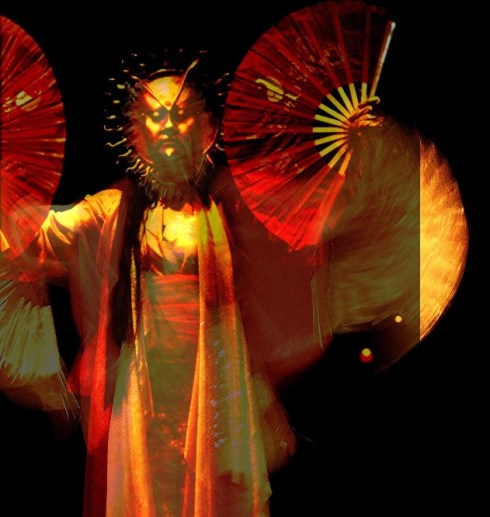
MASKS OF THE GODDESS: Bringing the Divine Feminine to Life by Lauren Raine
“What the audience saw when a dancer looked through the eyes of the mask was the Goddess Herself, an ancient and yet utterly contemporary presence, looking across time, across the miles.”
Diane Darling, Playwright
In Salt Lake City in October at the Parliament of World Religions a group of women and men will be will be literally “bringing the Goddess to life”. “Goddess Alive!” is produced and written by M. Macha NightMare (Aline O’Brien), with Mary Kay Landon. Participants will use my “Masks of the Goddess” Collection to create a ritual theatre event honoring the many faces of the Divine Feminine throughout the world.
The Masks of the Goddess Project began in 1998, and since then the ever-evolving, multi-cultural collection of masks have travelled around the U.S. to different communities for dance, storytelling, exhibit, and personal invocation, always collaborative.
Continue reading “MASKS OF THE GODDESS: Bringing the Divine Feminine to Life by Lauren Raine”

