The Fault is in Our Stars: Feminism, Sisterhood, and the Fight for Awesome by Marie Cartier

If you haven’t yet read the book The Fault is in Our Stars (or seen the movie) I guess I should begin by saying this blog will contain spoilers.

This story is about having cancer as a teen and dying from it. It’s also about a young woman, Hazel Grace, having cancer, a sense of humor, belief in her ability to have her life on her own terms, fall in love and claim her independence. It’s about a young man, Augustus Waters, falling in love, being insecure as a young man, yet secure enough to cry, and his belief  in making life better for those around him for as long as he can—even after death.

It’s quite remarkable and…its aftermath is also remarkable.  This book and its film and following have created some remarkable trends.

The author, John Green has coined a few phrases that deserve coinage in my every day usage. Among them, Green has proposed we use the phrase: “nerd fighter.” Nerd fighters fight to “increase awesome and decrease suck.”

We fight against suck….we fight for awesome. We fight using our brains, our hearts, our calculators and our trombones.

Continue reading “The Fault is in Our Stars: Feminism, Sisterhood, and the Fight for Awesome by Marie Cartier”

Wrestling with Jewish Learning By Casey Tova Markenson

TOVA_01You will be handed a sheet of paper. The paper will have a quote from the Torah or the Gemara or Abraham Joshua Heschel. The ‘what’ and ‘who’ and ‘why’ behind those sources will not be explained. You will read the passage and reflect on it with a partner. In ten minutes, you will share a piece of your conversation with the rest of the group. Then, the Jewish part of the Jewish social justice program you’re about to experience will be complete.

I have read and reflected on countless texts as part of that ritual. I don’t remember any of them. I do remember being embarrassed that I didn’t know who Rebbe Nachman was. I remember sensing that my training in literary criticism didn’t “count” as Jewish knowledge. I do remember every time I revealed that I misunderstood a detail or a Hebrew word, and all of the times that a (usually male identified) peer excessively explained it.  I remember feeling left out of an exclusive club, one that I was embarrassed to want to join to begin with. Continue reading “Wrestling with Jewish Learning By Casey Tova Markenson”

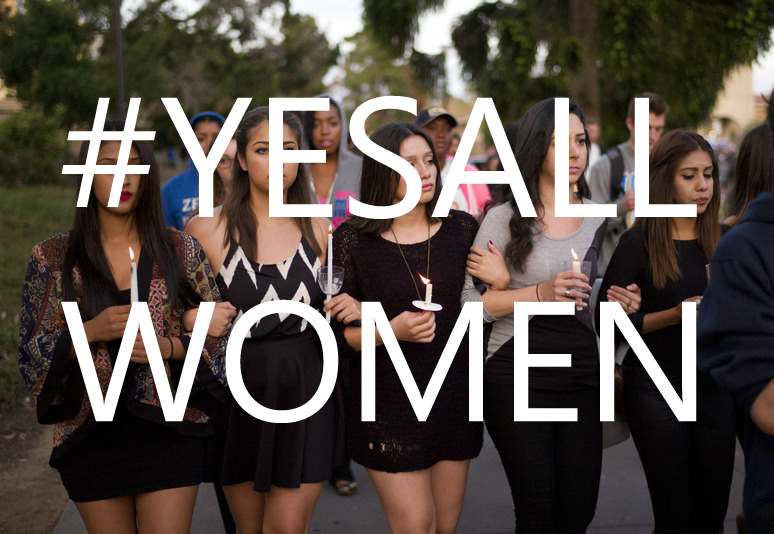
#YesAllWomen, the Darwin Debate, and the God Complex by John Erickson

#YesAllWomen proved that although not all men commit horrible crimes against women, the men that often get the headlines and create the most controversy are the ones that need to be watched out for.

John EricksonThe one thing I typically will choose to do on the rare occasion that I’m able to sit down and relax is to watch a documentary.  While some people may go to the gym, read a book, or hang with friends, I typically choose to stay in, nestle up on my couch, and learn.  While on my last bout of relaxation, I chose to watch the HBO documentary Questioning Darwin. Although it offers very little new insight into the evolution vs. creationism debate, it does offer an interesting new way to look at the recent social media hashtag war feminists, allies, and supporters found themselves in over the #YesAllWomen movement that took the world by storm.

yesallwomen

Now, before I discuss #YesAllWomen, I have to admit that I did not enter into the safe space women created for themselves to tell tales of the horrible things they have and have had to face on a daily basis.  I firmly believe that men should not have entered into the digital space Continue reading “#YesAllWomen, the Darwin Debate, and the God Complex by John Erickson”

“Don’t break the bucket” by Oxana Poberejnaia

oxanaVictor Pelevin is a prominent contemporary Russian author, with books translated into a multitude of languages. To me, his novels act as a series of Dhamma talks (Buddhist sermons, if you will).

I have also always thought that Pelevin’s novels can be broadly divided into two groups: “This is how to do it” and “This is how not to do it” groups. For instance, “The Clay Machine Gun” and “The Sacred Book of the Werewolf” are “How to do it” stories, with the protagonists reaching his and her (respectively) destinations. “Babylon”, on the other hand, is the “How not to do it” story, as the protagonist ends up enslaved by the world he has created.

Victor Pelevin
Victor Pelevin

One of my favourite novels by Pelevin is “Life of Insects”, which tells the tales of a number of characters, all of them “How not to do it” stories bar one. One of the most interesting quotes from the positive story for me is “Don’t break the bucket”.

Continue reading ““Don’t break the bucket” by Oxana Poberejnaia”

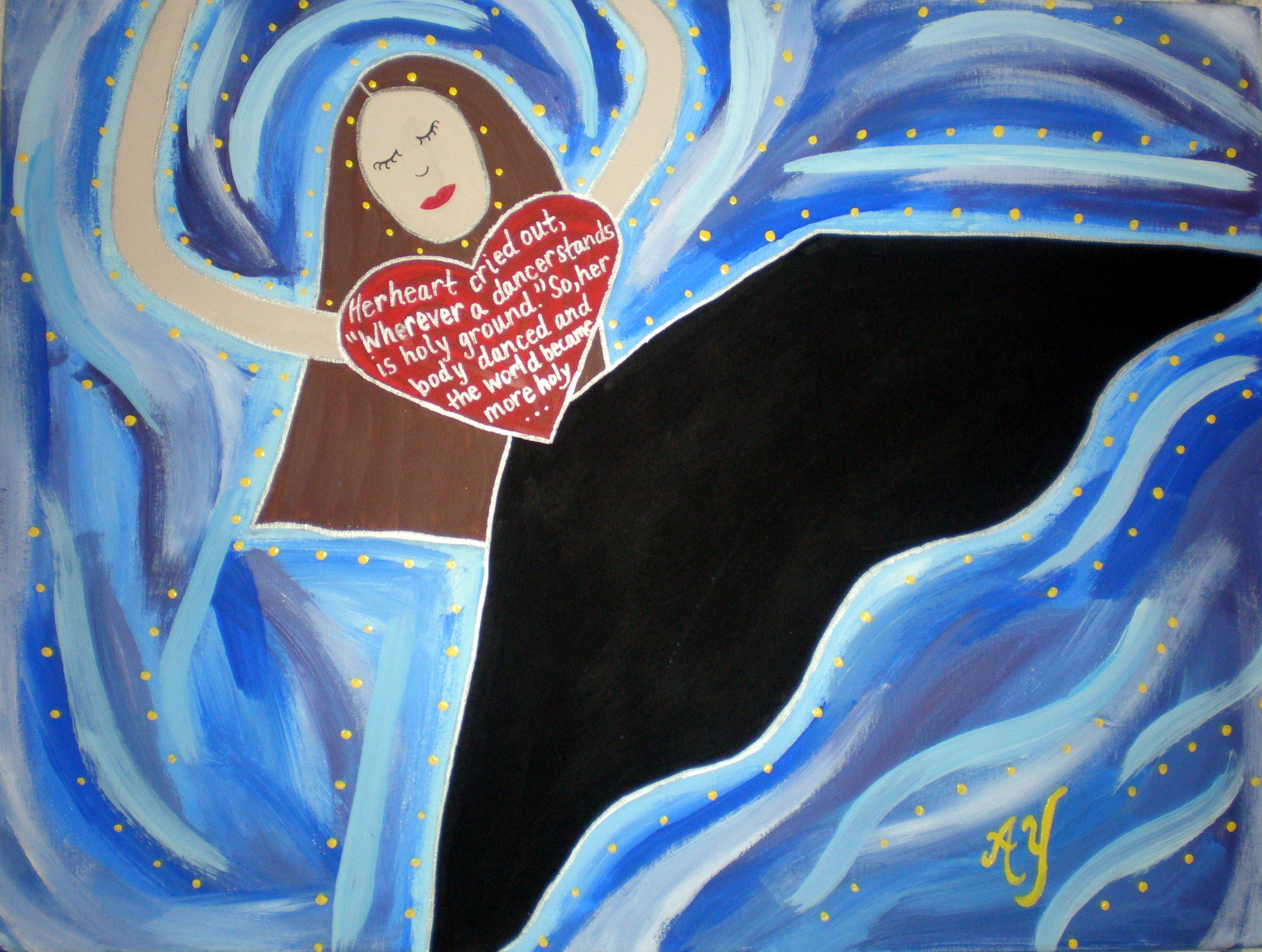
Painting Martha Graham by Angela Yarber

angela

Joining Virginia Woolf , the Shulamite, Mary Daly, Baby Suggs, Pachamama and Gaia, Frida Kahlo, Salome, Guadalupe and Mary, Fatima, Sojourner Truth, Saraswati, Jarena Lee, Isadora Duncan, Miriam, Lilith, Georgia O’Keeffe, Guanyin, Dorothy Day, Sappho, Jephthah’s daughter, Anna Julia Cooper, the Holy Woman Icon archetype, Maya Angelou, and all my other Holy Women Icons with a folk feminist twist  is the dancing revolutionary Martha Graham. So, as the contemporary and modern dancers on So You Think You Can Dance continue to amaze us this summer, let us remember from whence they came.

Martha Graham’s contribution to the world of dance cannot be overestimated. She is regaled as the Picasso of the dance world, revolutionizing it by introducing an entirely new quality of movement known as modern dance. Not only did Graham revolutionize the dance world, like Isadora Duncan before her, she also made great contributions to feminist spirituality. One of her most famous statements may well have been “wherever a dancer stands is holy ground.” Like most dancers who are so in tune with their bodies, Graham new the holiness therein, the ways in which the body can express the ineffable when words alone simply cannot. “The body never lies,” she famously reminds us.

Martha Graham Continue reading “Painting Martha Graham by Angela Yarber”

Eating: Thinking about Bodily Practices, Pt. 1 by Elise M. Edwards

Elise EdwardsI am currently preparing to teach a course on bioethics in the fall. I plan on combining some common, secular materials on biomedical ethics with some theological material and some feminist readings. After all, in a course that centers around practices related to the body, birth, and death, there seems ample opportunity to introduce feminist themes. Some feminist perspective, of course, is typical, like when we will discuss abortion and contraception. (Or at least it is common in my courses where try to present multiple sides of an issue.) Anything related to conception, pregnancy, and birth is easily understood as a “women’s issue” and therefore something that feminists address. I’ve discussed abortion and contraception in previous posts on this forum.

However, I realized in going through readings for this course that I have not focused much on other practices related to the body in my scholarship or personal reflection. Specifically, I have not connected them to theological principles or feminist convictions. Perhaps not everything concerning the body is directly relevant to feminism. But I am sure if I thought about it, I would be able to make the connections. We are physical creatures and the feminist movement generally affirms recognizing our embodiment.

Continue reading “Eating: Thinking about Bodily Practices, Pt. 1 by Elise M. Edwards”

Boys Don’t Cry (or at least the shouldn’t when they are interviewing you for a job) by Natalie Weaver

Natalie Weaver

I want to begin by saying that I am grateful for my work.  It is no small thing to have a relatively secure academic position, especially in a climate when tenured and full-time appointments represent a disgracefully small percentage of all teaching positions throughout the country.  Nevertheless, a certain degree of professional movement is welcome for the purposes of growth and renewal if and when opportunity arises.  It is on this basis that I have been receptive on a few occasions to apply for appointments at the invitation of search committee chairpersons.  When I have been solicited for an application, I have in turn applied.

It is a curious thing because when you are contacted out of the blue you think something like… “ah, they must like me… they must know something about my work.”  And, it is true that on the occasions when I was asked to apply for something, I was invited to come in for an interview.  This furthers, of course, thoughts like… “great, this is going somewhere.”  And, in my case anyway, I start thinking about and even planning in a tentative way for what a move would constitute, the logistics of change, the impact on my family, the disruption of my current obligations, and so on.  Showing up for an academic interview midcareer involves much more than preparing a research presentation, which is also no small task.  The whole affair is psycho-socially weighty, and that reality is intensified by the fact that it drags on for months.  It can take more than six months from the time of the initial contact to the interview to receiving news of the final outcome. Continue reading “Boys Don’t Cry (or at least the shouldn’t when they are interviewing you for a job) by Natalie Weaver”

The Hidden Curriculum in Evangelism: Patriarchy by Erin Lord Kunz

Erin kaylaspic12

A good evangelist, especially in college ministries, acts as if there is no agenda to his or her evangelism. It’s very, “Do you want a cup of coffee? How are your classes going?” with a lot of understanding head nodding. The goal is to stay cool and not seem threatening (even though eternal damnation is at stake). A good evangelist then finds the opportunity to advance on whatever personal problem the interlocutor divulges, and the solution from the evangelist remains constant: “You need to accept Jesus Christ as your personal Lord and Savior.”

A ‘good evangelist’ does not believe this interaction is an agenda at all, as evidenced by new slogans popping up in evangelist circles. There is “Jesus without Religion,”“I am Second,”“H20,”“Freedom Churches,” etc. All of these evangelist slogans attempt to portray “real” Christianity as something other than doctrine, simply a relationship with God, a freeing experience, a nonthreatening choice.  Continue reading “The Hidden Curriculum in Evangelism: Patriarchy by Erin Lord Kunz”

Apathy by Deanne Quarrie

DeanneWhen I sat down to write my article this month, I browsed through my computer for ideas.  As I did, I found this article that I wrote about 18 years ago for a newsletter I prepared for my workplace.  Because it is still a very relevant topic to me today, I thought I would share it here. ( food for thought – I am an introvert,  a triple Aries and a Myers Briggs INFJ)

I have spent a lot of my life sorting through very strong feelings in order to decide to express them or not. Of course, there are those that erupt before given the opportunity for that kind of sorting!  Just ask my friends and family!  I have often wondered if everyone has this going on inside their heads.  It is part and parcel of being an introvert to ponder such things. I have even wondered if perhaps some just  don’t have that experience of heavy duty “feeling”!  Of course, that’s a ridiculous idea.  We all have feelings.  We all just have varying levels of willingness to share them.  Continue reading “Apathy by Deanne Quarrie”

Feminist Musings on Mother’s Day.

photo1Happy Mother’s Day!

Yes, I said it, but Mother’s Day invokes within me a certain hesitancy. Now before you say, “Well that’s because you don’t have children of your own so you don’t understand what it is like to be a mother or because your relationship with your own mother is awful, you hate the day.” I would respond that that is an unfair assessment of the situation. First, Mother’s Day doesn’t bother me because I don’t have children. (By the way, I find the idea that I don’t truly understand love or commitment and/or motherhood because I don’t have kids unbelievably condescending. Yes, motherhood can give one gifts and insights but those can also come from other areas of one’s life and/or other experiences.) I am also not hesitant about Mother’s Day because my mother and I have an awful relationship.  We don’t. In fact, it is quite good.

Rather, Mother’s Day bothers me for three reasons. First, it often seems fake. People seem to go through the motions because it is expected and not because they sincerely want to honor their mothers. Second, I often wonder if Mother’s Day isn’t just some consumer-driven, capitalist, patriarchal creation asking us to buy expensive cards and “remember” all our mothers have done for us this one very special day of year.

Third, what are we celebrating about mothers?  Most of the cards at the store and advertisements on television (if we would take them as research on what the general sentiments on Mother’s Day are) honor a mother’s love, support, guidance and acknowledge the child’s needs.  They thank mothers for all they do.  Continue reading “Feminist Musings on Mother’s Day.”