
Difficult Dialogues by John Erickson

Let’s have a conversation about men and feminism and how we can continue to abolish the patriarchy together rather than writing mean, hurtful comments online.

logo-CCWA few months ago Governor Jerry Brown appointed me to be the first man on the prestigious California Commission on the Status of Women and Girls. I am so excited and honored by this amazing opportunity to continue the great work that California is doing to tackle issues such as pay equality, advancing more girls in the STEM field, creating more opportunities for women in leadership positions across California, and a host of other hot topic issues.

From the moment I started telling people, the responses were extremely positive. People were very excited that we could have a conversation about how men can be included in creating change to better impact the lives of women and girls from all walks of life.  It felt great to see such a positive response from so many people that I love, trust, and admire. However, while much positivity still remains, it has come to my attention that some people are not so thrilled about my appointment. However, what these people and groups online do not realize is that I fully expected and am happy to see such conversations occurring about men in feminism.
Continue reading “Difficult Dialogues by John Erickson”

What Happened When I Dared to Wear a Kippah by Ivy Helman

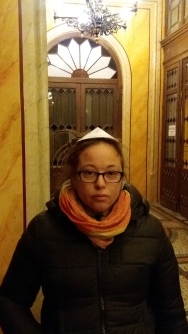
20171203_124919Last week Sunday, my partner and I were in Budapest, Hungary.  We stopped at the Dohany Street Synagogue, the second largest synagogue in the world and the largest in Europe.  After we bought our tickets and proceeded through security, we decided to go into the synagogue first and then the museum.
We walked into the synagogue.  A younger man (maybe 20) was handing out paper kippot (yarmulke in Yiddish).  My partner and I both put our hands out but were refused.  There was an elderly man there who said that the kippot were only for men.  That didn’t surprise me initially as I take my students to the Jewish Museum in Prague and I often argue with the elderly ladies over the right and acceptability of women wearing kippot.  They begrudgingly give my female students kippot saying “only as souvenir,” which boils my blood.  Usually, by the time they give the women kippot even those who traditionally wear them are too shamed to do so.   Continue reading “What Happened When I Dared to Wear a Kippah by Ivy Helman”

Gas-lighting on Al Franken(stein)’s Street by Elisabeth Schilling

I will add my #metoo, but don’t feel like going into details. I will just say that in light of my past experience and Al Franken’s statement of apology, I’m realizing why some of us don’t tell at an even deeper level.

This is Al Franken’s statement:

“I’ve met tens of thousands of people and taken thousands of photographs, often in crowded and chaotic situations. I’m a warm person; I hug people. I’ve learned from recent stories that in some of those encounters, I crossed a line for some women — and I know that any number is too many. Some women have found my greetings or embraces for a hug or photo inappropriate, and I respect their feelings about that. I’ve thought a lot in recent days about how that could happen, and recognize that I need to be much more careful and sensitive in these situations. I feel terribly that I’ve made some women feel badly and for that I am so sorry, and I want to make sure that never happens again.”

Summary: It’s super hard to be a guy in this society.

Continue reading “Gas-lighting on Al Franken(stein)’s Street by Elisabeth Schilling”

#MeToo by Michele Stopera Freyhauf

metoo image 1Once again it is time for another blog post, and once again I find it difficult to write.  The news embroils you in a landslide of negativity and you feel like all common sense and rationality has dissipated – I even made the comment that I am glad I am not young because I fear the state of the world in the future.
With that said, the one thing discussed and needs to be discussed is the #MeToo movement.  First, yes, I have several stories, and yes, I stayed silent for over 25 years.  Did I attempt to resolve the issues with the remedies available? Yes.  Did I suffer backlash? Yes. To the detriment of losing my job?  Yes. Did I consult an attorney? Yes.  What was I told – move on or risk being blacklisted from your field – as a new career professional in her twenties, there was no choice?  Yes.  Did it happen again?  Did I out of fear, just try to stay away from the person but never reported it?  Yes. Continue reading “#MeToo by Michele Stopera Freyhauf”

High Stakes for Women in Leadership: A Reflection and a Prayer by Elise M. Edwards

elise-edwardsA few weeks ago, I was asked to give the invocation for a luncheon at my university.  Baylor University was celebrating our presidential inauguration and there were several events leading up to the installation of the university’s 15th president. The inauguration was historic because it ceremonially marks the beginning of a term for our first female president, Dr. Linda A. Livingstone.

As I write, it is a year after Hillary Rodham Clinton lost the election for President of the United States of America. Like many of us, I’m still coming to terms with the choice my nation made, and how we came to it.  I’m thinking about women in leadership, especially occasions such leadership marks a first, a departure for an institution or system marked by male privilege.

What does it mean when an institution is willing to deviate from its long-established patterns of leadership and entrust its governance to women?

Continue reading “High Stakes for Women in Leadership: A Reflection and a Prayer by Elise M. Edwards”

How Do We Heal Rape Culture? Part 2: How to Help Men Become Safer by Trelawney Grenfell-Muir

In Part 1, I presented a spectrum of male behaviors and attitudes, from violently misogynistic to safe ally. Next it is time to think about how we – as women, male allies, and society – can help men move up that scale to become increasingly safer for women. The strategies will differ depending on where a man starts out. However, using current research about change theory, we can find some concrete strategies to help us start to make progress.

The Research

Social scientists have conducted many studies about persuasion and social change, and I encourage everyone to follow these research trends. For this piece, I will focus on a few simple ideas about what works. I’m gearing this advice mainly toward men who want to become safer and to help other men become safer, but some of it applies to women as well. It also applies to religious communities – if they prioritize this issue, the men who attend will learn to be safer.

Continue reading “How Do We Heal Rape Culture? Part 2: How to Help Men Become Safer by Trelawney Grenfell-Muir”

Please Keep It in Your Pants by Carol P. Christ

Trigger warning: this post describes sexual abuse

Last week while responding to a comment on my blog, I suddenly remembered a series of incidents in which men I did not know exposed themselves to me in public places. The first time occurred at a park around dusk during an outing with a group of girls. I was about 11, I may have wandered away from the group, or I may have been with others. What I remember is seeing a man with his pants down sitting on a park bench, possibly the first time I ever saw an adult man’s penis. I told or we told, but the man was not reported by the adults. Fast forward to the beautiful gardens of the Palace Schoenbrunn in Vienna where I was confronted by a penis while lost in thought when I was 19. I ran, but said nothing. In my 20s at the early showing of movies in New York City men would sit next to me and jerk off into paper bags. Continue reading “Please Keep It in Your Pants by Carol P. Christ”

What I Believe (Post-2016) by John Erickson

Ever since the election of You-Know-Who, I have been doing a lot of creative writing.

Ever since the election of You-Know-Who, I have been doing a lot of creative writing. Unlike academic publications, policy reports, or my dissertation, creative writing, much like my mentor Dr. Marie Cartier has written about, provided me with a needed escape from a world that seems to grow darker with each passing day.  In college, I served as Poetry Editor for the Wisconsin Review, the oldest literary journal in Wisconsin. Continue reading “What I Believe (Post-2016) by John Erickson”

Reclaiming My Time: A Meditation about Mindfulness and Faithfulness to One’s Purpose by Elise M. Edwards

elise-edwardsYou may have seen the viral video of Congressional Representative Maxine Waters’ demands for “Reclaiming my time!”  Video was taken during a proceeding in which Representative Waters is questioning Treasury Secretary Steven Mnuchin, who responds with long-winded answers and indirect statements.  Ms. Waters appears annoyed, and she is not interested in flattery.  She wants a direct response to her question.  When she does not get it, she appeals to protocol, which allows her to “reclaim” the time allotted to her (intentionally) wasted by a man who wants to dodge her questions.

The video was very popular on my social media feeds.  I know of preachers who used “Reclaiming my Time” in their sermons the following Sunday.  There were memes, of course.  There was even another viral video of Mykal Kilgore singing his gospel composition of Waters’ words.  He and Waters appeared on a TV show soon after.

It’s fairly obvious why this video–and the sentiment behind it–struck such a chord with so many people.  We wish we could reclaim our time in situations where we are moving forward with a purpose, only to be met with delays and roadblocks from those who want to deter us.  Sometimes, these delays are unintentional.  But too often, they are strategic attempts to wear us down, distract us, and redirect our energy away from our goal.  Ms. Waters wasn’t having it.  She called out the delay tactics and held firm to what was rightfully hers.  Her time.

Continue reading “Reclaiming My Time: A Meditation about Mindfulness and Faithfulness to One’s Purpose by Elise M. Edwards”

A Middle: Understanding the Relationship between Violence and Power by Katie M. Deaver

In my last post here on Feminism and Religion I unpacked the three primary understandings of atonement theology as well as some of the feminist critiques of those understandings.  In this post I’d like to focus a bit more on how the relationship between power and violence influences how Christian women view the atonement.

In her book, On Violence, Hannah Arendt puts forth a new analysis of the relationship between power and violence.  Arendt’s analysis, though primarily focused around concepts of the potential for worldwide destruction and war following major global occurrences such as the Second World War and the struggles for civil and women’s rights within the United States context, supplies an interesting framework with which to consider this relationship as it relates to domestic violence.    Continue reading “A Middle: Understanding the Relationship between Violence and Power by Katie M. Deaver”