
The Making of Women Religion Revolution by Xochitl Alvizo

Last month in Boston during the American Academy of Religion (AAR) Annual Meeting I presented on Women Religion Revolution, a volume of collaborative work with fifteen other women that Gina Messina and I co-edited. The book is the third one published with FRS Books, the new book series of Feminist Studies in Religion, Inc. (FSR, Inc.) – a project with which we are very proud to partner.

FSR Books organized a panel featuring these first books. Serving as a backdrop of the whole panel was Elisabeth Schüssler Fiorenza’s own book, Congress of Wo/men: Religion, Gender, and Kyriarchal Power, which was FSR Books’ first publication. In this book, Schüssler Fiorenza introduces the concept and vision of the ekklēsia of wo/men as kosmopolis. Defining the ekklēsia of wo/men as “the decision-making assembly of the kosmopolis,”[1] she explains the kosmopolis as the polis/city-state “governed by the egalitarian values and visions of justice and well-bring for everyone without exception” (106). She calls feminists in religion to “build a global, transcultural, cosmopolitan organizations for articulating a wisdom spirituality of cosmic world citizenship and for securing the welfare of everyone in the kosmos/world and of the kosmos itself” (111-112). In other words, Schüssler Fiorenza’s volume is a renewed call for feminists to think big and think together beyond the binary of secular/religious so as to more effectively counter the neoliberal domination of our current global context. Continue reading “The Making of Women Religion Revolution by Xochitl Alvizo”

Putting “Winter Solstice” in your “Happy Holidays!” Greeting by Marie Cartier

When you read this dear FAR family, it will be December 22, the day after the winter Solstice. Winter Solstice is the shortest day of the year, and marks the beginning of winter.

I am Catholic, a board member of the Ministry for Gay and Lesbian Catholics. And I have practiced various forms of meditation since I was in high school through yoga and martial arts.

But I am also a witch, ordained in the Temple of Isis/ Fellowship of Isis and circle with various other Goddess groups, especially Circle of Aradia in Southern California. When I think of the winter holidays, yes, I think of Christmas and New Year’s, but I definitely also think of winter Solstice. Continue reading “Putting “Winter Solstice” in your “Happy Holidays!” Greeting by Marie Cartier”

God Says No Moore by Gina Messina

Doug Jones victory in the Alabama Senate election last Tuesday is certainly something to celebrate. Although many claimed God supported Roy Moore for Senate, his defeat says otherwise.

However, it must be noted that this narrow victory ended with 48% of the vote in Roy Moore’s favor. In addition, 80% of white evangelicals cast their votes for Moore. This begs the question, what should our votes be based on, particularly if we are claiming the Christian faith as the foundation of our values? While we should all value the separation of church and state, and it is true that government needs to be protected from religion, sometimes religion also needs protecting from government. Continue reading “God Says No Moore by Gina Messina”

The Trouble  with “Wellness” by Katey Zeh

katie-smith-104748

During the holiday season we’re bombarded constantly with contradictory messages about how we ought to take care of our bodies this time of year. Over the early winter months there is a collective expectation and even glorification of indulging in all kinds of ways–eating, drinking, spending money, etc. But if we dare enjoy ourselves a bit, we’re then on the receiving end of the diet and fitness culture propaganda that capitalizes on our time of indulging by telling us we need to clean up our eating and get (back) to the gym–assuring us that 2018 will be the year when we finally achieve our “dream bodies.”

Oftentimes the coded language of “wellness,“ “clean eating,” and even “health” is rooted in the same problematic framework that toxic diet and fitness culture espouses: your best self is your thinnest self. Strict binary language used to describe food–processed foods high in fat or sugar are “bad” while fruits, vegetables, and whole grains are “good”–attributes moral weight to what we eat. Beneath this is the myth that our health outcomes and the way that our bodies look are completely within our control. If we simply commit to “healthy” habits, we can become “good” (thin). Continue reading “The Trouble  with “Wellness” by Katey Zeh”

Black People Elect Jones, White People Vote for Moore: And What That Means by Carol P. Christ

By now the exit poll statistics from the recent election in the state of Alabama are well known: 98% of black women and 92% of black men voted for Democrat Doug Jones, while 74% of white men and 65% of white women voted for Republican pedophile and child-molester Roy Moore.

These statistics raise two important questions. The first is why white women would vote—some would say against their own interests—for a man whose abusive behavior toward women and girls is a matter of public record. The second, and related question, is whether the Democratic strategy of trying to appeal to racist and sexist white people by downplaying racism and sexism is a winning strategy. Continue reading “Black People Elect Jones, White People Vote for Moore: And What That Means by Carol P. Christ”

Spirit of Bali by Jassy Watson

Over the past year I have travelled to Bali on a number of occasions for both pleasure and work, and with each visit a little more of my heart and soul stays behind on this green tropical island paradise waiting for my next return. I was never really that keen to travel to Bali in the past; my pre-conceived ideas had been largely influenced by the negative media attention this “hot destination” often receives in Australia.  Whether it be a volcano erupting, scooter accident, terrorist attack. or young Australian party-goers getting up to mischief while on holiday, the shadow side of Bali tourism remains the focus for hype-hungry media – with consequences often detrimental to the tourism industry that the island has become so reliant on.

Yet for many years pilgrims from all over the world have been flocking to Bali to experience the spirit and culture. I was curious and decided it was finally time I went to see firsthand what all the hype was about. After seeking an inexpensive and close overseas getaway to recharge our parenting batteries, my husband and I decided to join the flock and fly to the island paradise. From the moment my feet hit the ground I was engulfed with the chaos & humidity that is Bali – and I was captivated. Continue reading “Spirit of Bali by Jassy Watson”

Just South of Ventura by Sara Frykenberg

For those of us living in Southern California, it has been a tense week to say the least: flames ravaging up and down the coast, homes lost, thousands displaced, freeway and school closures, smoke thick in the air, and ash raining from the sky.

And the fires are still raging. 

Whether or not one is directly impacted by the wildfires here in Ventura and Los Angeles County, you can’t walk through the grocery store, turn on the radio, or get a cup of coffee without engaging the fear and concern, or hearing about the devastation left behind. We are sharing a trauma, howbeit differently, and with different levels of need.

I have been lucky during the fires.  I live just south of Ventura. My work is on the Getty side of the 405: it was threatened, but not in flames.  I spent the week checking in with family and friends, offering my home, and breathing the toxic air. I also made dinner, picked my brother up from the airport, attended a baby shower, and graded papers. … This is a strange juxtaposition, and like many Californians, I have had a hard time processing what’s going on.

On Sunday afternoon, surrounded by the unnatural darkness of an ash filled sky while traveling down the 101 freeway, I wrote the following. This is my effort to make sense.  And I offer it to you all here, in case this helps you make sense too.  Continue reading “Just South of Ventura by Sara Frykenberg”

Sheela na gig: The Dark Goddess of Sacred Power BOOK REVIEW by Kay Bee

If there are devotees of the Dark Goddess on your Yuletide gift list, Starr Goode’s gorgeous book, Sheela na gig: The Dark Goddess of Sacred Power, may be the best gift you could choose for them.
Goode’s connection to the Sheela is profound. Equal parts scholastic study, visual feast, & ardent devotional, this book will take the reader along on the author’s epic journey into the Mysteries of the Sheela na gig. As Goode explains thoroughly, there are no written primary source documents illuminating the origins & purposes of the Sheelas that survive today. Scholars and thea/ologians argue about the truth behind Her presence, but no one can yet definitively declare Her history and meaning. However, that does not mean one cannot  still study that history as one way of connecting deeply with Her Mysteries today. Continue reading “Sheela na gig: The Dark Goddess of Sacred Power BOOK REVIEW by Kay Bee”

What Happened When I Dared to Wear a Kippah by Ivy Helman

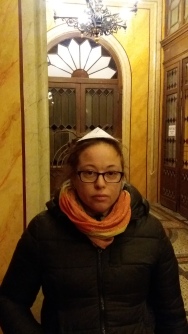
20171203_124919Last week Sunday, my partner and I were in Budapest, Hungary.  We stopped at the Dohany Street Synagogue, the second largest synagogue in the world and the largest in Europe.  After we bought our tickets and proceeded through security, we decided to go into the synagogue first and then the museum.

We walked into the synagogue.  A younger man (maybe 20) was handing out paper kippot (yarmulke in Yiddish).  My partner and I both put our hands out but were refused.  There was an elderly man there who said that the kippot were only for men.  That didn’t surprise me initially as I take my students to the Jewish Museum in Prague and I often argue with the elderly ladies over the right and acceptability of women wearing kippot.  They begrudgingly give my female students kippot saying “only as souvenir,” which boils my blood.  Usually, by the time they give the women kippot even those who traditionally wear them are too shamed to do so.   Continue reading “What Happened When I Dared to Wear a Kippah by Ivy Helman”

Grieving through the Holidays: Painting Holy Women Icons of Grief by Angela Yarber

The holiday season is a particularly difficult time for grief. Whether it is grieving someone who died earlier in the year as you celebrate your first holiday season without them, or the lasting memories of loved ones who are no longer present at family gatherings, this time of year makes grief bubble to the surface. Since this is my first holiday season without my little brother, who died in March, I’ve planned ahead with coping strategies that I’d like to share with other feminists struggling to grieve through the holidays.

Upon the death of a loved one, most people in the West are offered commodified grief, costly funerals, and stifled feelings pre-packaged as dignified tradition. When deathcare became a commercial enterprise at the turn of the twentieth century, there was what mortician and author Caitlin Doughty calls a seismic shift in who was responsible for the dead. “Caring for the corpse went from visceral, primeval work performed by women to a ‘profession,’ an ‘art,’ and even a ‘science,’ performed by well-paid men. The corpse, with all its physical and emotional messiness, was taken from women. It was made neat and clean, and placed in its casket on a pedestal, always just out of our grasp (Caitlin Doughty, From Here to Eternity: Traveling the World to Find the Good Death, 136).”

Continue reading “Grieving through the Holidays: Painting Holy Women Icons of Grief by Angela Yarber”