“Justice, Justice You Shall Pursue:” Finding Hope in Justice-Seeking Movements. by Ivy Helman

20140903_180423For the past few weeks, there has been a lot of discussion about racism in the United States and rightly so. It is clear from the lack of charges and the repetition of similar crimes across the United States by different members of various law force communities that some people because of the color of their skin are immune to the consequences of their actions and others, also because of the color of their skin, are often the victims of such actions. Criticism, here, in the forms of protests, federal inquiries and outrage are essential.

I am reminded of oft-quoted part of the Torah: Devarim (Deuteronomy) 16:20, one that I saw on some of the signs Rabbis carried with them in the protests. “Justice, justice shall you pursue, that you may thrive and occupy the land that the Lord your God is giving you,” (from the JPS translation). G-d tells those early Israelites that justice is a requirement not just for their survival in the Promised Land, but also if they want to have good, long lives. Later tradition, from the Talmud to Rashi and beyond, interpret this passage as a call for a just court system within Jewish society.  Likewise, all who use the system should have the principle of justice in mind.  There is also a lot of conjecture as to why justice is said twice. Many modern scholars call attention to the way in which religion and state were considered one in same for this time period and much of human history. Continue reading ““Justice, Justice You Shall Pursue:” Finding Hope in Justice-Seeking Movements. by Ivy Helman”

Awake! Awake! A Reflection on the Awakening of Conscience and Advent by Elise M. Edwards

Elise Edwards‘Tis the season to be…?

For me, this has not been a season to be jolly. I teach at a university, and again, I’m in the midst of the most hectic time of year of grading and exams and wrapping up projects due at the end of the calendar year. There have been moments of joy and rest. But I’ve been more reflective and sorrowful. This year, my heart and mind and soul have been opened up in new ways and I feel more urgency and need for social change. I’ve been experiencing “conscientization” during the time of year many Christians refer to as Advent.

I was introduced to the concept of conscientization in the work of Christian feminist and womanist ethicists like Beverly Wildung Harrison and Stacey Floyd-Thomas. Other feminist and liberationist thinkers had already convinced me of the vital role that critical thinking, consciousness-raising, and action occupy in ethical reflection and social change. In a chapter on “Feminist Liberative Ethics” in a textbook on liberative approaches to ethics, Michelle Tooley explains the meaning of conscientization:

“Activists speak of conscientization as waking up to the injustice in the world—or seeing it for the first time. It is not that the injustice is beginning; it is that you encounter oppression, injustice, violence yourself or you see it in a person or situation. You may have seen the same situation many times before, but for some reason you begin to connect the event with a deeper recognition that the injustice is wrong.”

(p. 185, Ethics: A Liberative Approach, Miguel A. De La Torre, Editor)

I was conscientized the night I heard that a grand jury did not indict Darren Wilson for killing Mike Brown, an unarmed black man. I was horrified to learn that this police officer doesn’t even have to stand trial for his violent and deadly act. Now it wasn’t like before grand jury’s decision I thought that black lives were given equal value in the US justice system. After all, for months I have been researching and preparing a paper called “When the Law does not Secure Justice or Peace” about artistic and religious responses to the dishonoring of black male personhood. I have been mourning the loss of Trayvon Martin and others as I write. But this decision left me sobbing in a hotel room as I watch the events unfold in Ferguson, Missouri. I gained a deeper social awareness about the depths to which the demonization and disregard of the lives of black women, men and children are entrenched in American life and the institutions within it.

I gained deeper self-awareness too. One reason the tragedy of the grand jury’s decision became so palpable to me is that just hours prior, I witnessed former president Jimmy Carter address the American Academy of Religion. He spoke passionately about the proliferation of violence, mistreatment of women, climate change, and other social concerns. To put it plainly, I was floored to see a white man in his 90s who was raised in Georgia and was a Southern Baptist until his 70s state without any qualms that people in power intentionally misinterpret religious texts to support the domination of women and nonwhites because those they do not want to lose their privilege. Yet he also called himself, like Archbishop Desmond Tutu, a “prisoner of hope.” He believes that things will change, and draws from his Christian convictions to sustain hope and motivate his work to fight injustice.

I was electrified by his words. I, too, had hope. In the days prior, I had gotten a break from my daily life, connected with friends, and conversed with like minds. I had been thinking about art and love. I had learned strategies for de-centering dominant narratives in the classroom and I was hopeful that I could use them to make a difference in my students’ lives. But mere hours later, while watching the news, the self-awareness I came to is that my hope is more fragile than I wish it to be. Futility consumed my hope.

A few weeks later, I can assert that my faith in God is not shaken, but my hope in humanity’s goodness has as much stability as a house of cards. In my present state of mind, I’m grateful that we are at a point in the church year that provides me with an opportunity to mourn the brokenness of our world. Christmas is approaching, but that doesn’t mean I have to sing merry carols. Advent is a season when Christians reflect on why the world needs God’s miraculous action and what it means to wait for light to emerge in the darkness. In the church calendar, it is a time when Christians re-enact and re-experience the anticipation of Jesus’ coming. Advent songs have a different character than Christmas carols. Many of them have a haunting tone or an eerie, sad, or mysterious sound. The lyrics of these songs place exhortations to “Rejoice!” next to pleas of “O come, o come, Emmanuel!” Emmanuel, also spelled Immanuel, means “God with us.” Christians draw this name from the Hebrew prophecies in Isaiah that are cited in the Gospel of Matthew’s account of Jesus’ birth. Matthew describes Jesus’ birth as the fulfillment of prophecy.

My conscientization allows me to hear these prophecies anew. They are familiar to me, as they are repeated often this time of year in Christian settings, but I hear them in new ways. I hear Isaiah 9:6 quite differently: For to us a child is born, to us a son is given, and the government will be on his shoulders. And he will be called Wonderful Counselor, Mighty God, Everlasting Father, Prince of Peace.

“The government will be upon his shoulders” likely means that this child will have authority. But as I hear those words this year, I imagine the Prince of Peace in the choke-hold of a law enforcement officer. I think of a little baby who are welcomed into the world with joy but who grows up only to be killed at a young age by threatened authorities and crowds of supporters. This is the story Christians tell about the God who is with us, the God who is also fully human. And this is the story we tell about Michael Brown, Eric Garner, Tamir Rice, Alesia Thomas, Aiyana Stanley-Jones and far too many others.

This Advent, I’m making a real effort to hold hope and despair together. I don’t want to become hopeless. I don’t want to think that my work in the classroom, in my church, in my community, on this site and in the printed page have no meaning. Hope is what sustains us to work for justice. I want to believe in that transformation of hearts and minds and souls is possible and immanent even when it emerges through sorrow and struggle. Suffering, sorrow, and killing without consequences must not be acceptable. With my new eyes, I see just how terrible they are.

Elise M. Edwards, PhD is a Lecturer in Christian Ethics at Baylor University and a graduate of Claremont Graduate University. She is also a registered architect in the State of Florida. Her interdisciplinary work examines issues of civic engagement and how beliefs and commitments are expressed publicly. As a black feminist, she primarily focuses on cultural expressions by, for, and about women and marginalized communities. Follow her on twitter, google+ or academia.edu.

Whose God is it, Anyway? by Esther Nelson

esther-nelsonI do not attend church (or any “house of worship”) regularly anymore.  However, one hot, humid, Sunday morning this past August, I wended my way to St. Mark’s Episcopal to hear my friend, Dale, preach.  He does “pulpit supply” there (his home church) occasionally.  Dale earned an MFA (Master of Fine Arts) in creative writing after finishing his seminary studies.  He’s written a one-man play titled “Jesus Phreak” and has performed it in churches and universities nationwide.  Dale and I have been friends for a decade or so.  He identifies as a Christian, but he’s not like any Christian I’ve ever known.
Church is familiar to me.  I was born to Protestant, missionary parents who “served the Lord” in Buenos Aires, Argentina, after graduating from Moody Bible Institute in Chicago, Illinois.  My parents had a “special burden” for Jews and worked to bring them to “the knowledge of Jesus Christ.”  In other words, they sought to convert Jews to Christianity–not just any Christianity, but the specific Christianity my parents believed in–a literal, “fundamental” understanding of Scripture made popular by Dwight L. Moody (1837-1899) and Cyrus I. Scofield (1843-1921).

I was raised on church and Sunday School, attending three services every Sunday for years.  Later on, as a young adult in the United States, I added Wednesday night prayer meeting, heeding a pastor’s adage: “Those who love the church come on Sunday morning, those who love the pastor come on Sunday evening, but those who love the Lord come on Wednesday night.”  I did not stop my regular church attendance (non-denominational, Baptist, Presbyterian, Reformed Episcopal, and just plain Episcopal–in that order) until well into my 40s.  By then, I could no longer contort myself to fit the mold “church” demanded from me. Continue reading “Whose God is it, Anyway? by Esther Nelson”

Painting Tiamat/Tehom by Angela Yarber

angelaToday I am honored to give a lecture on “Queering Iconography: Holy Women Icons from Sappho to Pauli Murray” at the North Star LGBT Center in Winston-Salem, NC. So, I want to continue the theme of featuring some of my queer Holy Women Icons. Joining Virginia Woolf , the Shulamite, Mary Daly, Baby Suggs, Pachamama and Gaia, Frida Kahlo, Salome, Guadalupe and Mary, Fatima, Sojourner Truth, Saraswati, Jarena Lee, Isadora Duncan, Miriam, Lilith, Georgia O’Keeffe, Guanyin, Dorothy Day, Sappho, Jephthah’s daughter, Anna Julia Cooper, the Holy Woman Icon archetype, Maya Angelou, Martha Graham, Pauli Murray, La Negrita, and all my other Holy Women Icons with a folk feminist twist is the often overlooked and misunderstood primordial goddess of creation: tehom.

In Genesis 1 we read, “In beginning, God created the heavens and the earth, the earth was a formless void and darkness covered the face of the deep, while a wind from God swept over the face of the waters.” It is the creation narrative held dear, formative, and meaningful for countless Jews and Christians. Interestingly, this word, deep, in Hebrew is tehom. Tehom translates as “deep or depths,” but it’s also a cognate for Tiamat, a Babylonian Goddess of creation. Out of the face of the deep, the world begins. Out of tehom, God creates. Out of Tiamat, the earth comes into being. This dancing Babylonian goddess syncretistically intermingles with the creation myth so pivotal to the faith of Christians and Jews in a way that could be terrifying, or beautiful, or—like the chaotic body of Tiamat that brings the world into being—both. Continue reading “Painting Tiamat/Tehom by Angela Yarber”

Putting Faith in Interfaith Dialogue by Esther Nelson

esther-nelsonWhy do it?  Sit around a table with people who profess a faith tradition different from our own, drink coffee, nibble on snacks, and talk.  What’s the point?  No doubt the reasons vary depending on the particular people getting together.  Nevertheless, there is the sense that if we “sit down together and talk together about our faiths,” we’ll “break down barriers,” and….then what?  Do we think (or hope) that those on the other side of the table will eventually “come around?”  Is conversion a goal?  Or, perhaps we just want to become more “tolerant” of other faiths.

So, for example, if Muslims share facts with Christians about the history of Prophet Muhammad, the Sunni/Shi’a division, and Shari’a law, will that help Christians tolerate Muslims?  Books on the history of religions abound.  Yet, religion-based violence flares around our globe.  Would learning about doctrinal beliefs–“truths” based on (usually male) interpretation of scriptural narrative–be helpful?  Christians understand Jesus to be God incarnate.  Muslims reject any doctrine that compromises the oneness of God.  Now what?  Are barriers broken down?  Are we more tolerant? Continue reading “Putting Faith in Interfaith Dialogue by Esther Nelson”

Good Theology is Feminist Theology by Carol P. Christ

carol christJudith Plaskow and I are just now completing the draft of the manuscript of the book we have been working on for the past 2 ½ years. It has a new title: Two Views of Goddess and God for Our Time.* I have been thinking of little else for the past few weeks. An editor who is considering our book said that she was hoping we could address our book to an audience larger than the feminist theology community. Thinking about this, a light dawned: if feminist theology is right that traditional theology denies the full humanity of women, then good theology must be feminist theology. Our work is not tangential to the theological mainstream, but is at its center.

We have revised the Introduction and Conclusion to the book with the assumption that our work should appeal not just to other feminists, but to a wide range of intelligent readers and thinkers. The fact that we were asked to participate in a dialogue about the nature of God in Tikkun magazine’s Summer 2014 inspires us to hope that we are right that feminist theology is becoming part of the progressive theological mainstream.

We began our new book because – though we agree about many things – we disagree about God and Goddess. After working together for decades with shared commitments to feminism, justice, the environment, and the flourishing of life, it was a bit of a shock to come face to face with our differences on such a major theological issue as the nature of divinity. We began our discussion with a shared critique of the God of Biblical traditions as a dominating male other. We agreed that this God has justified not only male domination of women, but other forms of domination as well, including myriad forms of injustice and war. We questioned the theological doctrine of divine omnipotence in light of the holocaust, the on-going domination of one half of the human race, and other oppressions including slavery, colonialism, and war.

But as we articulated our own views of divinity in light of this critique, our views diverged: Judith concluded that God is an impersonal power of creativity that is the ground of all being and becoming, including all good and all evil. Carol understands Goddess as the intelligent embodied love that is the ground of all being and becoming, a personal presence who cares about the world and all individuals it, but who does not have the power to intervene with a mighty arm to set things straight.

We both can give reasons for our views, and in the course of our theological discussion in our book, we give many. Our different views of Goddess and God are significant both theologically and personally. Is God or Goddess good? Or does the divine power include both good and evil? Does Goddess or God care about the fate of the world and our individual lives? Or are love, care, and understanding qualities that are not appropriately attributed to divinity? Is there someone listening to us when we worship, pray, or meditate? Or is addressing Goddess or God a metaphoric way of speaking that inspires feeling in individuals and communities but not in a divine individual? Is the notion that Goddess is love likely to inspire us to love the world more deeply and to promote its flourishing? Or does the notion that God includes both good and evil remind us more clearly of our own capacities to do both?

The fact that we could not agree about the nature of Goddess or God despite our many attempts to persuade each other with rational arguments, led us to conclude that the philosophical, theological, and moral reasons we give in justification of our views are only part of the story. All of these reasons are situated in our individual bodies and in communities and histories. We do not believe there is any simple link between experience and theological views. On the other hand, our experiences form the matrix from which we all begin to think theologically. As we develop our theological views, we constantly test them against our experiences, asking if they ring true, if they help us make sense of our personal, communal, and social lives.

In the first chapters of our book Judith and I locate our theologies in the contexts of our lives. We not only articulate our views of Goddess and God, but also situate them in community. Judith is committed the feminist transformation of Judaism, while I am one of the early voices of the feminist Goddess movement. In the concluding chapters we probe and query each other’s views–from experiential, rational, and moral perspectives. We are hoping to model the kind of feminist dialogue we would like to see more of—one that crosses religious boundaries and is not afraid to probe the differences in standpoints and theological views.

We also hope that our book will inspire a lively feminist–and wider–dialogue about the nature of divinity—something that has been oddly missing heretofore in feminist theology. Engaging in a thoroughly open and honest theological debate is not always easy—even among friends. But we can both testify that doing so has not only illuminated important issues in feminist theology, but also has strengthened our friendship.

*Much this essay is adapted from a draft of the book.

Carol P. Christ is looking forward to the fall Goddess Pilgrimage to Crete which she leads through Ariadne Institute.   Space available.  Carol can be heard in a recent interviews on Voices of the Sacred Feminine, Goddess Alive Radio, and Voices of Women.  Carol is a founding voice in feminism and religion and Goddess spirituality. Her books include She Who Changes and Rebirth of the Goddess and with Judith Plaskow, the widely-used anthologies Womanspirit Rising and Weaving the Visions.  Follow Carol on GoddessCrete on Twitter.

The Mosaic Language of God by Andreea Nica

Andreea Nica, pentecostalismThroughout my “bible-thumping, smitten with God” years, I scribbled countless thoughts and prayers in four devotional journals. Recently I came across these journals, wiping away the years of dust accumulated. As I have been detaching from the Pentecostal god, it was a painful, downright mortifying experience to read through my past communication with god. This god seemed so foreign now given my liberated, enlightened, evolved self. I remember writing to and about Him, but I couldn’t help thinking how dysfunctional and convoluted the language I used really was.

I love you Father. Take me…surrender me to your will…your ways. Let me not lean on my own understanding and foolishness.

Mary Daly in Beyond God the Father advocates, “Time to go beyond God the Father. Don’t you see? If God is male, then the male is God. Reclaim the right to name your self, your world, your God. The liberation of language is rooted in the liberation of ourselves. Be a wild woman…God is not A Being. God is Be-ing.”

Many social scientists contend that language is the foundation of our socially constructed realities. We use language as a creative tool and guide to frame our perceptions of the world around us. We also use language to create our own unique creative expressions. That even though we share and appropriate from the accessible pool of creative expressions, each individual designs and discovers their own true form. Continue reading “The Mosaic Language of God by Andreea Nica”

Women at the Secular Student Alliance Conference by Kile Jones

KileA few days ago I had the pleasure of giving a talk at the Secular Student Alliance Conference on how non-believing persons can work with Churches.  Amidst the chaos of conferences–managing your time, deciding which talks to attend, and making sure you have enough water (it was a Burning Ring of Fire outside in Tempe, AZ)–I got to meet some pretty incredible secular women.

One of them was Heina Dadabhoy.

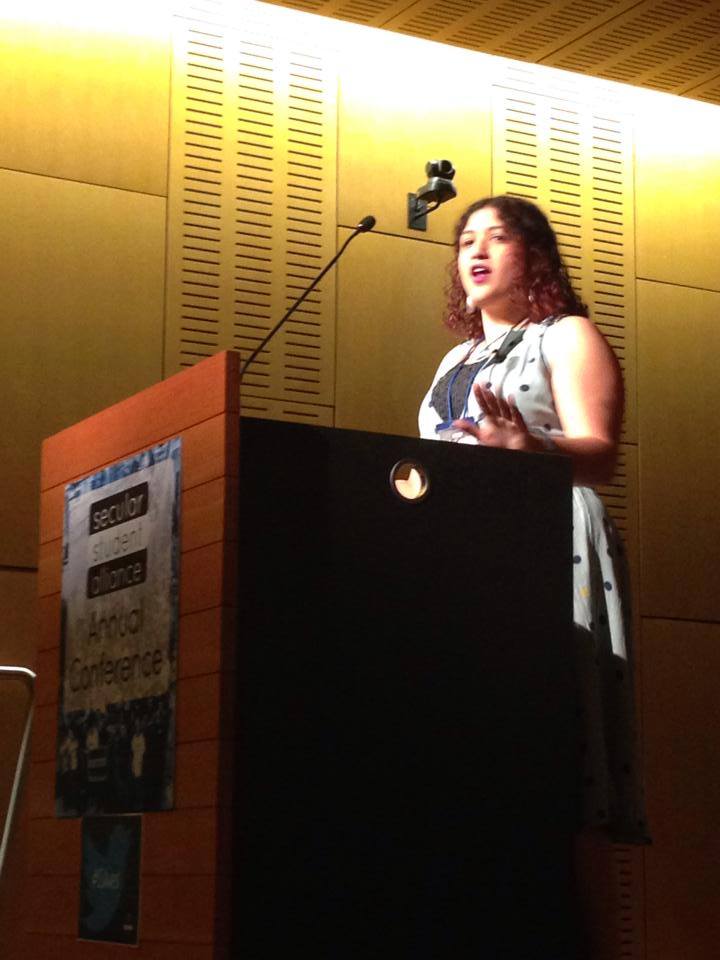
Heina speaking at SSA
Heina speaking at SSA.

Former Muslim, blogger at Freethought Blogs, and overall bad-ass, Heina spoke about ways in which secular groups can create a more welcoming environment for ex-Muslims and Muslims beginning to doubt.  Her talk, “Of Murtids and Muslims,” (a “murtid” is a public apostate) was not only about her experiences coming out as a secular humanist, but considered some of the absurd questions people ask her (and other ex-Muslims) about leaving Islam.  “So did your parents try to honor kill you?”  “Have you gone through FGM?”  It was disturbingly humorous.

What I considered to be Heina’s main point, was that we should respect each others’ individual differences and not generalize and caricature all Muslims with the depictions of some.  “Just because you read Ayaan Hirsi Ali’s book,” Heina notes, “does not make you an expert on Islam.”  Heina made sure to emphasize the radical diversity that exists in Islam.  She also spoke of the some of the issues that people go through when they leave Islam: How do I create a new identity when my old one was intricately tied up in my Muslim community, family, and culture?  How do I navigate popular culture when I have missed a bunch of it?  How do I find myself in this new secular world?  Heina’s answers were refreshingly honest and insightful.

P.S. Aisha (one of Muhammed’s wives) should not simply be reduced to the young person Muhammed married; she was also a war leader, influential Muslim thinker, and someone who contributed greatly to early Islam.  This is, of course, Heina’s insight.

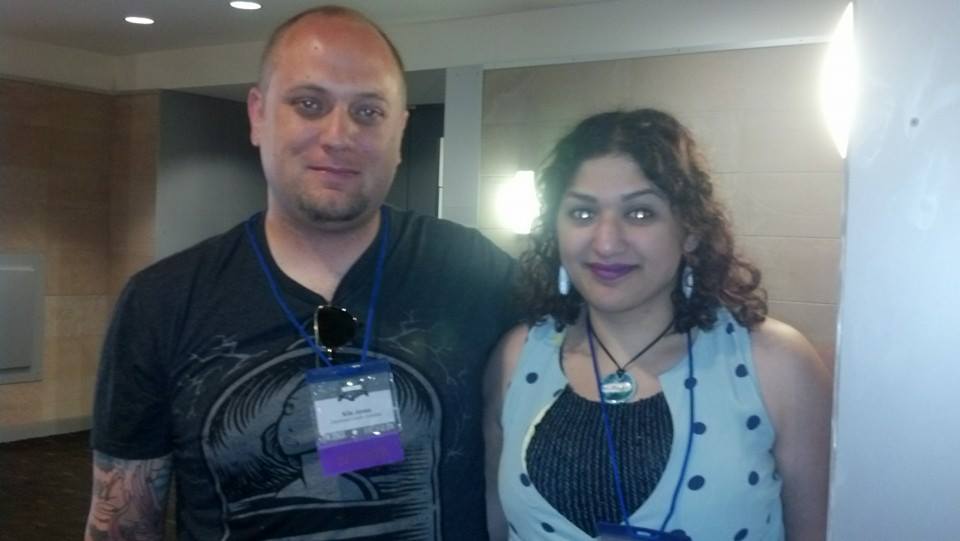
Me and Heina at SSA
Me and Heina at SSA

Another awesome secular woman I met, was Sarah Morehead.

Sarah. Photo from Apostacon.

Sarah is a former evangelical Southern Baptist, Executive Director of the “Recovering From Religion” project, and another overall bad-ass.  She spoke on how to start up a Recovering From Religion group on your campus.  Here is a blurb about Recovering From Religion,

“If you are one of the many people who have determined that religion no longer has a place in their life, but are still dealing with the after-effects in some way or another, Recovering From Religion (RR) may be just the right spot for you. Many people come to a point that they no longer accept the supernatural explanations for the world around them, or they realize just how much conflict religious belief creates. It can be difficult to leave religion because family and culture put so much pressure on us to stay and pretend to believe the unbelievable. If this is you, we want to help you find your way out. Don’t let people convince you that you just didn’t have ‘enough’ faith, or that you just haven’t found the “right” religion.”

Sarah and I chatted (and often laughed) about our old experiences as conservative Christians.  We discussed some of the funny language (Christian-eze) we used to use, the various levels of guilt and shame that were cast upon us, and how science helps explain some of the interesting displays of piety often seen at Pentecostal services.  Sarah’s jovial and welcoming demeanor was calming, and as an Executive Director for a project aimed at helping people “recover” from religion, I cannot think of a better person for the job.

Lyz.  Photo by SSA.
Lyz. Photo by SSA.

The last woman I have in mind is Lyz Liddell.

Lyz is the Director of Campus Organizing for the Secular Student Alliance.  I have an interview I did with her a while back, on this very blog!  Besides running around with her headset on, standing on chairs for announcements, and generally keeping the world of SSA from not crumbling into oblivion, Lyz is a great motivation and example.  If you are ever interested in starting a SSA group on your campus, talk to her.

To all those who attended this years SSA West, or who are involved with helping secular students: Unite!

Kile Jones holds a Bachelors of Theology (B.Th.) from Faith Seminary, a Masters of Theological Studies (M.T.S.) and a Masters of Sacred Theology (S.T.M.) from Boston University, and is a current Ph.D. in Religion student at Claremont Lincoln University.  He also holds a Certificate in Science and Religion from the Boston Theological Institute.  Mr. Jones has been published in Zygon: Journal of Religion and Science, Philosophy Now, Free Inquiry, World Futures, Human Affairs, and the Secular Web.  He is the Founder/Editor-in-Chief of Claremont Journal of Religion (www.claremontjournal.com), and is the Founder/Director of Interview an Atheist at Church Day (interviewatheists.wordpress.com).

#YesAllWomen, the Darwin Debate, and the God Complex by John Erickson

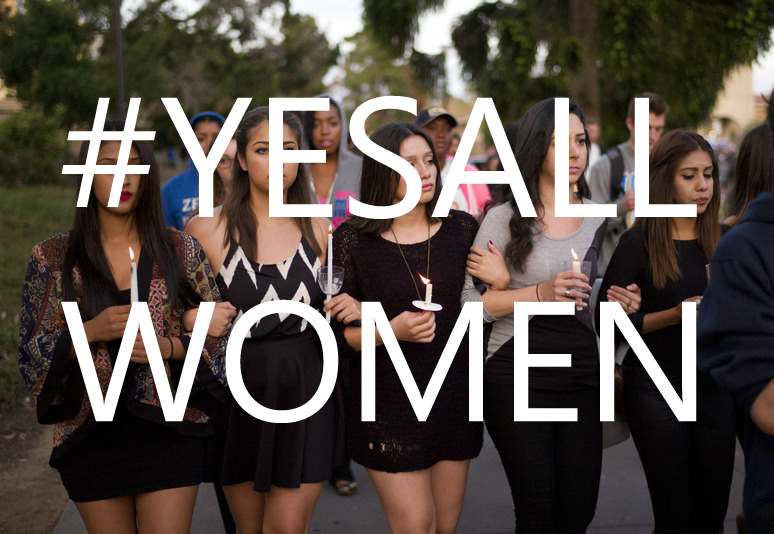
#YesAllWomen proved that although not all men commit horrible crimes against women, the men that often get the headlines and create the most controversy are the ones that need to be watched out for.

John EricksonThe one thing I typically will choose to do on the rare occasion that I’m able to sit down and relax is to watch a documentary.  While some people may go to the gym, read a book, or hang with friends, I typically choose to stay in, nestle up on my couch, and learn.  While on my last bout of relaxation, I chose to watch the HBO documentary Questioning Darwin. Although it offers very little new insight into the evolution vs. creationism debate, it does offer an interesting new way to look at the recent social media hashtag war feminists, allies, and supporters found themselves in over the #YesAllWomen movement that took the world by storm.

yesallwomen

Now, before I discuss #YesAllWomen, I have to admit that I did not enter into the safe space women created for themselves to tell tales of the horrible things they have and have had to face on a daily basis.  I firmly believe that men should not have entered into the digital space Continue reading “#YesAllWomen, the Darwin Debate, and the God Complex by John Erickson”

Theological Reflection: Outward, Not Inward by Kelly Brown Douglas

Rev.-Dr.-Kelly-Brown-Douglas - Version 2I was asked recently what frustrates me most about theology. I am a theologian, and love doing theology. Nevertheless, I do have my moments of frustration with the theological enterprise. I am most frustrated when theology loses its dynamic edge and focus. Too much of theological reflection has become “navel gazing” falling prey to the infamous accusation of Medieval theology, that is, wondering “how many angels can dance at the end of a pin.” It seems to me, that we must not lose sight of the fact that the foundation of theological reflection is the revelation of god, which is nothing less than god’s movement that is god’s dance, in human history. All that we know about the transcendent reality is made known to us by that reality making itself known by entering into our world. The best of theological reflection, then, is a response to that revelation, wrestling with the meanings and challenges of god’s revelation to us. Again, far too often our theology is consumed by intellectual strivings as opposed to struggling with god. We, as theologians and religious thinkers, find ourselves debating the essence of god—who god is in god-self, what we call the godhead—as opposed to who god is in relationship to us and our world. Too often we focus our attention on the appropriate pronouns and nouns that we should use to define god as opposed to the verbs that describe the very movement of god in our world. And so, despite the fact that we do not know god in “god-self” or in the god head, theological reflection is spent debating it, and has a long history of debating it. In the meantime, the world stays just as it is—which is anything but a reflection of the gods/goddesses we claim to follow. Even as we can assume that who god reveals god-self to be is a reflection of the very essence of god, theological reflection is best served not by this upward, inward turn to god, but by following god outward into our world. As god moves toward us and into our world, so too are we to move toward one another and into the world, for this is where we will find god. Theological reflection must not be about who god is in god-self, but rather about who god is for us and who we are to be for god. Theology, as it is essentially grounded in the notion that god acts first, is at best an attempt to discern how god is acting so that we can act back in a responsive and responsible way. So what does this mean? Continue reading “Theological Reflection: Outward, Not Inward by Kelly Brown Douglas”