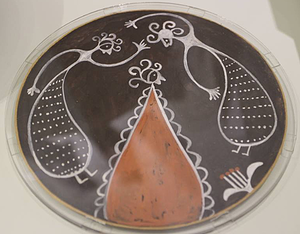
Painting Tiamat/Tehom by Angela Yarber

angelaToday I am honored to give a lecture on “Queering Iconography: Holy Women Icons from Sappho to Pauli Murray” at the North Star LGBT Center in Winston-Salem, NC. So, I want to continue the theme of featuring some of my queer Holy Women Icons. Joining Virginia Woolf , the Shulamite, Mary Daly, Baby Suggs, Pachamama and Gaia, Frida Kahlo, Salome, Guadalupe and Mary, Fatima, Sojourner Truth, Saraswati, Jarena Lee, Isadora Duncan, Miriam, Lilith, Georgia O’Keeffe, Guanyin, Dorothy Day, Sappho, Jephthah’s daughter, Anna Julia Cooper, the Holy Woman Icon archetype, Maya Angelou, Martha Graham, Pauli Murray, La Negrita, and all my other Holy Women Icons with a folk feminist twist is the often overlooked and misunderstood primordial goddess of creation: tehom.

In Genesis 1 we read, “In beginning, God created the heavens and the earth, the earth was a formless void and darkness covered the face of the deep, while a wind from God swept over the face of the waters.” It is the creation narrative held dear, formative, and meaningful for countless Jews and Christians. Interestingly, this word, deep, in Hebrew is tehom. Tehom translates as “deep or depths,” but it’s also a cognate for Tiamat, a Babylonian Goddess of creation. Out of the face of the deep, the world begins. Out of tehom, God creates. Out of Tiamat, the earth comes into being. This dancing Babylonian goddess syncretistically intermingles with the creation myth so pivotal to the faith of Christians and Jews in a way that could be terrifying, or beautiful, or—like the chaotic body of Tiamat that brings the world into being—both. Continue reading “Painting Tiamat/Tehom by Angela Yarber”

Medb, Celtic Sovereignty Goddess of War and Fertility

judith Shaw photoMedb, Celtic Sovereignty Goddess of Connacht, the wilderness in the Irish west, ruled war, fertility and the earth. A man became king of Connacht only by participating in a ritual of intoxication and entering into sacred marriage with Medb at Connacht’s mystical center, Tara. She had an insatiable sexual appetite, taking men as she pleased and marrying at least four, who became King of Connacht in their turn. Her first husband was probably King Conchobar of Ulster, with whom she had seven sons and later became her mortal enemy. With Aillil she had three daughters.

Continue reading “Medb, Celtic Sovereignty Goddess of War and Fertility”

Kali Ma, The Dark Creator and Destroyer by Nancy Vedder-Shults

nancymug_3In contrast to our dualistic thinking here in the West — thinking that separates light from dark, life from death, and chaos from order –there are a number of Eastern philosophies and religions that have retained a more holistic approach to reality. One religion that has done a good job of preserving the awesomeness of its deities by representing them through the full spectrum of life, death and rebirth is the Hindu culture in India. Remarkably, most of the major Hindu gods and goddesses represent divinity as forms of “coincidence of opposites.” In other words, the great deities like Shiva, Vishnu and Devi (the Goddess), simultaneously encompass life and death, good and evil, darkness and light, creation and destruction. For Westerners who live in a society which easily polarizes such distinctions, looking at the living mythology of one of these divine figures might offer us some ideas of how we can create a more unified mythology for ourselves.

It is no surprise to me that in India people acknowledge death as an inevitable part of life, just as they see darkness as half the daily round. When I visited India 35 years ago, I found it to be an overwhelming experience. The streets were filled to overflowing with people, oxcarts, cars with horns blaring, trucks inching along between the pedestrians, camel carts, bicycles and more people, food stalls, markets with vegetables and spices I had never seen before and people on top of people. As a Westerner I found all this lively interaction disconcerting, especially since it was very difficult to find a time and place to be alone. Life — even human life — was abundant to the point of excess. Continue reading “Kali Ma, The Dark Creator and Destroyer by Nancy Vedder-Shults”

Facing Depression by Carol P. Christ

carol mitzi sarahThe suicide death of Robin Williams prompted me to reflect again on my own experience with depression and to share my story in the hope that it can help others.

In my twenties, thirties, and forties, I suffered severe intermittent depressions. My life in those days was a series of ups and downs. When I feel in love and was having good sex, I was in love with the world and could literally feel energy radiating from my body connecting it to the world. When I was dumped, the energy retreated, and I crawled into a dark hole of despair and self-pity from which there seemed to be no escape. In the in-between times, I carried on my life with neither the highs or the lows.

In recent days, a number of people have tried to describe what depression feels like. Here is what it felt like to me.

It was as if my mind had a single track on which were repeated a few deadly words: “No one loves me. No one will ever love me. I might as well die.” I could not erase the track or jump to another one. The words repeated themselves relentlessly in my mind.

Although I usually managed to get up and go to work during those times, these words were ever present: they would take over when my mind wandered on the bus or the subway and whenever I was alone. I could go through the motions of life, but I could not connect to the wellsprings of my creativity.

In the low times, I thought often about suicide. Indeed the words “I might as well die” encouraged them. Thoughts of my mother usually stopped me.

One time I decided to slit my wrists (slightly) to see if committing suicide would hurt. When I found that it didn’t, I immediately called two friends and asked them to take me to their home for the weekend.

When I was depressed, well-meaning friends told me that “this too will pass” and assured me that “you will find someone else.” I didn’t believe them. When I was in the place of depression those words did not help at all.

In therapy I learned that depression often masks enormous anger. Sometimes I screamed out my rage at my latest boyfriend in the confines of my apartment. But when the depression had taken hold, this did not help either.

I also tried all kinds of spells and divination to see “if our love was meant to be,” “to bring him back,” and “to find my true love.” None of this worked. (Readers of this blog who have wondered why I put little faith in divination and spells have their answer: not from lack of trying!)

Just as I was coming out of my last serious bout with depression, a friend who had suffered in similar ways told me that she had resorted to anti-depressant pills. She explained to me that the pills seemed to move her mind away from her depressing thoughts. When she felt stronger, she weaned herself off of them gradually. She said that she would go back to the pills if the depression came back. I was elated to learn that there was something that could work, and I filed this information in the back of my mind.

I don’t suffer from depression any more. Yes, life has its ups and downs, and I sometimes feel lonely or under-appreciated. I never did find “the right” man. But my disappointments no longer spiral down into depression and not wanting to live.

What happened?

It was like a miracle.

When my mother died, I felt the room fill with love. From that day to this I have never doubted that there is enough love to go around and that I am loved.

Thinking about the change that “happened” in my life, I can now say that I was suffering from an “error in thought.” I had equated “being loved” with finding my “true love.” In the process I was discounting all the many other forms of love in my life—including the love of my mother and grandmothers that had sustained my childhood years, and the love of friends, family, animals, plants, and the universe itself that continued to sustain it.

Soon after that, I realized that I had compounded my suffering with a major “error in theology.” When I bemoaned my inability to find “true love,” I was blaming the universe. I was blaming the divine power.

When, years earlier, I expressed my anger at God for not “saving” women from patriarchy, I heard the words: “In God is a woman like yourself. She shares your suffering.” These words inspired my journey to the Goddess.

cave woman climbingBut I needed to take another step.

I was still angry at the universe for not giving me what I wanted and thought I needed in my life. I was angry at Goddess because I thought She could make my life better and She was not doing it!

When I finally expressed my enormous anger to Her, I learned that I had been making the “theological error” of attributing omnipotence to Goddess. However She sympathized with my suffering, She did not have the power to “send my true love to me” when I poured out my heart to Her.

“The path you are on is not easy,” She said to me, “but I will be with you all the way.” Reflecting on those words, I understood that Her power is not omnipotence, but omnipresence, not power over, but power with.

So what advice would I give to those are in the throes of depression. (I am speaking here to those who suffer as I did from “garden variety” depression, not its more serious forms.)

• I would tell them that I understand how they are feeling. I would tell them that I understand how bad it really can feel. Not: “oh come on, it’s not that bad.”

• I would recommend getting in touch with the anger and sadness that underlies depression with the help of therapy, spirituality, family, and friends. A depressed person often feels that whatever underlies depression is too horrible to be faced. Yet there is nothing that cannot be faced “with help” from someone who can listen. However, this might have to wait until the depression has lifted.

• I would encourage exercise, singing, and dancing. Sometimes moving the body can also move the mind off the fixed track that leads to depression.

• I would suggest anti-depressant drugs not for the long-term, but for their short-term power to move the mind off a fixed track.

• After the depression has lifted, I would ask if “errors in thought” led to the conclusion that life is not worth living. I would urge them to open new tracks in their minds that lead to different conclusions—while they are healthy enough and strong enough to do so. Repeating a mantra like, “my true love is me,” “life is worth living,” or “life is a gift” just might help.

• I would also ask them to examine their “theology”–even if they think they don’t have one. Feelings that “God” could make things right, but in “this particular case” chooses not to, are one of the pathways to depression.

• I would urge them to be open to miracles.

Carol is looking forward to the fall Goddess Pilgrimage to Crete–$150 discount for the next two women to sign up for the fall 2014 tour–www.goddessariadne.org.  Carol can be heard in a recent interviews on Voices of the Sacred Feminine, Goddess Alive Radio, and Voices of Women.  Carol is a founding voice in feminism and religion and Goddess spirituality. Her books include She Who Changes and Rebirth of the Goddess and with Judith Plaskow, the widely-used anthologies Womanspirit Rising and Weaving the Visions.  Follow Carol on GoddessCrete on Twitter.


Thealogy of the Ordinary by Molly

crop027

The Goddess Gaia is alive
In this time and in this space
She speaks in sunrises
And waves against the shore
She sings with the wind
She dances in moonlight
She holds you close
Your heart beats in time with hers
A great, grand hope and possibility
For this planet…

Over the last two months, I have been listening to a wonderful telesummit about priestesses. I am also a huge fan of the radio show, Voices of the Sacred Feminine. However, as I listen to both, I sometimes find myself wondering if walking a Goddess path is also viewed as synonymous with, “believe everything, question nothing.” Crystal essences, gemstone healing, soul contracts, past lives, spirit guides, astrology, the many realms and dimensions of the occult, mystical, New Age and metaphysical. Is wholesale suspension of logic required to join hands with the Goddess? Is deft management of the tarot essential to the priestess path?  Is excavating my “inner masculine” relevant or appropriate? Must I ascribe to “enlightened” tenets like, “you are not your body,” “I am a spiritual being having a spiritual experience” and “we made an agreement to do this work before we showed up in this body at this time and place” in order to move forward? Continue reading “Thealogy of the Ordinary by Molly”

Branwen, Welsh Goddess of Love and Beauty by Judith Shaw

judith Shaw photoBranwen, Goddess of Love and Beauty, daughter of Penardim and Llyr, sister of Bran the Blessed, King over all the Island of the Mighty, was loved by her people for her gentleness, compassion and beauty. As Mother of the king to come in the tradition of the Old Tribes of the British Isles, she is the embodiment of Sovereignty. She is the Center from which all life emerges. She rules over the Land, both its spirit and its manifestation. Her vision is long, seeing the whole, the greater scheme of things. Sometimes this knowledge can be too much to bear.

Branwen (“white raven”), is most likely an ancient Goddess whose sacred spot is Cadair Bronwen (Branwen’s Seat), a mountain peak in the Berwyn range of Wales. Cadair Bronwen is topped with a cairn that resembles a nipple from afar.

Continue reading “Branwen, Welsh Goddess of Love and Beauty by Judith Shaw”

How the Dark Fairy Carabosse Found the Light by Barbara Ardinger

Barbara ArdingerThe dark fairy Carabosse was in a snit. “Here I am,” she fumed, “the smartest, most literate, least mischievous fairy in any world, and no one will listen to me. I’m the best of all possible fairies in the best of all possible worlds. And do I receive my due respect? Why am I not Goddess of the Sun?”

“Hush, dear,” said Carabosse’s amanuensis. “There’s already a sun god. There can’t ever be a sun goddess. The sun shoots out masculine energy—that’s what the mortals say. The moon absorbs and reflects the masculine energy. The moon is the feminine planet.”

“Well, I’m tired of reflecting men’s power. I’m also tired of being ruled by the phases of the moon. I demand to be a sun goddess so I can rule the moon! Grimmella, what’s the moon phase today?”

Grimmella looked at her handy pocket calculator. “It’s eleven percent waning, Almost dark. Which might explain your mood.” As Carabosse sniffed and glared at her, she added, “You can’t be a sun goddess. It’s just not done!”

“Oh, Grimmella,” the dark fairy exclaimed, “don’t be so old-fashioned! Wake up! We’re done with all that reflected light business. I want to be the source of light. Besides, it’s a new century! Even for the mortals. And I’ve done so much for them—for us fairies, too—that I deserve a reward. I deserve to the Goddess of the Sun.” When Grimmella laid her pen down and frowned, the dark fairy went on with her rant. “Do you know who that hubristic Apollo really is?” Continue reading “How the Dark Fairy Carabosse Found the Light by Barbara Ardinger”

Good Theology is Feminist Theology by Carol P. Christ

carol christJudith Plaskow and I are just now completing the draft of the manuscript of the book we have been working on for the past 2 ½ years. It has a new title: Two Views of Goddess and God for Our Time.* I have been thinking of little else for the past few weeks. An editor who is considering our book said that she was hoping we could address our book to an audience larger than the feminist theology community. Thinking about this, a light dawned: if feminist theology is right that traditional theology denies the full humanity of women, then good theology must be feminist theology. Our work is not tangential to the theological mainstream, but is at its center.

We have revised the Introduction and Conclusion to the book with the assumption that our work should appeal not just to other feminists, but to a wide range of intelligent readers and thinkers. The fact that we were asked to participate in a dialogue about the nature of God in Tikkun magazine’s Summer 2014 inspires us to hope that we are right that feminist theology is becoming part of the progressive theological mainstream.

We began our new book because – though we agree about many things – we disagree about God and Goddess. After working together for decades with shared commitments to feminism, justice, the environment, and the flourishing of life, it was a bit of a shock to come face to face with our differences on such a major theological issue as the nature of divinity. We began our discussion with a shared critique of the God of Biblical traditions as a dominating male other. We agreed that this God has justified not only male domination of women, but other forms of domination as well, including myriad forms of injustice and war. We questioned the theological doctrine of divine omnipotence in light of the holocaust, the on-going domination of one half of the human race, and other oppressions including slavery, colonialism, and war.

But as we articulated our own views of divinity in light of this critique, our views diverged: Judith concluded that God is an impersonal power of creativity that is the ground of all being and becoming, including all good and all evil. Carol understands Goddess as the intelligent embodied love that is the ground of all being and becoming, a personal presence who cares about the world and all individuals it, but who does not have the power to intervene with a mighty arm to set things straight.

We both can give reasons for our views, and in the course of our theological discussion in our book, we give many. Our different views of Goddess and God are significant both theologically and personally. Is God or Goddess good? Or does the divine power include both good and evil? Does Goddess or God care about the fate of the world and our individual lives? Or are love, care, and understanding qualities that are not appropriately attributed to divinity? Is there someone listening to us when we worship, pray, or meditate? Or is addressing Goddess or God a metaphoric way of speaking that inspires feeling in individuals and communities but not in a divine individual? Is the notion that Goddess is love likely to inspire us to love the world more deeply and to promote its flourishing? Or does the notion that God includes both good and evil remind us more clearly of our own capacities to do both?

The fact that we could not agree about the nature of Goddess or God despite our many attempts to persuade each other with rational arguments, led us to conclude that the philosophical, theological, and moral reasons we give in justification of our views are only part of the story. All of these reasons are situated in our individual bodies and in communities and histories. We do not believe there is any simple link between experience and theological views. On the other hand, our experiences form the matrix from which we all begin to think theologically. As we develop our theological views, we constantly test them against our experiences, asking if they ring true, if they help us make sense of our personal, communal, and social lives.

In the first chapters of our book Judith and I locate our theologies in the contexts of our lives. We not only articulate our views of Goddess and God, but also situate them in community. Judith is committed the feminist transformation of Judaism, while I am one of the early voices of the feminist Goddess movement. In the concluding chapters we probe and query each other’s views–from experiential, rational, and moral perspectives. We are hoping to model the kind of feminist dialogue we would like to see more of—one that crosses religious boundaries and is not afraid to probe the differences in standpoints and theological views.

We also hope that our book will inspire a lively feminist–and wider–dialogue about the nature of divinity—something that has been oddly missing heretofore in feminist theology. Engaging in a thoroughly open and honest theological debate is not always easy—even among friends. But we can both testify that doing so has not only illuminated important issues in feminist theology, but also has strengthened our friendship.

*Much this essay is adapted from a draft of the book.

Carol P. Christ is looking forward to the fall Goddess Pilgrimage to Crete which she leads through Ariadne Institute.   Space available.  Carol can be heard in a recent interviews on Voices of the Sacred Feminine, Goddess Alive Radio, and Voices of Women.  Carol is a founding voice in feminism and religion and Goddess spirituality. Her books include She Who Changes and Rebirth of the Goddess and with Judith Plaskow, the widely-used anthologies Womanspirit Rising and Weaving the Visions.  Follow Carol on GoddessCrete on Twitter.

Almighty Isis by Elizabeth Cunningham

Elizabeth Cunningham headshot jpegWhen the press began using I.S.I.S. as a perhaps inaccurate and now obsolete acronym for the Islamic State of Iraq and Syria, diverse groups made a connection with the Egyptian goddess who was once worshiped all over the Greco- Roman empire. A pagan organization protested the appropriation of the goddess’s name. Others took it as a sign that the self-declared Islamic State represented the anti-Christ or confirmed a conspiracy by the Illuminati. (Divinity of any kind seems to attract human projection.)

When I was doing research for my novel, The Passion of Mary Magdalen, Isis found a special place in my heart. A lover and mother goddess, later associated with both Mary Magdalen and the Virgin Mary, Isis appealed to people from all classes and cultures, especially to women, respectable Roman matrons and prostitutes alike. Continue reading “Almighty Isis by Elizabeth Cunningham”

Dog Days, Holly, Spears and Swords by Deanne Quarrie

Deanne QuarrieWe are little more than midway in what are called the “dog days” of summer. Imagine that the ancients thought that Sirius (one of the dog constellations) was the cause of the extra hot and sultry days of summer  because that star rose with the sun each day during this time and they actually thought we received heat from it.  But no, there is no heat from Sirius, only the tilt of the earth, giving us more heat during. Continue reading “Dog Days, Holly, Spears and Swords by Deanne Quarrie”