Sequana and Blessed Water by Deanne Quarrie

deanne_2011_B_smWater is the daily necessity for earth’s creatures.

When the Continental Celts were looking for a new homeland, they ventured west from the known river valleys of the great landmass we call Eurasia. Just beyond the great mountains, the Alps, they discovered sweet and abundant water, fertile soil, expansive woodlands, and the plentiful fish, game, berries, grasses, fungi and broad-leafed plants necessary to support their tribe.

We know that Celtic spirituality was, in its roots, animistic (spirit was alive in every living thing), non-anthropomorphic (the source of life and death was water, land, plant and animal-life), tribe-specific (in France alone there is evidence of several hundred deities) and a spirituality of place, of the major landforms that defined the world (rivers, springs, forests, animals, heavenly bodies). To the extent that Celtic spirituality was theistic, the creator/sustainer/destroyer of life was typically a goddess. Continue reading “Sequana and Blessed Water by Deanne Quarrie”

What is a Crone? By Deanne Quarrie

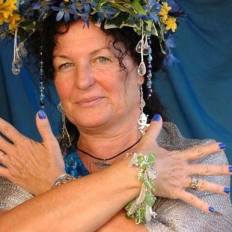
Deanne QuarrieFirst of all a Crone is a woman. She has lived most of her life already and has accumulated many life experiences and therefore, can relate to those younger than her with greater understanding. She has acquired the wisdom associated with having had those life experiences. She has reached a place in her life when she may be slowing down. She may have retired from her career. She may want to devote more time to herself, serving more as an advisor rather than as the doer. We can read the poem, Warning by Jenny Joseph to get an idea, or watch her read it here or below…

“When I am an old woman I shall wear purple
With a red hat which doesn’t go, and doesn’t suit me.
And I shall spend my pension on brandy and summer gloves
And satin sandals, and say we’ve no money for butter.
I shall sit down on the pavement when I’m tired
And gobble up samples in shops and press alarm bells
And run my stick along the public railings
And make up for the sobriety of my youth.
I shall go out in my slippers in the rain
And pick flowers in other people’s gardens
And learn to spit.

You can wear terrible shirts and grow more fat
And eat three pounds of sausages at a go
Or only bread and pickle for a week
And hoard pens and pencils and beermats and things in boxes.

But now we must have clothes that keep us dry
And pay our rent and not swear in the street
And set a good example for the children.
We must have friends to dinner and read the papers.

But maybe I ought to practice a little now?
So people who know me are not too shocked and surprised
When suddenly I am old, and start to wear purple.”

Continue reading “What is a Crone? By Deanne Quarrie”

An Archaic Trinity of Goddesses? Not Necessarily. by Barbara Ardinger

Barbara ArdingerIn her comment following my last post which was about mythology, my friend, Carol Christ, expands on my paragraph about how the so-called “ancient triple goddess” was really invented in 1948 by Robert Graves in his book, The White Goddess. (Thanks, Carol.)

Back in the 1970s and 1980s, when the Goddess movement was just getting up on its feet and our ovular books were being published, the idea arose that if “they” have a holy trinity, “we” have one, too. And ours is older and holier. We see it in the three phases of the moon, new (Virgin), full (Mother), and dark (Crone). Here’s a tiny sample of these books that changed the lives of so many women and men:

  • Woman’s Mysteries Ancient and Modern by M. Esther Harding (1971, but first published in 1933)
  • The Goddesses and Gods of Old Europe (1974) by Marija Gimbutas
  • When God Was a Woman (1976) by Merlin Stone
  • Lost Goddesses of Early Greece: A Collection of Pre-Hellenic Myths (1978) by Charlene Spretnak
  • The first edition of The Spiral Dance (1979) by Starhawk
  • The Chalice and the Blade (1987) by Riane Eisler
  • Laughter of Aphrodite (1987) by Carol P. Christ
  • The Holy Book of Women’s Mysteries (1989) by Z. Budapest
  • The Reflowering of the Goddess (1990) by Gloria Feman Orenstein
  • Whence the Goddesses: A Source Book (1990) by Miriam Robbins Dexter

Triple goddess? ’Tain’t so. Our beloved triple goddess is one of our foundational myths. It’s nice and it’s perhaps inspiring, but it’s only a myth. Anyone who looks at a calendar or almanac—or up into the sky every night for a month—can easily see that the moon doesn’t have three phases. It has four: waxing, full, waning, and dark. And since the late 20th century, women have lived long enough to go through more than three stages of life. Continue reading “An Archaic Trinity of Goddesses? Not Necessarily. by Barbara Ardinger”

Max Dashu: Feminist Scholar, Author, Historian, Artist by Jassy Watson

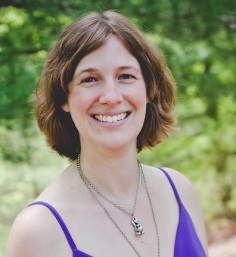
JassyI had the honour of hosting Max Dashu, Feminist Scholar, Historian and Artist here at Goddesses Studio this weekend past. Max is currently on her second Australian tour and we were blessed for her to come on quite the journey to present to an intimate group of Wide bay Goddesses, “Rebel Woman Shamans: Women Confront Empire” and “Deasophy: Goddess Wisdom” with a little “Female Iconography” thrown in.

Max’s knowledge and gift of story-telling is inspirational. “Rebel Woman Shamans: Woman Confront Empire” looked at holy women and female prophets who led many rebellions to resist conquest, slavery, and colonization. These women visionaries, priestesses, diviners and medicine women challenged systems of domination on multiple levels and drew on their cultural traditions to resist empire. It was their direct access to transformative power that these women had, that makes the spiritual political, as they act to lead, defend, and protect their peoples. Continue reading “Max Dashu: Feminist Scholar, Author, Historian, Artist by Jassy Watson”

She Alone Was There In The Beginning: Nature Creatrix by Stuart Dean

Stuart WordPress photoI concluded my last post by suggesting that “Creator” in the Declaration of Independence (DI) should have been ‘Creatrix.’  Though ‘Creator’ imbues the DI with a bit of quasi-scriptural authority, the possessive pronoun “their” before it effectively limits the full benefits of creation to men.  That alone should have precluded even the suggestion that the DI effectively endorses Christianity or that it constitutes the basis for a civil religion.

Quite obviously that has not been the case, but that should not be taken to validate the misogyny the DI manifests.  ‘Creator,’ the masculine form of the Latin noun derived from the verb ‘to create’ (‘Creatrix’ is the feminine), is unambiguously masculine in a way that ‘God’ simply is not.  Its appearance in the DI raises the suspicion that it was selected to underscore the masculinity of “Nature’s God,” the phase used in the DI’s opening paragraph.  Surely some of the signatories of the DI knew their Latin authors well enough to know how peculiar it is to speak of Nature as having or needing a God.  Perhaps they wanted to clarify things. Continue reading “She Alone Was There In The Beginning: Nature Creatrix by Stuart Dean”

Thealogy of the Ordinary by Molly

crop027

The Goddess Gaia is alive
In this time and in this space
She speaks in sunrises
And waves against the shore
She sings with the wind
She dances in moonlight
She holds you close
Your heart beats in time with hers
A great, grand hope and possibility
For this planet…

Over the last two months, I have been listening to a wonderful telesummit about priestesses. I am also a huge fan of the radio show, Voices of the Sacred Feminine. However, as I listen to both, I sometimes find myself wondering if walking a Goddess path is also viewed as synonymous with, “believe everything, question nothing.” Crystal essences, gemstone healing, soul contracts, past lives, spirit guides, astrology, the many realms and dimensions of the occult, mystical, New Age and metaphysical. Is wholesale suspension of logic required to join hands with the Goddess? Is deft management of the tarot essential to the priestess path?  Is excavating my “inner masculine” relevant or appropriate? Must I ascribe to “enlightened” tenets like, “you are not your body,” “I am a spiritual being having a spiritual experience” and “we made an agreement to do this work before we showed up in this body at this time and place” in order to move forward? Continue reading “Thealogy of the Ordinary by Molly”

Transcendence, Immanence, and the Sixth Great Extinction by Carol P. Christ

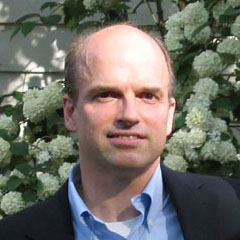
carol christIn my recent blog “The Flourishing of Life and Feminist Theology” I discussed Grace Jantzen’s view that theology should focus on “natality” or birth and life, rather than life after death or life apart from this world. This week Tikkun magazine published its summer issue with a feature called “Thinking Anew about God.” In it two male thinkers, one Buddhist and one Christian, argue for a similar turn toward the world in their traditions. Their calls for religions to focus on this world were published the same week scientists warned that the world stands on the brink of the sixth great extinction.

I have come to believe that any religion espousing cosmological dualism (devaluing this world in favor of a superior reality such as heaven) and individual salvation (the idea that what ultimately happens to me is disconnected from what ultimately happens to you) is contributing to our world’s problems rather than offering a solution. … [Religions should] stop emphasizing the hereafter and focus instead on how to overcome the illusion that we are separate from this precious, endangered earth. –David Loy, Buddhist, writing in Tikkun Summer 2014

My aim in this regard is to reawaken in each of us an emotionally felt and primordial sense of spiritual belonging within the wider natural world. In turn, my hope is that this deep sense of belonging to the earth — to God’s body, as it were — will en-flame our hearts and empower our wills to commit us to healing and saving the earth.—Mark I. Wallace, Christian, writing in Tikkun Summer 2014 Continue reading “Transcendence, Immanence, and the Sixth Great Extinction by Carol P. Christ”

“THE OLD RELIGION” OR A “NEW CREATIVE SYNTHESIS”? by Carol P. Christ

carol christIs Goddess feminism an old religion or a new creative synthesis? Can it be both?  Goddess feminism draws on the feminist affirmation of women’s experiences, women’s bodies, and women’s connection to nature; the feminist critique of transcendent male monotheism as the symbolic expression of male domination of women and nature; and 19th and early 20th century discussions of Goddesses and matriarchy.

Most Goddess and other spiritual feminists have experienced Wiccan rituals, which are often simply called Goddess rituals.  For many of us, elements of Wiccan practice strike a chord of knowing, while other aspects seem odd or strange or even just plain weird.  What are the roots of Wiccan ritual?

In their syntheses of women’s experiences, ancient Goddess religions, and feminism, Z Budapest and Starhawk drew upon the earlier creative synthesis of the Englishman Gerald Gardner which he variously called “the Old Religion,” “Witchcraft,” and “Wicca.” Continue reading ““THE OLD RELIGION” OR A “NEW CREATIVE SYNTHESIS”? by Carol P. Christ”

TWO MEANINGS OF ANTHROPOMORPHISM by Carol P. Christ

carol christ“The error of anthropomorphism” is defined as the fallacy of attributing human or human-like qualities to divinity. Recent conversations with friends have provoked me to ask in what sense anthropomorphism is an error.

The Greek philosophers may have been the first to name anthropomorphism as a philosophical error in thinking about God. Embarrassed by stories of the exploits of Zeus and other Gods and Goddesses, they drew a distinction between myth, which they considered to be fanciful and false, and the true understanding of divinity provided by rational contemplation or philosophical thought. For Plato “God” was the self-sufficient transcendent One who had no body and was not constituted by relationship to anything. For Aristotle, God was the unmoved mover.

Jewish and Christian theologians adopted the distinction between mythical and philosophical thinking in order to explain or explain away the contradictions they perceived between the portrayal of God in the Bible and their own philosophical understandings of divine power. While some philosophers would have preferred to abolish myth, Jewish and Christian thinkers could not do away with the Bible nor did they wish to prohibit its use in liturgy. Continue reading “TWO MEANINGS OF ANTHROPOMORPHISM by Carol P. Christ”

Heart of the Matter by Oxana Poberejnaia

oxanaMy friend whom I teach frame drumming teaches us shamanic journeying. There was an episode in one of my journeys, when, unable to see the way forward, I put the palm of my hand on the ground and went down a hole I was creating to the core of the earth. Since then, this scene came into my mind several times when I was talking to friends about inner truth. Also, the posture itself bears uncanny resemblance to the iconic Buddha posture of touching earth with his right hand.

Touch the Earth Mudra

According to a Buddhist legend, on the night of Enlightenment Prince Siddhartha encountered Mara, the Lord of Death, who threw various hindrances the Buddha’s way to prevent him from attaining Supreme Enlightenment.  The final challenge was Mara’s claim that the Buddha had no right to be in the seat of Enlightenment. The Buddha then touched the earth with his right hand to call Her as a witness of his past spiritual achievements and his right to gain Enlightenment.

Continue reading “Heart of the Matter by Oxana Poberejnaia”