(Femen)ism? by Kile Jones

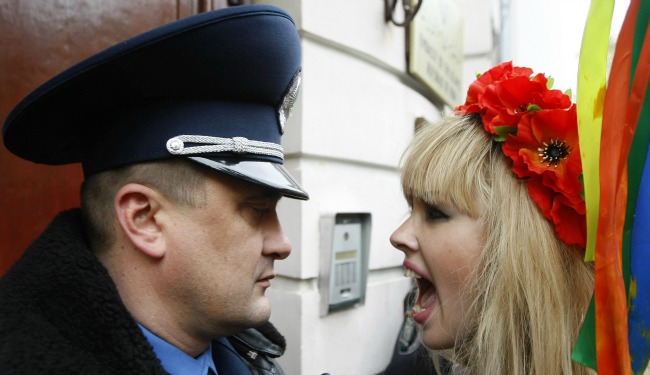
Kile Jones, atheistAs most of us are aware by now, there is a “feminist-sextremist” group from Ukraine called “Femen.”  This group has been very controversial by their public demonstrations of nudity, the words they paint on their bodies, and their explicit condemnations of political structures and organized religions.  They were started by Anna Hutsol in 2008 and have now spread throughout Europe and the Middle East.  The question I pose for this post is: Does Femen harness or hinder the power of the feminist critique?

Image from Konstantin Chernichkin/Reuters

Femen is precisely the kind of movement that pushes us in our understanding of feminism, the means by which it is best expressed, and the issues surrounding moral condemnation and religious sensitivity. Continue reading “(Femen)ism? by Kile Jones”

Protecting our Families: How the U.S. Falls Short in Protecting New Mothers (and Fathers) by Michele Stopera Freyhauf

Freyhauf, Feminism, Religion, Durham, Old Testament, Blogger, Bible, Gender, Violence, Ursuline, John CarrollLast weekend, I had the privilege of speaking at the National Convention for American Mothers, Inc. about motherhood in the 21st Century.  Because this is such a vital issue for mothers that live in the U.S. (since a large majority of families have two full-time wage earners), I thought it would be appropriate to share my speech here.  With the understanding that this a forum for feminism, I believe that this topic fits this forum because it continues to show how unequal the treatment is between the sexes – whether it is pay, position in employment, healthcare, education, or simply balancing the responsibilities of family/career.  For those that live in the United States, there is often a sense of exceptionalism, and as I clearly demonstrate in this speech, we are certainly a far cry from being role models that when it comes to protecting mothers (whether by birth or adoption) and families.

As a side note:  One topic that was not explored, due to lack of data, is how maternity/paternity leave impacts same sex couples who become new parents – I have to believe that this is a topic to also examine (and I am would encourage any feedback here).  

Recently the United States ranked 25 out of 165 countries for being the best place to live if you are a mother.  This number is up from 31 a year ago and places us between Belarus and the Czech Republic.

You may be asking yourself, Why isn’t the United States in the top five or even in the top ten? The answer to that question becomes evident once we examine how that determination is made. The categories examined are:

  • Mother’s education;
  • Child’s Health;
  • Economic status;
  • The Election of women to government office;
  • Breast feeding programs.  In the United States 75% of mothers breastfeed their babies, 35% continue to breastfeed after six weeks. The number shrinks because mothers usually return to work and find it difficult to to pump at the office;
  • Maternal death rate is another factor, which stunned me when I found out that the US has the highest maternal death rate of any industrialized nation. Approximately 1 in 2,100 women are at risk of dying during child birth;
  • Infant death rates is another category.  Infant deaths are estimated to be 8 per 1000 births – a number that throws us behind 40 other countries;

Feminism and Football By Marcia W. Mount Shoop

Marcia headshot“How did race and privilege affect the NCAA investigation of the football program at University of North Carolina?”

This was the question a student posed to me recently when I gave a Skype lecture to a Sports Ethics class at the University of Washington’s Center for Leadership in Athletics

I am going to take a wild guess (and I may be wrong), and assume that most readers of the FAR blog don’t know much about the NCAA investigation of the UNC football program.   I have outed myself on this blog before—I am more than just a feminist theologian; I am also a football coach’s wife.  Lots of people wonder how I manage to pull that off and still look at myself in the mirror.  That’s a complicated question.  I am finding that the challenges presented by our experience at UNC are creating more and more space for the feminist and the coach’s wife to find a common purpose.  Which brings us back to the question at hand—race and privilege and how it played into the football investigation at UNC.

You may want to investigate the many details of this investigation, but I would like to invite this feminist community to see what you think about this question of privilege in particular.   I will provide just a few factual statements for you all.  You tell me if you can think of ways that race and privilege may have been at work to the detriment of certain groups in this situation.  Continue reading “Feminism and Football By Marcia W. Mount Shoop”

Grief Beyond Belief and Rebecca Hensler by Kile Jones

Kile Jones, atheistIn my last post, “A Pro-Science, Skeptical Woman Speaks” I interviewed a woman with whom I share many views in common.  One of my goals here at Feminism and Religion is to introduce different secular, atheistic, liberal feminists who share many of the same ethical views as regular contributors and readers, but not the same “religious” or “spiritual” ideas.  In this post I examine an online support network for unbelievers, Grief Beyond Belief, and ask a few questions to its founder, Rebecca Hensler.

I met Rebecca in February in San Francisco while on a visit I made to meet with the Unitarian Universalist Association in regards to my ordination.  My girlfriend and I met Rebecca in North Beach, San Francisco for dinner and drinks.  I experienced her as a compassionate, friendly, and genuine person.  Her experiences and insights inspired me to think more about the role of grief and pain among unbelievers.  I mean, atheists cry, agnostics experience loss, skeptics lose family members, and we do it all without a “God” or “spirit” to help us.  And if we were to meet C.S. Lewis, we would make

sure to exclaim, “No…pain is not some megaphone for God to rouse a deaf world.”

R Hensler

Why did you start Grief Beyond Belief?

The original idea was born of my own grief.  After my son died, I found a group in which to share comfort and compassion with other grieving parents: The Compassionate Friends, a mainstream parental grief support organization with a strong online presence.  It was so close to exactly what I needed, but I frequently felt alienated by the religious and spiritual content — not just the offers of comfort that depended on beliefs I do not hold, but the assumption that everyone there held some sort of belief in life after death. And the assumption, so common in mainstream grief support, that even if I am not the same religion as you are, I have a religion, and I believe in some sort of afterlife was equally alienating and hurtful. Continue reading “Grief Beyond Belief and Rebecca Hensler by Kile Jones”

Marriage as a Commodity (Satisfaction Guaranteed) by Michele Stopera Freyhauf

Freyhauf, Feminism, Religion, Durham, Old Testament, Blogger, Bible, Gender, Violence, Ursuline, John CarrollThis Saturday I will be presenting a paper about Cyberbrides at the United Nations Commission on the Status of Women.  While my focus for that paper is the impact on mothers and families, my research also revealed how some Cyberbrides (or Mail-Order Brides) are selected from internet catalogues with “satisfaction guaranteed” and how “International Marriage Broker” may be a cloak hiding the agencies’ involvement with human trafficking.

Cyberbrides are essentially mail-order brides, but like pen pals, they can chat and exchange pictures on the Internet and interact through video or instant chat.  There are almost 2.9 million website matches that turn up when Google-ing “Mail-Order Brides” within 19 seconds of pressing the “return” button. With the low cost of social media, a new venue to market and display this “commodity” is available.  Presently,  about 30 Facebook sites exist that advertise “Mail-OrderBrides. Continue reading “Marriage as a Commodity (Satisfaction Guaranteed) by Michele Stopera Freyhauf”

Second Class Rape Victims: Rape Hierarchy and Gender Conflict

Deconstructing masculinity isn’t the key to solving social, sexual, and domestic violence across the world but it is a step worth taking when attempting to engage men in affecting change to stop these violent actions since men, statistically are the perpetrators of such crimes that both cause such outcry as well as perpetual silence.

johnThe most disturbing part of the 2006 documentary Deliver Us from Evil isn’t the fact that Father Oliver O’Grady is rewarded by the Catholic Church with a new congregation in Ireland after his short stint in prison for the rape of dozens of children in the 1970s, but rather the hierarchy of gendered victimization which is often created throughout the various rape cases that are both reported and unreported throughout history.

I am often troubled by the ways in which rape cases are discussed and deconstructed via mediums such as blogs, online communities, social media networks, the news, and popular culture.  No series of events troubled me more than the Jerry Sandusky trial, but more importantly, the ways in which the young boys and adult men who were subjected to Sandusky’s abuse quickly overshadowed the other rape cases that are reported on a daily basis, specifically those involving young girls and women. Continue reading “Second Class Rape Victims: Rape Hierarchy and Gender Conflict”

Don’t Worry, I Won’t Marry Your Girlfriend: Sexuality, Identity, and the Easy Laugh

No longer having to deconstruct the larger cultural and sexual narratives, heterosexuals who do not support marriage equality or feel threatened by homosexuals return to their one source of power that reinforces the ideology that they are on the right path: the Bible. “Marriage is between a man a woman,” or “A man shall not lie with another man as he would a woman,” becomes the newly reinforced heterosexual rallying cry and the progressive progress that occurred in the past becomes nothing more than a joke.

johnI must say, I will be the first to admit that the recent outbreak of videos promulgating the idea that gay men will marry a straight guy’s girlfriend or lesbians will marry a straight girl’s boyfriend all for the sake of marriage equality left me stifling my laughter as I attempted to pay attention in class.

However, after the calamity died down I took a moment to reflect upon the intrinsically embedded aspects of misdirected norms of sexuality, gender, and misogyny latent within the laugh lines and the guffaws throughout each video. Continue reading “Don’t Worry, I Won’t Marry Your Girlfriend: Sexuality, Identity, and the Easy Laugh”

The Impact of Excommunication in the 21st Century (Part I) – Spiritual Redemption or Hegemonic Power by Michele Stopera Freyhauf

The Lord loves everyone and died for everyone, and He wants all to be saved…the best lesson that can be learned from everything that has happened is that one finds happiness, joy and satisfaction in obedience to the Church.”Bishop Bruskewitz

One of the most misunderstood concepts in the Catholic Church is excommunication.  Many believe that excommunication is a complete termination or separation from the Catholic Church.  To say this another way, if excommunicated, you are no longer Catholic or part (a member) of the Catholic Church.  None of these statements are true.  By baptism, you are a member of the Catholic Church and no one can take that away.

Much of the misunderstanding stems from the way excommunication was used in the Middle Ages; a means of coercion to control kings and other high ranking officials.  Obedience to the Church meant that you will spend eternal life in heaven.  Disobedience to the Church meant a complete separation from the Church; a ban against  receiving Eucharist, a banishment of your soul to the eternal flames of hell.  Excommunication was the highest form of punishment and the most meaningful (and effective) tools of control.  When a person was excommunicated, there was even a public ceremony –  a bell tolled for the excommunicant, as a bell that would chime for the dead, the Gospels were closed, and a (baptismal) candle would be extinguished.  This ceremony signified eternal darkness and death. Continue reading “The Impact of Excommunication in the 21st Century (Part I) – Spiritual Redemption or Hegemonic Power by Michele Stopera Freyhauf”

Pussy Riot: Guilty of Crimes of Blasphemy or Being Feminists? By Michele Stopera Freyhauf

In a country that was willing to [sic] its secular court on a “religious” cause, Pussy Riot are true revolutionaries. Nonetheless, it was not until they delivered these closing statements that their supporters—and opponents—heard what these three brave women stand for. Although they are being crushed in the jaws of the system—and know it!—their courage and steadfast sincerity are sufficient cause for (impossible) hope. If not for the Russian state, then at least for the Russian people. —Bela Shayevich

“When religion puts people in jail it’s unjust” – David Gross 

The intermix of religion and politics are familiar, especially after this year’s presidential election.  Many supported Mitt Romney out of concern for religious freedom; a stance that had the potential to marry religion and politics in a dysfunctional union.  We also witnessed a veiled attempt by the Catholic Church to emphasize and sway the faithful to vote for the one true moral candidate; a stance contradicted by Obama’s ability to carry the Catholic vote.  I believe what we see in Russia is a shining example that shows what happens when regulations and laws do not segregate between secular law and church law.  Freedoms do not exist, rather, rules and restrictions are imposed creating an institutional prison.

The prosecution of an all girl punk band named Pussy Riot [i]  demonstrates a “complete fusion of the institutions of the state and church,” which devalues “women’s rights and freedom of speech.”Members of Pussy Riot are serving a two year sentence of hard labor for “hooliganism motivated by religious hatred.”  What was their crime?  They went into a Cathedral in Moscow and started singing a punk prayer – “Mother of God, Chase Putin Out!”

(The translated lyrics)

From The Atlantic.com
Frm the Atlantic.com

Virgin birth-giver of God, drive away Putin!

Drive away Putin, drive away Putin!

Black frock, golden epaulettes

Parishioners crawl bowing [toward the priest, during the Eucharist]

Freedom’s ghost [has gone to] heaven

A gay-pride parade [has been] sent to Siberia in shackles

Their chief saint is the head of the KGB

He leads a convoy of protestors to jail

So as not to insult the Holiest One

Woman should bear children and love

Shit, shit, the Lord’s shit!

Shit, shit, the Lord’s shit!

Virgin birth-giver of God, become a feminist!

From AlJazeera.com

Become a feminist, become a feminist!

The Church praises rotten leaders

The march of the cross consists of black limousines

A preacher is on his way to your school

Go to class and give him money!

Patriarch Gundyay believes in Putin

Would be better, the bastard, if he believed in God!

The Virgin’s belt won’t replace political gatherings

The eternal Virgin Mary is with us in our protests!

Virgin birth-Giver of God, drive away Putin!

Drive away Putin, drive away Putin!

Original Video: http://www.youtube.com/watch?v=grEBLskpDWQ&feature=related

Finished Video (music added): http://www.youtube.com/watch?v=NYzlaBPCM6c&feature=related

They danced, kneeled, and crossed themselves in front of the Church’s high altar.   This occurred the day before the re-election of Vladimir Putin.  While I do not support going into a sacred space with relics to make a protest, what I find problematic is their harsh sentence.  However, it should be noted that with the coverage of the trial and the outpouring of support received from many organizations, and musicians, they did manage to bring to the forefront issues surrounding the government and the Church.

Continue reading “Pussy Riot: Guilty of Crimes of Blasphemy or Being Feminists? By Michele Stopera Freyhauf”

Please Excuse Me for Having a Penis: Taking a Back Seat to Privilege and Power by John Erickson

Male feminists must be aware that we not only engage in an ongoing struggle against sexual and gender inequality, but more importantly an ongoing fight with ourselves.

I have often struggled with that little voice, call it my conscience if you will, that speaks to me during times of distress.  Although I consider myself a proud feminist, I still struggle with aspects of what I call, internalized misogyny, or more aptly defined as a male born characteristic trait that imparts the idea that men are not only dominant but also more powerful than the other 50% of the species.

For many reasons, I believe religion is one of the main culprits of this growing evil, one that we all witnessed throughout this last election cycle.  However, instead of placing blame solely on religion and images of the male Godhead we have to begin deconstructing the sociological consequences these subconscious social, sexual, religious, and gendered norms have on men but more importantly men who identify as feminists. Continue reading “Please Excuse Me for Having a Penis: Taking a Back Seat to Privilege and Power by John Erickson”