


Arbor Day, Earth Day, May Day and Mother’s Day are deeply connected conceptually, etymologically, culturally and emotionally.
The tree, with its roots buried deep in the earth and its branches reaching upward toward heaven, spread wide to embrace all of eternity, is a prime symbol of life in many cultures. Trees have long been worshipped as beneficent spirits of bounty. Trees, after all, shade and feed us. Supply and sustain us. Serve us in endless ways. Trees breathe life into our lungs, the source of endless inspiration.
Possessing the potent powers of fertility, growth, resilience and longevity, the tree is widely seen as the progenitor of the world Family Tree. The Tree of Life. The tree goddess was seen as a sylph, an airy tree spirit who resides among the green leaves, sustaining and nurturing the vegetative forces. She is the symbol of the flow of life, a Mother Goddess who is Herself the Tree of Life.
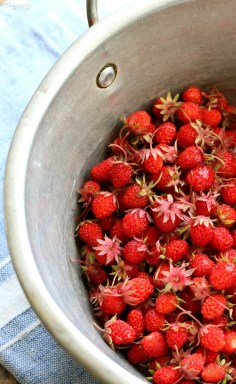 Strawberries shaped my view of a world full of gifts simply scattered at your feet. A gift comes to you through no action of your own, free, having moved toward you without your beckoning. It is not a reward, you cannot earn it, or call it to you, or even deserve it. And yet it appears.

 I don’t know if I could be a deep-sea welder. I don’t know what the risks of lethal electrocution, broken limbs, or the bends would be. I suspect it can be a dangerous occupation, like operating heavy equipment on good old dry land or fishing for crab or even collecting garbage from the neighbors’ driveways. So too is this the case with window washing, paving, disposing of medical waste, brick making, driving a giant tanker truck, and more. There are aspects of the world I know I take for granted, but the moment I stop to consider what those aspects might be, I am humbled and reminded of the privilege it is to philosophize and ponder the functions of religion in the shaping and making of society.
 While I am sure this articulation is on an “inspirational” meme somewhere, my thoughts coalesced to form it while I was looking at the mid-afternoon blue sky in a moment of rare optimism. Too often can I become confused and despondent about the situation of our earth and humanity, myself. “We want healing too,” it whispered. If we are for the sustainable restoration and support of our earth, then we have a whole universe on our side that moves toward this direction as well. Our bodies, one with the universe, join in this want of healing.
 Spring is here in the northern hemisphere and with it the return of light in the yearly round of seasons.
  Much of our lives lack the rich culture of ritual that I think would help us repair the relationships we have with our own bodies and with the earth. The Rg Veda is one of the oldest collection of hymns from India. In them, I find a playful and introspective expression of desires and fears that, at first, did not seem to me to hold much wisdom for a modern contemplative. But lately, I have been noticing how the speakers communicate to or about the earth, and how their lives seem centered around trying to take a part in creation. Mostly, these hymns are stories and supplications for rain, cows, victory in battle, and a long life. But there is a deep understanding of the power and divinity in the universe that is the very earth-based wisdom that our humanity-in- crisis needs. If the Qur’an is God calling for humanity to be grateful, the Rg Veda is a model of a humanity that could be nothing else.
 One of the concerns of ecofeminism is the modern materialistic mindset of capitalism. Materialism in capitalism instills not just owning many possessions, but it also inculcates the “need” to own the newest innovation. In addition, materialism advocates a throw-it-away mentality. In other words, it is often cheaper to buy a new shirt or computer than to have them repaired. Similarly, it is not enough to have a cell phone. Rather, one must have the newest and best one! The environment pays the price.
 Embodiment is a feminist principle which has, as its basis, two fundamental criteria. First, humans require their bodies to live. We must acknowledge that our existence is tied to our bodies. This fact grounds us in this world. Here, and not in some other-worldly place, we live out our lives. We are dependent on our bodies and what the world provides for our survival. In other words, humans are inseparable and interconnected to this world. Humans are not above nature as the Western hierarchical dualist mindset would suggest.
 Feminism and Religion