Considering Our Spaces in the Pursuit of Justice by Elise M. Edwards

This past summer, my friend and I were perusing the exhibits at the National Museum of African-American History and Culture when she urgently called for my attention.  “Psst… Isn’t this where you are from?” she asked, pointing at a placard titled African American Life in Montgomery County.  Yes!  I grew up, I was educated, and I was churched in Montgomery County, Maryland.  So I eagerly read the exhibit’s description:

By 1900 there were at least eight African American communities in Montgomery County, Maryland. Unlike many rural African Americans, the residents were not tenant farmers—they owned their property and homes.  This gave them greater control over the land and the crops they produced.  They also directly benefited from improvements to their homes, which was an incentive to make additions and to stay in place.  Descendants of these early settlers still live in these communities today. Continue reading “Considering Our Spaces in the Pursuit of Justice by Elise M. Edwards”

Another Season of Reflection and Review by Elise M. Edwards

elise-edwardsI turn inward and become reflective at this time of year.  It’s the Advent season in the Christian liturgical year, which encourages practices of piety focused on preparation, examination, and hopeful longing.  It’s the end of a semester and a calendar year, which provokes review of the months before.  In the northern hemisphere, it’s a time of darker days and longer nights, which suggest a retreat indoors, in silence or in stillness.

During this time of year, I’m typically exhausted, and so I seem to enact annual rituals with a recurring sense of ambivalence.   I really love the celebration of Christmas, but preparing for it takes a lot of energy.  So I do some decorating, but not as much as I planned.  I attend some parties and celebrations, but end up missing or cancelling others.  I start a new devotional book, only to set it aside within a week or so.  I want this time of year to be both reflective and celebratory.  I want it to be spiritual and religious.  I want to be sociable with friends and family and also find time to rest and recover in solitude.  At some point, those goals seem too contradictory to be realizable and then I start practical negotiations:  How much decorating will I do? What kind of time will I set aside for solitude and self-care?  Will I have enough energy to be joyful and present with my family and friends?

“Some, but not enough” is the answer I seem to come to every year.

Some decorating, but not enough.  Some time for solitude and self-care, but not enough.  Some energy for social occasions, but not enough.  This year, I want to let go of that voice that says it’s not enough.  That voice that says I am not enough.

To help myself let go of the guilt and self-deprecation, while retaining the reflective focus of the season that may be life-affirming, I reviewed my previous years’ December writings on this blog.  What might I discern from this pattern of yearly reflection?

In 2012, I wrote about why women might be tempted to cancel Christmas.  I was in my final year of the Ph.D. program when I wrote that, and was prompted to do so when I heard that friends and colleagues were planning to skip Christmas preparations or scale them back dramatically.  That year, I sought to maintain “religious and social rituals associated with Christmas” so that I could be “spiritually grounded, emotionally provoked, mentally rested, and physically fed.” I don’t have a vivid memory of that year’s holidays, but as I read it again, I wonder if I was carrying a sense of religious obligation rather than release.  Did I feel free or beholden to social custom? I’ve learned that I will only be able to let that “not enough” voice go when I let go of the expectation that Advent and Christmas should look a certain way or I should be present to it in a certain way.  I’m more willing this year to let peace and joy ebb and flow  in celebrations and moments of sadness and mourning that accompany the season, too.

In 2014 and 2016, my Advent reflections were more focused on justice and peace at the societal level than in the household.  They were mournful.  In December 2014, I was trying to stave off despair after Michael Brown’s killer was not indicted by a grand jury.  The police officer would not stand trial for killing the black teen.  That year, I was mourning Michael Brown and Trayvon Martin and the loss of my own naivete as I became more conscientized about racial violence. I had a similar wake-up call last year when Hillary Rodham Clinton lost the US presidential election and I working through the anger and dread I felt at 45’s approaching presidency.  This year, the struggle continues as we anticipate changes to the tax code and DACA.  But at least Roy Moore lost.  We do continue to work for progress and systemic change, and sometimes, it works.

Feminists have long asserted that the personal is political and that the political is personal.  I’m acknowledging this holiday season that my perpetual weariness during Advent and Christmas is legitimate, as it emerges from personal and political struggle.  I am frustrated with the injustices and hardships I encounter at home, work, and the broader community.  I would not be weary if I was not awakened to the suffering.  This year, I accept that the exhaustion is part of the cost of my work and my calling.  The weariness will ebb and flow, as will joy and peace. Being able to teach and write is a blessing that allows me to help others become more aware of injustice and more involved in addressing it.  This year, I’m acknowledging that I’ve done what I can do.  I’m resisting the impulse to assess whether it was enough.  In previous years, I’ve been trying to hold on to hope; this year I’m resting in God’s grace.

As Christmas approaches, I’m embracing the Christian teaching that the divine meets humanity where we are.  The beauty of the Incarnation is that the eternal meets the temporal and that God unites with human to bring light to a suffering world.  That’s a gift for me this year, a comfort to be able to shift the focus from my own action and being to divine action and being.

I can see the sacred work and presence in this online community and other communities of faith.  Holiday blessings to you all.

Elise M. Edwards, PhD is a Lecturer in Christian Ethics at Baylor University and a graduate of Claremont Graduate University. She is also a registered architect in the State of Florida. Her interdisciplinary work examines issues of civic engagement and how beliefs and commitments are expressed publicly. As a black feminist, she primarily focuses on cultural expressions by, for, and about women and marginalized communities. Follow her on twitter, google+ or academia.edu.

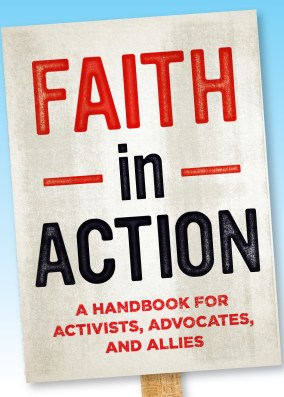
Faith in Action by Lisa Kloskin

Nearly a month ago, American voters showed up at the polls and delivered some big wins: the first openly transgender person was elected to a statehouse—Danica Roem in Virginia. Roem defeated an incumbent candidate who authored an anti-trans bathroom bill. Also in Virginia: the boyfriend of a reporter shot and killed on live TV, Chris Hurst, won a seat to the statehouse on a gun-control platform, defeating the three-term NRA-backed incumbent. And Hoboken, New Jersey, got its first Sikh mayor: Ravi Bhalla. These and others are encouraging signs that love and tolerance are gaining ground in the public sphere. But there’s still so much work to do. White Supremacists and Nazis still walk boldly in the streets, LGBTQIA teens still face bullying and higher rates of self-harm, women are still paid less for equal work and harassed in every arena, sea levels are rising at faster rates than we previously thought, people of color are still being killed by police, mass shootings are still a regular part of our news cycle, refugees are still waiting in camps around the world for a chance at a better, safer life.

Activists and advocates have been working for justice in these and other areas for decades. In the last year, spurred on by events like the Women’s March, a growing group of would-be activists has emerged. These allies are a welcome addition to the justice movement, but many worry they won’t do or say the right things, and want to have their perspectives deepened on important issues. They need guides and resources to give them the knowledge, tools, and confidence to make a real impact.

Continue reading “Faith in Action by Lisa Kloskin”

Small Business Saturday: Feminist Gift Guide for the Holidays by Angela Yarber

Wondering what to give the revolutionaries in your life for the holidays? Want to support feminist small businesses as you shop? Need some creative ideas with powerful feminist history and theory embedded in each purchase? Would it help if the gifts fused together feminism and religion? The Holy Women Icons ProjectLagusta Luscious,  and Bloodroot Feminist Vegetarian Restaurant has plenty of ways for you to celebrate the holidays with empowering gifts to please feminist in your life.

The feminist non-profit Holy Women Icons Project seeks to empower marginalized women by telling the stories of revolutionary holy women through art, writing, and special events. For over five years, a different holy woman has been featured each month on Feminism and Religion; we became an official non-profit earlier this year; and we have some beautiful, creative, and empowering offerings suitable for the holidays.

Continue reading “Small Business Saturday: Feminist Gift Guide for the Holidays by Angela Yarber”

“When You Know for Yourselves” by Oxana Poberejnaia

A female friend recently posted an article by a woman writer about motherhood. The article was entitled “Children are NOT life’s flowers” (referring to a famous Russian saying which means that children are what makes life beautiful).
A number of women contributed comments under this post. The discussion revolved around the image of an ideal mother and how we real mothers should relate to it.

It is amazing that in the current atmosphere of bringing out into the open so many issues, motherhood is not much discussed. Sexuality, gender and abuse are OK to speak about and question. At the same time, it is only within medical profession that such issues as “baby blues” or post-partum depression are valid topics.

Continue reading ““When You Know for Yourselves” by Oxana Poberejnaia”

An Algorithm for Capturing White Heteropatriarchy: The Woman Caught in Adultery and the Failure of the Civil Rights and Feminist Movements to Embrace Intersectionality by Blanche Cook


The church occasioned one of my first conscious experiences with inequality — Sunday school to be exact. I was nine and bedecked in black platform shoes and a bright pink polyester suit.  It was the 70s, a moment in fashion history never to be revisited.  My Sunday school teacher, a spiritually angelic woman, was explaining the demise of the Woman Caught in Adultery. According to the story, the leaders of law and religion wanted to stone the woman to death for having intercourse with a man that was not her husband.  Although she was vulnerable to the death penalty, the man was not exposed to any punishment.  This lopsided sanctioning plagued my young mind.  Little did I know, I would spend my legal career, as a federal sex trafficking prosecutor and as a legal scholar, trying to vindicate the Woman Caught in Adultery.

Continue reading “An Algorithm for Capturing White Heteropatriarchy: The Woman Caught in Adultery and the Failure of the Civil Rights and Feminist Movements to Embrace Intersectionality by Blanche Cook”

White Christianity, Flags, and Football by Gina Messina

While Puerto Rico has faced its worst natural disaster in over a century; Trump has once again used trumpfoolery to distract his base from his failed action in assisting Americans in crisis by starting a fight with the NFL. It seems a fitting plot for the reality show television host turned fake politician/president.
People are dying in the streets with no access to water or medication. It is expected to take four months to restore power to the island and everyday mothers take their children to stand in line for a minimum of twelve hours to get two packs of ice – hopefully, a few more if their children are allowed a share as well.

Rather than mobilizing efforts to bring aid to Puerto Ricans, Trump has diverted attention from his failure by ranting that NFL players should be fired for disrespecting the American flag by taking a knee during the national anthem. It is no surprise that our fake president is unable to make the connection between the peaceful protests and lack of rights for every American – he likely thinks that Rosa Parks was protesting the transportation system. Continue reading “White Christianity, Flags, and Football by Gina Messina”

What I Believe (Post-2016) by John Erickson

Ever since the election of You-Know-Who, I have been doing a lot of creative writing.

Ever since the election of You-Know-Who, I have been doing a lot of creative writing. Unlike academic publications, policy reports, or my dissertation, creative writing, much like my mentor Dr. Marie Cartier has written about, provided me with a needed escape from a world that seems to grow darker with each passing day.  In college, I served as Poetry Editor for the Wisconsin Review, the oldest literary journal in Wisconsin. Continue reading “What I Believe (Post-2016) by John Erickson”

Pride by John Erickson

When we come together, we are the Divine.  I didn’t think I could experience that twice in one year; clearly, I was wrong. 

If you’re anything like me you not only hate opening up your Twitter feed each morning but also feel compelled to in order to make sure you didn’t miss whatever new atrocity to come out of 1600 Pennsylvania Ave. After the Women’s March, I felt charged. I felt that whatever this administration threw at the proverbial “us,” I knew we could and would overcome it. Although that charge kept me going for a few months, there came a time where I just couldn’t go on anymore and that I was completely drained; then walked in a man named Brian Pendleton.

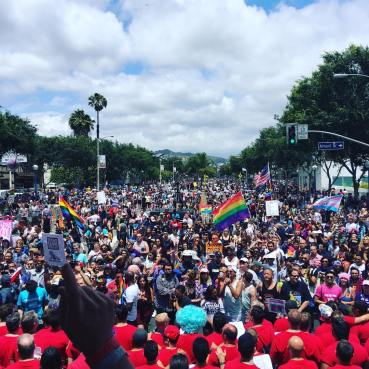
After the Women’s March on January 21, I didn’t know what to expect. The event was truly so successful that many of the organizers and coordinators were on an activist high as a result of what was a truly magical and divine moment. A few months came and went and the 45th President of the United States continued (much to our surprise) to be as awful as we all knew and expected. However, while I am able to exist in a world, no matter how oppressive, as a cisgendered white male and the full on privilege and power that comes along with that territory, many of the individuals and communities being attacked did not have those same freedoms; and like with the Women’s March and how that all took shape, in walked Brian Pendleton to my life to talk to me about the #ResistMarch.

Cover PhotoAlthough my involvement during the 120 days or more that led up to the #ResistMarch happened in a flash, one thing is for certain: miracles exist not because of divine intervention but because G-d places people on this Earth to make positive impacts. The beauty of the #ResistMarch was not just the passion of the organizers but the beauty of the rainbow that came out in full force on June 11
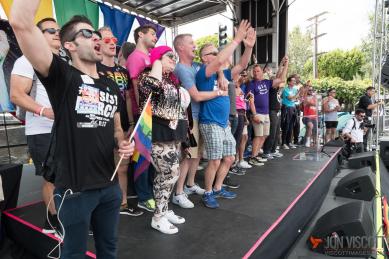
The strength shown by our community was one that, for all intensive purposes, proves that love does conquer all. RuPaul couldn’t have expressed the common and conquering theme better than when he said: “It’s all about love; giving love and being able to receive love. That’s our secret weapon; that’s the one thing they don’t have: our love and our music. That is our activism. That is what we use and what we always use to fight the ugliness.”

That is the one experience that I took most out of the #ResistMarch: the power of love and friendship; the beauty in the unexpected conversation that leads to changing the world, again.  Thank you, Brian. Thank you, for bringing us all together to resist, recharge, and love.

19055531_10158898620590385_6920780108892374453_o

When we come together, we are the Divine.  I didn’t think I could experience that twice in one year; clearly, I was wrong.

John Erickson is the President of the Hollywood Chapter of the National Organization for Women. John is a Ph.D. Candidate in American Religious History at Claremont Graduate University where he is finishing up his dissertation tentatively titled “Step Sons and Step Daughter”: Chosen Communities, Religion, and LGBT Liberation.” John holds a MA in Women’s Studies in Religion; an MA in Applied Women’s Studies; and a BA in English and Women’s Studies. He is the Founding and Past President of the University of Wisconsin Oshkosh’s LGBTQA+ Alumni Association and currently serves as the Chair of the Legislative Committee for the Stonewall Democratic Club, a Diversity and Inclusion Fellow at Claremont Graduate University. He is a permanent contributor to the blog Feminism and Religion, a Co-Founder of the blog The Engaged Gaze, and the Co-Chair of the Queer Studies in Religion Section of the American Academy of Religion’s Western Region, the only regional section of the American Academy of Religion that is dedicated to the exploration of queer studies in religion and other relevant fields in the nation. In April 2017, he was the first openly gay athlete to be inducted into the Wisconsin Volleyball Conference Hall of Fame. Most recently, John was one of the coordinators of the Women’s March Los Angeles, which brought together 750,000 people in downtown Los Angeles on January 21, 2017, and a Committee Member for the #ResistMarch, which brought together 100,000 people from Hollywood to West Hollywood in honor of LA Pride on June 11, 2017.


Anti-Muslim Demonstrations Demand Our Response by Katey Zeh

kamesh-vedula-208292

On June 10th anti-Muslim demonstrations were held in 28 cities across the United States, including one a few miles down the road from me at the North Carolina Capitol grounds in Raleigh. Organized by ACT for America, identified by the Southern Poverty Law Center as the largest Anti-Muslim hate group in the country, these “anti-Sharia” gatherings were advertised with propagandist messaging like “If you stand for human rights, please join us to march against Sharia” and “Sharia is incompatible with our Constitution and our American values.”

It’s no coincidence that these anti-Muslim demonstrations were organized during LGBTQ Pride month, specifically the weekend before the one year mark of the massacre at the Pulse nightclub in Orlando that left forty-nine people dead and fifty-three others wounded, nearly all of whom were young members of the Latinx community. The shooter Omar Mateen had pledged allegiance to the Islamic State before opening fire at the gay club. Scott Pressler, one of the major organizers of the anti-Muslim gatherings, claims that the Orlando massacre was a wake-up call that led him to do two things: to come out as a gay man, and to join ACT for America “to fight for my community, my country.”

ACT for America operates under the guise of human rights and women’s liberation to justify its anti-Muslim, white Supremacist agenda. The organization’s founder, Brigitte Gabriel, cited acts of violence against women including female genital mutilation and honor killings as the basis of organizing these anti-sharia demonstrations. She criticized U.S. feminists, claiming (falsely) that they have we have been silent on these issues. In an interview Scott Pressler also tried to appeal to feminists in joining his anti-Muslim crusade when he said, “ We [the LGBTQ community] are under attack simply because of our sexuality. Just like women, just for being born a female you are already under attack, and I think that’s demonstrative of how extreme radical Islam really is.”

Continue reading “Anti-Muslim Demonstrations Demand Our Response by Katey Zeh”