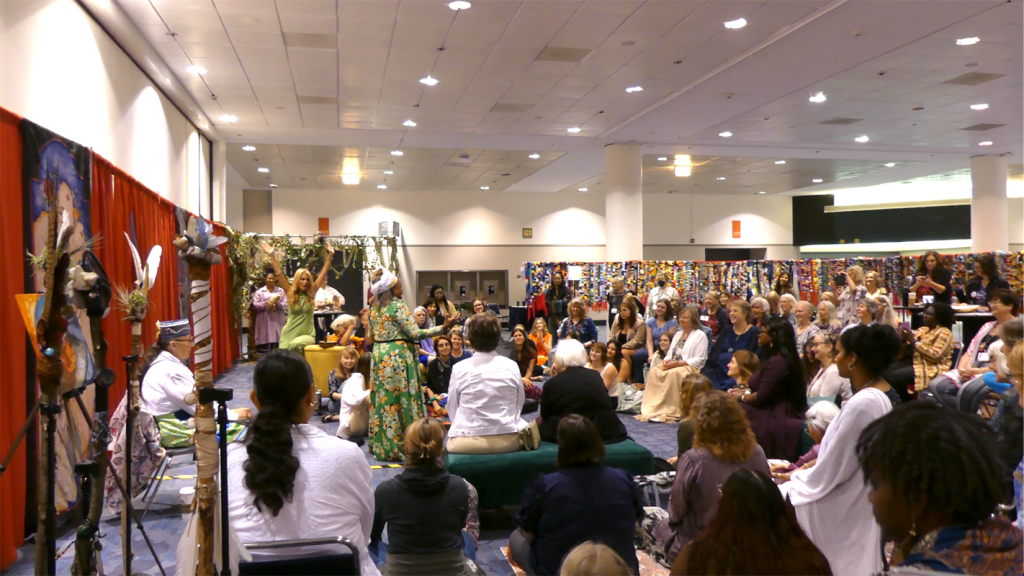
Label or Be Labelled Part 2: Professional and spiritual identity

This post continues from Part 1, where I situated this essay as a reflection on Xochitl Alvizo’s article Human, Just HumanThere, I questioned the difference between the power of naming versus the pressure to label. I then described my search for a personal identifier as ‘participation ticket’ to life. This feels important nowadays to join the conversation and not be dismissed by default. However, I wondered whether looking for things that set us apart emphasises otherness rather than shared humanity.

Today, I question what can we learn from autoethnography about the many selves we bring to different professional situations and how they might hide more than they reveal. I also describe the challenges of naming nature-based practices in a geographical area where 2000 years of Christianity forced our pagan traditions underground.

Continue reading “Label or Be Labelled Part 2: Professional and spiritual identity”

Fear and Need in the Absence of Mother God, part 2 by Caryn MacGrandle

Yesterday’s part 1 post quoted from the book, The Malleus Maleficarum

Witches Well in Edinburgh, Scotland, …the Roman numerals for 1479 on one side and 1722 [years when witch persecution was most prominent]

The book wasn’t just a message for women but for all. The tenets that formed the backbone of colonial culture:

  • Paddle your own canoe. 
  • Success comes with hard individual effort when you stay within the lines that we draw. 
  • And if you fail?  Well, that’s on you. 
  • Maybe you will get another shot if you are lucky, work relentlessly and act as you should.
  • And never ever forget that your worth is defined by the number of 0’s in your bank account.
Continue reading “Fear and Need in the Absence of Mother God, part 2 by Caryn MacGrandle”

Why We Need to Bring Back God as a Woman, part 1 by Caryn MacGrandle

26,000 years ago, life was precarious and dangerous.  And so the human race revered the Mother.  Mother Earth, who provided food amidst scarcity, protection from the dangers of the wild and healthy babies who grew to adulthood.

The Goddess.

In her many forms.

Some of these Goddesses.

Venus of Willendorf.  The artifact known as the Venus of Willendorf dates to between 24,000–22,000 B.C.E., making it one of the oldest and most famous surviving works of art.

Continue reading “Why We Need to Bring Back God as a Woman, part 1 by Caryn MacGrandle”

Free Write at the Turning of the Wheel by Sara Wright

Pink plastic barbies in a pink plastic world they said it was great it was garbage insulting every feminist I know – as for ecofeminism – well it must be dead am i dead too? – how could an earth lover survive in a plastic world with plastic pink barbies I barely made two hours? -oh yes a few colors they had to didn’t they? And the hourglass figures dominated the dolls that tip over because they are so tall even without high heels – an insane movie full of patriarchal lies and this is our culture – constructed out of lies – i left in confusion – people i trusted said a “must see” – turns out one, a professor that recommended it hadn’t seen it – had been seduced by reviews – who doesn’t believe the new york times besides me ?– thick humidity greeted me at the door after the pink charade – oh something alive captures me from a ten inch tree – two rosy apples ignite a soul dead corpse – yet another torrential downpour blurred my

Continue reading “Free Write at the Turning of the Wheel by Sara Wright”

Curiosity by Beth Bartlett

In my last post I mentioned the tale of Prometheus who stole fire from the gods.  Zeus’s punishment of eternal torture was not enough to avenge the offense.[i]  In addition, Zeus punished the entire human race by sending the first woman, Pandora.  Pandora is a woman of “all gifts,” one of which is the curiosity that drives Pandora to open the forbidden jar, unleashing evils and miseries into the world.  Woman as punishment, as the bringer of evil and misery — these themes have shaped the western view of women for millennia.

Continue reading “Curiosity by Beth Bartlett”

How Mary Magdalen Came into My Life: an excerpt, edited for brevity, from My Life as a Prayer: A Multifaith Memoir by Elizabeth Cunningham

(Author’s note: Mary Magdalen, or Magdalene, comes to people in many ways. To me, she came as an unconventional, fictional character. I worked hard to get the first century setting of her story as accurate as possible. Otherwise, I make no claim to historicity. I respect all the ways in which others know her.)

When I finished writing my novel Return of the Goddess in 1990, I thought I had nothing more to say. Yet, I sensed there was something—someone—missing.

An artist friend suggested I take up drawing or painting for a time—visual art being a form in which I had no experience, skill, and best of all, no ambition. I dabbled in paint and charcoal but soon reverted to magic markers, my childhood medium. 

One day a line drawing in brown marker took shape. An ample woman sat naked at a kitchen table having a cup of coffee. The round clock on the wall read a little after three in the afternoon. (The same time of day I was born.) She told me her name was Madge.

Continue reading “How Mary Magdalen Came into My Life: an excerpt, edited for brevity, from My Life as a Prayer: A Multifaith Memoir by Elizabeth Cunningham”

The Importance of Finding a Local Sacred Circle or Event by Caryn MacGrandle

What not many know that the founder Caryn MacGrandle (aka Karen Lee Moon), who is a soul-sister to me, has devoted her life to the building, developing and promoting of this app, in service to the Rising Feminine … “ Jonita D’Souza, Rising Feminine

I came back this weekend from my land in North Carolina to two email messages about women finding divinely feminine events through the divine feminine app. I cannot even begin to tell you how happy this makes me. After nine years of nurturing, developing, daily work and pouring my personal funds into the app, it is truly working.

Continue reading “The Importance of Finding a Local Sacred Circle or Event by Caryn MacGrandle”

Matot-Massei: The Question of Women’s Agency and Lives under Patriarchy.

The Torah portion for July 15th is the double-portion, Matot-Massei  (Bamidbar/Numbers 30:2-36:13).  Matot, meaning tribes, runs from Numbers 30:2 to 32:42 and covers vow making as well as what the spoils of war with the Midianites are.  Massei, or journeys, is Numbers 33:1 to 36:13 and describes the Israelites journey through the desert after fleeing Egypt and the boundaries of the Promised Land.  While Matot-Massei have so much that could be discussed including war, images for the deity, and cities of refuge, this post focuses on their women. 

There are three occasions where women are specifically mentioned.  The first concerns vows and their atonement when broken.  Next, women are discussed as spoils of war.  Finally, Matot-Massei describes what to do with inheritance when there are only daughters. 

Continue reading “Matot-Massei: The Question of Women’s Agency and Lives under Patriarchy.”

Future of Mifepristone by Winifred Nathan

Today is the one year anniversary of the Dobbs decision.

The alarm grows louder. How far will the antiabortion lobby restrict women’s reproductive health care before they are satisfied? If they successfully secure a complete abortion ban, will they stop? Or will they go on to control women’s dress, education, travel, etc.?

Reportedly, Dobbs v Jackson overturned Roe v Wade so the states could set the legal boundaries of abortion through the democratic process. But on November 18, 2022, the US District Court of Northern Texas delivered Alliance for Hippocratic Medicine et al. v US Fodd and Drug Administration et al., a decision that stops medical abortion in all fifty states by ending FDA approval of mifepristone. The Supreme Court has stayed (paused) the Texas order as the appeal works its way to their docket. Mifepristone continues to be available, but for how long? Will the Supreme Court eventually side with the plaintiffs?

Continue reading “Future of Mifepristone by Winifred Nathan”

Bathsheba: From Survivor of Sexual Abuse to Queen Mother by Linda Cooper Costelloe

Bathsheba by Artemisia Gentileschi, wikimedia commons, public domain

The image we have of Bathsheba is that of a scheming temptress. That’s the way she’s been portrayed in media, such as the 1951 movie, David and Bathsheba, and Leonard Cohen’s song, Hallelujah. She deliberately bathed on a rooftop in sight of King David. She caught his eye and he was helpless to withstand her charms. The Bible does not support that image of Bathsheba, however. It says that Bathsheba was used and abused by David, and God was displeased.

The Bible says that David was on his rooftop. It does not say where Bathsheba was, only that she was bathing to purify herself after her period (2 Samuel 11:2-4). She was probably in an inner courtyard. In their book, Flawed Families of the Bible. How God’s Grace Works Through Imperfect Relationships, David E. Garland and Diana R. Garland write: “The laws required ritual washing at the conclusion of her menstrual period. A woman would be highly unlikely to conduct such a cleansing from her menstrual period as a come-on. If she were in public view, she would have washed without disrobing. There is no reason even to assume that she was naked. Public nudity was not acceptable in this ancient Jewish culture but instead was considered shameful. There is no foundation for assuming she was some kind of exhibitionist.”i

Continue reading “Bathsheba: From Survivor of Sexual Abuse to Queen Mother by Linda Cooper Costelloe”