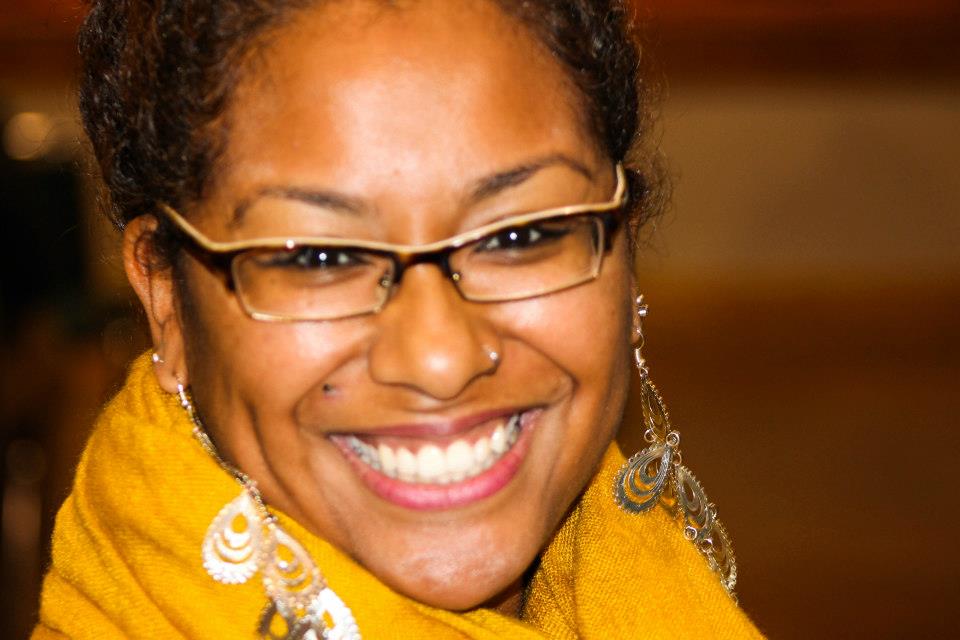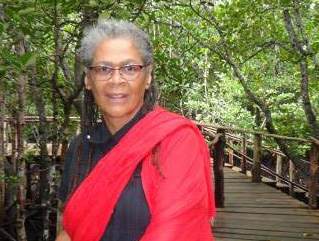
Truths My Mother Taught Me by John Erickson

I never gave much credence to religion but through my mother, I met G-d, and through her I understood that I’m not a feminist because of the books I’ve read but rather because of the woman I call mom.

Graduation PhotoThe first question I always get asked when I’m in feminist spaces is: “What inspired you to become a feminist?”  Although I could go into the various histories revolving around men’s involvement in the early stages of the women’s movement to the similarities between the LGBTQ and women’s movements, my simple answer has always relied on one person: my mother.

I’ll be the first to admit (as well as many other people who will join me in the same chorus) that my mother deserves Sainthood for having put up with all the shenanigans I have, and still continue to, put her through. From running away from our local Catholic church the moment she dropped me off at Sunday School, to swearing like a sailor on leave at a very early age in front of Father Schmidt (who still fondly remembers me and the list I brought in with me to the confessional booth). Continue reading “Truths My Mother Taught Me by John Erickson”

In Dreams I Trust by Annette Allen

AnnetteGrowing up in an agnostic family in 1950’s Britain, I did not hear religion discussed.  So it seemed odd that my parents sent my brothers and me to Sunday school.  At home, as I was battling my father’s constant criticism and jealousy towards Eric, my younger brother, learning about Jesus thrilled me.   Jesus seemed to love and value young children – what a hero!

Moving to Addis Ababa, Ethiopia, in 1962, deepened my faith.   At Nazareth School for Girls, I practised Catholicism, recited the rosary, and devoured books about female Catholic saints. But the American sisters taught that our bodies were impure, not healthy; lustful thoughts about boys were wrong, and husbands were masters.  Worst of all, heaven didn’t have any animals.  To an innocent girl, God was now judging and condemning.  I was very confused. Continue reading “In Dreams I Trust by Annette Allen”

Matriarchal Societies of Peace Make Sound Social Policy by Carolyn Lee Boyd

carolyn portrait

The true measure of a society’s success should be the well being of those who live in it.  Are they healthy and happy? Do they have their basic needs met? Are they free from the fear of violence? While the matriarchal “Societies of Peace,” as described the book of the same title edited by Heidi Goettner-Abendroth, represent many differing eras and places and each is unique, in general they succeed in creating such lives for those who live or lived in them. Carol Christ recently explained what characterizes these matriarchal societies:

Matriarchal societies have 4 characteristics in common:
1) They practice small-scale agriculture and achieve equality through gift-giving as a social custom.
2) They are egalitarian, matrilocal, and matrilineal. Women and men are defined by their connection to the maternal clan which holds land in common.
3) They have well-developed systems of consensus decision-making that insure that everyone’s voice is heard and considered.
4) They honor principles of care, love, and generosity which they associate with motherhood and teach both genders to express. They often view the Earth as a Great Mother.

Mindfulness of Putting Ourselves Down by Oxana Poberejnaia

oxanaFrom the Buddhist point of view, all phenomena are conditioned, i.e. they arise, carry on, and come to an end because of other phenomena. Buddhism does not look at anything we experience as “things”, but rather as processes.

Confusion arises due to various factors, chief among them : 1) vague sense of “ego”, and 2) language. The vague sense of ego is portrayed in Khemaka Sutta as the last delusion that a monk drops before getting Enlightened, so we won’t worry about it now. Where language is concerned, Buddhism stands on similar positions to those of postmodernism and feminism, i.e. our social world is defined by how we speak about it. One can say that we actually create society by the act of speaking.

Continue reading “Mindfulness of Putting Ourselves Down by Oxana Poberejnaia”

Birth Warrior by Molly

editMollyNov 083“In this culture…a woman can be made to feel foolish for emphasizing the centrality of giving birth to her identity or her personal religiousness, her ‘womanspirit…’” –Stephanie Demetrakopoulos (Listening to Our Bodies)

After the birth of my daughter in 2011, I received a small package from a Birthing from Within mentor friend. In it was a sweet little t-shirt imprinted with the words, My Mama is a Birth Warrior. The words on the shirt surrounded a labyrinth image, which I love as a metaphor for birth and life

Written on the enclosed card was the following:

Imagine a tribe in which a woman is prepared for childbirth in the same way warriors are prepared for battle. Imagine a Ceremony for this woman before she gives birth, a grand send-off with holy songs and fire. Imagine a feast, prepared just for her.

Her tribe tells her, they say to her “Go to your journey, you have prepared. We have prepared you. If you fall from your horse once or a hundred times, it does not matter. All that matters is that you come back to us, that you come home.

Throughout your journey–your labyrinth of Great Love, Great Determination, Great Faith and Great Doubt—you rode on!

The Great Tribe of Mothers welcomes you back from your birth journey with honor.

Modeling her little t-shirt.

Imagine, indeed. After I read this note I reflected that I did feel I embarked on a mighty journey during my last pregnancy, I did pass through those Gates, and I did ride on. I AM a birth warrior!  Continue reading “Birth Warrior by Molly”

Hidden Meanings in the Rituals of the Assumption by Carol P. Christ

carol-christ“[T]he Old European sacred images and symbols were never totally uprooted; these persistent features in human history were too deeply implanted in the psyche.  They could have disappeared only with the total extermination of the female population.” Marija Gimbutas, The Language of the Goddess, 318.

August 15 is known to Greek Christians as the date of the Koimisi, “Falling Asleep” or Dormition of the Panagia, She Who Is All Holy.  December 25 is a minor holiday in the Orthodox tradition, while Easter and August 15 are major festivals.  The mysteries of Easter and August 15 concern the relation of life and death.  In Orthodox theology, both Easter and August 15 teach that death is overcome:  Jesus dies and is resurrected; Mary falls asleep and is assumed into heaven.  These mysteries contain the promise that death is not the final end of human life.  Yet this may not be the meaning of the rituals for many of those who participate in them.

In Christus Victor, Gustaf Aulen argued that Eastern (Orthodox) and Western (Catholic and Protestant) traditions understood salvation differently.  The Western Church focuses on salvation from sin, while the Eastern Church focuses on transcending death.  This contrast is not absolute, as for the Western Church sin is the cause of death and when sin is overcome, immortal life is restored.  While Orthodoxy has strong ascetic and monastic traditions, it does not teach ordinary Christians to focus on sexual purity and impurity as Western traditions have done.  Nor is there a strong emphasis on transforming collective sin in movements for social justice.  Significantly, though Roman Catholics and others consistently refer to the “Virgin Mary,” Orthodox Christians prefer “Panagia,” She Who Is All Holy.

In Greece the ordinary rhythms of life are disrupted at Easter and in August.  During lent, many women (and some men) fast, while in August women named Mary and Panagiota–as well as others who wish to honor or petition the Panagia–wear black for two weeks.

Assumption1Throughout the first 2 weeks of August, Greek Christians focus on the death of the Panagia.  According to theology, her Son appears after her death and “assumes” her into heaven.  The Orthodox icon depicts Mary surrounded by the Apostles, while Jesus holds the assumed body of Mary depicted as an infant wrapped in swadling clothes.

When she first saw this icon, my friend Naomi Goldenberg commented that it is an example of the widespread attempt on the part of men to appropriate the power to give birth.  The icon reverses the symbolism of the nativity where the baby wrapped in swadling clothes is held in the hands of his mother.  Christian baptism described as re-birth through the Father, Son, and Holy Spirit is another version of “male birth.” Continue reading “Hidden Meanings in the Rituals of the Assumption by Carol P. Christ”

THE LABRYS: A RIVER OF BIRDS IN MIGRATION by Carol P. Christ

carol-christ“There’s a river of birds in migration, a nation of women with wings.” Goddess chant, Libanalabrys seal ring

On the Goddess Pilgrimage to Crete, I explain that many of the names given to “Minoan” (c. 3000-1450 BCE) Cretan artifacts and architecture are products of patriarchal and Eurocentric imaginations, and as such, are misleading.  For example the name “Minoan” was given to the culture of Bronze Age Crete in honor of “King Minos,” who was said to have ruled in Crete a few generations before the Trojan War–several hundred years after the end of the culture to which his name was attached.  In fact, despite his eagerness to find evidence that King Minos ruled at Knossos, the excavator Sir Arthur Evans finally had to concede that the best he could do was to produce a fresco of a “Prince of the Lilies” which he identifed as the image of the male ruler of the culture he called “Minoan.”  Evans’ Prince had white skin, a fact that Evans conveniently overlooked–because according to his own interpretation of “Minoan” iconography, white skin would mark the figure as female.  Mark Cameron, who reviewed Evans’ reconstruction of the fresco, suggested that the Prince is more likely to be a young woman who is perhaps leading a bull to take part in the bull-leaping games.  He also stated that the “crown” belonged to another fresco altogether.

Evans’ failure to find evidence of a King or for that matter a Queen at the complex of buildings he called “The Palace of Knossos” calls into question his idea that these structures were palaces.  Nanno Marinatos argued that the “palace” was instead a ritual center for the surrounding village, as well as a community gathering place, a place for storing grain, wine, and oil in a sacred way, and a place where ritual objects were fashioned of clay, bronze, stone, and gold.  Following her lead, I renamed the “Palaces” “Sacred Centers.” In this blog I will experiment with renaming the “Minoan” culture “Ariadnian,” after the pre-Greek name Ariadne, which may be one of the names of the Goddess of Bronze Age Crete.

One of the most pervasive–and many would say–most enigmatic symbols of the Ariadnian culture is the labrys.  Continue reading “THE LABRYS: A RIVER OF BIRDS IN MIGRATION by Carol P. Christ”

Blindness of the Gals by Oxana Poberejnaia

Oxana PoberejnaiaWomen (and men) are often blind to women’s inequality. I, as a Buddhist practitioner, have been blind to the reality of women’s second-class status in sacred texts of Buddhism and practice.

In her book “Buddhism After Patriarchy” Rita M. Gross describes how her fellow western Buddhist women completely overlooked the fact that women are not allowed into Rumtek Buddhist monastery in Sikkim, even after watching a video of a woman leaving an offering outside the gate and walking away.

Continue reading “Blindness of the Gals by Oxana Poberejnaia”

Creating Ritual by Linn Marie Tonstad

Linn Marie TonstadLast time, we considered whether the creation of rituals, I mean habits, might serve as an antidote to depression, or as a way of managing depression. But the creation of ritual has had a much more significant role in feminist religious practice than such an approach might suggest. Currently, WATER – Women’s Alliance for Theology, Ethics, and Ritual, a leading center for feminist religious thought – creates multiple rituals marking various seasons and events in the year, most recently for the summer solstice. These rituals can provide alternative ways of marking the year’s rhythms, and they can serve as ways to take control of liturgical spaces that have tended to exclude women or to allow women to serve only in various subordinate roles.

Yet the terminology is odd. What does it mean to create a ritual? If I think of the rituals of my childhood, what presented itself to me as ritual was connected either with religious practice, or with seasons of exception. Indeed, the most stylized rituals of the year were areligious (as I understood religion). They took place on Christmas Eve. First, during the distribution of presents, my father would put on a terrifying, horrifying, grotesque Santa mask. It was intended, clearly, to be a friendly Santa, which was why its leering was so fundamentally disturbing. My sister and I would try to run away, emotionally and sometimes physically petrified by the transformation of our father into this monster. Second, after Christmas dinner, we would eat cold rice porridge with cream and try to get an almond – “mandel i grøten” in Norwegian tradition. Getting the almond, which is blanched and hidden in the porridge, is considered an auspicious omen for the new year, and requires that the finder be given a gift – traditionally, a marzipan pig. Continue reading “Creating Ritual by Linn Marie Tonstad”

To Have and to Hold: Gay Marriage and the Religion Question

If a conservative religious traditions can’t give their mothers or sisters full equality, how can we expect them to give a GLBT individual the time of day?

John Erickson, sports, coming out.Outrage.  Anger.  Fear.  Hatred.  These are just a few of the words that flashed across my Twitter feed as I woke up on that fateful Wednesday, June 26 morning when the Supreme Court of the United States ruled that the Defense of Marriage Act (or DOMA) was unconstitutional and that supporters of Proposition 8, the hotly contested voter initiative in California that banned same-sex marriage, had no standing.   People were mad.  However, it wasn’t just the typical kind of mad that is associated with hatred, it was a type gay_marriage_81102178_620x350of mad that was met with impossible anguish because what I was reading and feeling was a result of one thing: there was nothing more they could do.

What does all this mean?  Questions from friends and family were filling up my inbox and although I wanted to take a moment to just hit “Reply All,” and input the words: Equality, I had to hold back and start to examine the notion that although equality may now be firmly on the proverbial table, there is still a lot of work to be done, specifically for gay marriage and those wanting to marrying inside the traditional church spaces they grew up in and not just the ones that have come out as open and affirming in recent years towards LGBT individuals. Continue reading “To Have and to Hold: Gay Marriage and the Religion Question”